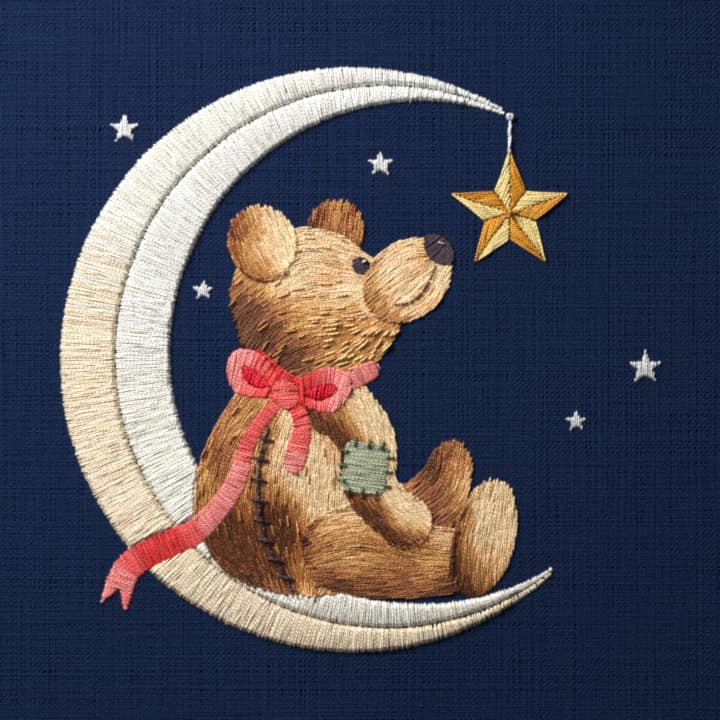
Teddy bear and a twinkle little star hand embroidery pattern
Advanced · 19 colors · 8 kinds of stitch
Download free PDFPDF, US Letter · 62 KBFor your own stitching, gifts and handmade pieces you sell. Do not resell or share this PDF or copies of it. Selling, classes and kits: the rules
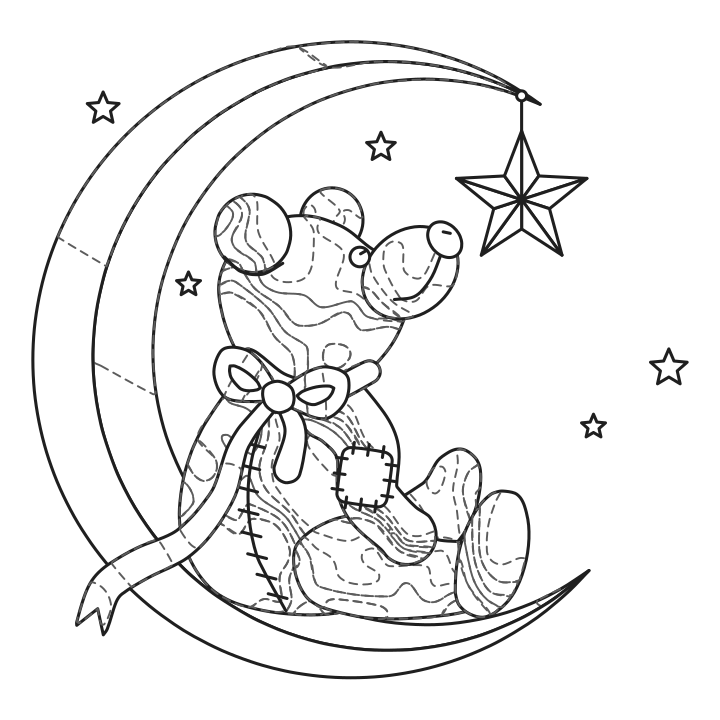
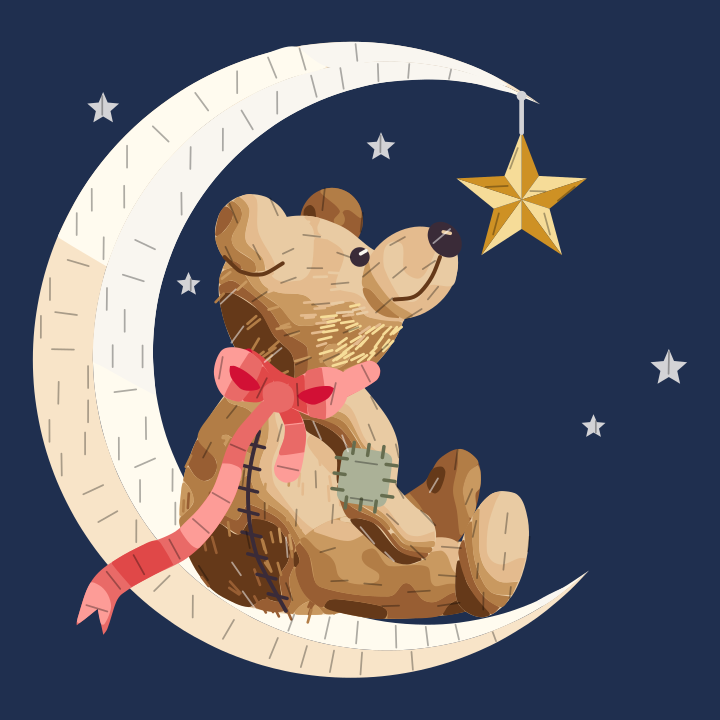
The teddy is worked in short long and short stitch, six honey browns from dark to pale, lit on the side that faces the star. A seam of back stitch runs down his back, crossed by straight stitches, and a sage satin stitch patch covers one elbow. The moon is two bands of padded satin stitch that meet in a ridge, the star is ten gold facets of satin stitch, and it hangs from the moon on a thread of stem stitch. A coral satin stitch ribbon is tied at his neck and trails off the edge of the moon. It is drawn for indigo linen. In the picture of where the colors go, the fine lines show which way the stitches lie.
Size and details
Advanced. Uses padded satin stitch, long and short stitch, satin stitch over about a sixth of the cloth in a 6 inch hoop, 19 colors and a great deal of stitching; from a 6 inch hoop up some of the satin stitches are long.
19 colors of floss and 8 kinds of stitch:
- Padded satin stitch
- Satin stitch
- Long and short stitch
- Straight stitch
- Split stitch
- Back stitch
- Stem stitch
- French knot
- Which stitch goes where
| Hoop | Inches | Centimeters | Satin stitch up to |
|---|---|---|---|
| 3 in (8 cm) | 1.7 × 1.6 in | 4.3 × 4.1 cm | 1/8 in (3 mm) |
| 4 in (10 cm) | 2.5 × 2.4 in | 6.4 × 6.1 cm | 1/4 in (6 mm) |
| 5 in (13 cm) | 3.3 × 3.2 in | 8.4 × 8.1 cm | 5/16 in (8 mm) |
| 6 in (15 cm) | 4.2 × 4 in | 10.7 × 10.2 cm | 3/8 in (10 mm) |
| 8 in (20 cm) | 5.8 × 5.6 in | 14.7 × 14.2 cm | 1/2 in (13 mm) |
- In an 8 inch hoop the widest satin stitch shape is 1/2 in (13 mm) across. Satin stitches longer than about 12 mm (just under 1/2 in) tend to work loose: divide the shape into sections, or work it in long and short stitch.
- In a 3, 4, 5 or 6 inch hoop the French knot is drawn smaller than about 2 mm (a little over 1/16 in). Use one strand of floss for it there, or choose a larger hoop.
The pattern is drawn inside a circle about half an inch (1.3 cm) smaller all around than the hoop.
What you need
- 1DMC 712 CreamMoon (light)
- 2DMC 3865 Winter WhiteMoon (middle), lights (lighter)
- 3DMC 739 Ultra Very Light TanMoon (dark)
- 4DMC 415 Pearl GraySilver stars and thread
- 5DMC 434 Light BrownLegs, back, ears, head, arms and feet (dark)
- 6DMC 801 Dark Coffee BrownBack, legs, head, arms, ears and feet (darkest), mouth and ear seam
- 7DMC 435 Very Light BrownBack, head, legs, ears, arms and feet (middle dark)
- 8DMC 436 TanLegs, back, head, arms, feet and ears (middle light)
- 9DMC 738 Very Light TanBack, head, arms, feet, ears and legs (lightest), lights (darker)
- 10DMC 437 Light TanHead, back, legs, arms, feet and ears (light)
- 11DMC 523 Light Fern GreenElbow patch
- 12DMC 520 Dark Fern GreenPatch stitches
- 13DMC 3822 Light StrawGold star (lighter), cheek glow
- 14DMC 3371 Black BrownSeam, nose and eye
- 15DMC 350 Medium CoralRibbon (dark)
- 16DMC 349 Dark CoralRibbon (darkest)
- 17DMC 351 CoralRibbon (light)
- 18DMC 352 Light CoralRibbon (lightest)
- 19DMC 783 Medium TopazGold star (darker)
Skeins: one of each color is enough. An estimate for the 8 inch hoop, from the length of each line and the area of each filled shape, with a fifth added for tails.
The floss is six-strand cotton; the stitch guide says how many strands to use. You also need a hoop, an embroidery needle (a size 9 or 10 for one strand, 7 to 9 for two or three) and plain cotton or linen fabric, in indigo, the color it is drawn for. A pencil line does not show on it: see how to transfer a pattern to dark fabric. To frame the piece in its hoop, cut a square 3 inches (8 cm) wider than the hoop: a 9 inch (23 cm) square for a 6 inch hoop.
When it is stitched, how to finish a hoop shows how to back it for the wall.
Stitch guide
- Put the pattern on the fabric (how to transfer a pattern) and the fabric in the hoop.
- Stitch the filled parts first, what lies behind before what lies in front of it.
- Then stitch the lines: stems, veins and outlines over the edges of the filled parts.
- Keep the knots for the end, so that the hoop and your hand do not flatten them.
Inside a filled shape start with two or three tiny stitches, which the filling covers: a knot shows as a bump. A line may start with a small knot on the back or one of the knotless starts. End each thread by running the needle under the backs of a few stitches. (Starting and ending a thread shows how.) Use the strands this list gives, and begin as it says, also where a page about a stitch names another number or begins with a knot.
- Padded satin stitch 2 strandsMoon
- Satin stitch 2 strandsSilver stars, elbow patch, nose, eye, ribbon, gold star
- Long and short stitch 1 strandEars, legs, back, feet, arms, head, cheek glow
- Straight stitch 1 to 2 strands2 strands: patch stitches, seam1 strand: lights
- Split stitch 1 strandEar seam
- Back stitch 1 to 2 strands2 strands: seam1 strand: mouth
- Stem stitch 2 strandsThread
- French knot 2 strands, two wrapsThread
Getting it onto your fabric
The PDF holds the pattern twice at actual size: once as drawn, and once mirrored for an iron-on transfer pen. Print it at 100% with scaling off and check the one-inch square (25.4 mm) with a ruler before you trace. How to transfer a pattern explains tracing, carbon paper, the sticky wash-away sheet for knits, denim and dark cloth, and the other ways. The files are under Downloads.
Downloads
- Download free PDF PDF, US Letter, 3 pages, for a 6 inch (15 cm) hoop
- Download free PDF, A4 PDF, A4, 3 pages, for a 6 inch (15 cm) hoop
More patterns like this
Advanced prints 3–14 in · 19 colors
Seven mini nursery rhymes
Advanced prints 3–14 in · 24 colors
Jack and Jill going up the hill
Advanced prints 3–14 in · 16 colors
Sleeping moon ringed with stars
Advanced prints 3–14 in · 19 colors
Childhood cancer gold ribbon teddy bear
Advanced 3–8 in hoop · 19 colors
Snowman teddy bear bookmark
Advanced 3–8 in hoop · 21 colors
Cute little airplane with a heart
Advanced opening to 5 in · 21 colors
Baby Peter Pan collar with teddy bears
Advanced 3–8 in hoop · 17 colors
Memory bear patchwork sampler
New to hand embroidery? Starting hand embroidery, step by step