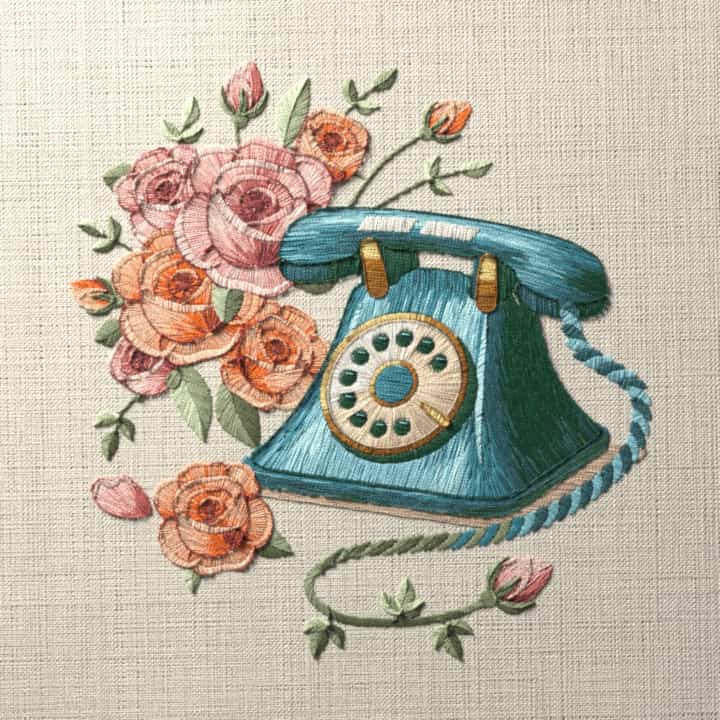
Vintage rotary telephone with roses hand embroidery pattern
Advanced · 22 colors · 4.5 × 4.6 in · 6 kinds of stitch
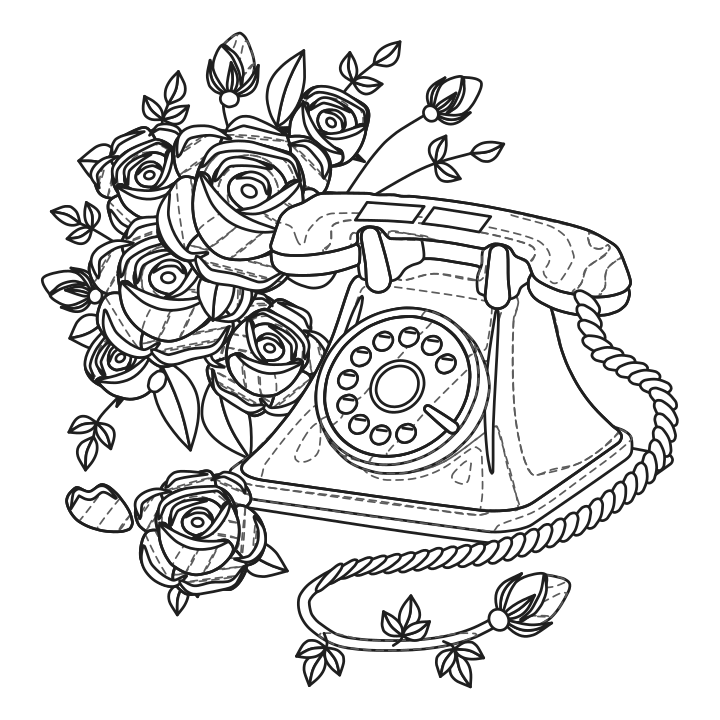

Download free PDFPDFPrints on US Letter and A4You may sell what you make from it by hand, in small quantities. The PDF itself is not to be sold or shared. Selling, classes and kits: the rules
An old teal telephone sits three quarters turned, its handset level on brass horns and ten plain finger holes in its cream dial. Roses and buds in blush and apricot spill from behind it, one bloom and a petal have dropped at its foot, and the twisted cord sweeps forward in an S until it is a green stem with one bud.
Size and details
Advanced. Uses long and short stitch over much of the design, 22 colors and a great deal of stitching; from a 6 inch hoop up the widest satin stitches are long.
The telephone and the petals are long and short stitch with split stitch edges, the dial, horns, cord and window light are satin stitch, the leaves fishbone stitch, and the stalks stem stitch. In the picture of where the colors go, the fine lines show which way the stitches lie.
| Hoop | Inches | Centimeters | Satin stitch up to |
|---|---|---|---|
| 3 in (8 cm) | 1.8 × 1.9 in | 4.6 × 4.8 cm | 1/8 in (3 mm) |
| 4 in (10 cm) | 2.7 × 2.8 in | 6.9 × 7.1 cm | 3/16 in (5 mm) |
| 5 in (13 cm) | 3.6 × 3.7 in | 9.1 × 9.4 cm | 5/16 in (8 mm) |
| 6 in (15 cm) | 4.5 × 4.6 in | 11.4 × 11.7 cm | 3/8 in (10 mm) |
| 8 in (20 cm) | 6.3 × 6.5 in | 16 × 16.5 cm | 1/2 in (13 mm) |
- In an 8 inch hoop the widest satin stitch shape is 1/2 in (13 mm) across. Satin stitches longer than about 12 mm (just under 1/2 in) tend to work loose: divide the shape into sections, or work it in long and short stitch.
What you need
- Fabric
- Plain cotton or linen, cut 9 in (23 cm) square.
- Needle
- Embroidery needle, size 9 for 1 strand, size 7 for 2 or 3 (a lower number is a thicker needle).
- Floss
- 22 colors of six-strand cotton, listed below. DMC is a brand: another brand in a like color will do.
- Marker
- A pen or a sheet that suits the fabric: how to transfer a pattern says which.
Floss
- 1DMC 520 Dark Fern GreenLeaves (dark), stem, sepals and stalks (darker)
- 2DMC 522 Fern GreenLeaves (middle), stem, sepals and stalks (lighter), rose hips, twisted cord (light)
- 3DMC 524 Very Light Fern GreenLeaves (light)
- 4DMC 224 Very Light Shell PinkRoses (shade 5 of 8), turned petal edges (darkest)
- 5DMC 221 Very Dark Shell PinkRoses (shade 1 of 8), petal edges (dark), rose hearts (darker)
- 6DMC 3722 Medium Shell PinkRoses (shade 3 of 8), petal edges (light)
- 7DMC 225 Ultra Very Light Shell PinkRoses (shade 8 of 8), turned petal edges (lightest)
- 8DMC 3825 Pale PumpkinRoses (shade 6 of 8), turned petal edges (dark)
- 9DMC 355 Dark Terra CottaRoses (shade 2 of 8), petal edges (middle), rose hearts (lighter)
- 10DMC 922 Light CopperRoses (shade 4 of 8)
- 11DMC 3856 Ultra Very Light MahoganyRoses (shade 7 of 8), turned petal edges (light)
- 12DMC 3782 Light Mocha BrownTable shadow and finger wheel edge, finger wheel (dark)
- 13DMC 500 Very Dark Blue GreenFoot rim (dark), telephone body (darkest), handset edge and 6 more parts
- 14DMC 3808 Ultra Very Dark TurquoiseFoot rim (middle), telephone body (dark), twisted cord (darkest) and 5 more parts
- 15DMC 3810 Dark TurquoiseDial collar, foot rim and handset (light), telephone body (middle) and 2 more parts
- 16DMC 598 Light TurquoiseTelephone body (light), handset and twisted cord (lightest) and 2 more parts
- 17DMC 3811 Very Light TurquoiseGloss, telephone body (lightest)
- 18DMC 3822 Light StrawBrass ring and cradle horns (light), finger stop (lighter)
- 19DMC 780 Ultra Very Dark TopazCradle horns and brass ring (dark), finger stop (darker)
- 20DMC 782 Dark TopazBrass ring and cradle horns (middle)
- 21DMC 739 Ultra Very Light TanFinger wheel (middle)
- 22DMC 712 CreamFinger wheel (light), window light
Skeins: one of each color is enough. An estimate for the 6 inch hoop, from the length of each line and the area of each filled shape, with a fifth added for tails.
How to stitch it
- New to hand embroidery? Start here.
- Print at 100%, trace the pattern onto the fabric, and put it in the hoop: inner ring under, drawing up, tight as a drum.
- Floss is six strands. Cut 18 inches (45 cm), pull out the number given one at a time, and lay them together.
- Inside a filled shape start with two or three tiny stitches, which the filling covers. Start a line with a small knot on the back. End each thread by running the needle under the backs of a few stitches.
- A fine broken line inside a shape is where two shades meet: trace it, do not stitch it.
- A number under “Where colors go” is a color of the list. The fine lines on the colors show which way the stitches lie.
Stitch in this order
Filled parts from the back of the picture forward, then lines. Where a stitch page names another number of strands, use the number here.
- Fishbone stitch 2 strandsLeaves, sepals
- Long and short stitch 1 strandRoses, table shadow, foot rim, telephone body, handset
- Satin stitch 2 strandsTurned petal edges, rose hips, rose hearts, gloss, dial collar, brass ring, finger wheel, finger holes, dial center, finger stop, cradle, ear caps, window light, cradle horns, stem, twisted cord
- Stem stitch 2 to 3 strandsStalks
- Split stitch 1 strandPetal edges, body edge, finger wheel edge, finger stop, handset edge, cradle horns
- Straight stitch 1 strandFinger hole lights
When it is done, take off any lines that still show and finish the hoop. A guide to this kind of work: How to embroider a rose.
More patterns like this
Advanced 3–8 in hoop · 13 colors
Candlestick telephone phone case panel
Advanced prints 3–14 in · 24 colors
Hello friend
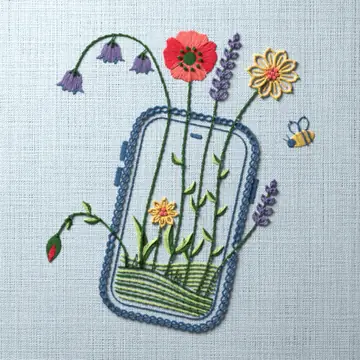
Easy 3–8 in hoop · 7 colors
Easy cell phone with wildflowers
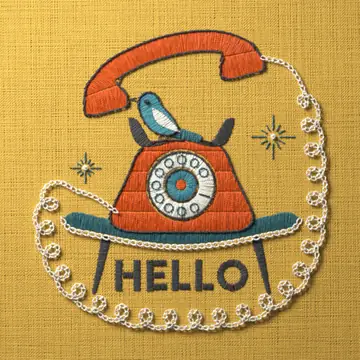
Easy prints 3–14 in · 5 colors
Hello
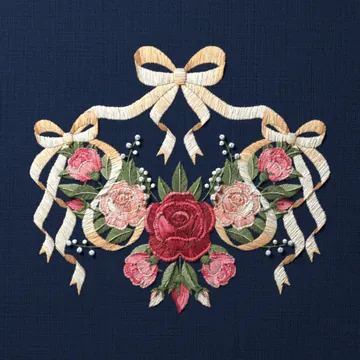
Advanced 3–8 in hoop · 22 colors
Victorian rose swag with ribbon bows
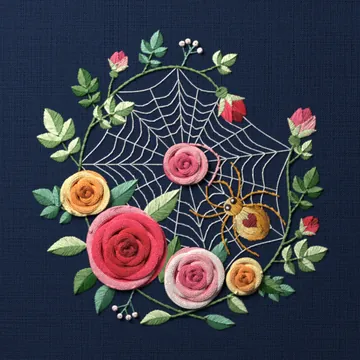
Advanced prints 3–14 in · 22 colors
Spider web roses and a tiny spider
Advanced 3–8 in hoop · 22 colors
Little coin purse with a woven rose
Advanced 3–8 in hoop · 22 colors
Floral sprigs for net and tulle
New to hand embroidery? Starting hand embroidery, step by step