Woman clay shooting in autumn hand embroidery pattern
Advanced · 21 colors · 9 kinds of stitch
Download free PDFPDF, US Letter · 68 KBFor your own stitching, gifts and handmade pieces you sell. Do not resell or share this PDF. What you may do, in full
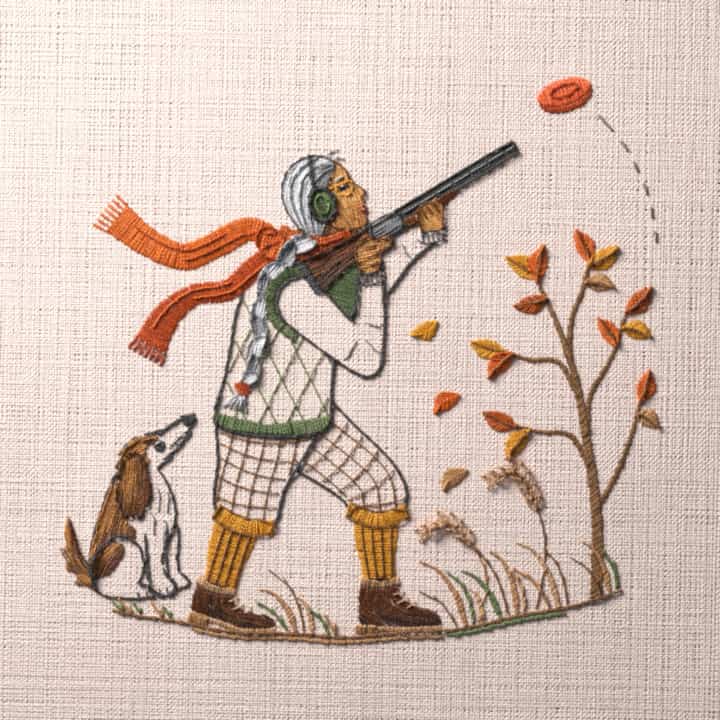
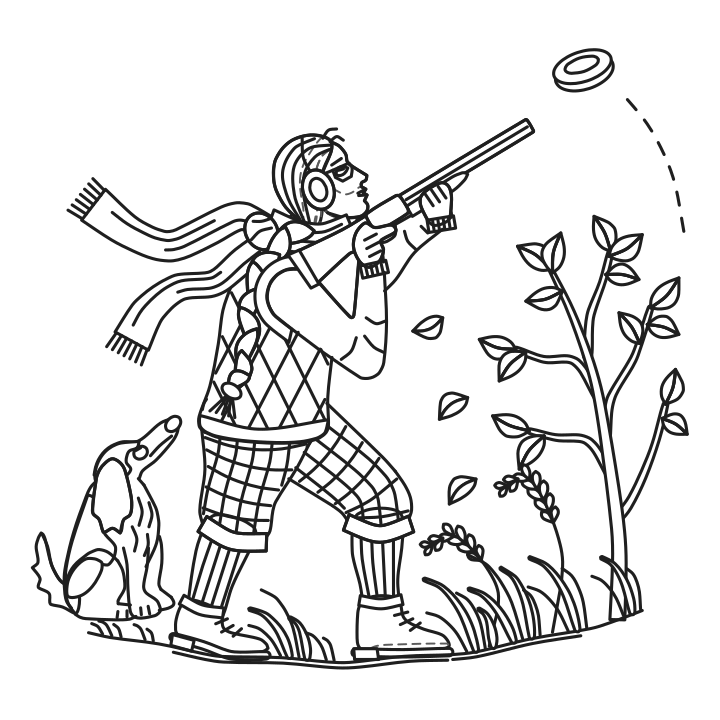
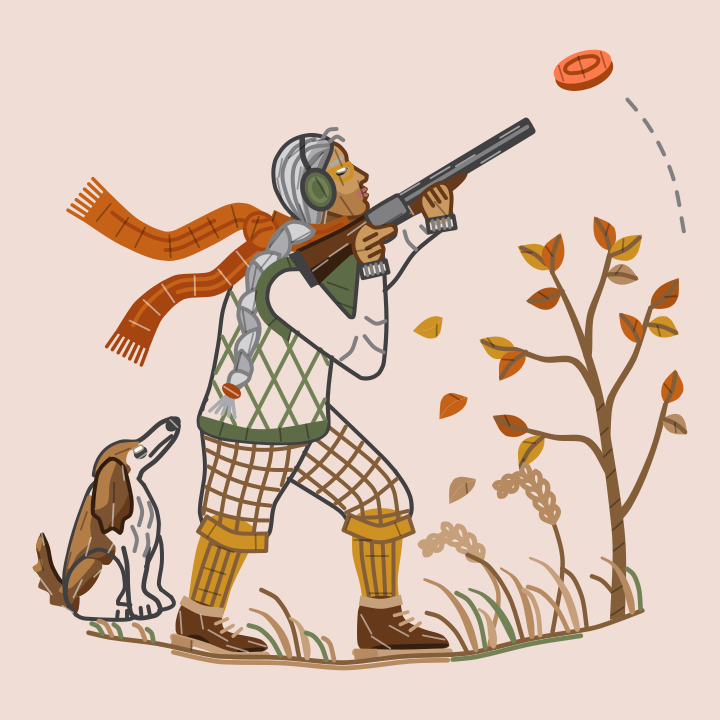
A woman in country clothes leans into her front foot and follows an orange clay across the sky, with her scarf flying and her spaniel watching behind her. The outlines are split stitch, heavier on the shadow side, and the gilet and breeks are back stitch checks. The scarf, plait, socks, clay and green trim are satin stitch, and the face, hands, hair, boots, gun and the spaniel’s patches are long and short stitch. The leaves are fishbone stitch, the grasses are stem stitch and satin stitch with lazy daisy seed heads, and the flight of the clay is running stitch. It is drawn for blush pink linen. In the picture of where the colors go, the fine lines show which way the stitches lie.
Size and details
Advanced. Uses long and short stitch, 21 colors and a great deal of stitching.
21 colors of floss and 9 kinds of stitch:
- Long and short stitch
- Split stitch
- Stem stitch
- Satin stitch
- Straight stitch
- Back stitch
- Running stitch
- Fishbone stitch
- Lazy daisy stitch
- Which stitch goes where
| Hoop | Inches | Centimeters | Satin stitch up to |
|---|---|---|---|
| 3 in (8 cm) | 1.6 × 1.6 in | 4.1 × 4.1 cm | 1/8 in (3 mm) |
| 4 in (10 cm) | 2.5 × 2.3 in | 6.4 × 5.8 cm | 3/16 in (5 mm) |
| 5 in (13 cm) | 3.3 × 3.1 in | 8.4 × 7.9 cm | 1/4 in (6 mm) |
| 6 in (15 cm) | 4.1 × 3.9 in | 10.4 × 9.9 cm | 5/16 in (8 mm) |
| 8 in (20 cm) | 5.8 × 5.5 in | 14.7 × 14 cm | 7/16 in (11 mm) |
- In a 3, 4 or 5 inch hoop the shortest lazy daisy loops are drawn smaller than about 2 mm (a little over 1/16 in). Use one strand of floss for them there, or choose a larger hoop.
The pattern is drawn inside a circle about half an inch (1.3 cm) smaller all around than the hoop.
What you need
- DMC 433 Medium BrownSpaniel patches (middle), skin (dark) and 2 more parts
- DMC 801 Dark Coffee BrownBoots and stock (lighter), fingers, fore end and profile and 3 more parts
- DMC 435 Very Light BrownSpaniel patches (light), skin (middle) and 2 more parts
- DMC 938 Ultra Dark Coffee BrownStock and boots (darker), spaniel ear and spaniel tail (darkest), eye
- DMC 3799 Very Dark Pewter GraySpaniel, sleeves, breeks and gilet, barrels (darker) and 11 more parts
- DMC 414 Dark Steel GrayPlait (dark), hair strands and flight line and 7 more parts
- DMC 712 CreamEye light, spaniel eye (lighter)
- DMC 783 Medium TopazSocks, leaves (lightest), sock tops (lighter) and 2 more parts
- DMC 869 Very Dark Hazelnut BrownTweed check and sapling, ground (dark) and 4 more parts
- DMC 422 Light Hazelnut BrownBoot soles and boot cuffs, grasses (lightest) and 2 more parts
- DMC 3828 Hazelnut BrownGrasses, ground and leaves (light), seed heads (darker) and 2 more parts
- DMC 3363 Medium Pine GreenQuilting, grasses (dark), ground (middle), ear defenders (light)
- DMC 3362 Dark Pine GreenGilet trim, ear defenders (middle)
- DMC 919 Red CopperScarf (dark), scarf folds, clay and scarf fringe (darker), plait tie
- DMC 921 CopperScarf (light), leaves (middle), scarf folds (lighter) and 2 more parts
- DMC 436 TanSkin (light)
- DMC 415 Pearl GrayHair (lightest), plait (light)
- DMC 318 Light Steel GrayPlait (middle), hair (light), plait end and eyebrow
- DMC 3722 Medium Shell PinkLips
- DMC 920 Medium CopperScarf (middle), leaves (dark)
- DMC 947 Burnt OrangeClay (lighter)
Skeins: one of each color is enough. An estimate for the largest size, the 8 inch hoop: the length of each line and the area of each filled shape, a fifth added for tails and ends, a tenth of every 8 m (8.7 yd) skein kept spare.
The floss is six-strand cotton; the stitch guide says how many strands to use. You also need a hoop, an embroidery needle (a size 7 to 9 suits two or three strands) and plain cotton or linen fabric. To frame the piece in its hoop, cut a square 3 inches (8 cm) wider than the hoop: a 9 inch (23 cm) square for a 6 inch hoop.
When it is stitched, how to finish a hoop shows how to back it for the wall.
Stitch guide
- Put the pattern on the fabric (how to transfer a pattern) and the fabric in the hoop.
- Stitch the filled parts first, what lies behind before what lies in front of it.
- Then stitch the lines: stems, veins and outlines over the edges of the filled parts.
Start each thread with a small knot on the back or one of the knotless starts, and end it by running the needle under the backs of a few stitches (starting and ending a thread). Use the strands this list gives, also where a page about a stitch names another number.
- Long and short stitch 1 strandSpaniel tail, spaniel patches, spaniel ear, boots, skin, hair, barrels, stock
- Split stitch 1 to 3 strandsSpaniel tail, spaniel, spaniel toes, chest fur, spaniel ear, spaniel mouth, sock ribs, breeks, and 19 more
- Stem stitch 1 to 3 strandsSpaniel, headband, ear defenders, leaves, grasses, ground
- Satin stitch 2 strandsSpaniel nose, spaniel eye, socks, boot soles, boot heels, boot cuffs, sock tops, gilet trim, scarf, and 10 more
- Straight stitch 1 to 2 strandsSpaniel eye, boot laces, scarf fringe, eyebrow, eye light, lips, plait end, cuffs
- Back stitch 1 strandTweed check, quilting, barrels
- Running stitch 2 strandsFlight line
- Fishbone stitch 2 strandsLeaves, falling leaves
- Lazy daisy stitch 1 strandSeed heads
Getting it onto your fabric
The PDF holds the pattern twice at actual size: once as drawn, and once mirrored for an iron-on transfer pen. Print it at 100% with scaling off and check the one-inch square (25.4 mm) with a ruler before you trace. How to transfer a pattern explains tracing, carbon paper and the other ways. The files are under Downloads.
Downloads
- Download free PDF PDF, US Letter, 3 pages, for a 6 inch (15 cm) hoop
- Download free PDF, A4 PDF, A4, 3 pages, for a 6 inch (15 cm) hoop
More patterns like this
Advanced 3–8 in hoop · 21 colors
River rafting through white water
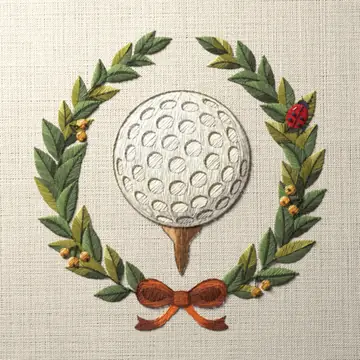
Advanced 3–8 in hoop · 23 colors
Golf ball in laurel
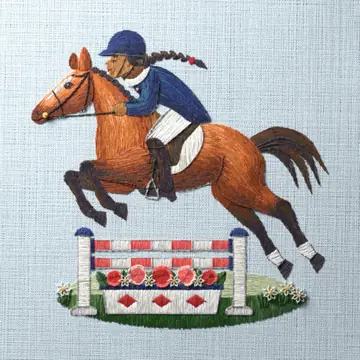
Advanced 3–8 in hoop · 24 colors
Hunter jumper horse and rider
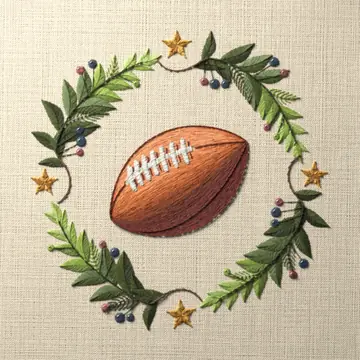
Advanced 3–8 in hoop · 18 colors
Football in a laurel wreath
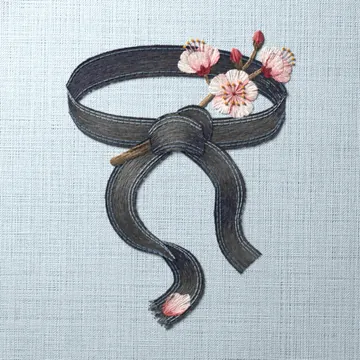
Advanced 3–8 in hoop · 18 colors
Tied black belt with plum blossom
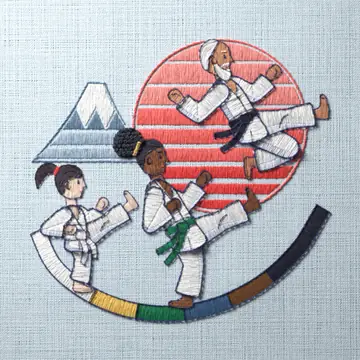
Advanced 3–8 in hoop · 18 colors
Martial arts kicks, white to black belt
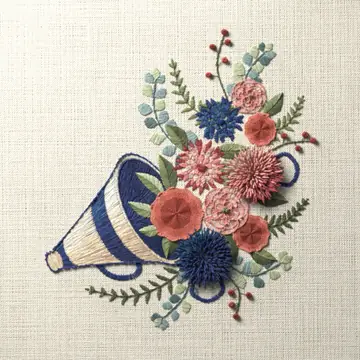
Advanced 3–8 in hoop · 17 colors
Megaphone with pom poms and flowers
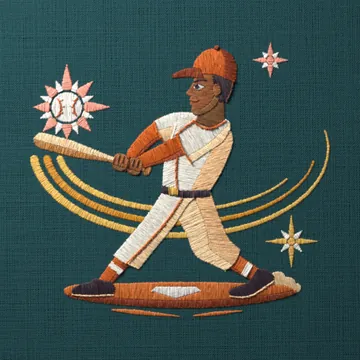
Advanced 3–8 in hoop · 15 colors
Baseball batter swinging
New to hand embroidery? Starting hand embroidery, step by step