Needlepoint, knitting and crochet: the difference
Needlepoint is stitched with a threaded needle onto a canvas that is already there. Knitting and crochet make the cloth itself out of loops of yarn: knitting on two needles, with a whole row of loops open, and crochet on one hook, with one. To begin, needlepoint on a painted canvas is the easiest of the three as a rule, because the holes say where the needle goes.
On this page
The difference at a glance
| Needlepoint | Knitting | Crochet | |
|---|---|---|---|
| What you make | A canvas covered with stitches | A cloth, out of loops | A cloth, out of loops |
| Tools | A blunt needle with an eye, scissors, often a frame | Two needles without eyes, or one circular needle: two tips joined by a cord | One hook |
| What it is worked on | Woven canvas, which is a stiff open cloth with holes, or a plastic sheet with holes | Nothing | Nothing |
| Thread | Wool, cotton or silk, in short cut lengths | Yarn, straight from the ball | Yarn or fine cotton, straight from the ball |
| First thing to learn | One slanted stitch, called tent stitch | Casting on, which puts the first loops on the needle, then the knit stitch | A slip knot and a chain |
| Open loops at any moment | None | A whole row | One, as a rule |
| A mistake | The last few stitches come out backward, eased out with the needle. Older ones are snipped and picked out; the rest stay, and the loose ends are fastened on the back: taking stitches out | Back along the row, loop by loop, or rows pulled out | Pull the yarn, and stitches come out one after another, back to the mistake |
| If you let go | Nothing happens | Loops slide off the needle and can run down | The last loop can pull out, and the rest after it |
| Counting | None on a painted canvas; squares on a chart | Stitches in each row, and rows | Stitches in each row |
| To travel with | A small canvas; a large frame stays at home | A ball and needles; a big piece grows heavy | A ball and a hook |
| Stretch | None. It is as firm as canvas | A great deal | Some, less than knitting as a rule |
| What it is good for | Pillows, ornaments, belts, seats, pictures | Sweaters, socks, hats, scarves | Blankets, toys, bags, lace, hats |
| To finish | Straighten it, back it, sew or frame it | Bind off, which closes the last row of loops so that none can run; hide the yarn's ends in the cloth; sew pieces together if there are any | Pull the end of the yarn through the last loop, and hide the ends in the cloth |
| What you pay for | Canvas, thread by the color, and the making up | Yarn, by the ball | Yarn, by the ball |
What to do next. To try needlepoint, go to how to needlepoint. To choose among more crafts than three, see crafts like needlepoint.
How each is built
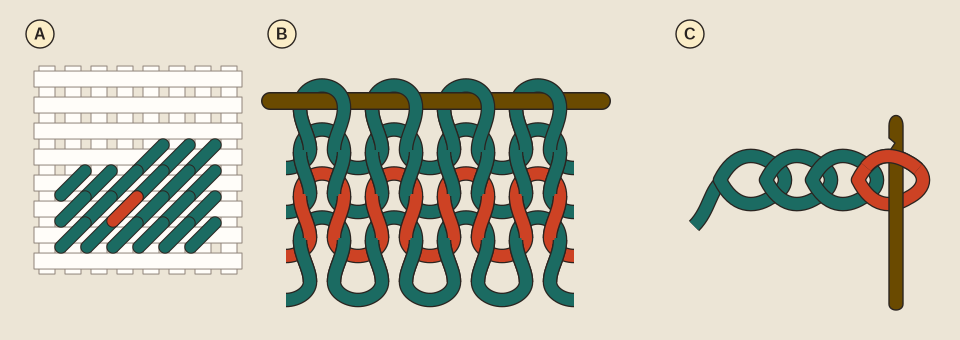
Needlepoint (A). The thread goes down one hole of the canvas and up the next, so every stitch is tied to the canvas and not to its neighbor. Cut one, and the stitches round it do not run. The two cut ends are fastened on the back, and the gap is stitched again.
Knitting (B). One long yarn makes a row of loops, and each new loop is drawn through the loop under it. The loops can bend and straighten, which is why it stretches; and they hold each other, which is why a dropped one can run.
Crochet (C). The hook draws a loop through a loop, finishes it, and begins the next. Rows are built on the chain, in stitches of several heights.
Which is easier?
| You are | Easiest to begin | Why |
|---|---|---|
| Someone who has never made anything | Needlepoint on a printed or painted canvas | One stitch, no counting, and it stays as you leave it |
| A child of school age | Needlepoint on plastic canvas | Big holes, a blunt needle: needlepoint for kids |
| Wanting something warm in few stitches | Crochet or knitting | Thick yarn and a big hook or needles make large stitches |
| Wanting clothes | Knitting | The stretch fits the body |
| Wanting a picture | Needlepoint | Each stitch is a dot of color, and any dot can be any color |
| Fond of puzzles and patterns | Any of them, from a chart | In flat knitting every second row of the chart is worked from the back; a needlepoint chart is always followed from the front |
| Likely to be interrupted | Needlepoint | It can be dropped in the middle of a row |
| Short of things to carry | Crochet | A ball and one hook |
Needlepoint is easy at the start and has its hard part at the end, in the finishing. Knitting and crochet are the other way about: the hands have first to learn to hold yarn and tools, and then a scarf is done when its last row is.
What is hardest in each
| The hard part | What helps | |
|---|---|---|
| Needlepoint | Even stitches, and keeping the canvas square | A light pull, a frame, basketweave in wide areas |
| Needlepoint | Finishing | A ready-made blank that the needlepoint slips into, such as a tray or a key fob (self-finishing), or a picture frame |
| Knitting | Dropped stitches, and loops too tight to get the needle into | Smooth yarn in a light color, medium thickness, and needles on the thick side |
| Knitting | Coming out the right size | A sample first: every hand knits to its own size |
| Crochet | Finding where the hook goes in, and keeping the count at the ends of rows | Smooth light yarn, and a marker, which is a clip or a loop of other yarn, in the first and last stitch |
The most difficult yarn is much the same in all three: fuzzy yarn that hides the stitches, black or navy that hides everything, slippery yarn, and yarn that splits. In needlepoint add metallic thread, which frays as it goes through the holes: metallic threads says how to use it. Begin any of the three with smooth wool in a middling or pale color.
How the hands work
In needlepoint the needle passes right through and is let go twice in every stitch. With a frame on a stand, one hand stays above and one below. In knitting both hands hold something all the time: each has a needle, and one also guides the yarn. In crochet one hand has the hook and the other holds the work and lets the yarn run. Which feels best is for your own hands to say. Sore hands is about holding needlepoint well.
Can one chart serve another?
Often. A needlepoint chart in tent stitch, the one slanted stitch, is a grid of squares, one to a stitch, and a canvas stitch is square. A knitted stitch is wider than it is tall, so the picture comes out squat unless the chart is changed.
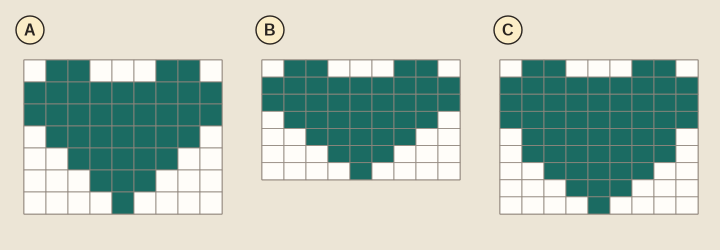
The arithmetic for B: 7 rows at 27 to 4 inches are 1.04 inches (2.6 cm) tall, where 9 stitches at 21 to 4 inches are 1.71 inches (4.4 cm) wide. For a true heart 9 wide and 7 tall it should be 1.33 inches (3.4 cm) tall, and 9 rows are.
| From | To | What to do |
|---|---|---|
| Needlepoint chart | Knitting | The steps under this table, or embroider the picture on afterward in duplicate stitch |
| Needlepoint chart | Single crochet, the short plain stitch, in colors | The same steps, with a sample in single crochet. A chart of 72 worked through |
| Knitting color chart | Needlepoint | Stitch it square by square. It comes out taller than the knitting. To keep the knitted shape, leave out about two rows in nine |
| Chart for cables (stitches that cross over one another) or lace | Needlepoint | No. Its signs are moves and not colors |
| Filet crochet chart (filet is a net with some squares open and some filled) | Needlepoint | Two colors, one for open and one for solid |
| Bargello chart (upright stitches, each over several threads of the canvas) | Knitting or crochet | No. Its stitches are long and stepped |
To knit a needlepoint chart:
- Knit a sample, 4 inches (10 cm) square or a little more, in the yarn and on the needles you will use.
- Count it. Lay a ruler on the middle and count the stitches in 4 inches (10 cm) across, and the rows in the same length up. Say there are 21 and 27.
- Find the rows you need. The squares up the chart, times 27, divided by 21. A chart of 7 rows needs 9, and one of 70 rows needs 90.
- Work some rows twice. With 21 and 27 it is two in every seven: knit the third and the fourth row of each seven, counted from the top, twice, as in C.
- Read it in turn. Going to and fro, the rows on the back of the work are read the other way along. In the round, all are read the same way.
Can the yarn be shared?
Mesh is the number of holes in an inch (2.5 cm) of canvas. The numbers of knitting yarn, such as 4, are on its label and say how thick it is.
| Yarn | In needlepoint | In knitting or crochet |
|---|---|---|
| Tapestry wool, uncut skeins | Yes: 10 to 14 mesh | Small firm things. It has little stretch |
| Needlepoint wool in cut lengths | Yes | No: too short |
| Worsted knitting yarn, number 4 | 7 mesh plastic canvas | Yes |
| Sock and lace yarn, smooth | 13 to 18 mesh, if it hides the canvas. Stitch ten by ten in the margin and look: the cover trial | Yes |
| Six-strand cotton floss | 13 to 18 mesh, in several strands | Small crochet flowers and toys |
| Fluffy, looped or brushed yarn | Accents only: it wears thin in the eye | Yes, with care |
Wool yarn and acrylic and knitting yarn give strands for each mesh.
Is it knitting, embroidery or needlework?
| Family | What is done | Members |
|---|---|---|
| Embroidery | Stitches are added to a cloth that exists | Needlepoint, cross stitch, crewel, surface embroidery |
| Looped cloth | Cloth is made from loops | Knitting, crochet |
| Woven cloth | Cloth is made from crossing threads on a loom | Weaving, tapestry |
| Sewing | Cloth is joined to cloth | Dressmaking, quilting |
Needlework is the wide word. Strictly it is decorative work with a needle, so needlepoint is needlework. Loosely it takes in knitting and crochet too, though a crochet hook is not a needle. Fiber arts and textile crafts are wider still and hold them all. A fair or a survey may put needlepoint under any of these, so read its list and not only its title.
Confusing words. Knitting has needles but they have no eye. A tapestry needle is used by knitters too, to hide ends. Basketweave in needlepoint is a way of working tent stitch, the slanted stitch, in diagonal rows; in knitting it is a pattern of blocks. Frogging means taking stitches out, in all three.
Painting, and other things to do at home
Painting asks you to mix and place color yourself. A painted canvas has that done, and you lay thread over it. If you like color and not the drawing, take needlepoint; if you like a wet brush, paint, and you may end up painting a canvas to stitch. Why needlepoint? sets it beside sewing and yoga as well, and has five small starts.
Questions people ask
What is the difference between needlepoint and knitting, in a sentence? Needlepoint adds stitches to a canvas, and knitting makes cloth out of loops.
Can a knitter learn needlepoint quickly? Wool, charts and evenness are familiar already. New are short lengths, two holes to a stitch, and starting a thread without a knot.
Is crochet a kind of needlepoint? No. It is made of loops with a hook, and nothing is stitched to a canvas. The two can share a yarn and, at times, a chart.
Can I add needlepoint to something knitted? Not as canvas stitches, for there is no canvas. Duplicate stitch, which follows each knitted stitch with a needle, puts a charted picture on it. Needlepoint on a sweater has the steps. Crafts like needlepoint sets the crafts side by side.
Which is older? The oldest knitting known is of about the 11th century. Needlepoint on canvas was a common craft of the home from the 16th, and crochet is firmly recorded only in the 19th. See the history of needlepoint.