Why needlepoint?
People like needlepoint because one small stitch, made over and over, turns into a thing that lasts, and because it asks for no drawing and can be put down at any moment. To find out whether you do, stitch one square of 20 by 20 stitches before you buy anything large: the nine steps are just below.
On this page
Try it first
You need a piece of blank 13 mesh canvas (13 holes to the inch, or 2.5 cm) 6 inches (15 cm) square, one skein of tapestry wool, which is a smooth wool used as one single strand, a blunt tapestry needle of size 20, small scissors and masking tape. A skein is a long coil of thread held by paper bands. The square takes about 4 yards (3.7 m) of wool, an estimate.

This is for the right hand. If you are left-handed, take steps 1, 2 and 8 from here and the stitches from there. Your first stitch is at the lower left corner of the square, 2 inches (5 cm) in from the left edge and the bottom edge.
- Bind the edges. Lay masking tape over each cut edge of the canvas, half on the front and half on the back.
- Thread the needle with 18 inches (46 cm) of wool, and tie a knot in the other end.
- Find the corner. Measure 2 inches (5 cm) down from the top edge and 2 inches in from the right edge. The hole there is the top right corner of the square.
- Park the knot. Count about 13 holes, which is an inch (2.5 cm), straight left of that corner hole, and take the needle down there from the front. The knot stays on the front.
- Make one stitch. Come up in the hole one to the left of the corner hole and one below it. Go down in the corner hole. That slanted stitch is called tent stitch, and it is the only one you need (1 in the picture).
- Work a row of 20 from right to left (as 1 to 5). Each stitch comes up one hole to the left of where the last one came up. Snip the knot off close to the canvas just before you reach it.
- Work the row back, straight below and from left to right (as 6 to 10). Its first stitch lies right under the last one you made. Now come up at the upper right of each stitch and go down at its lower left. Then a row like the first, and so on by turns, to 20 rows.
- End a thread while it is still longer than the needle: run it under three or four stitches on the back, and cut it. Begin the next one by running it under stitches on the back in the same way.
- Decide. If you wanted to go on at the end of it, choose one of the four pieces numbered 2 to 5 under "Five small starts", below.
How to needlepoint draws each of these moves larger. Its own first piece, with a heart, is a longer one: you need not do both.
What there is to like
| What people like | Why needlepoint has it | The other side of it |
|---|---|---|
| Nothing to draw | The design is painted on the canvas, or counted from a chart, which is a drawing in squares with one square for each stitch | Your own drawing comes later, if you want it: how to design your own |
| Little to learn | The holes say where the needle goes, and one stitch is enough to begin | Many other stitches are there when you want them: which stitch to use |
| It forgives | A wrong stitch comes out, and the canvas is as it was: taking stitches out | A canvas that has been cut is another matter |
| It has an end | You see how much is bare and how much is done | Finishing, the making up into an ornament or a pillow, is still to come |
| It can be put down | No row has to be completed, and nothing unravels when you stop | The canvas has to be kept clean and flat between times |
| It travels | A small canvas, a needle and a few skeins go in one bag: on a plane | A large frame that stands on the floor stays at home |
| You can talk while you do it | The hands are busy and the mind need not count, on a painted canvas | Charts and patterned stitches want your attention |
| It lasts | Thread covers the whole canvas, and the cloth that results wears hard. Old seats and cushions are proof | Sun fades it, and water can make colors run |
| It is yours to give | A piece can carry a name, a place or a pet: what to make | Giving it finished means allowing for the finishing |
| Company, if you want it | Needlework guilds take beginners and experts, in local chapters and at a distance | It needs nobody: alone in a chair is how most stitches are made |
Under all of these is a plain one: at the end there is a thing on the table that was not there before.
What puts people off, and what helps
| What is in the way | What helps |
|---|---|
| "I cannot draw" | You never have to. Choose a free chart or a painted canvas |
| "It is expensive" | A painted canvas is the dear part. A chart, a piece of blank canvas and cotton floss are not: what it costs |
| "I will never finish" | Choose a piece of 4 inches (10 cm) or less, in two or three colors, from the easy patterns |
| "The holes are too small" | Larger holes: 10 mesh, or a plastic sheet with 7 holes to the inch. See easier to see and hold |
| "I lose count" | Stitch a painted or printed canvas, which needs no counting, or stripes |
| "It is not my taste" | The stitch has no taste. Look at modern, geometric, cool and unusual and retro designs |
| "What would I do with it?" | Decide before you begin: a coaster, a key fob, a belt, an ornament |
| "I tried it and it came out crooked" | Most canvas leans as it is stitched, and is straightened afterward: how to block |
| "The shops talk in words I do not know" | The glossary has them |
Five small starts
For anyone who has meant to begin and has not. Each can be finished, and each is drawn below at one scale.
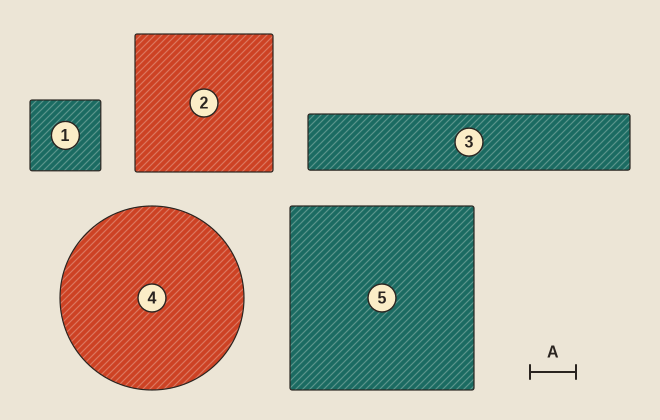
| Start | Finished size | Stitches | What it asks of you |
|---|---|---|---|
| 1. The practice square from "Try it first", 13 mesh | About 1 1/2 inches (4 cm) | 20 by 20, which is 400 | One color of wool, one stitch. Size 20 needle |
| 2. A square in stripes on 7 mesh plastic canvas: the steps, with a new color every four rows | 3 inches (7.6 cm), cut 21 holes each way | 20 by 20, which is 400, and yarn over the bare edge | Medium (worsted) yarn, size 16 needle. Big holes, no frame and no edge to fray |
| 3. A chevron key fob | A strip 7 by 1 1/4 inches (18 by 3 cm) on 18 mesh, to be folded in two | 126 by 22, which is 2,772 | Two colors, and one V that repeats from end to end. Making it up needs a clamp and a ring |
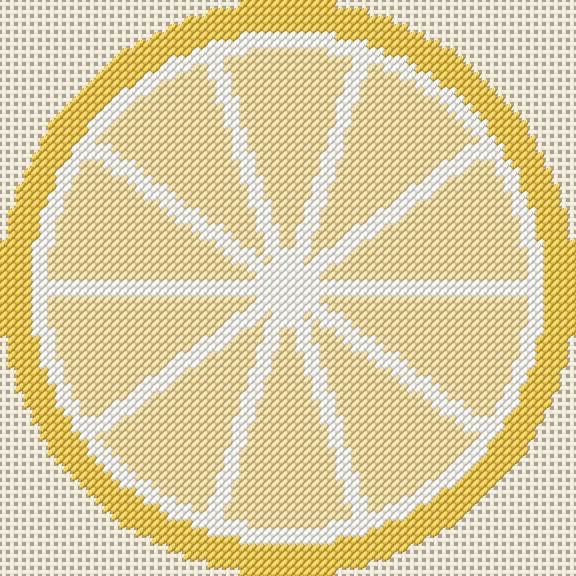
| 4. A round lemon slice | 4 inches (10 cm) on 18 mesh | A round 72 across, about 4,060 | Three colors and a chart to count |
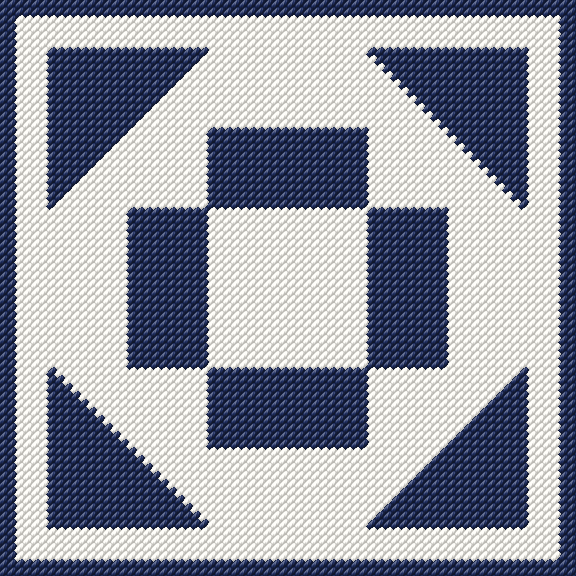
| 5. A churn dash coaster | 4 inches (10 cm) on 18 mesh | 72 by 72, which is 5,184 | Two colors in plain blocks |
For 3, 4 and 5 on 18 mesh you need a size 22 needle, four to six strands of six-strand cotton floss together, and 2 inches (5 cm) of bare canvas on every side. Work them from the chart on the pattern's page: how to read a chart says where to begin.
Charts 4 and 5 can also be worked on 13 mesh, in one strand of tapestry wool, where they come out 5 1/2 inches (14 cm) across in the same number of stitches. The canvas size calculator does that sum for any chart.
If even the square does not get begun: thread the needle and leave it in the bare canvas at the edge, where no stitch will go, in a basket beside the chair you sit in. Stitch one row. A piece that is out is stitched on; one in a drawer is not.
Needlepoint for adults who are beginning
An adult can begin with one small square of canvas, and needs no other craft first: the holes guide the needle. Choose smaller and plainer than you would like. After the square, any of the small starts above will do. Here is one order, if you would like one:
| Piece | You need | What it teaches |
|---|---|---|
| 1. The practice square, under "Try it first" | What is listed there | The stitch, two kinds of row, starting and ending a thread |
| 2. The churn dash coaster, start 5, on 13 mesh in wool. Its page has a file for 13 mesh | 13 mesh canvas 9 1/2 inches (24 cm) square, wool in two colors, the needle of piece 1 | A whole chart, counted |
| 3. The chevron key fob, start 3, on 18 mesh in floss | 18 mesh canvas 11 by 5 1/4 inches (28 by 13 cm), floss in two colors, as an estimate 4 skeins in all, a size 22 needle, a clamp and a ring | Smaller holes, several strands in one needle, making a piece up |
| 4. A small printed kit, or a painted canvas, for an ornament | A kit holds it all. For a painted canvas, thread in its colors | Following color with nothing to count, then making an ornament |
- Buy at once, for 1 and 2: two squares of 13 mesh canvas, 6 and 9 1/2 inches (15 and 24 cm); tapestry wool, as an estimate 29 yards (26 m) of white and 25 yards (23 m) of navy, with the square counted in the navy, which is 4 skeins and 3 of 8.7 yards (8 m) each; a size 20 tapestry needle; small scissors; masking tape. Any two colors will do.
- Or be led lesson by lesson. The red heart of the course takes the place of 1 and 2.
- Look at a kit before you buy it. Find a line in the picture that should be straight, such as a wall, and see whether it stays on one canvas thread: what to check.
- See it. Set a lamp behind the shoulder away from the hand that holds the needle. If 13 mesh is too fine, take 10 mesh, whose holes are larger: easier to see and hold.
- Learn from a page, which shows a stitch as often as you like, or from people: the chapters of a needlework guild take beginners.
- Leave for later metallic and velvet threads, shading, and large pieces. The charts to go on with are the easy patterns, in six colors or fewer.
Is it popular? Is it in fashion?
In short: needlepoint is not counted by itself. A little over one adult in ten in the United States does at least one of six yarn and needle crafts in a year, needlepoint among them, and that share was the same in 2022 as in 2017. One news report of 2024 says that younger people have taken it up since 2020.
The two kinds of evidence, one after the other:
The public count. The United States asks its adults, every few years, which arts they did in the last twelve months. Needlepoint is in one question with five others: weaving, crocheting, quilting, knitting and sewing.
| Year | Adults who did any of the six | Note |
|---|---|---|
| 2002 | About 16 percent | Asked in slightly other words |
| 2012 | 13.2 percent | About the same as in 2008 |
| 2017 | 11.7 percent | |
| 2020 | 9.2 percent | Another, shorter survey |
| 2022 | 11.7 percent | No different from 2017, by the survey's own test. It covers the year to July 2022 |
So over one adult in ten did at least one of the six in the year to July 2022, and the share did not grow over those five years. In 2012 it was 23.2 percent of women and 2.4 percent of men, 9.8 percent of people aged 18 to 24 and 19 percent of those aged 65 to 74.
What is reported. A British broadcaster's article of June 2024 describes a return that began in the lockdowns of 2020 and went on: first people in their twenties and thirties, then younger ones, stitch clubs across the United States and beyond, and canvases with jokes and sayings in place of roses. That is reporting, from people who teach and sell it. It is not a count.
Which is more popular: cross stitch, embroidery or needlepoint? No public count that this page could find asks about them one by one. A ranking you meet elsewhere is counting something else, such as searches or sales. What surveys do count is in which is more popular.
Is it cool? It was a pastime of queens in the 1500s, of a British king who learned it in the navy, and, by that report, of a good many people under thirty in 2024. Fashion comes and goes with the designs. The stitch has not changed, and its history is a long one.
Who does it? Anyone who can hold a needle, or learn to with one hand. Children begin on plastic canvas. Designs run from golf and fishing to flowers, so nobody is kept out by the subjects.
Why is needlepoint popular again?
Reports of 2024 to 2026, from a broadcaster, two magazines and a trade body, give five reasons between them. Most come from people who sell or teach it, and the public count above shows no rise up to 2022.
- The lockdowns of 2020. Many people took up some handwork, and went on.
- Short videos. They showed the craft to people who had never met it.
- New designs. Food and drink, jokes, lines from songs, towns and colleges stand beside the roses.
- Something to hold. It is slow and solid, and it cannot be done while scrolling.
- Company. Clubs and stitching evenings.
The trends: what is stitched now. Small canvases and small kits, on 13 mesh for beginners. They become ornaments, patches, key fobs and pillows with a few words on them. Pieces in blue and white are liked all year, and so are souvenirs of a place. Self-finishing makes a small one up at home.
Beside other pastimes
Needlepoint, knitting, sewing and yoga side by side
Needlepoint asks the hands for one small stitch through a hole that is already there, knitting for two needles that move together, crochet for one hook, sewing for a straight seam, and yoga for no tool at all, since it is done with the whole body. What each needs, when you can stop and what you have at the end stand in the table. Which of them helps with stress is not a thing this page can say: the part on stress and therapy, below, says whose question that is.
| Pastime | What you need | Can you stop in the middle? | What you have at the end |
|---|---|---|---|
| Needlepoint | Canvas, a blunt needle, thread | At any stitch | A firm stitched cloth, to be made up |
| Knitting | Two needles and yarn | Yes, but the open loops must stay on the needle | A stretchy cloth: a scarf, a sock, a sweater |
| Crochet | One hook and yarn | Yes, with one open loop to keep safe | A cloth, a blanket, a toy |
| Sewing | Cloth, thread, a needle or a machine | Between seams | Clothes, curtains, repairs |
| Yoga | Room to move, and somebody to learn it from | At the end of a posture | Nothing to keep or to dust |
Needlepoint, knitting and crochet sets the first three side by side, and crafts like needlepoint has the nearer ones.
Why is needlepoint like meditation?
Because of what the two share on the outside. Some kinds of meditation hold the mind on one thing, such as the breath, a sound or a picture. Needlepoint gives the hands one small movement to repeat, in one place, and the eyes one thing to look at, and people who stitch call that repeated movement meditative. So a painted canvas in one stitch is the nearest to it, because nothing breaks the movement. A chart is less like it: you stop to count. Yoga, which often has meditation in it, is compared with needlepoint for the same reason.
Whether they share more is not something a page about stitching can say. The next part says where such questions belong.
Needlepoint and stress, and needlepoint as therapy
This page makes no claim that needlepoint relieves stress or treats anything: those questions, and every other about health, belong to a doctor. What can be told is what people say about the doing of it. In reports of 2024 and 2026, people who stitch speak of small movements that repeat, of work that is slow on purpose, of hands that hold a needle and not a screen, and of a finished thing that lasts.
| A pastime at home | Art therapy | |
|---|---|---|
| Who leads it | Nobody, or a friend | A therapist with a degree and supervised training |
| What it is for | The stitching, and the piece at the end | The goals of a treatment |
| What is made | The whole point | A way to express something, beside talking |
Is needlepoint a therapy? On its own it is a pastime. Therapy is what a trained person does with you, and a needle in the hand does not turn one into the other.
A quiet evening of stitching at home
What people call do-it-yourself therapy with a needle is, seen from outside, a plain evening's stitching: one place, one lamp, one stitch, one color. Here is the evening, with nothing promised for it.
- Choose the place: a chair with a table beside it, out of reach of anything that rings or lights up.
- Set the lamp over the shoulder away from the hand that holds the needle: lights and magnifiers shows where.
- Take a canvas with no counting: the plain background of a painted one. The practice square under Try it first does too: you count its first row, and then only how many rows there are, up to 20.
- Thread three needles with one color, 18 inches (46 cm) in each, so that you need not stop to cut and thread. The first begins with the knot of Try it first, an inch (2.5 cm) along the row you are about to stitch, and each one after that is run under stitches on the back, as there. On a painted canvas it is the same.
- Work one stitch only, continental in rows or basketweave on the slant.
- Stop at any stitch you like, with the needle parked in the bare margin. The end of a row is only the easiest place to find again.
Questions people ask
What is the point of needlepoint? To cover a canvas with thread, for a use or for its own sake. What is made of it can be sat on, hung up, worn or given.
What are the benefits of needlepoint? The ones that can be seen are in the first table: nothing to draw, little to learn, a mistake that comes out, and a thing that lasts. What is claimed for it beyond those, for the body or the mind, is a question of health, and this page does not answer it.
Do I need patience? Some. It is spent a stitch at a time. A small piece in few colors asks for less than a large one with many.
Do I need to be neat? No. First rows are uneven, and the stitches grow more even as you work more of them.
Is it better with other people? It is pleasant either way. In a group, take a painted canvas or wide plain areas, so that you can talk and not count.
Kit or chart to begin with? A kit holds a printed or painted canvas, as a rule with its thread, and decides for you. A chart costs least and lets you choose the thread.
What if I do not like it? Give the canvas and thread to someone who does, or to a guild. A part-done canvas can be finished by another hand, as a preworked canvas is: one that is sold with its picture stitched and its background left bare.