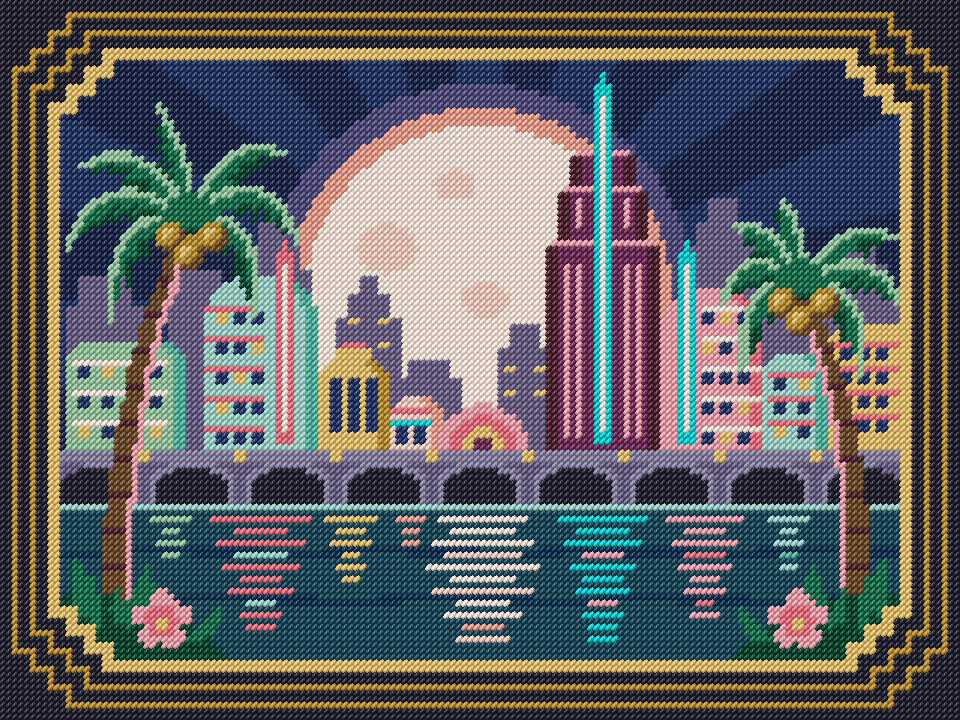
Miami skyline at night needlepoint pattern
Needlepoint, 16 × 12 in on 10 mesh, 24 colors, advanced
Download free PDFOptionsPDFPrints on US Letter and A4You may sell what you make from it by hand, in small quantities. The PDF itself is not to be sold or shared. Selling, classes and kits: the rules
Your PDF is ready: look in your downloads. Open the PDF (opens in a new tab)
Next: How to start · How to finish a pillow
You will need
- Canvas: blank mono canvas, 10 mesh (10 threads to the inch), cut 20 × 16 in
- Needle: tapestry, size 16 or 18. Also masking tape for the cut edges, and small scissors
- Thread: 24 colors of six-strand floss, 8 strands in the needle, six of one length and 2 of the next (9 or 10 if canvas shows), about 58 skeins in all (an estimate)
- Thread: 24 colors of pearl cotton size 3, 2 strands in the needle, about 41 skeins in all (an estimate)
- Thread: 24 colors of tapestry wool, 1 strand in the needle, about 38 skeins in all (an estimate)
- Thread: 24 colors of Persian wool, 3 strands in the needle, about 43 skeins in all (an estimate)
- Two rows more all round in DMC 310, for the seam: buy 8 skeins of it, not 6 (an estimate)
Make it a pillow. Backing fabric, an insert the size of the stitching or an inch larger, and cord or piping for the edge. The seam takes two rows: stitch two extra rows all round. How to finish a pillow
Pastel art deco hotels and a tall plum tower stand before a huge cream moon, their lights lying in dashes on the teal bay. Two palms rise from gardens with pink hibiscus. The sky is navy, and the border is black with stepped gold lines.
Threads
- DMC 310 Black 3,917 stitches about 48.3 yards 6 skeins
- DMC 311 Medium Navy Blue 2,009 stitches about 24.8 yards 4 skeins
- DMC 3770 Very Light Tawny 1,466 stitches about 18.1 yards 3 skeins
- DMC 336 Navy Blue 1,369 stitches about 16.9 yards 3 skeins
- DMC 3821 Straw 1,353 stitches about 16.7 yards 3 skeins
- DMC 939 Very Dark Navy Blue 1,272 stitches about 15.7 yards 2 skeins
- DMC 3852 Very Dark Straw 1,154 stitches about 14.3 yards 2 skeins
- DMC 3746 Dark Blue Violet 958 stitches about 11.8 yards 2 skeins
- DMC 3706 Medium Melon 664 stitches about 8.2 yards 1 skein
- DMC 964 Light Seagreen 522 stitches about 6.5 yards 1 skein
- DMC 955 Light Nile Green 513 stitches about 6.4 yards 1 skein
- DMC 910 Dark Emerald Green 510 stitches about 6.3 yards 1 skein
- DMC 155 Medium Dark Blue Violet 428 stitches about 5.3 yards 1 skein
- DMC 892 Medium Carnation 382 stitches about 4.8 yards 1 skein
- DMC 34 Dark Fuchsia 375 stitches about 4.7 yards 1 skein
- DMC 500 Very Dark Blue Green 320 stitches about 4 yards 1 skein
- DMC 31 Blueberry 311 stitches about 3.9 yards 1 skein
- DMC 433 Medium Brown 310 stitches about 3.9 yards 1 skein
- DMC 3846 Light Bright Turquoise 284 stitches about 3.5 yards 1 skein
- DMC 820 Very Dark Royal Blue 281 stitches about 3.5 yards 1 skein
- DMC 3341 Apricot 243 stitches about 3 yards 1 skein
- DMC 154 Very Dark Grape 241 stitches about 3 yards 1 skein
- DMC 353 Peach 199 stitches about 2.5 yards 1 skein
- DMC 959 Medium Seagreen 119 stitches about 1.5 yards 1 skein
Skeins are estimates.
Thread colors are approximate screen matches to DMC numbers. Check against real thread before you buy.
How to stitch it
- Each square is one tent stitch, up at 1, down at 2: basketweave for the background, continental for lines.
- Bind the edges. Cut 18 in of thread; start and end it without a knot left behind.
- Mark the middle of the canvas. It is the outlined square: start there. Count threads, not holes.
- Picture first, then border, background last. Gray squares are on two pages: stitch them once.
- A heavier line stands every ten squares: count by them.
- When it is done, block it square.
See the chart on this page
The chart is drawn when this is opened.
It opens in the pattern maker, with your colors and your name on it.
Options
Another mesh, another thread, large print and tools
On another mesh
The chart is 160 × 120 stitches: a pillow on 10 mesh canvas.
| Mesh | Stitched size | Canvas to cut |
|---|---|---|
| 10 | 16 × 12 in 40.6 × 30.5 cm | 20 × 16 in 50.8 × 40.6 cm |
| 12 | 13.3 × 10 in 33.9 × 25.4 cm | 17.3 × 14 in 44 × 35.6 cm |
| 13 | 12.3 × 9.2 in 31.3 × 23.4 cm | 16.3 × 13.2 in 41.4 × 33.6 cm |
| 14 | 11.4 × 8.6 in 29 × 21.8 cm | 15.4 × 12.6 in 39.2 × 31.9 cm |
| 18 | 8.9 × 6.7 in 22.6 × 16.9 cm | 12.9 × 10.7 in 32.7 × 27.1 cm |
Mesh is the number of canvas threads to the inch; the row in bold is the mesh this chart is sized for. Canvas to cut includes a margin of 2 in (5.1 cm) of bare canvas on every side.
In another thread
The numbers are DMC color numbers, which its six-strand cotton and its pearl cotton share. Persian wool and silk are numbered differently: match those by eye. Which thread suits which mesh
In large print
The same chart in squares of about 6 mm, on 17 pages.
Another stitch
The chart is in tent stitch. The plain part of the sky can have a texture of its own: try brick stitch or Parisian stitch there, and keep the rest in tent stitch. Stitches for sky and water shows more of them. Another stitch takes another amount of thread: allow a skein more of that color.
How the level is set
Advanced. Many colors, or changes every few stitches: best with a canvas or two behind you.
Advanced: 24 colors. Changes of color are about 3.5 stitches apart, leaving out the border. With 10 colors or more, closer than 4.5 apart is Advanced, 4.5 or more is Intermediate, and a design with this many colors is never Beginner.
How the thread is counted
The yards are of thread as it is threaded in the needle: stitched with several strands together, a thread takes that many yards of single strand for every yard counted. For six-strand cotton on 10 mesh, the thread and needle chart gives 8 to 10 strands.
An estimate. The length of thread one stitch uses on the front and back of the canvas, times the number of stitches, plus 30 percent for starting, ending and the tail left in the needle. Each count is estimated as basketweave or continental and rounded up to a tenth of a yard. The 30 percent is this site's own choice. The thread calculator works the same estimate for any count and mesh.
What you may do with it
You may sell what you make from it by hand, in small quantities. The PDF itself is not to be sold or shared. Selling, classes and kits: the rules
More patterns like this
Advanced 10,816 stitches 8 × 8 in · 18 colors · 13 mesh
Miami Art Deco hotels and palms
Advanced 19,200 stitches 16 × 12 in · 24 colors · 10 mesh
Florida license plate in deco pastels
Intermediate 19,600 stitches 14 × 14 in · 16 colors · 10 mesh
Retro Florida state shape
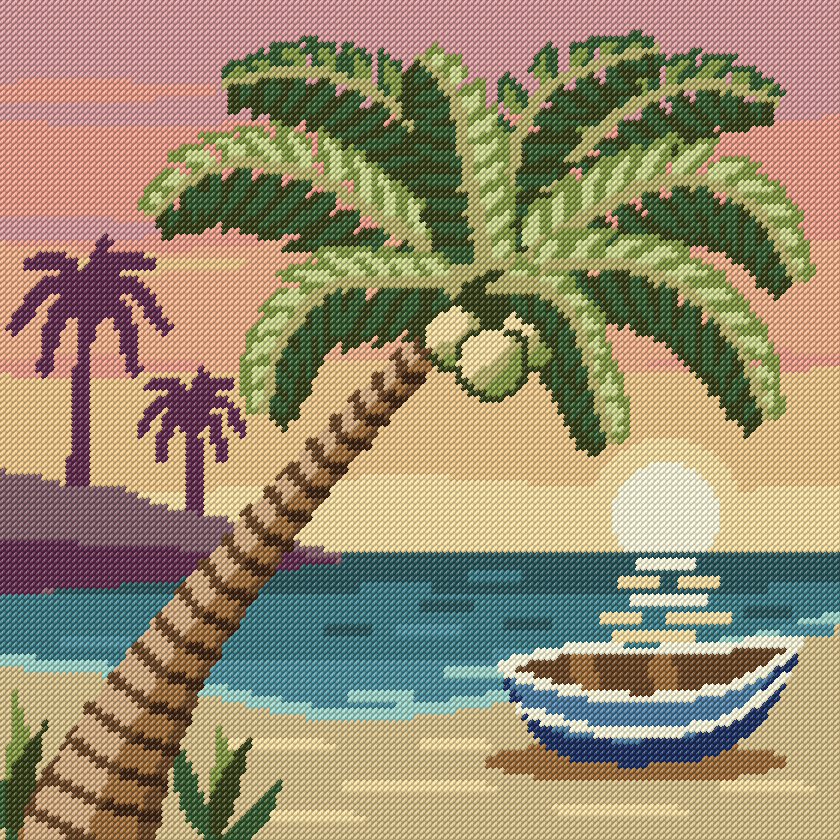
Advanced 19,600 stitches 14 × 14 in · 24 colors · 10 mesh
Classic palm tree with three palms
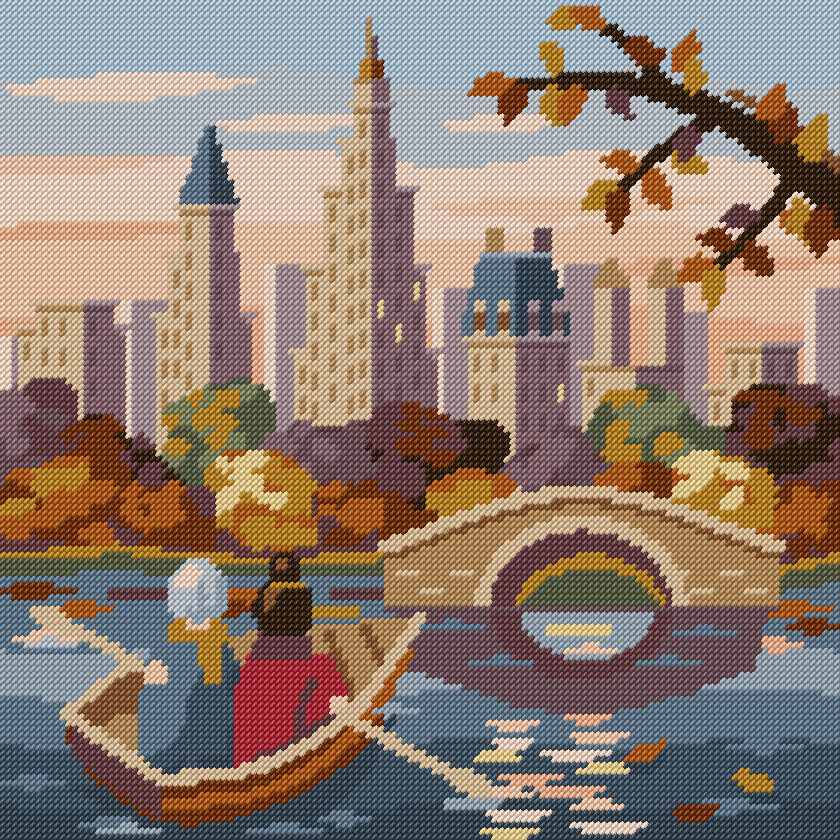
Advanced 19,600 stitches 14 × 14 in · 24 colors · 10 mesh
Classic city skyline from the park
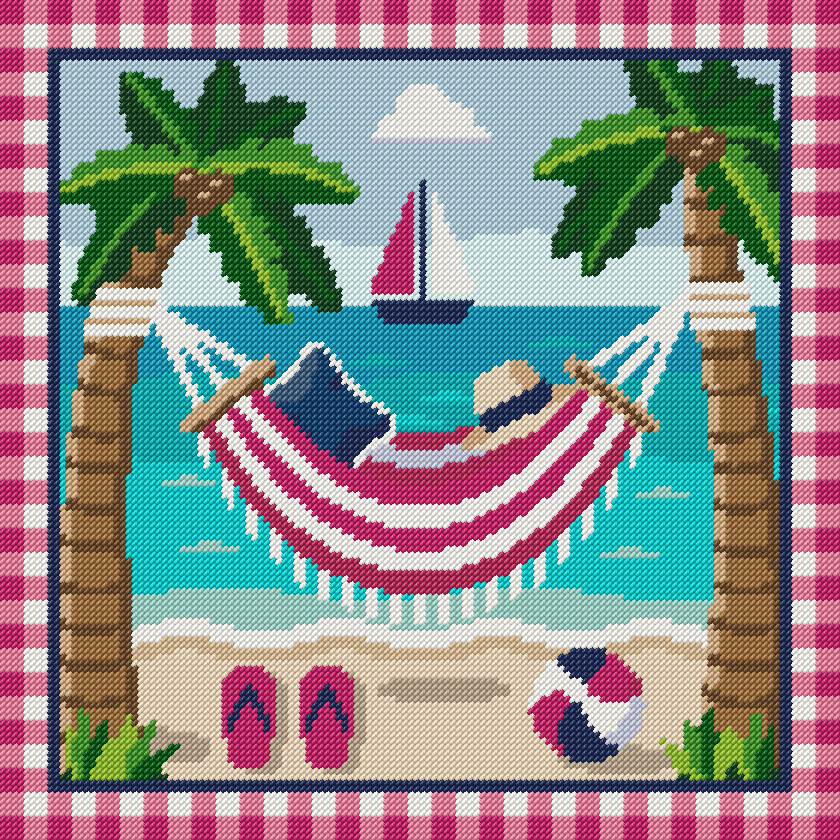
Intermediate 19,600 stitches 14 × 14 in · 24 colors · 10 mesh
Preppy beach hammock
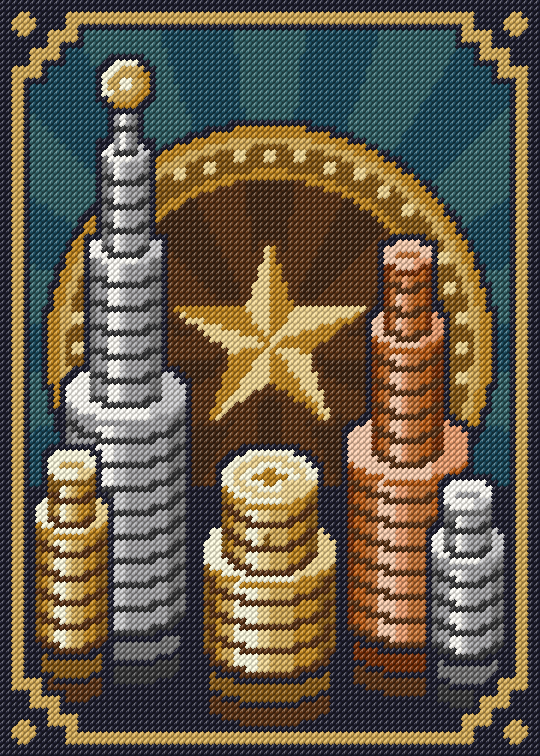
Advanced 11,340 stitches 5 × 7 in · 20 colors · 18 mesh
Art deco coins stacked like a skyline
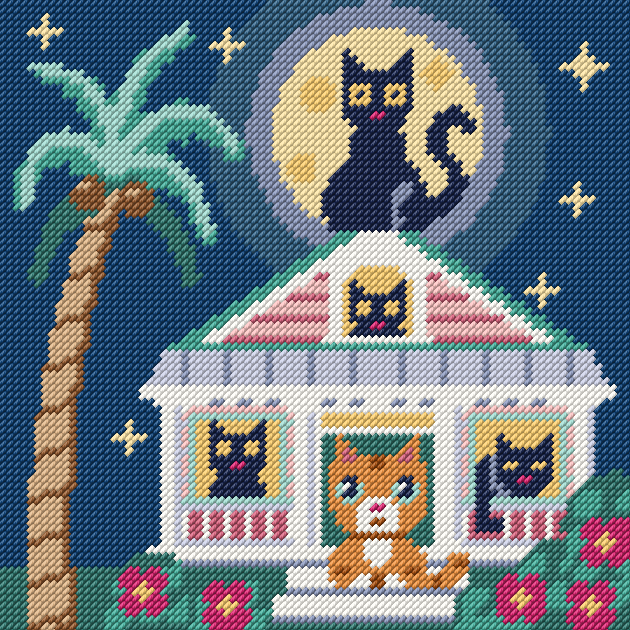
Advanced 8,100 stitches 5 × 5 in · 18 colors · 18 mesh
Whimsical Key West house
New to needlepoint? How to needlepoint