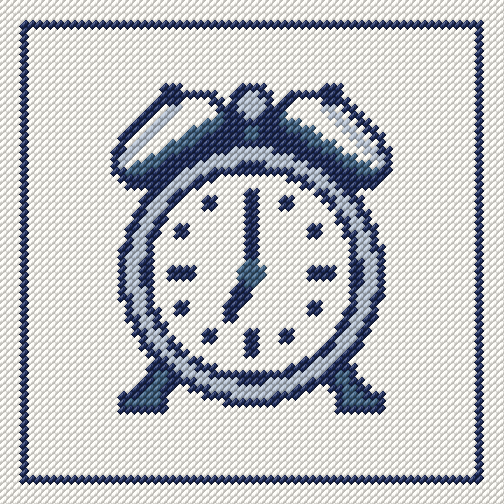
Blue and white alarm clock needlepoint pattern
Needlepoint, 4 × 4 in on 18 mesh, 4 colors, intermediate
Shape and border: Its own borderChange
Download free PDFOptionsPDFPrints on US Letter and A4You may sell what you make from it by hand, in small quantities. The PDF itself is not to be sold or shared. Selling, classes and kits: the rules
Your PDF is ready: look in your downloads. Open the PDF (opens in a new tab)
You will need
- Canvas: blank mono canvas, 18 mesh (18 threads to the inch), cut 8 × 8 in
- Needle: tapestry, size 22. Also masking tape for the cut edges, and small scissors
- Thread: 4 colors of six-strand floss, 4 strands in the needle (5 or 6 if canvas shows), about 6 skeins in all (an estimate)
- Thread: 4 colors of pearl cotton size 5, 1 strand in the needle, about 4 skeins in all (an estimate)
- Thread: 4 colors of Persian wool, 1 strand in the needle, about 4 skeins in all (an estimate)
- Two rows more all round in DMC 823, for the seam: buy 2 skeins of it, not 1 (an estimate)
- Canvas: blank mono canvas, 18 mesh (18 threads to the inch), cut 8 × 8 in
- Needle: tapestry, size 22. Also masking tape for the cut edges, and small scissors
- Thread: 4 colors of six-strand floss, 4 strands in the needle (5 or 6 if canvas shows), about 7 skeins in all (an estimate)
- Thread: 4 colors of pearl cotton size 5, 1 strand in the needle, about 4 skeins in all (an estimate)
- Thread: 4 colors of Persian wool, 1 strand in the needle, about 4 skeins in all (an estimate)
- Two rows more all round in DMC 823, for the seam: buy 2 skeins of it, not 2 (an estimate)
- Canvas: blank mono canvas, 18 mesh (18 threads to the inch), cut 8 × 8 in
- Needle: tapestry, size 22. Also masking tape for the cut edges, and small scissors
- Thread: 4 colors of six-strand floss, 4 strands in the needle (5 or 6 if canvas shows), about 7 skeins in all (an estimate)
- Thread: 4 colors of pearl cotton size 5, 1 strand in the needle, about 4 skeins in all (an estimate)
- Thread: 4 colors of Persian wool, 1 strand in the needle, about 4 skeins in all (an estimate)
- Two rows more all round in DMC BLANC, for the seam: buy 4 skeins of it, not 3 (an estimate)
- Canvas: blank mono canvas, 18 mesh (18 threads to the inch), cut 8 × 8 in
- Needle: tapestry, size 22. Also masking tape for the cut edges, and small scissors
- Thread: 4 colors of six-strand floss, 4 strands in the needle (5 or 6 if canvas shows), about 7 skeins in all (an estimate)
- Thread: 4 colors of pearl cotton size 5, 1 strand in the needle, about 5 skeins in all (an estimate)
- Thread: 4 colors of Persian wool, 1 strand in the needle, about 5 skeins in all (an estimate)
- Two rows more all round in DMC BLANC, for the seam: buy 4 skeins of it, not 4 (an estimate)
Make it an ornament. Board, thin batting, backing fabric and twisted cord. Stitch two extra rows all round: the edge of the board takes them. How to finish an ornament
Make it an ornament. Board, thin batting, backing fabric and twisted cord. Stitch two extra rows all round in DMC 823, the color at its edge: the edge of the board takes them. How to finish an ornament
Make it an ornament. Board, thin batting, backing fabric and twisted cord. Stitch two extra rows all round in DMC 823, the color at its edge: the edge of the board takes them. How to finish an ornament
Make it an ornament. Board, thin batting, backing fabric and twisted cord. Stitch two extra rows all round: the edge of the board takes them. How to finish an ornament
Make it an ornament. Board, thin batting, backing fabric and twisted cord. Stitch two extra rows all round in DMC BLANC, the color at its edge: the edge of the board takes them. How to finish an ornament
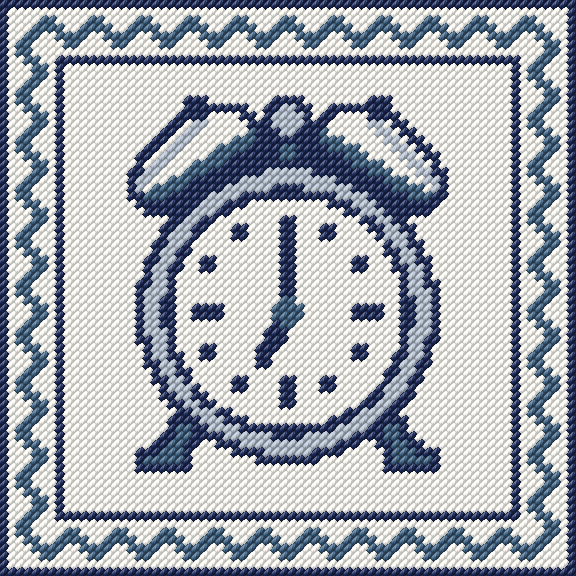
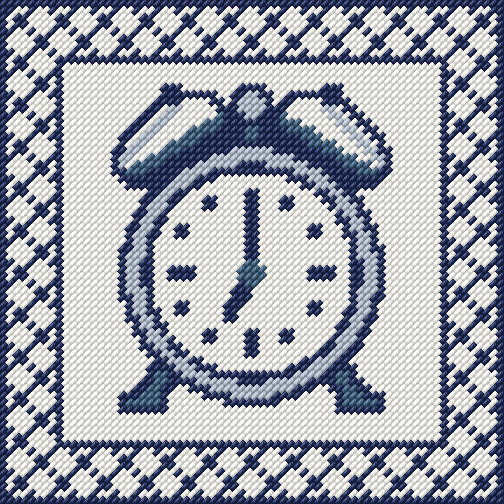
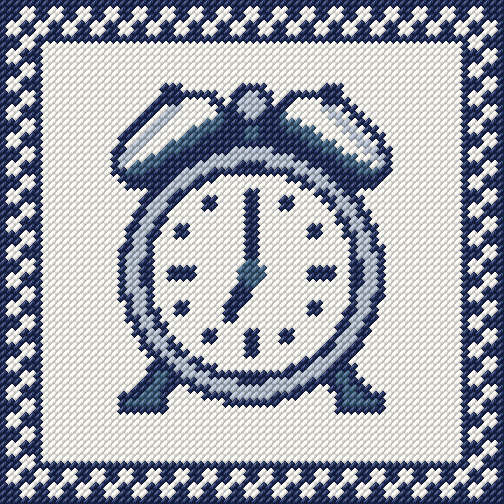
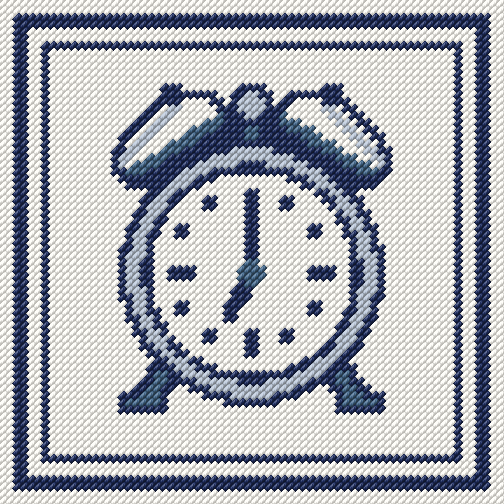
An alarm clock in navy and blue has two bells on top with a hammer between them, two splayed feet and a white face with its hands at seven o'clock. The background is white.
Make it yours
Threads
Its own border
- DMC BLANC White 3,238 stitches about 22.2 yards 3 skeins
- DMC 823 Dark Navy Blue 1,088 stitches about 7.5 yards 1 skein
- DMC 798 Dark Delft Blue 608 stitches about 4.2 yards 1 skein
- DMC 800 Pale Delft Blue 250 stitches about 1.8 yards 1 skein
Skeins are estimates.
Lattice border
- DMC BLANC White 3,166 stitches about 21.7 yards 3 skeins
- DMC 823 Dark Navy Blue 1,668 stitches about 11.5 yards 2 skeins
- DMC 800 Pale Delft Blue 250 stitches about 1.8 yards 1 skein
- DMC 798 Dark Delft Blue 100 stitches about 0.7 yards 1 skein
Skeins are estimates.
Check border
- DMC BLANC White 3,202 stitches about 22 yards 3 skeins
- DMC 823 Dark Navy Blue 1,632 stitches about 11.2 yards 2 skeins
- DMC 800 Pale Delft Blue 250 stitches about 1.8 yards 1 skein
- DMC 798 Dark Delft Blue 100 stitches about 0.7 yards 1 skein
Skeins are estimates.
Double line border
- DMC BLANC White 3,494 stitches about 24 yards 3 skeins
- DMC 823 Dark Navy Blue 1,340 stitches about 9.2 yards 2 skeins
- DMC 800 Pale Delft Blue 250 stitches about 1.8 yards 1 skein
- DMC 798 Dark Delft Blue 100 stitches about 0.7 yards 1 skein
Skeins are estimates.
Line border
- DMC BLANC White 3,998 stitches about 27.4 yards 4 skeins
- DMC 823 Dark Navy Blue 836 stitches about 5.8 yards 1 skein
- DMC 800 Pale Delft Blue 250 stitches about 1.8 yards 1 skein
- DMC 798 Dark Delft Blue 100 stitches about 0.7 yards 1 skein
Skeins are estimates.
Thread colors are approximate screen matches to DMC numbers. Check against real thread before you buy.
How to stitch it
- Each square is one tent stitch: up at 1, down at 2. All slant the same way.
- Cut 18 in of thread. Start and end it without a knot left behind.
- Mark the middle of the canvas. It is the outlined square: start there. Count threads, not holes.
- Stitch the picture, then the background, then stray dots. End the thread before crossing another color.
- A heavier line stands every ten squares: count by them.
- First time? How to needlepoint.
See the chart on this page
The chart is drawn when this is opened.
It opens in the pattern maker, with your colors and your name on it.
Options
Another mesh, another thread, plastic canvas, large print and tools
On another mesh
The chart is 72 × 72 stitches: a square ornament on 18 mesh canvas.
The chart is 72 × 72 stitches: a square ornament on 18 mesh canvas.
The chart is 72 × 72 stitches: a square ornament on 18 mesh canvas.
The chart is 72 × 72 stitches: a square ornament on 18 mesh canvas.
The chart is 72 × 72 stitches: a square ornament on 18 mesh canvas.
| Mesh | Stitched size | Canvas to cut |
|---|---|---|
| 10 | 7.2 × 7.2 in 18.3 × 18.3 cm | 11.2 × 11.2 in 28.4 × 28.4 cm |
| 12 | 6 × 6 in 15.2 × 15.2 cm | 10 × 10 in 25.4 × 25.4 cm |
| 13 | 5.5 × 5.5 in 14.1 × 14.1 cm | 9.5 × 9.5 in 24.2 × 24.2 cm |
| 14 | 5.1 × 5.1 in 13.1 × 13.1 cm | 9.1 × 9.1 in 23.2 × 23.2 cm |
| 18 | 4 × 4 in 10.2 × 10.2 cm | 8 × 8 in 20.3 × 20.3 cm |
Mesh is the number of canvas threads to the inch; the row in bold is the mesh this chart is sized for. Canvas to cut includes a margin of 2 in (5.1 cm) of bare canvas on every side.
On 13 mesh, easier to see
- Size: the piece comes out 5.5 × 5.5 in
- Canvas: 13 mesh, cut 9.5 × 9.5 in
- Needle: tapestry, size 20
- Thread: 4 colors of tapestry wool in the nearest shades, 1 strand in the needle, about 8 skeins in all (an estimate)
- Or 4 colors of pearl cotton size 3, 1 strand in the needle, about 5 skeins in all (an estimate)
- Or 4 colors of six-strand floss, 7 strands in the needle, six of one length and one of the next (8 if canvas shows), about 9 skeins in all (an estimate)
- Wool by color, after DMC’s own table of nearest shades:
- Wool BLANC White (cotton BLANC), 4 skeins
- Wool 7307 Dark Navy Blue (cotton 823), 2 skeins
- Wool 7029 Dark Delft Blue (cotton 798), 1 skein
- Wool 7800 Pale Delft Blue (cotton 800), 1 skein
On 13 mesh, easier to see
- Size: the piece comes out 5.5 × 5.5 in
- Canvas: 13 mesh, cut 9.5 × 9.5 in
- Needle: tapestry, size 20
- Thread: 4 colors of tapestry wool in the nearest shades, 1 strand in the needle, about 8 skeins in all (an estimate)
- Or 4 colors of pearl cotton size 3, 1 strand in the needle, about 5 skeins in all (an estimate)
- Or 4 colors of six-strand floss, 7 strands in the needle, six of one length and one of the next (8 if canvas shows), about 10 skeins in all (an estimate)
- Wool by color, after DMC’s own table of nearest shades:
- Wool BLANC White (cotton BLANC), 4 skeins
- Wool 7307 Dark Navy Blue (cotton 823), 2 skeins
- Wool 7800 Pale Delft Blue (cotton 800), 1 skein
- Wool 7029 Dark Delft Blue (cotton 798), 1 skein
On 13 mesh, easier to see
- Size: the piece comes out 5.5 × 5.5 in
- Canvas: 13 mesh, cut 9.5 × 9.5 in
- Needle: tapestry, size 20
- Thread: 4 colors of tapestry wool in the nearest shades, 1 strand in the needle, about 8 skeins in all (an estimate)
- Or 4 colors of pearl cotton size 3, 1 strand in the needle, about 6 skeins in all (an estimate)
- Or 4 colors of six-strand floss, 7 strands in the needle, six of one length and one of the next (8 if canvas shows), about 10 skeins in all (an estimate)
- Wool by color, after DMC’s own table of nearest shades:
- Wool BLANC White (cotton BLANC), 5 skeins
- Wool 7307 Dark Navy Blue (cotton 823), 1 skein
- Wool 7800 Pale Delft Blue (cotton 800), 1 skein
- Wool 7029 Dark Delft Blue (cotton 798), 1 skein
In another thread
The numbers are DMC color numbers, which its six-strand cotton and its pearl cotton share. Persian wool and silk are numbered differently: match those by eye. Which thread suits which mesh
On plastic canvas
On plastic canvas: 5.1 × 5.1 in on 14 mesh, 7.2 × 7.2 in on 10 and 10.3 × 10.3 in on 7, from one sheet (on 7, a large one of 13½ × 22½ in). Take worsted yarn and a size 16 needle on 7 mesh; sport yarn or 12 strands of floss and a size 18 needle on 10; 6 strands of floss and a size 22 needle on 14. Yarn is matched to the list by eye. How to stitch a chart on plastic canvas
On plastic canvas: 5.1 × 5.1 in on 14 mesh, 7.2 × 7.2 in on 10 and 10.3 × 10.3 in on 7, from one sheet (on 7, a large one of 13½ × 22½ in). Take worsted yarn and a size 16 needle on 7 mesh; sport yarn or 12 strands of floss and a size 18 needle on 10; 6 strands of floss and a size 22 needle on 14. Yarn is matched to the list by eye. How to stitch a chart on plastic canvas
On plastic canvas: 5.1 × 5.1 in on 14 mesh, 7.2 × 7.2 in on 10 and 10.3 × 10.3 in on 7, from one sheet (on 7, a large one of 13½ × 22½ in). Take worsted yarn and a size 16 needle on 7 mesh; sport yarn or 12 strands of floss and a size 18 needle on 10; 6 strands of floss and a size 22 needle on 14. Yarn is matched to the list by eye. How to stitch a chart on plastic canvas
On plastic canvas: 5.1 × 5.1 in on 14 mesh, 7.2 × 7.2 in on 10 and 10.3 × 10.3 in on 7, from one sheet (on 7, a large one of 13½ × 22½ in). Take worsted yarn and a size 16 needle on 7 mesh; sport yarn or 12 strands of floss and a size 18 needle on 10; 6 strands of floss and a size 22 needle on 14. Yarn is matched to the list by eye. How to stitch a chart on plastic canvas
On plastic canvas: 5.1 × 5.1 in on 14 mesh, 7.2 × 7.2 in on 10 and 10.3 × 10.3 in on 7, from one sheet (on 7, a large one of 13½ × 22½ in). Take worsted yarn and a size 16 needle on 7 mesh; sport yarn or 12 strands of floss and a size 18 needle on 10; 6 strands of floss and a size 22 needle on 14. Yarn is matched to the list by eye. How to stitch a chart on plastic canvas
In large print
The same chart in squares of about 6 mm, on 6 pages.
How the level is set
Intermediate. The color changes often enough that you count as you go.
Intermediate: 4 colors. Changes of color are about 3.3 stitches apart, leaving out the border and the background around the picture. With up to 7 colors, closer than 3.5 apart is Intermediate and 3.5 or more is Beginner.
How the thread is counted
The yards are of thread as it is threaded in the needle: stitched with several strands together, a thread takes that many yards of single strand for every yard counted. For six-strand cotton on 18 mesh, the thread and needle chart gives 4 to 6 strands.
An estimate. The length of thread one stitch uses on the front and back of the canvas, times the number of stitches, plus 30 percent for starting, ending and the tail left in the needle. Each count is estimated as basketweave or continental and rounded up to a tenth of a yard. The 30 percent is this site's own choice. The thread calculator works the same estimate for any count and mesh.
What you may do with it
You may sell what you make from it by hand, in small quantities. The PDF itself is not to be sold or shared. Selling, classes and kits: the rules
The rest of this set
Beginner 5,184 stitches 4 × 4 in · 5 colors · 18 mesh
Blue and white stag beetle
Intermediate 5,184 stitches 4 × 4 in · 4 colors · 18 mesh
Blue and white blue crab
Intermediate 5,184 stitches 4 × 4 in · 5 colors · 18 mesh
Blue and white ice cream cone
Beginner 5,184 stitches 4 × 4 in · 4 colors · 18 mesh
Blue and white typewriter
Intermediate 5,184 stitches 4 × 4 in · 4 colors · 18 mesh
Blue and white awareness ribbon
Intermediate 5,184 stitches 4 × 4 in · 5 colors · 18 mesh
Blue and white potion bottles
Beginner 5,184 stitches 4 × 4 in · 4 colors · 18 mesh
Blue and white spinning wheel
Beginner 5,184 stitches 4 × 4 in · 5 colors · 18 mesh
Snarky blue and white dumpster fire
More patterns like this
Intermediate 5,184 stitches 4 × 4 in · 5 colors · 18 mesh
Blue and white clock
Intermediate 5,184 stitches 4 × 4 in · 8 colors · 18 mesh
Classic anniversary clock
Advanced 5,184 stitches 4 × 4 in · 12 colors · 18 mesh
Whimsical crayons
Intermediate 5,184 stitches 4 × 4 in · 8 colors · 18 mesh
Folk art Emerald City
Intermediate 5,184 stitches 4 × 4 in · 8 colors · 18 mesh
Retro tooth with rainbow bands
Intermediate 4,060 stitches 4 × 4 in · 8 colors · 18 mesh or plastic
Preppy Dala horse ornament
Intermediate 5,184 stitches 4 × 4 in · 8 colors · 18 mesh
Whimsical rocking horse
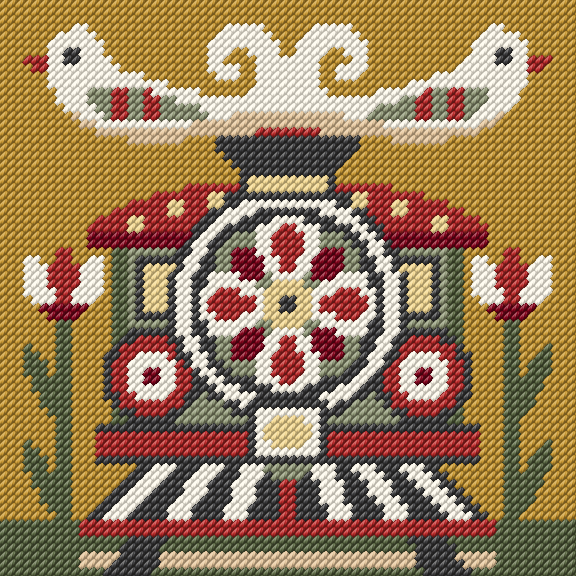
Intermediate 5,184 stitches 4 × 4 in · 9 colors · 18 mesh
Folk art steam locomotive
New to needlepoint? How to needlepoint