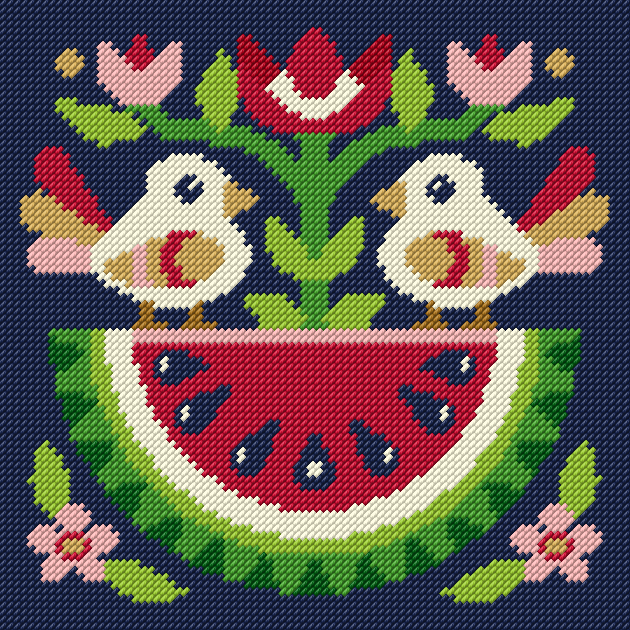
Folk art watermelon slice with birds needlepoint pattern
Intermediate, 5 × 5 in on 18 mesh, 10 colors
Download free PDFPDFYou may sell what you make from it by hand, in small quantities. The PDF itself is not to be sold or shared. Selling, classes and kits: the rules
Your PDF is ready: look in your downloads. Open the PDF (opens in a new tab)
Next: How to start · How to fit it into a lid
What you need
- Canvas: blank mono canvas, 18 mesh (18 threads to the inch), cut 9.5 in square
- Needle: blunt tapestry, size 22. Also masking tape for the cut edges, and small scissors
- Thread: six-strand floss, 10 colors, about 13 skeins in all (an estimate). Stitch with 4 strands (5 or 6 if canvas shows)
- Thread: pearl cotton size 5, 10 colors, about 11 skeins in all (an estimate). Stitch with 1 length. It comes in fewer colors than floss: for one that is not made, take the nearest, or 4 strands of floss
- Thread: Persian wool, 10 colors, about 11 skeins in all (an estimate). Stitch with 1 strand
Fit it into a lid. The box or tray, acid-free board and backing. Measure the opening first. How to fit it into a lid
Threads
- DMC 939 Very Dark Navy Blue 3,612 stitches about 24.8 yards 4 skeins
- DMC 349 Dark Coral 1,092 stitches about 7.5 yards 1 skein
- DMC 3823 Ultra Pale Yellow 870 stitches about 6 yards 1 skein
- DMC 704 Bright Chartreuse 748 stitches about 5.2 yards 1 skein
- DMC 702 Kelly Green 626 stitches about 4.3 yards 1 skein
- DMC 3716 Very Light Rose 510 stitches about 3.5 yards 1 skein
- DMC 3820 Dark Straw 302 stitches about 2.1 yards 1 skein
- DMC 699 Green 248 stitches about 1.7 yards 1 skein
- DMC 817 Very Dark Coral Red 50 stitches about 0.4 yards 1 skein
- DMC 782 Dark Topaz 42 stitches about 0.3 yards 1 skein
Skeins are estimates, with the two extra rows.
Thread colors are approximate screen matches to DMC numbers. Check against real thread before you buy.
How to stitch it
- Each square is one tent stitch, up at 1, down at 2. Lines in continental, right to left, the canvas upside down for the next row; wide areas in basketweave.
- Cut 18 in of thread. Start and end it without a knot left behind.
- Mark the middle of the canvas. It is the outlined square, column 45, row 45 (DMC 702): start there. Count threads, not holes.
- Go on from it: picture first, background last. Gray squares are on two pages: stitch them once.
- Last, two more rows all round in DMC 939: the opening’s edge hides them.
First time? How to needlepoint, how to read a chart
See the chart on this page
The chart is drawn when this is opened.
It opens in the pattern maker, with your colors and your name on it.
Options
On another mesh
The chart is 90 × 90 stitches: a tray insert on 18 mesh canvas, a square of needlepoint that is set into a tray made with an opening for it.
| Mesh | Stitched size | Canvas to cut |
|---|---|---|
| 10 | 9 × 9 in 22.9 × 22.9 cm | 13.5 × 13.5 in 34.3 cm |
| 12 | 7.5 × 7.5 in 19.1 × 19.1 cm | 12 × 12 in 30.5 cm |
| 13 | 6.9 × 6.9 in 17.6 × 17.6 cm | 11.5 × 11.5 in 29.2 cm |
| 14 | 6.4 × 6.4 in 16.3 × 16.3 cm | 11 × 11 in 27.9 cm |
| 18 | 5 × 5 in 12.7 × 12.7 cm | 9.5 × 9.5 in 24.1 cm |
Mesh is the number of canvas threads to the inch; the row in bold is the mesh this chart is sized for. Canvas to cut is the stitched size, the two extra rows where the finish takes them and 2 in (5.1 cm) of bare canvas on every side, up to the next half inch.
On 13 mesh, easier to see
- Size: the piece comes out 6.9 × 6.9 in
- Canvas: 13 mesh, cut 11.5 in square
- Needle: tapestry, size 20
- Thread: 10 colors of tapestry wool in the nearest shades, about 15 skeins in all (an estimate). Stitch with 1 length
- Or 10 colors of pearl cotton size 3, about 12 skeins in all (an estimate). Stitch with 1 length
- Or 10 colors of six-strand floss, about 19 skeins in all (an estimate). Stitch with 7 strands (8 if canvas shows)
- Wool by color, after DMC’s own table of nearest shades:
- Wool 7308 Very Dark Navy Blue (cotton 939), 5 skeins
- Wool 7666 Dark Coral (cotton 349), 2 skeins
- Wool 7746 Ultra Pale Yellow (cotton 3823), 1 skein
- Wool 7341 Bright Chartreuse (cotton 704), 1 skein
- Wool 7342 Kelly Green (cotton 702), 1 skein
- Wool 7133 Very Light Rose (cotton 3716), 1 skein
- Wool 7504 Dark Straw (cotton 3820), 1 skein
- Wool 7346 Green (cotton 699), 1 skein
- Wool 7107 Very Dark Coral Red (cotton 817), 1 skein
- Wool 7783 Dark Topaz (cotton 782), 1 skein
In another thread
The numbers are DMC color numbers. Its pearl cotton has the same numbers as its six-strand cotton, in fewer colors. Persian wool and silk are numbered differently: match those by eye. Which thread suits which mesh
On plastic canvas
On plastic canvas: 6.4 × 6.4 in on 14 mesh, 9 × 9 in on 10 and 12.9 × 12.9 in on 7, from one sheet (on 7, a large one of 13½ × 22½ in). Take worsted yarn and a size 16 needle on 7 mesh; sport yarn or 12 strands of floss and a size 18 needle on 10; 6 strands of floss and a size 22 needle on 14. Yarn is matched to the list by eye. How to stitch a chart on plastic canvas
In large print
The same chart in squares of about 6 mm, on 10 pages.
Another stitch
My stitch guide: choose a stitch for every part, with its strands for your mesh.
How the level is set
Intermediate. The color changes often enough that you count as you go.
Intermediate: 10 colors. Changes of color are about 4.50 stitches apart, leaving out the background around the picture. With 10 colors or more, 4.5 or more apart is Intermediate, closer is Advanced, and a design with this many colors is never Beginner.
How the thread is counted
The yards are of thread as it is threaded in the needle: stitched with several strands together, a thread takes that many yards of single strand for every yard counted. For six-strand cotton on 18 mesh, the thread and needle chart gives 4 to 6 strands.
An estimate. The length of thread one stitch uses on the front and back of the canvas, times the number of stitches, plus 30 percent for starting, ending and the tail left in the needle. Each count is estimated as basketweave or continental and rounded up to a tenth of a yard. The 30 percent is this site's own choice. The thread calculator works the same estimate for any count and mesh.
What you may do with it
You may sell what you make from it by hand, in small quantities. The PDF itself is not to be sold or shared. Selling, classes and kits: the rules
More patterns like this
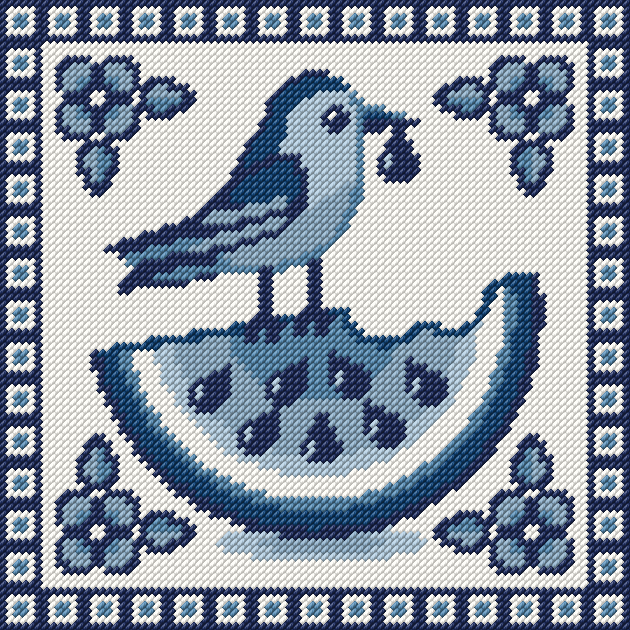
Blue and white watermelon slice
Intermediate 5 × 5 in
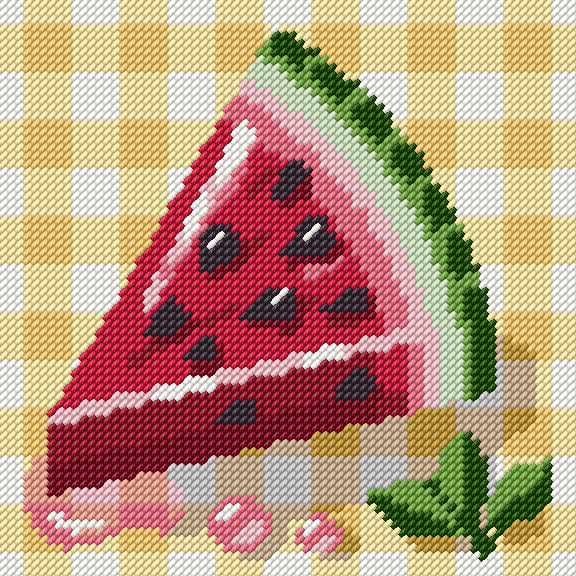
Glossy watermelon slice on gingham
Advanced 4 × 4 in
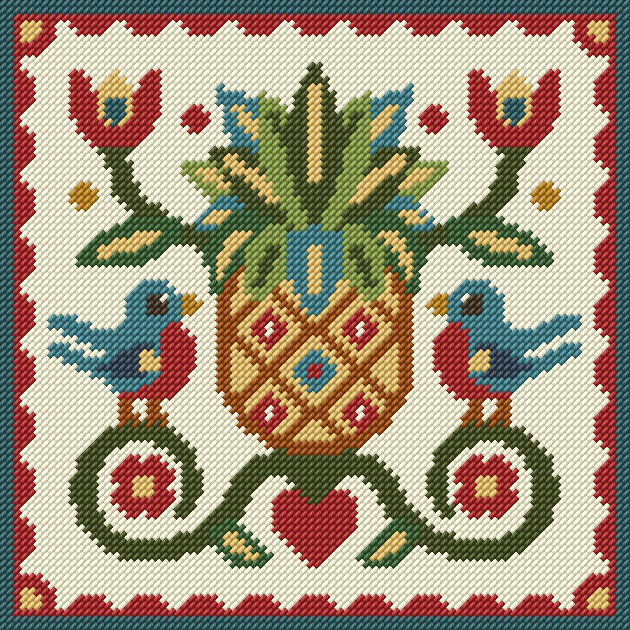
Folk art pineapple
Advanced 5 × 5 in
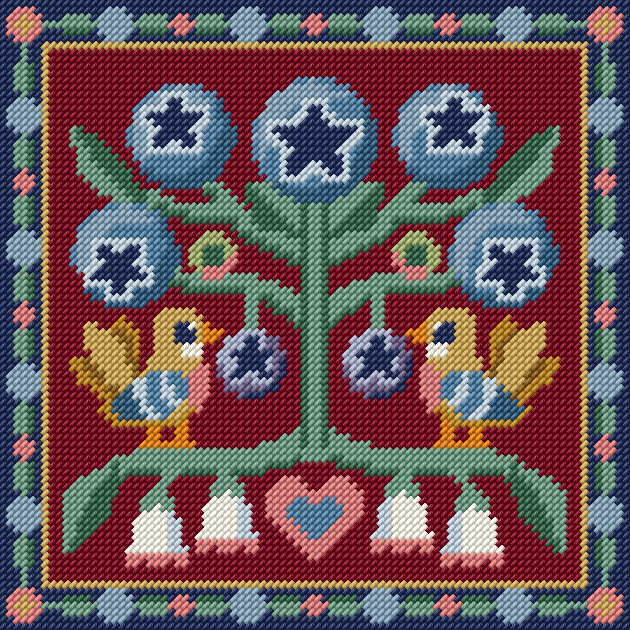
Blueberry tree with two gold birds
Advanced 5 × 5 in
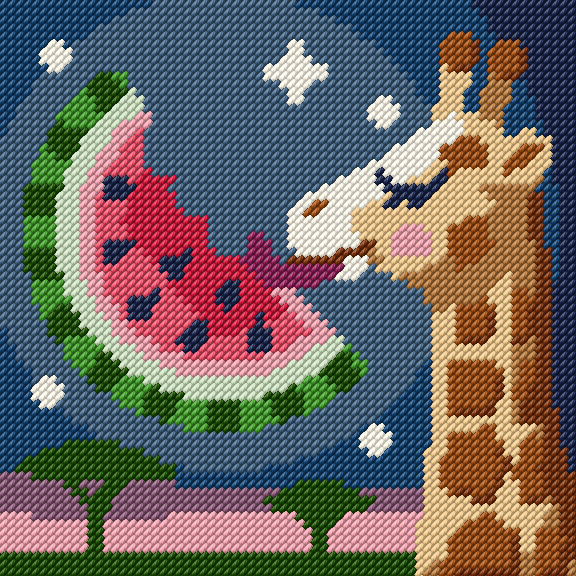
Whimsical watermelon slice moon
Intermediate 4 × 4 in
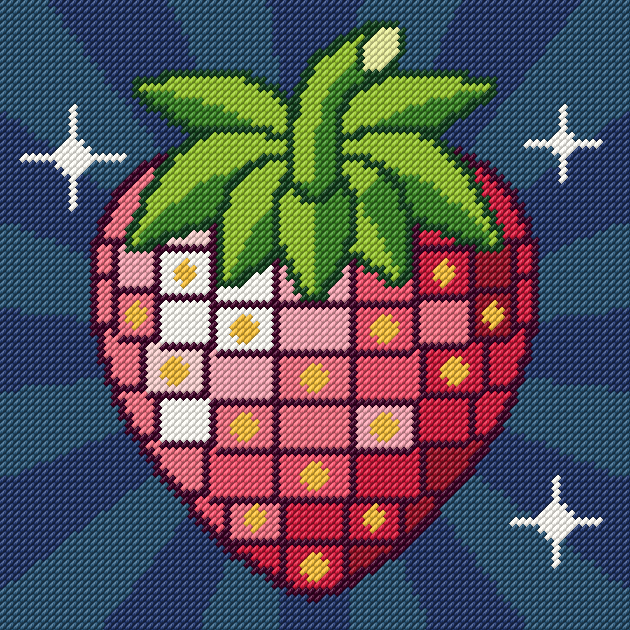
Modern disco strawberry
Intermediate 5 × 5 in
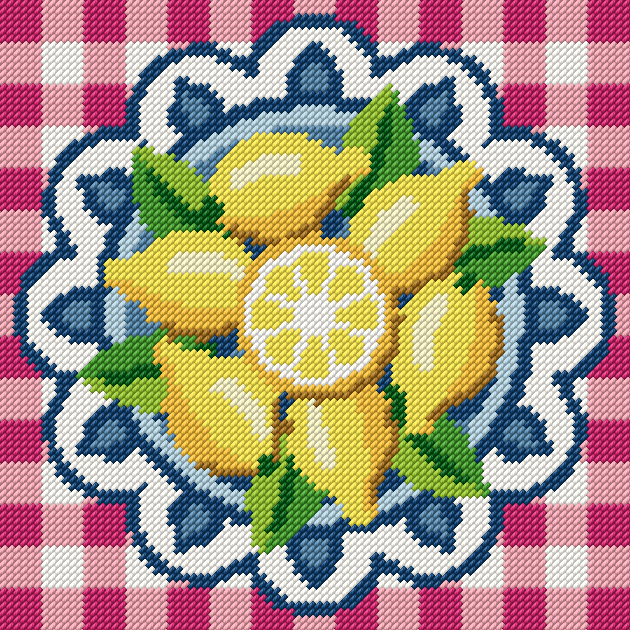
Preppy bowl of lemons
Advanced 5 × 5 in
Grapefruit slice ornament
Advanced 4 × 4 in
About this pattern
Two cream birds with gold wings face each other on a big half watermelon, with a tulip tree growing up between them. The ground is midnight navy with a pink flower in each lower corner.