Preppy penguin belt needlepoint pattern
Intermediate, 1.2 in tall on 18 mesh, 8 colors

The picture shows one end of the chart.
Download free PDFPDFYou may sell what you make from it by hand, in small quantities. The PDF itself is not to be sold or shared. Selling, classes and kits: the rules
Your PDF is ready: look in your downloads. Open the PDF (opens in a new tab)
Next: How to start · How to make a belt
What you need
- Canvas: blank mono canvas, 18 mesh (18 threads to the inch), cut 36 × 5.5 in for a size 36 belt
- Stitch 30 to 32 in of its length (540 to 576 stitches): 6 repeats of 90 and plain ground at both ends
- Needle: blunt tapestry, size 22. Also masking tape for the cut edges, and small scissors
- Thread: six-strand floss, 8 colors, about 16 skeins for a size 36 belt (an estimate). Stitch with 4 strands (5 or 6 if canvas shows)
- Thread: pearl cotton size 5, 8 colors, about 9 skeins for a size 36 belt (an estimate). Stitch with 1 length. It comes in fewer colors than floss: for one that is not made, take the nearest, or 4 strands of floss
- Thread: Persian wool, 8 colors, about 10 skeins for a size 36 belt (an estimate). Stitch with 1 strand
Make it a belt. A finisher who mounts it on leather, or a buckle and leather tabs. How to make a belt, How to finish a belt
Make it yours
Put initials or a name on it
What you type stays on this page.
Threads
- DMC 603 Cranberry 1,440 stitches about 9.9 yards 4 skeins
- DMC 702 Kelly Green 672 stitches about 4.6 yards 3 skeins
- DMC BLANC White 648 stitches about 4.5 yards 3 skeins
- DMC 823 Dark Navy Blue 526 stitches about 3.6 yards 2 skeins
- DMC 3325 Light Baby Blue 374 stitches about 2.6 yards 1 skein
- DMC 742 Light Tangerine 116 stitches about 0.8 yards 1 skein
- DMC 322 Dark Baby Blue 106 stitches about 0.8 yards 1 skein
- DMC 699 Green 78 stitches about 0.6 yards 1 skein
Skeins are estimates for a size 36 belt, with the two extra rows.
Thread colors are approximate screen matches to DMC numbers. Check against real thread before you buy.
How to stitch it
- Each square is one tent stitch, up at 1, down at 2. Lines in continental, right to left, the canvas upside down for the next row; wide areas in basketweave.
- Cut 18 in of thread. Start and end it without a knot left behind.
- Mark the middle of the canvas. It is the outlined square, column 90, row 11 (DMC 603), for a size 36 belt: start there. Count threads, not holes.
- Go on from it: picture first, background last. One repeat is 5 in: carry on both ways to your length.
- Last, two more rows along each long edge, each stitch in the color it lies beside: they are folded under. Ask your finisher first.
First time? How to needlepoint, how to read a chart
See the chart on this page
The chart is drawn when this is opened.
It opens in the pattern maker, with your colors.
Options
On another mesh
The chart is 180 × 22 stitches: 10 in of the belt's length on 18 mesh, not the whole belt. The chart shows 2 repeats; one repeat is 90 × 22 stitches. A belt is stitched 4 to 6 in less than belt size, because leather at each end carries the buckle and the holes. The belt calculator gives the length to stitch for yours.
| Mesh | Length of this chart | Canvas to cut |
|---|---|---|
| 13 | 13.8 × 1.7 in 35.2 × 4.3 cm | 36 × 6 in 91.4 × 15.2 cm |
| 14 | 12.9 × 1.6 in 32.7 × 4 cm | 36 × 6 in 91.4 × 15.2 cm |
| 18 | 10 × 1.2 in 25.4 × 3.1 cm | 36 × 5.5 in 91.4 × 14 cm |
Mesh is the number of canvas threads to the inch; the row in bold is the mesh this chart is sized for. Canvas to cut is the stitched size, the two extra rows where the finish takes them and 2 in (5.1 cm) of bare canvas on every side, up to the next half inch. A size 36 belt is stitched 32 in at the most: for another size, as many inches more or less. On 13 and 14 mesh it is wider than the usual belt of 1¼ in: ask your finisher first.
In another thread
The numbers are DMC color numbers. Its pearl cotton has the same numbers as its six-strand cotton, in fewer colors. Persian wool and silk are numbered differently: match those by eye. Which thread suits which mesh
In large print
The same chart in squares of about 6 mm, on 6 pages.
A name by hand
This pattern fills the belt, so give the letters a plain block: one color, as tall as the belt, with a line of one stitch down each end, and work the pattern out from it both ways. Letters 10 stitches high leave 6 rows above and below them; three initials are about 27 stitches, up to 34 in letters as wide as M and W, and a name of six letters about 55. The block is then 33 stitches (1.8 in) or 61 (3.4 in), and as much longer as wide letters are. To the right of it the pattern begins with the first stitch of a repeat, and to the left it ends with the last. Of this chart's threads, Dark Navy Blue (DMC 823) shows best on Cranberry (DMC 603). Three alphabets to copy are in the lettering guide. Which side the initials go on is in the belt guide.
How the level is set
Intermediate. The color changes often enough that you count as you go.
Intermediate: 8 colors. With 8 or 9 colors, a design is Intermediate, while 7 or fewer can be Beginner and 10 or more can be Advanced.
How the thread is counted
The yards are of thread as it is threaded in the needle: stitched with several strands together, a thread takes that many yards of single strand for every yard counted. For six-strand cotton on 18 mesh, the thread and needle chart gives 4 to 6 strands.
An estimate. The length of thread one stitch uses on the front and back of the canvas, times the number of stitches, plus 30 percent for starting, ending and the tail left in the needle. Each count is estimated as basketweave or continental and rounded up to a tenth of a yard. The 30 percent is this site's own choice. The thread calculator works the same estimate for any count and mesh.
What you may do with it
You may sell what you make from it by hand, in small quantities. The PDF itself is not to be sold or shared. Selling, classes and kits: the rules
More patterns like this
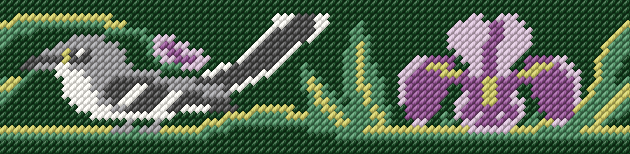
Tennessee belt, mockingbird and iris
Intermediate 1.2 in tall
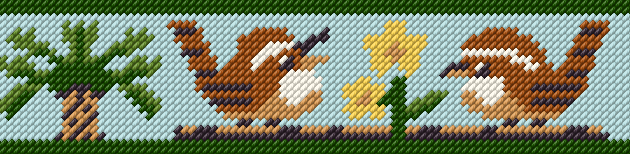
South Carolina belt, palmetto and wren
Intermediate 1.2 in tall
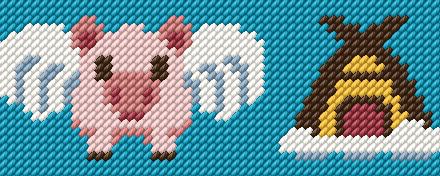
Preppy three little flying pigs belt
Intermediate 1.2 in tall
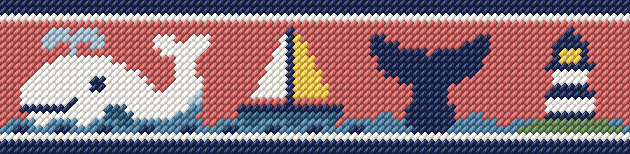
Nantucket red belt with whales
Intermediate 1.2 in tall
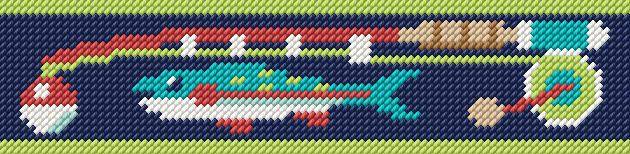
Preppy rod and reel belt
Intermediate 1.2 in tall
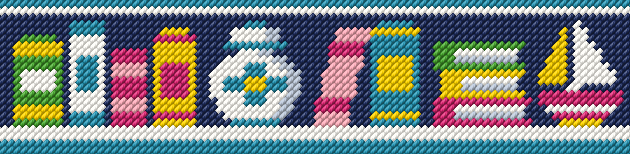
Preppy bookshelf belt with books
Intermediate 1.2 in tall
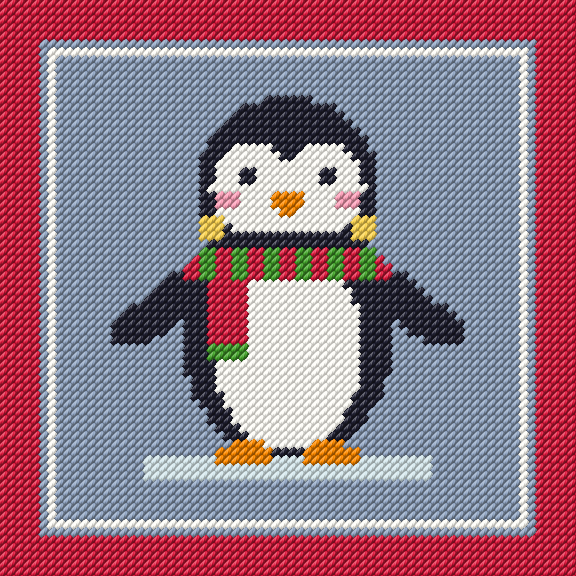
Whimsical penguin
Intermediate 4 × 4 in
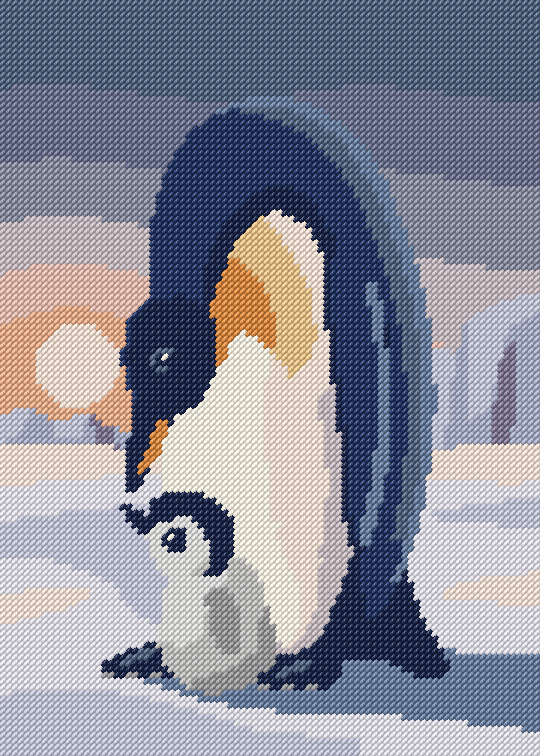
Classic penguin with chick
Intermediate 5 × 7 in
About this pattern
A penguin in a green scarf faces front, another slides on its belly with its scarf flying, and a third waddles in a striped pompom hat. The ground is candy pink over pale blue ice, between green and white striped edges.