A free crochet course to follow at home
Twelve lessons, and each one is a thing you finish. Begin at lesson 1 with a hook and one ball of yarn. Every lesson adds one or two new moves to what you know, links to the pages that show them, and says when to go on.
On this page
- The twelve lessons
- Before lesson 1
- What each lesson takes
- Lesson 1: a practice square
- Lesson 2: a dishcloth
- Lesson 3: a scarf
- Lesson 4: a striped cloth
- Lesson 5: a kerchief
- Lesson 6: a round coaster
- Lesson 7: a granny square
- Lesson 8: a hat
- Lesson 9: an ear warmer
- Lesson 10: a teddy bear
- Lesson 11: a flower
- Lesson 12: a blanket
- What you can do: a sheet to tick
- For a child, the left hand, or one hand
- If you would rather have a class
- If it goes wrong
- Questions people ask
The twelve lessons
Stitch names are United States terms, with the United Kingdom name in brackets.
| Lesson | Make | New in it |
|---|---|---|
| 1 | A practice square | Slip knot, chain, single crochet (UK double crochet), turning, counting |
| 2 | A dishcloth | Straight edges, slip stitch, weaving in ends |
| 3 | A scarf | Half double crochet (UK half treble), a new ball |
| 4 | A striped cloth | Double crochet (UK treble), a new color |
| 5 | A kerchief | Increases at the edges |
| 6 | A round coaster | The ring, rounds, a marker |
| 7 | A granny square | Chain spaces, corners, joined rounds |
| 8 | A hat | Measuring, gauge |
| 9 | An ear warmer | A stitch pattern, reading rows, a seam |
| 10 | A teddy bear | Decreases, stuffing, sewing on |
| 11 | A flower | A chart of symbols |
| 12 | A blanket | Choosing size, yarn and stitch, a border |
Before lesson 1
You need one hook, one ball of smooth, light-colored yarn of medium weight (number 4 on the label), scissors and a yarn needle. Take the hook that the label names. What you need to start crocheting has the whole list, and holding the hook and yarn has the two usual grips.
What each lesson takes
You need not buy it all at once. One 5.5 mm (I-9) hook does eight of the lessons: 1 to 4, 6, 7, 9 and 12. Each piece also takes the scissors and the yarn needle, and from lesson 2 on a tape measure. Other sizes are on the lesson's own page or pattern. The amounts are estimates.
| Lesson | Yarn | Hook | Also | Do first |
|---|---|---|---|---|
| 1. Square | Medium (4), part of a ball | 5.5 mm (I-9), or the label's | ||
| 2. Dishcloth | Medium cotton, about 75 yd (69 m) with the loop and edge | 5.5 mm (I-9) | Lesson 1 | |
| 3. Scarf | Medium, about 450 yd (411 m) for the whole scarf | 5.5 mm (I-9) | Lesson 1 | |
| 4. Striped cloth | Medium cotton in two colors. The one-color cloth of lesson 2 is about 65 yd (59 m), without loop and edge | 5.5 mm (I-9) | Lesson 2 | |
| 5. Kerchief | Light (3) cotton, 65 yd (59 m) for a child, 95 yd (87 m) for an adult | 4 mm (G-6) | Lessons 1 and 2 | |
| 6. Coaster | Medium cotton, about 15 yd (14 m) | 5.5 mm (I-9) | A stitch marker | Lessons 1 and 2 |
| 7. Granny square | Medium, a light color, about 15 yd (14 m) for three rounds | 5.5 mm (I-9) | Pins | Lessons 2 and 4 |
| 8. Hat | Bulky (5), about 140 yd (128 m) for a woman | 6.5 mm (K-10 1/2) | A soft tape measure | Lessons 2, 3, 6 and 7 |
| 9. Ear warmer | Medium, about 55 yd (50 m) for a woman | 5.5 mm (I-9) | Lessons 1, 2 and 7 | |
| 10. Bear | Medium, about 125 yd (114 m) brown and 15 yd (14 m) cream, a little black and rose | 3.5 mm (E-4) | Toy stuffing, two 10 mm eyes with washers, a marker, pins | Lesson 6 |
| 11. Flower | Medium in two colors, 2 yd (2 m) and 4 yd (4 m) | 5 mm (H-8) | Lessons 2, 4, 6 and 7 | |
| 12. Blanket | Medium, about 1,350 yd (1,234 m) for a baby blanket | 5.5 mm (I-9) | Lesson 3 |
The last column is for a person who wants to skip. "Lesson 2" there means the slip stitch too, and "Lesson 7" the chain space and the joined round.
Where a lesson says watch, the page it links to has a drawing that moves when you press Play. You can step through it as slowly as you like: crochet stitches that move.
Lesson 1: a practice square
Read first: slip knot, which puts the first loop on the hook. Everything starts from it.
Watch: chain stitch, single crochet, turning chain.
Make: the square in how to crochet. It starts with 16 chains and has 15 rows of 15 stitches. The page goes from the first loop to the cut end.
Go on when you have worked five rows running of 15 stitches each. If the square is a wedge, make it again. That is what it is for.
Lesson 2: a dishcloth
Watch: slip stitch. Read: straight edges, weaving in ends.
Make: the dishcloth, 27 chains and rows of 26 single crochet until it is square. Add the loop, which is where you use the slip stitch. The edge is up to you.
Go on when both side edges are straight and every row has 26.
Lesson 3: a scarf
Watch: half double crochet. Read: joining new yarn.
Make: the plain scarf in how to crochet a scarf. Go straight to the part "A first scarf, written out" and take the column headed plain: 22 chains and rows of 20. It is one row over and over. A shorter strip teaches the same thing. Stop when you have joined a second ball.
Go on when you can work a row without looking up each move, and the join holds when you tug it, once its ends are woven in.
Lesson 4: a striped cloth
Watch: double crochet, changing colors.
Make: the dishcloth again, in double crochet and two colors. Its table gives the chain, 28, and about 14 rows: see "The same cloth in another stitch" on the dishcloth page. Change color after every second row.
The new thing to mind: the 3 chains at the start of a row count as its first stitch. They stand on the first stitch of the row below, so leave that one alone and work into the second. At the far end, the last stitch goes into the top chain of the 3. Turning chain says which chains count.
Go on when you still have 26, and the new color starts on the last pull of the row before.
Lesson 5: a kerchief
Watch: increases.
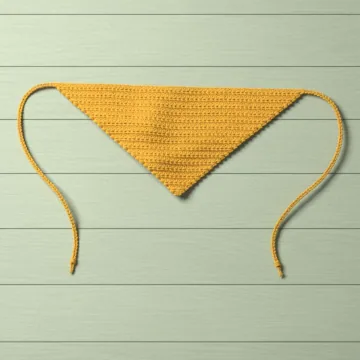
Make: the simple solid kerchief. It begins with 3 stitches at the point, and every row after the first grows by 2, one at each edge. A child's size ends with 61 stitches and an adult's with 77. Two chains make the ties. It is worked in thinner yarn with a 4 mm (G-6) hook.
Go on when both edges slope alike. It is your first pattern here without a lesson page of its own. If a short form stops you, look it up in the abbreviations.
Lesson 6: a round coaster
Watch: magic ring, and increases again. Read: using stitch markers.
Make: the round coaster: 6 stitches in the ring, then 6 more in each round, 7 rounds in all. The counts are 6, 12, 18, 24, 30, 36, 42.
Go on when it lies flat. A ruffle has too many stitches and a bowl has too few.
Lesson 7: a granny square
Watch: joining rounds. Read: chain space.
Make: a granny square. The stitches go into spaces now, not into the tops of stitches. Three rounds teach the corner. Each later round has the same corners and one more group on each side.
Go on when you can work a round and find all four corners without the page.
Lesson 8: a hat
Read: gauge, counting stitches and rows.
Make: a simple hat, in six sizes. It has half double crochet from lesson 3, a ring and rounds that grow from lesson 6, and the join of lesson 7 at the end of every round. It is the first thing here that has to fit. Measure the head, and measure the crown where the page tells you to.
Go on when the crown came out at the size on the page. If it did not, you know to change the hook and begin again.
Lesson 9: an ear warmer
Read: how to read a crochet pattern, then moss stitch. Its stitches go into the chain spaces of lesson 7.
Make: a headband as a strip in short rows. The stitches are old and the order is new: one stitch, one chain, skip one. Brackets and repeats do the talking. A seam closes it.
Go on when you can read a line with brackets in it and say how many stitches it makes.
Lesson 10: a teddy bear
Watch: decreases.
Make: the one-piece bear. You know its rounds from the coaster. Its rounds are not joined. New are the decrease, which makes two stitches into one, the stuffing, and eight small parts to pin and sew.
Go on when no stuffing shows between the stitches and the ears are level.
Lesson 11: a flower
Watch: magic ring and double crochet once more. Read: reading charts.
Make: the five-petal flower, two rounds. The slip stitch is from lesson 2, the ring from lesson 6 and the join at the end of a round from lesson 7. Work the first flower from the words. Then make a second one and look only at its chart.
Go on when you made a petal from the chart alone.
Lesson 12: a blanket
Read: stitch multiples, crochet stitches for blankets.
Make: a blanket. The page has a plain one in three sizes with every number, and it shows how to work out your own. For one that waves, take the ripple. For one in pieces, make more squares from lesson 7 and join them.
You are done when the border lies flat. After this, choose from the easy patterns. Each is marked beginner, the first level, or easy, the next.
What you can do: a sheet to tick
Print this page from your browser's menu, or copy the list into a notebook.
| I can | Lesson | Tick |
|---|---|---|
| make a chain in which every loop is the same size | 1 | |
| work rows with the same count from end to end | 2 | |
| join a new ball and hide both ends | 3 | |
| tell three stitches apart by their height | 4 | |
| make a piece wider where I want it wider | 5 | |
| start a circle and keep it flat | 6 | |
| work into spaces and turn a corner | 7 | |
| measure my gauge and change the hook | 8 | |
| read a row with brackets and repeats | 9 | |
| make a piece narrower, stuff it and sew it | 10 | |
| follow a chart of symbols | 11 | |
| plan a piece from its size | 12 |
For a child, the left hand, or one hand
A child. Take a large hook and thick yarn, and begin with chains: a length of chain is already a necklace. Then do lessons 1, 2 and 6, smaller. How to teach someone to crochet has a part on children.
The left hand. Every lesson works as it is. Hold the hook in the left hand, go from left to right, and read a picture as its mirror image. The moving drawings have a button, Left-handed, that turns them round for you. Start with left-handed crochet.
One hand. A clamp on the table holds the hook, and your hand does the rest. Crocheting with one hand has the set-up. Learn the chain and single crochet there, then make lessons 1 to 3 here.
Hands that get sore. Crocheting with sore or shaky hands has grips, hooks and places to rest.
By touch. Crocheting by touch starts without pictures.
If you would rather have a class
A person beside you sees your hands, and no page can do that. These are the kinds of place that teach.
| Place | What it is usually like | Ask first |
|---|---|---|
| A library | A club where each person brings a piece, or a one-time program with yarn and hooks given out | Does somebody teach, or do people only sit together? |
| A yarn store | Classes, and drop-in hours with help on your own piece | Must the yarn be bought there? |
| An adult or community school | A first class, or a class that makes one thing, such as a bag | What is on the list to bring? |
| A craft or folk school | Days away with a teacher, where beginners often make a granny square | Are materials in the fee? |
| A guild or a group | Meetings, with workshops now and then | Is crochet taught, or mostly knitting? |
| A school, a club or a camp for children | Crochet as one craft among several | How many children to one teacher? |
| One teacher, one learner | Lessons on what you are stuck on | Which hand does the teacher use? |
How to find one. Search "crochet class" and "learn to crochet" with the name of your town, look at the library's calendar, and ask at the yarn store's counter. Crochet groups has more ways.
A first class should begin as lesson 1 does, with the chain and one stitch. Bring back a piece that went wrong: it is the thing a teacher can help with. For a class that ends with a paper, read crochet certificates. This course gives none.
If you teach the class, the twelve lessons can be your plan, and the stitch cheat sheet prints as a handout.
If it goes wrong
| What happens | What to do |
|---|---|
| A lesson will not come | Go back one lesson and make its piece again in another color |
| You can do the stitch but cannot read the pattern | Stay on lessons whose rows are short and nearly alike: 2, 3 and 6 |
| Every piece comes out narrower | Read straight edges, then count each row of the next one |
| You stopped halfway through the course | Make lesson 1 again as a warm-up and go on where you were |
| You want to skip | See the last column of "What each lesson takes". For lesson 9 you may read chain space in place of making lesson 7 |
Questions people ask
Is the course free? Yes. Every lesson is a page of this site, and nothing is bought or signed up for.
Can I learn to crochet online? Yes. People learn from pictures, from words, from video and from a person. Here the pictures come one move at a time, and you can go back as often as you like.
What does a crochet class cost? Each place sets its own fee, so no figure here would be right for yours. A library table usually asks nothing. Before you compare two classes, ask how many meetings the fee is for, whether yarn and a hook are in it, and what happens if you miss one.
Is there a certificate or a diploma? Not from this course. Crochet certificates and standards says who gives them.
What comes after a beginner course? Texture, lace and color. Try bobble stitch, shell stitch and tapestry crochet, each on a small square, then a sweater or a shawl.
Can I do it on paper? Print each page from the browser. The moving drawings print as still ones.