Stitches · Intermediate
Double running stitch and blackwork
Blackwork is counted embroidery in straight stitches: outlines filled with small geometric patterns that repeat (the fills), most often in one dark thread and not always black. Its stitch is the double running stitch, also called Holbein stitch. You work a running stitch one way along the line and fill its gaps on the way back, and the line is the same on both faces of the cloth. Learn the line first, steps 1 to 5; the corner, the branch and the fills are made of it.
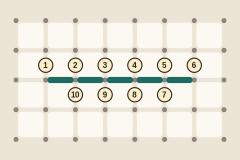
How to work it
Work the journey out
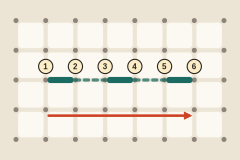
Thread one strand. Start with a waste knot: a knot left on the front a little way off, and cut away later. Then make a running stitch along the line: over one block and behind the next, every stitch and every gap the same length. Up at 1, down at 2, up at 3, down at 4, up at 5, down at 6. On evenweave, which has no blocks, each stitch covers two threads.
Turn at the end
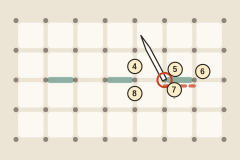
Do not turn the cloth. From 6, pass behind the last stitch and come up in the hole where that stitch began (7). It is the same hole as 5.
Fill the gaps on the way back
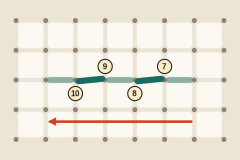
From 7 go over the gap and down at its other end (8, the same hole as 4). Pass behind the next stitch, come up at 9 and go down at 10. The old stitch and the new one share a hole: come up in it just above the thread that is there, and go down just below. Do it the same way every time, and the line lies straight and does not step up and down.
Close the line and fasten off
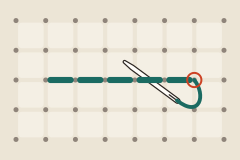
From 10, pass the needle behind the first stitch, to the hole where the line began, so that the back has no gap there. Do not come up. Run the needle under a few of the stitches on the back and cut the thread. Cut off the waste knot, and run its thread under the stitches in the same way.
Look at the back
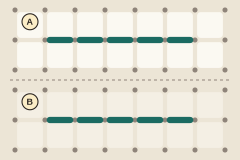
Turn the cloth over. The line on the back is as solid as the line on the front.
Take a corner
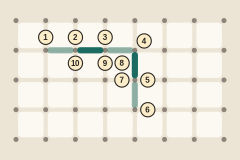
The numbers begin again here and in the next step, on new lines. Go round a corner as if the line were straight, one block at a time: up at 1, down at 2, up at 3, down at the corner (4), behind the first block of the turn, up at 5, down at 6. The way back goes up at 7 and down at 8, and from 9 to 10. A gap may fall just before the corner or just after it, as here; the journey back fills it. On an upright stitch, come up on one side of the thread and go down on the other.
Stitch a branch on the way past
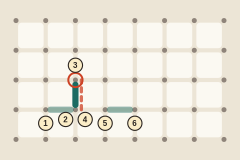
A branch is a short side line. Finish it when you reach it. From the hole where it leaves the line (2), pass behind to its tip and come up (3). Go down where it joins the line (4, the same hole as 2). It is now made on both faces. Go on along the line (5 to 6). For a branch two stitches long: from 2, pass behind its first block and come up, go down at its tip, pass behind to come up where you last came up, and go down where it joins the line.
Practice a fill of battlements
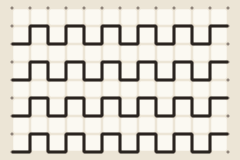
The line goes along one block, up one, along one, down one, and so on. Work the row out and back: on the way out every stitch along is on the front and every stitch up or down is behind; on the way back the thread fills the ones up and down. Begin the next row two blocks below.
Practice a fill of diamonds
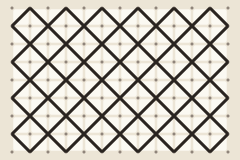
Each stitch slants across one block, from corner to corner, one up and the next down, in a zigzag. Work it out and back: every other slant on the way out, the rest on the way back. The next row is one block below and starts with the slant the other way, so that the two rows meet point to point and make diamonds.
Make it darker or lighter
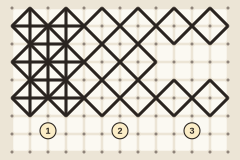
Add stitches for shadow and leave stitches out for light. Here the same diamonds have a cross of straight stitches inside (1), then are plain (2), then lose every second row of diamonds (3).
At a glance
- Also called
- Holbein stitch, line stitch, two-sided line stitch, blackwork embroidery
- Used for
- blackwork outlines and fills; outlines round cross stitch; bookmarks, cuffs and other work seen from both sides
- Cloth
- Aida of 14, 16 or 18 count over one block, or evenweave or linen of 28 or 32 count over two threads. Begin on 14 count Aida. (The count is how many blocks or threads lie in an inch, 2.5 cm.)
- Strands
- One for the fills. One or two for the outlines, which are often the heavier.
- Needle
- A blunt tapestry needle, the same as for cross stitch. It finds the holes and does not pierce the threads.
- Against backstitch, the front
- Much the same. Double running lies flatter and a little smoother.
- Against backstitch, the back
- Double running: one fine line, the same as the front. Backstitch: a thicker line, with slanting threads behind the corners that can show through.
- Against backstitch, the path
- Double running has to find its way back, so plan it. Backstitch can stop anywhere.
Blackwork need not be black. The name comes from black silk on white linen, as it was worn on collars and cuffs in Tudor England, and Holbein stitch is named for a painter of that court whose portraits show it. The same patterns are stitched today in any color, with a touch of metallic thread now and then. What makes it blackwork is the counting and the line.
A blackwork chart is read differently from a cross stitch chart. The stitches are the lines, not the squares. Each line runs along an edge of the grid, or across a square from corner to corner, and one edge of one square is one stitch: one block of Aida, or two threads of evenweave.
Work the outline first. It gives the fill an edge to stop at, so there is no need to count how many repeats fit. Then start the fill across the widest part of the shape, and where a repeat meets the outline, stitch as much of it as there is room for.
Plan the journey before you begin. Look along the line for the way out and the way back, and note every branch to be stitched as you pass it. The journey back only works if the journey out left a path, and that is the one hard thing about the stitch. Marking each journey on a printed chart helps.
Begin without a knot that stays. Start with a waste knot or leave a tail, and weave the thread under the stitches when the line is made. End by running the needle under a few stitches of an outline on the back. Travel from place to place under stitches that are already there, never across bare cloth, where a dark thread shows.
In a cross stitch piece the same stitch does the work of backstitch. It is handy where a line of backstitch would stop far from the next one, since the journey back ends where the line began. Running stitch by itself, if a chart asks for it, is the journey out with no return: a line of dashes.
Blackwork and cross stitch share their cloth, thread and needle, so they mix well. Cross stitch makes the solid parts and the darkest tones, and blackwork fills the rest. A blackwork chart cannot simply be stitched in crosses, though: its lines lie between the squares, and the pattern would have to be charted again.
Tips
- Keep the tension light. Straight stitches pulled tight open the holes of the cloth.
- Shade with the thread as well as the pattern: the same fill in two strands is darker than in one.
- Turn the work over after the first few repeats. A long slanting thread on the back is the first sign that a journey went astray.
When it goes wrong
- The line wobbles
- The journey back came up above the thread in one hole and below it in another. Come up above and go down below each time, or the other way about, but always the same.
- You reach the end and stitches are missing behind you
- A branch was passed by. Stitch it now, out and back from the nearest point, running under stitches on the back to reach it.
- The path is lost in the middle of a fill
- Go back to the last stitch that matches the chart and begin again from there. With the outline done first there is always an edge to count from.
- The back does not match the front
- Somewhere the thread took a short cut. Some fills cannot be the same on both faces, those made of separate crosses or boxes, for instance. That matters only if both sides will be seen.
- Dark threads show through from the back
- They were carried across bare cloth. Take them out and travel under stitches, or fasten off and start again.
Variations
- Holbein stitch in hand embroidery. The same two journeys on plain or evenweave fabric.
- Running stitch. The first journey alone, as a line of its own.
- Blackwork in backstitch. The same patterns may be worked in backstitch, which needs no planned way back. The back is not the same as the front.
- On cloth with no grid. Waste canvas basted over plain cloth gives counted stitches a grid, and is pulled out afterward.
Questions
- What is blackwork in cross stitch?
- Counted patterns made of straight stitches along the threads of the cloth, not crosses. They outline a shape and fill it with a small repeating pattern, most often in one color.
- Is double running stitch the same as Holbein stitch?
- Yes. Both names mean a running stitch worked out and then back to fill its own gaps.
- What is the difference between backstitch and double running stitch?
- On the front, little. On the back, double running leaves the same single line as on the front, and backstitch leaves a thicker one. Backstitch is made in one pass and double running in two.
- How many strands do I use for blackwork?
- One for fills on most cloths. Outlines are often worked in two. The fewer strands, the finer and lighter the pattern.
- Can I do blackwork on Aida?
- Yes. Each stitch goes along the edge of one block, from hole to hole. 14 count is a good cloth to learn on.
- Does blackwork have to be black?
- No. It is named for black thread, but any thread that stands out from the cloth will do.