Baby boy with a teddy and blocks hand embroidery pattern
Advanced · 22 colors · 10 kinds of stitch
Download free PDFPDF, US Letter · 92 KBFor your own stitching, gifts and handmade pieces you sell. Do not resell or share this PDF or copies of it. Selling, classes and kits: the rules
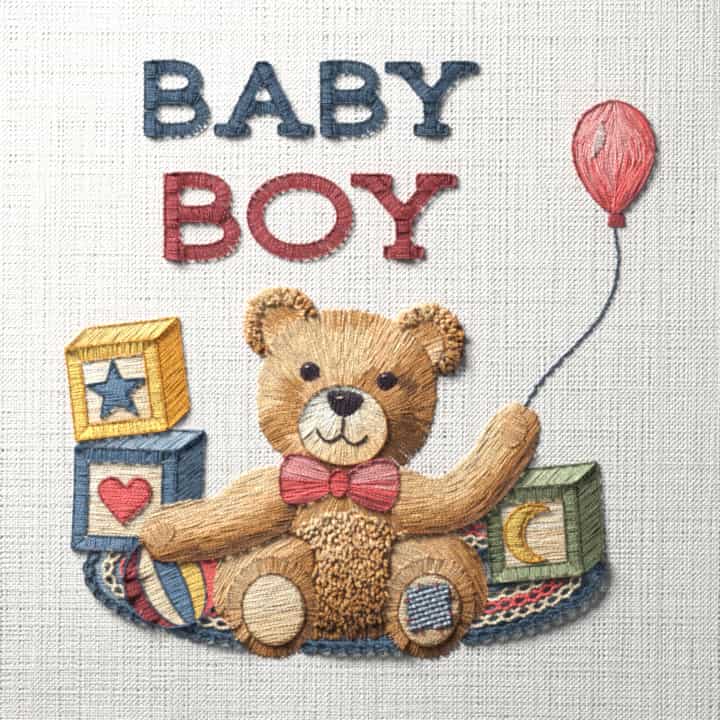
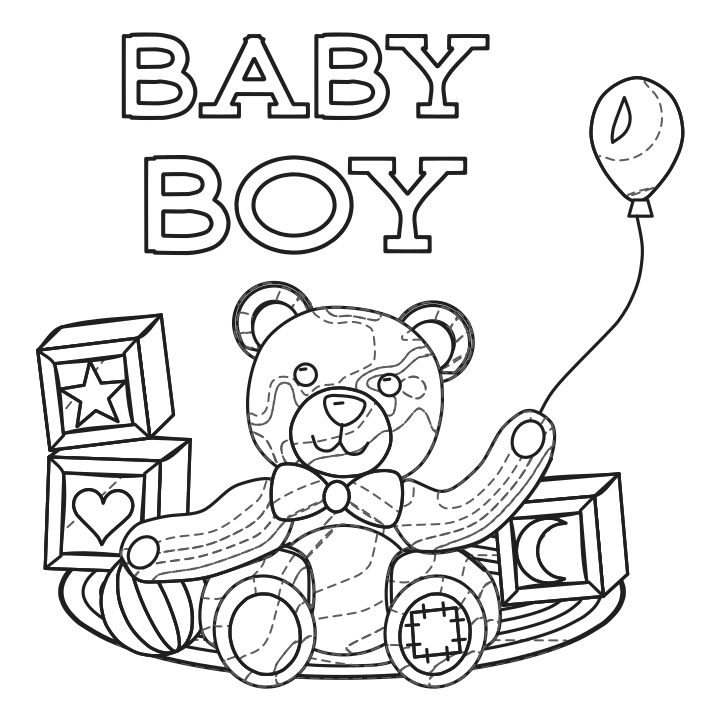
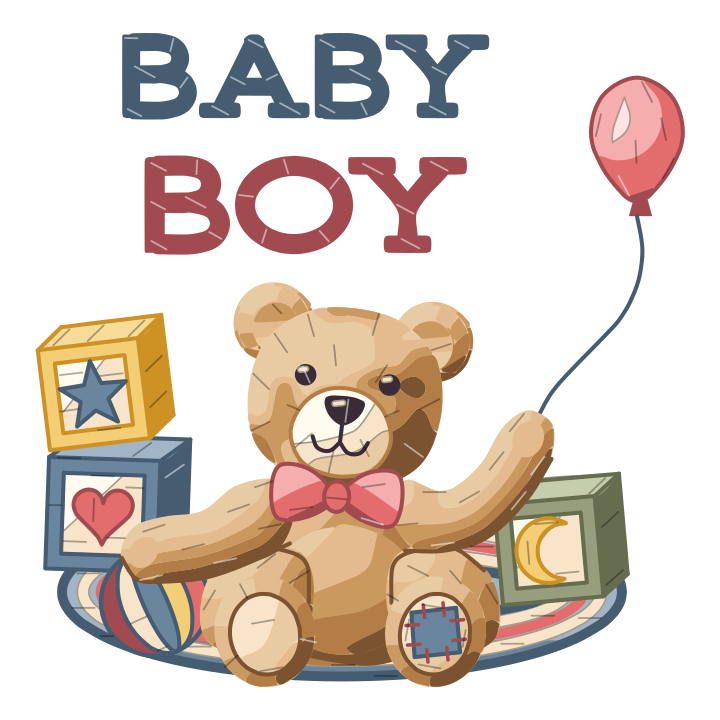
The words “Baby boy” with a teddy with a patched foot on a rag rug, with blank blocks, a ball and a balloon. The words are worked in satin stitch, in capitals with square serifs. A honey colored teddy sits on an oval rag rug with one paw on a striped ball and a red balloon in the other. Three toy blocks beside him show a star, a heart and a moon. The fur is short long and short stitch, the tummy and ears are turkey work, the blocks are satin stitch with padded satin shapes, and the rug has rows of chain stitch. In the picture of where the colors go, the fine lines show which way the stitches lie.
Size and details
Advanced. Uses long and short stitch over much of the design, padded satin stitch, turkey work, 22 colors and a great deal of stitching; from a 5 inch hoop up the widest satin stitches are long.
22 colors of floss and 10 kinds of stitch:
- Long and short stitch
- Chain stitch
- Satin stitch
- Split stitch
- Padded satin stitch
- Stem stitch
- Turkey work
- Woven filling stitch
- Straight stitch
- Back stitch
- Which stitch goes where
| Hoop | Inches | Centimeters | Satin stitch up to |
|---|---|---|---|
| 3 in (8 cm) | 1.6 × 1.6 in | 4.1 × 4.1 cm | 3/16 in (5 mm) |
| 4 in (10 cm) | 2.4 × 2.4 in | 6.1 × 6.1 cm | 1/4 in (6 mm) |
| 5 in (13 cm) | 3.2 × 3.2 in | 8.1 × 8.1 cm | 3/8 in (10 mm) |
| 6 in (15 cm) | 4 × 4 in | 10.2 × 10.2 cm | 7/16 in (11 mm) |
| 8 in (20 cm) | 5.7 × 5.7 in | 14.5 × 14.5 cm | 5/8 in (16 mm) |
- In an 8 inch hoop the widest satin stitch shape is 5/8 in (16 mm) across. Satin stitches longer than about 12 mm (just under 1/2 in) tend to work loose: divide the shape into sections, or work it in long and short stitch.
The pattern is drawn inside a circle about half an inch (1.3 cm) smaller all around than the hoop.
What you need
- DMC 932 Light Antique BlueRug (middle), block tops (dark)
- DMC 931 Medium Antique BlueRug, block frames, ball and block shapes (dark), foot patch
- DMC 3752 Very Light Antique BlueRug (light)
- DMC 930 Dark Antique BlueWords (darker), rug rows, block edges and block sides (dark) and 5 more parts
- DMC 739 Ultra Very Light TanBlock fronts and muzzle (middle), rug rows and soles (light) and 3 more parts
- DMC 3328 Dark SalmonRug rows, balloon, bow, block shapes and ball (middle), bow knot
- DMC 738 Very Light TanHead, arms, ears, legs and feet (lightest), soles (middle) and 4 more parts
- DMC 712 CreamBlock fronts and muzzle (light)
- DMC 3721 Dark Shell PinkWords (lighter), bow edges and balloon edge, ball (darkest) and 5 more parts
- DMC 783 Medium TopazBlock edges, block sides and block shape edges (light)
- DMC 3822 Light StrawBlock tops (light)
- DMC 3821 StrawBlock frames, ball and block shapes (light)
- DMC 520 Dark Fern GreenBlock edges and block sides (middle)
- DMC 524 Very Light Fern GreenBlock tops (middle)
- DMC 522 Fern GreenBlock frames (middle)
- DMC 760 SalmonBalloon and bow (light)
- DMC 3713 Very Light SalmonBalloon light
- DMC 435 Very Light BrownTummy, head, legs, arms, feet and ears (dark), muzzle edge
- DMC 433 Medium BrownTummy, head, arms, legs, ears and feet (darkest), seams and sole edges
- DMC 436 TanTummy, head, legs, feet, arms and ears (middle), ear linings (dark)
- DMC 437 Light TanLegs, feet, arms, tummy, ears and head (light), ear linings (middle) and 2 more parts
- DMC 3371 Black BrownNose, eyes and mouth
Skeins: one of each color is enough. An estimate for the largest size, the 8 inch hoop: the length of each line and the area of each filled shape, a fifth added for tails and ends, a tenth of every 8 m (8.7 yd) skein kept spare.
The floss is six-strand cotton; the stitch guide says how many strands to use. You also need a hoop, an embroidery needle (a size 9 or 10 for one strand, 7 to 9 for two or three) and plain cotton or linen fabric. To frame the piece in its hoop, cut a square 3 inches (8 cm) wider than the hoop: a 9 inch (23 cm) square for a 6 inch hoop.
When it is stitched, how to finish a hoop shows how to back it for the wall.
Stitch guide
- Put the pattern on the fabric (how to transfer a pattern) and the fabric in the hoop.
- Stitch the filled parts first, what lies behind before what lies in front of it.
- Then stitch the lines: stems, veins and outlines over the edges of the filled parts.
- Keep the raised parts for the end, so that the hoop and your hand do not flatten them.
Inside a filled shape start with two or three tiny stitches, which the filling covers: a knot shows as a bump. A line may start with a small knot on the back or one of the knotless starts. End each thread by running the needle under the backs of a few stitches. (Starting and ending a thread shows how.) Use the strands this list gives, and begin as it says, also where a page about a stitch names another number or begins with a knot.
- Long and short stitch 1 strandRug, block fronts, balloon, tummy, legs, feet, arms, ears, ear linings, head, muzzle
- Chain stitch 3 strandsRug rows
- Satin stitch 2 strandsBlock sides, block tops, block frames, ball, balloon light, balloon neck, paw pads, nose, eyes, bow, bow knot, words
- Split stitch 1 to 2 strandsBlock edges, block shape edges, ball seams, balloon edge, seams, sole edges, foot patch edge, muzzle edge, mouth, bow edges, words
- Padded satin stitch 2 strandsBlock shapes, soles
- Stem stitch 1 strandBall edge
- Turkey work 2 strandsTummy, ears
- Woven filling stitch 3 strandsFoot patch
- Straight stitch 1 strandPatch stitches, nose light, eye lights
- Back stitch 2 strandsBalloon string
Getting it onto your fabric
The PDF holds the pattern twice at actual size: once as drawn, and once mirrored for an iron-on transfer pen. Print it at 100% with scaling off and check the one-inch square (25.4 mm) with a ruler before you trace. How to transfer a pattern explains tracing, carbon paper, the sticky wash-away sheet for knits, denim and dark cloth, and the other ways. The files are under Downloads.
Downloads
- Download free PDF PDF, US Letter, 3 pages, for a 6 inch (15 cm) hoop
- Download free PDF, A4 PDF, A4, 3 pages, for a 6 inch (15 cm) hoop
More patterns like this
Advanced 3–8 in hoop · 22 colors
New baby with a teddy and blocks
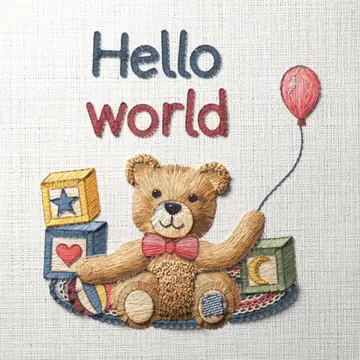
Advanced 3–8 in hoop · 22 colors
Hello world with a teddy and blocks
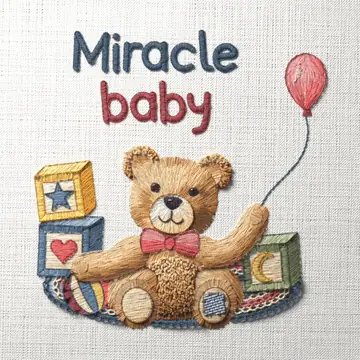
Advanced 3–8 in hoop · 22 colors
Miracle baby with a teddy and blocks
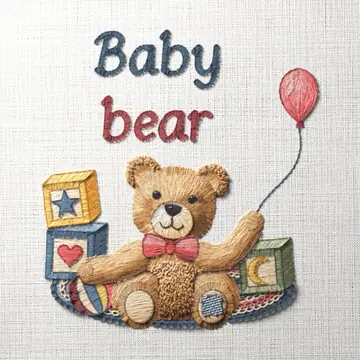
Advanced 3–8 in hoop · 22 colors
Baby bear with a teddy and blocks
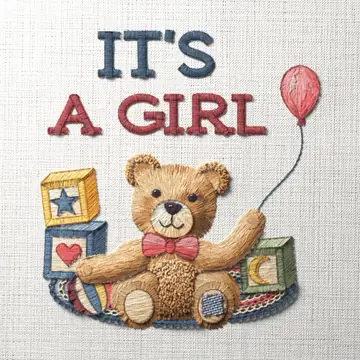
Advanced 3–8 in hoop · 22 colors
It’s a girl with a teddy and blocks
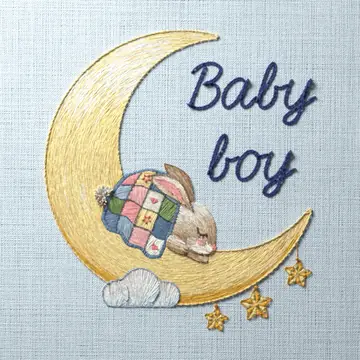
Advanced 3–8 in hoop · 24 colors
Baby boy with a bunny on the moon
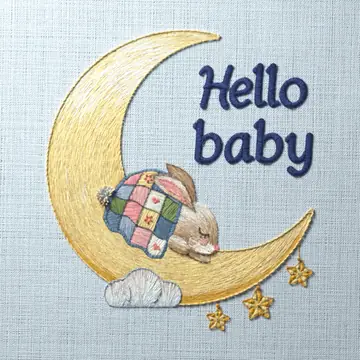
Advanced 3–8 in hoop · 24 colors
Hello baby with a bunny on the moon
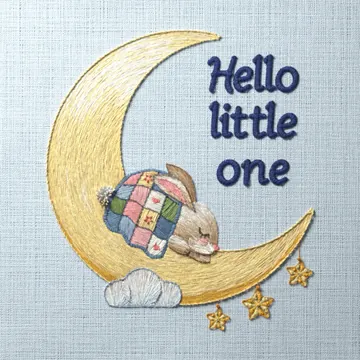
Advanced 3–8 in hoop · 24 colors
Hello little one, bunny on the moon
New to hand embroidery? Starting hand embroidery, step by step