Country church in a summer valley hand embroidery pattern
Advanced · 24 colors · 9 kinds of stitch
Download free PDFPDF, US Letter · 129 KBFor your own stitching, gifts and handmade pieces you sell. Do not resell or share this PDF. What you may do, in full
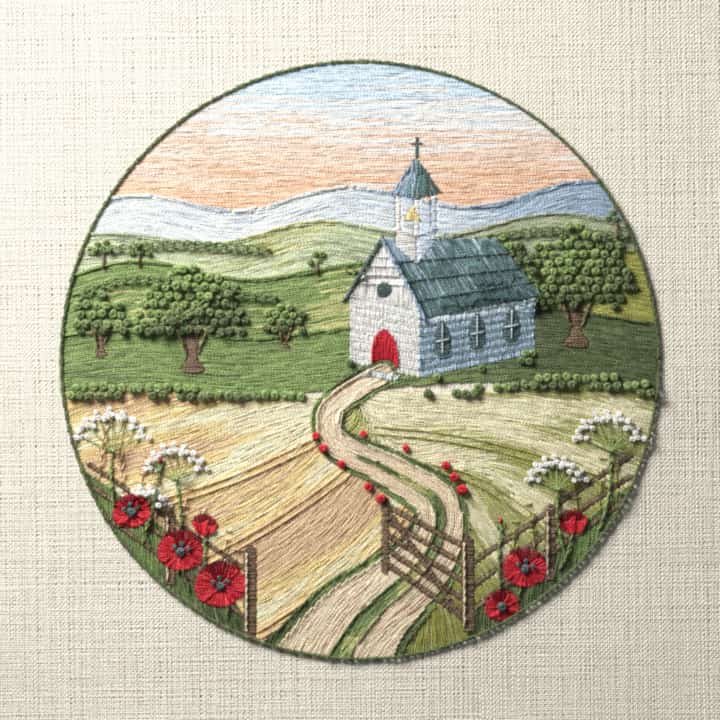
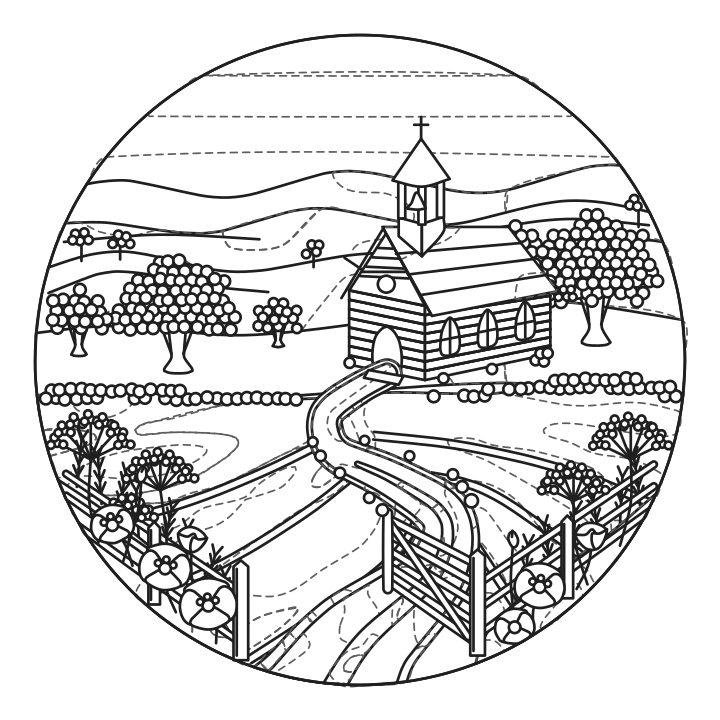
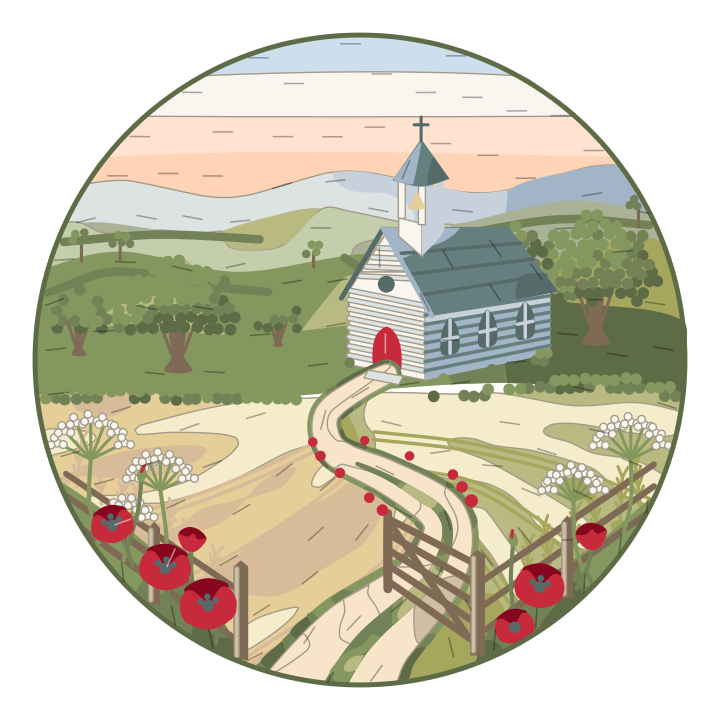
A pale lane with grass down its middle runs past a half-open gate, through two barley fields and up to a white clapboard church with a red door and a bell in its open belfry. Behind it are oaks, hedgerows, layered green and blue hills and a sky from peach to pale blue. The sky, hills, fields, lane and roof are long and short stitch, the church boards, gate, fence and poppies are satin stitch, and the oaks, hedges and cow parsley heads are French knots. Barley ears are fern stitch, far hedges are chain stitch, field rows are split stitch and the rim is stem stitch. In the picture of where the colors go, the fine lines show which way the stitches lie.
Size and details
Advanced. Uses long and short stitch over much of the design, more than a hundred French knots, 24 colors and a great deal of stitching.
24 colors of floss and 9 kinds of stitch:
- Long and short stitch
- Chain stitch
- Straight stitch
- French knot
- Satin stitch
- Back stitch
- Stem stitch
- Split stitch
- Fern stitch
- Which stitch goes where
| Hoop | Inches | Centimeters | Satin stitch up to |
|---|---|---|---|
| 3 in (8 cm) | 1.9 × 1.9 in | 4.8 × 4.8 cm | 1/8 in (3 mm) |
| 4 in (10 cm) | 2.8 × 2.8 in | 7.1 × 7.1 cm | 3/16 in (5 mm) |
| 5 in (13 cm) | 3.8 × 3.8 in | 9.7 × 9.7 cm | 3/16 in (5 mm) |
| 6 in (15 cm) | 4.7 × 4.7 in | 11.9 × 11.9 cm | 1/4 in (6 mm) |
| 8 in (20 cm) | 6.6 × 6.6 in | 16.8 × 16.8 cm | 3/8 in (10 mm) |
- In a 3, 4 or 5 inch hoop the French knots are drawn smaller than about 2 mm (a little over 1/16 in). Use one strand of floss for them there, or choose a larger hoop.
The pattern is drawn inside a circle about half an inch (1.3 cm) smaller all around than the hoop.
What you need
- DMC 951 Light TawnySky (light)
- DMC 3841 Pale Baby BlueSky (dark)
- DMC 3865 Winter WhiteSky (lightest), front wall and 2 more parts
- DMC 3856 Ultra Very Light MahoganySky (darkest)
- DMC 928 Very Light Gray GreenFar hills (light) and 2 more parts
- DMC 932 Light Antique BlueSide wall (darker) and 4 more parts
- DMC 3752 Very Light Antique BlueFar hills (middle) and 3 more parts
- DMC 523 Light Fern GreenMiddle hills (dark)
- DMC 524 Very Light Fern GreenMiddle hills (light)
- DMC 3013 Light Khaki GreenGreen barley (middle) and 3 more parts
- DMC 3364 Pine GreenChurchyard grass (light) and 10 more parts
- DMC 3012 Medium Khaki GreenNear hills (middle) and 3 more parts
- DMC 3362 Dark Pine GreenChurchyard grass (dark), rim and 4 more parts
- DMC 3363 Medium Pine GreenVerges and grass bank (middle) and 7 more parts
- DMC 3790 Ultra Dark Beige GrayGate, fence and oak trunks
- DMC 3768 Dark Gray GreenRoof (middle) and 2 more parts
- DMC 924 Very Dark Gray GreenWindows and roof courses and 5 more parts
- DMC 676 Light Old GoldBarley (middle), bell
- DMC 321 RedPoppies (lighter), door and far poppies
- DMC 3046 Medium Yellow BeigeBarley (dark) and 2 more parts
- DMC 677 Very Light Old GoldGreen barley and barley (light)
- DMC 739 Ultra Very Light TanLane (lighter)
- DMC 842 Very Light Beige BrownLane (darker), gate light
- DMC 815 Medium GarnetPoppies (darker)
Skeins: 2 for churchyard grass (light) and 10 more parts and 2 for barley (dark) and 2 more parts; one of each other color. An estimate for the largest size, the 8 inch hoop: the length of each line and the area of each filled shape, a fifth added for tails and ends, a tenth of every 8 m (8.7 yd) skein kept spare.
The floss is six-strand cotton; the stitch guide says how many strands to use. You also need a hoop, an embroidery needle (a size 7 to 9 suits two or three strands) and plain cotton or linen fabric. To frame the piece in its hoop, cut a square 3 inches (8 cm) wider than the hoop: a 9 inch (23 cm) square for a 6 inch hoop.
When it is stitched, how to finish a hoop shows how to back it for the wall.
Stitch guide
- Put the pattern on the fabric (how to transfer a pattern) and the fabric in the hoop.
- Stitch the filled parts first, what lies behind before what lies in front of it.
- Then stitch the lines: stems, veins and outlines over the edges of the filled parts.
- Keep the knots for the end, so that the hoop and your hand do not flatten them.
Start each thread with a small knot on the back or one of the knotless starts, and end it by running the needle under the backs of a few stitches (starting and ending a thread). Use the strands this list gives, also where a page about a stitch names another number.
- Long and short stitch 1 to 2 strandsSky, far hills, middle hills, near hills, and 9 more
- Chain stitch 2 strandsFar hedges
- Straight stitch 1 to 3 strandsOak trunks, cross, gate light, cow parsley rays, poppies
- French knot 1 to 2 strands, two wrapsOaks, hedgerows, churchyard shrubs, cow parsley, and 2 more
- Satin stitch 2 strandsOak trunks, front wall, side wall, belfry, bell, and 7 more
- Back stitch 1 strandClapboards, roof courses, window bars
- Stem stitch 2 to 3 strandsRoof edge, flower stems, rim
- Split stitch 1 strandBarley rows
- Fern stitch 1 strandBarley ears
Getting it onto your fabric
The PDF holds the pattern twice at actual size: once as drawn, and once mirrored for an iron-on transfer pen. Print it at 100% with scaling off and check the one-inch square (25.4 mm) with a ruler before you trace. How to transfer a pattern explains tracing, carbon paper and the other ways. The files are under Downloads.
Downloads
- Download free PDF PDF, US Letter, 3 pages, for a 6 inch (15 cm) hoop
- Download free PDF, A4 PDF, A4, 3 pages, for a 6 inch (15 cm) hoop
More patterns like this
Advanced 3–8 in hoop · 23 colors
Christmas village at blue dusk
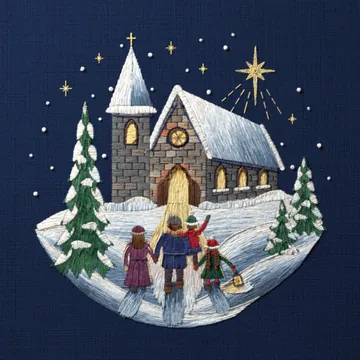
Advanced 3–8 in hoop · 22 colors
Christmas church in the snow at night
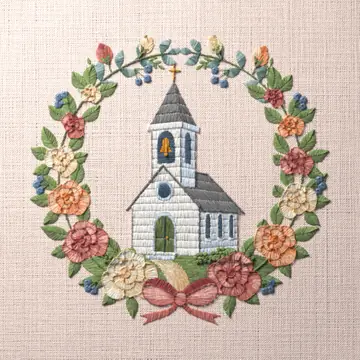
Advanced 3–8 in hoop · 23 colors
White chapel in a rose wreath
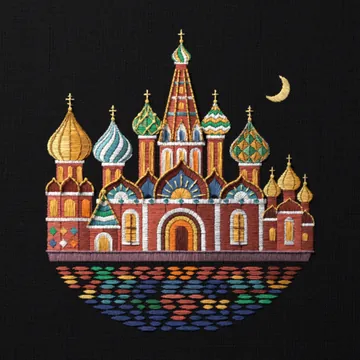
Advanced 3–8 in hoop · 22 colors
Church of the Savior on Spilled Blood
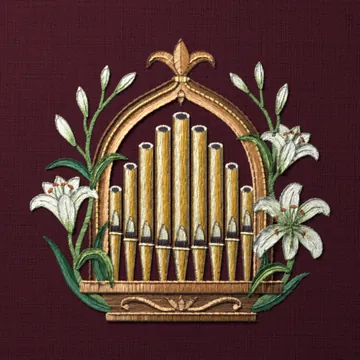
Advanced 3–8 in hoop · 21 colors
Church organ pipes with white lilies
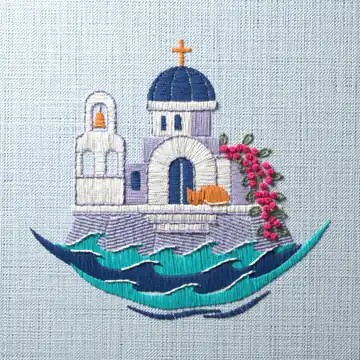
Easy 3–8 in hoop · 7 colors
Blue domed Orthodox chapel by the sea
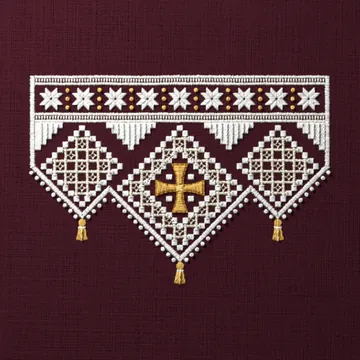
Advanced 3–8 in hoop · 6 colors
Hardanger style altar cloth border
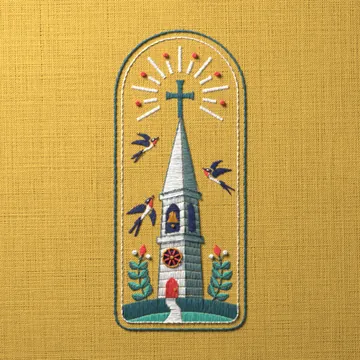
Intermediate 3–8 in hoop · 7 colors
Church steeple bookmark with swallows
New to hand embroidery? Starting hand embroidery, step by step