Dancer in folk costume hand embroidery pattern
Advanced · 24 colors · 11 kinds of stitch
Download free PDFPDF, US Letter · 175 KBFor your own stitching, gifts and handmade pieces you sell. Do not resell or share this PDF. What you may do, in full
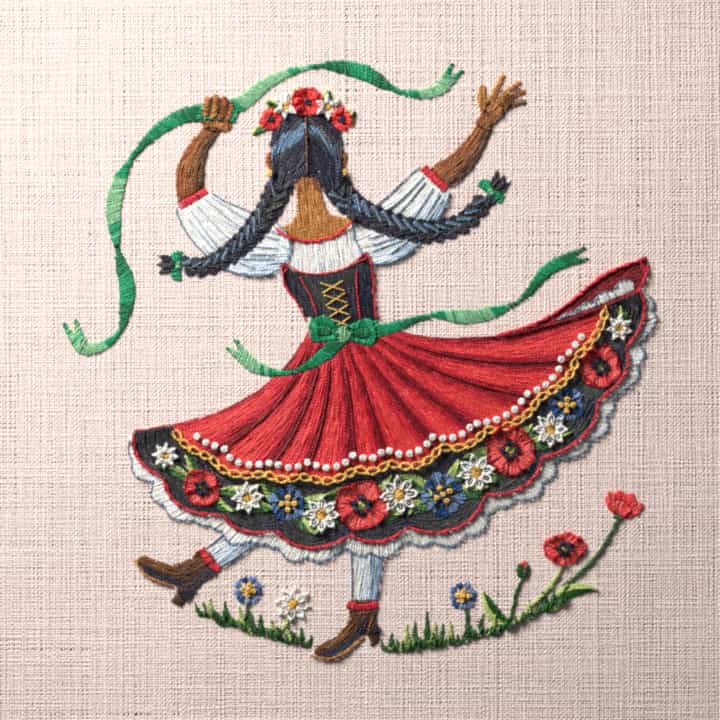
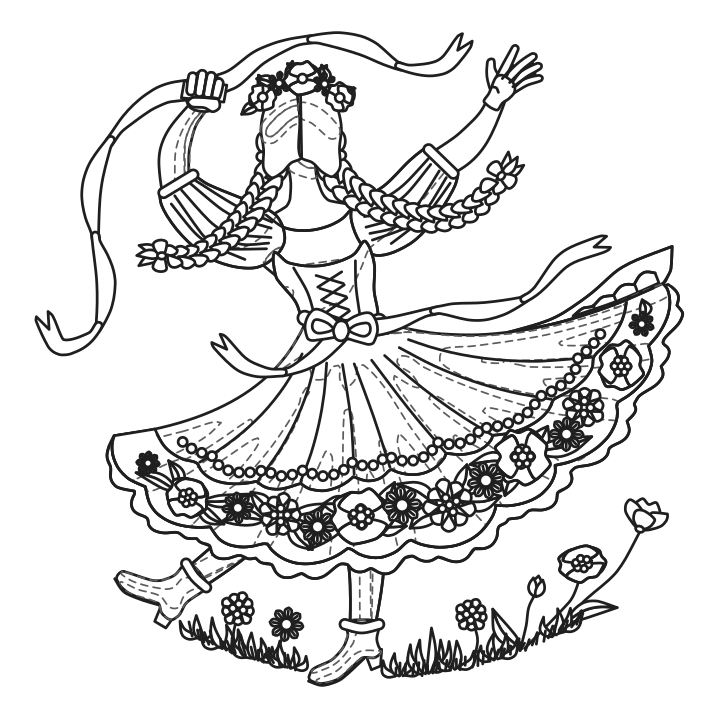
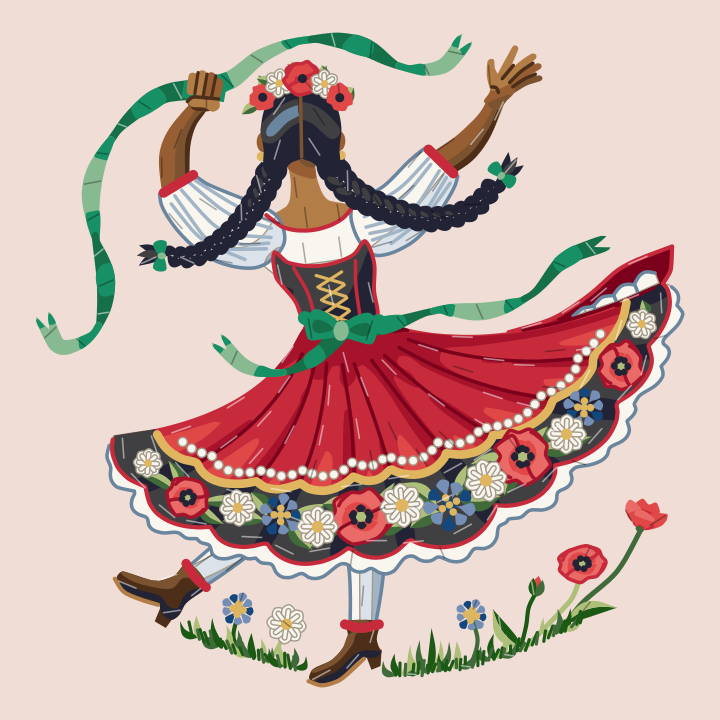
A dancer with brown skin and two dark braids turns away from us, arms lifted, in a wide red skirt, a white blouse and a laced black bodice. The skirt, hem band, sleeves, hair and poppy petals are long and short stitch, with the folds and pleats drawn in split stitch. The braids, ribbons, cornflowers and blades of grass are satin stitch, the daisies are lazy daisy stitch, and the hem edging is chain stitch with a row of French knots above it. The petticoat is edged in back stitch, the poppy stems are stem stitch and the leaves fishbone stitch. It is drawn for blush pink linen. In the picture of where the colors go, the fine lines show which way the stitches lie.
Size and details
Advanced. Uses long and short stitch over much of the design, padded satin stitch, more than a hundred French knots, 24 colors and a great deal of stitching.
24 colors of floss and 11 kinds of stitch:
- Stem stitch
- Fishbone stitch
- Long and short stitch
- Split stitch
- Satin stitch
- Back stitch
- Chain stitch
- French knot
- Lazy daisy stitch
- Straight stitch
- Padded satin stitch
- Which stitch goes where
| Hoop | Inches | Centimeters | Satin stitch up to |
|---|---|---|---|
| 3 in (8 cm) | 1.9 × 1.9 in | 4.8 × 4.8 cm | 1/16 in (1.6 mm) |
| 4 in (10 cm) | 2.8 × 2.8 in | 7.1 × 7.1 cm | 1/8 in (3 mm) |
| 5 in (13 cm) | 3.7 × 3.7 in | 9.4 × 9.4 cm | 3/16 in (5 mm) |
| 6 in (15 cm) | 4.6 × 4.6 in | 11.7 × 11.7 cm | 3/16 in (5 mm) |
| 8 in (20 cm) | 6.5 × 6.5 in | 16.5 × 16.5 cm | 5/16 in (8 mm) |
- In a 3, 4, 5 or 6 inch hoop the French knots and the shortest lazy daisy loops are drawn smaller than about 2 mm (a little over 1/16 in). Use one strand of floss for them there, or choose a larger hoop.
The pattern is drawn inside a circle about half an inch (1.3 cm) smaller all around than the hoop.
What you need
- DMC 3346 Hunter GreenLeaves and grass (middle) and 2 more parts
- DMC 471 Very Light Avocado GreenLeaves and grass (light) and 2 more parts
- DMC 3345 Dark Hunter GreenGrass and leaves (dark) and 2 more parts
- DMC 3865 Winter WhitePetticoat (light) and 5 more parts
- DMC 932 Light Antique BluePleats, stockings and sleeves (dark)
- DMC 3753 Ultra Very Light Antique BlueSleeves and stockings (light) and 2 more parts
- DMC 931 Medium Antique BluePetticoat (dark) and 3 more parts
- DMC 898 Very Dark Coffee BrownBoots (middle), arms (dark) and 3 more parts
- DMC 310 BlackHem band and braids (darker) and 6 more parts
- DMC 433 Medium BrownArms (middle), hands (dark) and 3 more parts
- DMC 435 Very Light BrownNeck (light), hands (lightest), boot soles
- DMC 321 RedSkirt (light) and 9 more parts
- DMC 814 Dark GarnetSkirt folds and 2 more parts
- DMC 498 Dark RedSkirt (dark) and 3 more parts
- DMC 350 Medium CoralSkirt (lightest) and 3 more parts
- DMC 3799 Very Dark Pewter GrayHem band and bodice (lighter) and 2 more parts
- DMC 3820 Dark StrawHem edging (middle) and 3 more parts
- DMC 351 CoralHem poppies and meadow poppies (light)
- DMC 797 Royal BlueCornflowers and flower centers (darker)
- DMC 799 Medium Delft BlueCornflowers (lighter)
- DMC 909 Very Dark Emerald GreenRibbons (dark)
- DMC 911 Medium Emerald GreenRibbons (middle)
- DMC 954 Nile GreenRibbons (light)
- DMC 434 Light BrownArms and hands (light), neck (middle), ears
Skeins: 2 for skirt (light) and 9 more parts; one of each other color. An estimate for the largest size, the 8 inch hoop: the length of each line and the area of each filled shape, a fifth added for tails and ends, a tenth of every 8 m (8.7 yd) skein kept spare.
The floss is six-strand cotton; the stitch guide says how many strands to use. You also need a hoop, an embroidery needle (a size 7 to 9 suits two or three strands) and plain cotton or linen fabric. To frame the piece in its hoop, cut a square 3 inches (8 cm) wider than the hoop: a 9 inch (23 cm) square for a 6 inch hoop.
When it is stitched, how to finish a hoop shows how to back it for the wall.
Stitch guide
- Put the pattern on the fabric (how to transfer a pattern) and the fabric in the hoop.
- Stitch the filled parts first, what lies behind before what lies in front of it.
- Then stitch the lines: stems, veins and outlines over the edges of the filled parts.
- Keep the knots for the end, so that the hoop and your hand do not flatten them.
Start each thread with a small knot on the back or one of the knotless starts, and end it by running the needle under the backs of a few stitches (starting and ending a thread). Use the strands this list gives, also where a page about a stitch names another number.
- Stem stitch 1 to 3 strandsPoppy stems, boot soles, skirt lining, hem edging, and 2 more
- Fishbone stitch 2 strandsLeaves
- Long and short stitch 1 strandStockings, boots, petticoat, skirt lining, skirt, and 11 more
- Split stitch 1 strandStockings, petticoat, skirt folds, petal edges, and 5 more
- Satin stitch 2 strandsBoot heels, boot cuffs, petticoat, poppy hearts, and 11 more
- Back stitch 1 strandPetticoat
- Chain stitch 2 strandsHem edging
- French knot 1 to 2 strands, two wrapsHem edging, anthers, flower centers, earrings, wreath flowers
- Lazy daisy stitch 2 strandsDaisies
- Straight stitch 1 to 2 strandsDaisies, grass, finger lines, lacing
- Padded satin stitch 2 strandsFlower centers
Getting it onto your fabric
The PDF holds the pattern twice at actual size: once as drawn, and once mirrored for an iron-on transfer pen. Print it at 100% with scaling off and check the one-inch square (25.4 mm) with a ruler before you trace. How to transfer a pattern explains tracing, carbon paper and the other ways. The files are under Downloads.
Downloads
- Download free PDF PDF, US Letter, 3 pages, for a 6 inch (15 cm) hoop
- Download free PDF, A4 PDF, A4, 3 pages, for a 6 inch (15 cm) hoop
More patterns like this
Advanced 3–8 in hoop · 24 colors
Woman in a Romanian style blouse
Advanced 3–8 in hoop · 22 colors
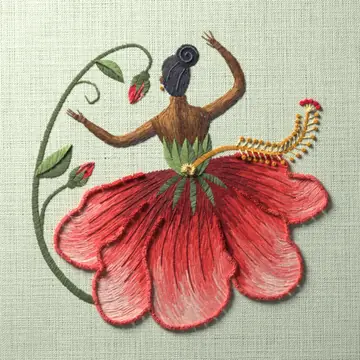
Flower dancer in a hibiscus skirt
Advanced 3–8 in hoop · 9 colors
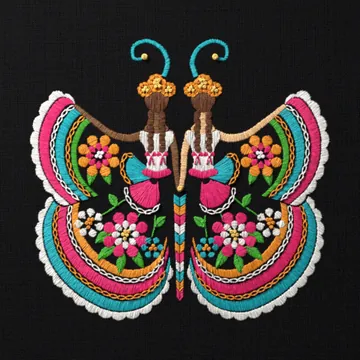
Mexican folk dancers
Advanced 3–8 in hoop · 24 colors
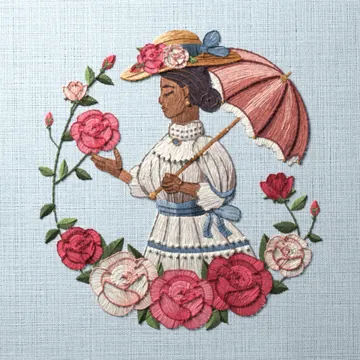
Edwardian lady in a rose garden
Advanced 3–8 in hoop · 24 colors
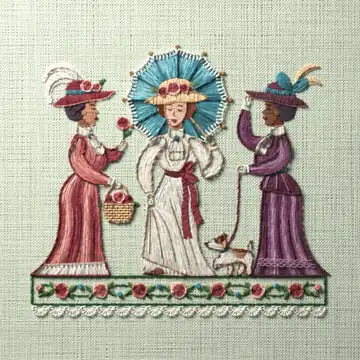
Edwardian ladies border
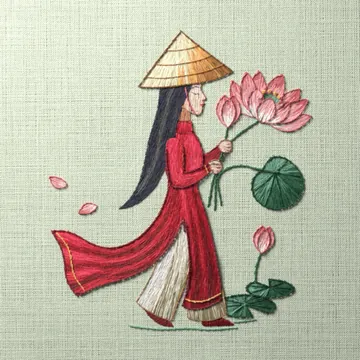
Advanced 3–8 in hoop · 24 colors
Vietnamese woman in an ao dai
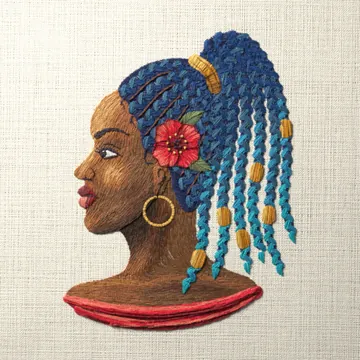
Advanced 3–8 in hoop · 24 colors
Woman with blue box braids
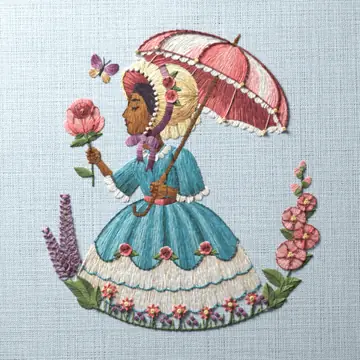
Advanced 3–8 in hoop · 24 colors
Lady in a bonnet with parasol and flower
New to hand embroidery? Starting hand embroidery, step by step