Goblin gathering mushrooms hand embroidery pattern
Advanced · 24 colors · 11 kinds of stitch
Download free PDFPDF, US Letter · 95 KBFor your own stitching, gifts and handmade pieces you sell. Do not resell or share this PDF. What you may do, in full
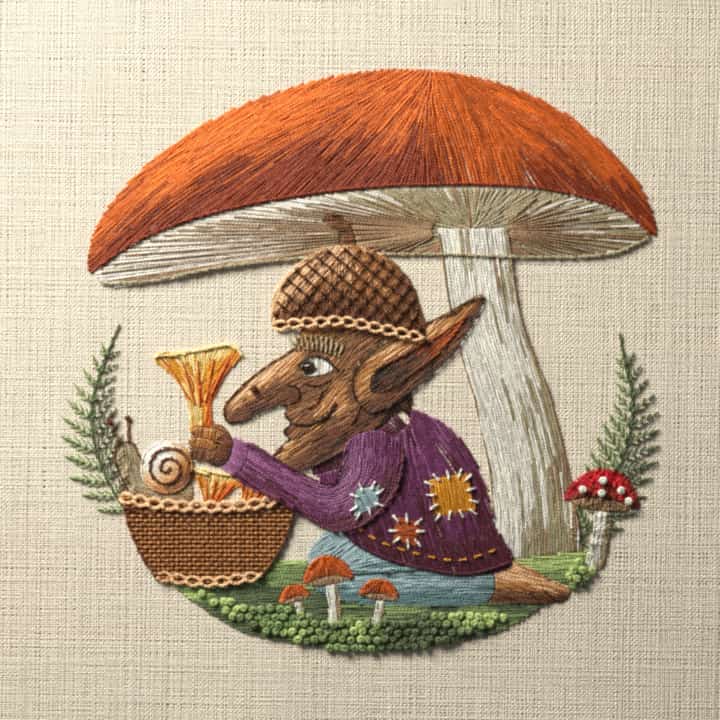
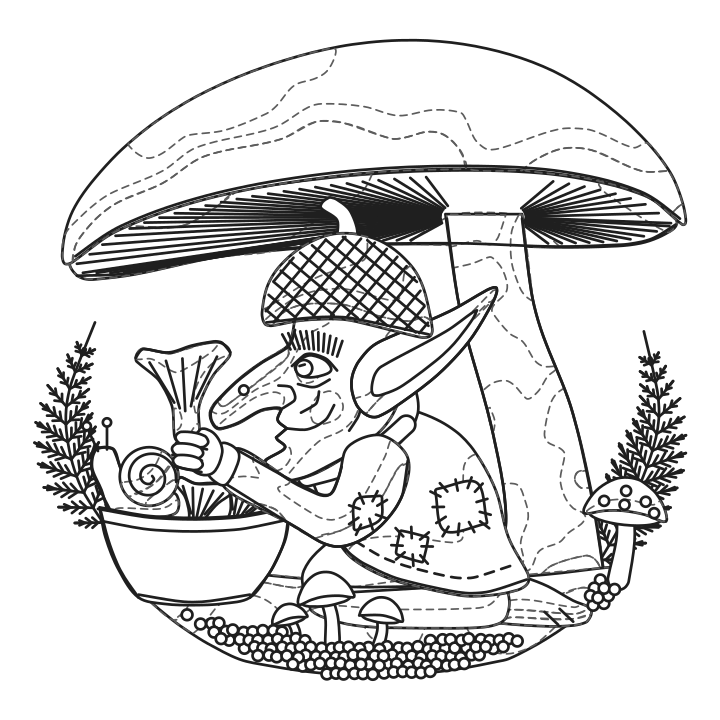
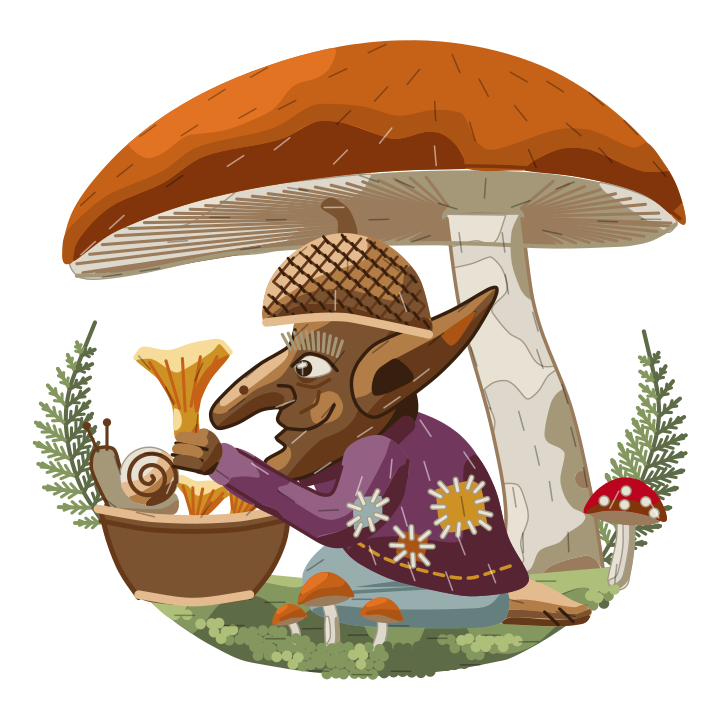
A little folklore goblin with nut-brown skin, a patched plum coat and an acorn cup for a hat kneels under one sweeping toadstool and lifts a chanterelle over his basket, where a snail is already aboard. The goblin, the cap and the chanterelles are long and short stitch, with straight stitch gills. The basket is woven filling stitch with a chain stitch rim, and the acorn cup is crossed with trellis stitch. French knots make the moss, fly stitch makes the ferns, and one red cap stands at the side. In the picture of where the colors go, the fine lines show which way the stitches lie.
Size and details
Advanced. Uses long and short stitch over much of the design, trellis stitch, more than a hundred French knots, 24 colors and a great deal of stitching.
24 colors of floss and 11 kinds of stitch:
- Stem stitch
- Fly stitch
- Long and short stitch
- Straight stitch
- Split stitch
- Running stitch
- Satin stitch
- French knot
- Trellis stitch
- Chain stitch
- Woven filling stitch
- Which stitch goes where
| Hoop | Inches | Centimeters | Satin stitch up to |
|---|---|---|---|
| 3 in (8 cm) | 1.9 × 1.8 in | 4.8 × 4.6 cm | 1/8 in (3 mm) |
| 4 in (10 cm) | 2.8 × 2.7 in | 7.1 × 6.9 cm | 3/16 in (5 mm) |
| 5 in (13 cm) | 3.7 × 3.6 in | 9.4 × 9.1 cm | 1/4 in (6 mm) |
| 6 in (15 cm) | 4.7 × 4.6 in | 11.9 × 11.7 cm | 5/16 in (8 mm) |
| 8 in (20 cm) | 6.5 × 6.4 in | 16.5 × 16.3 cm | 7/16 in (11 mm) |
- In a 3, 4 or 5 inch hoop the French knots are drawn smaller than about 2 mm (a little over 1/16 in). Use one strand of floss for them there, or choose a larger hoop.
The pattern is drawn inside a circle about half an inch (1.3 cm) smaller all around than the hoop.
What you need
- DMC 3362 Dark Pine GreenGround (dark), ferns (darker) and 2 more parts
- DMC 3364 Pine GreenGround and moss (middle), ferns (lighter)
- DMC 642 Dark Beige GrayGills (dark) and 5 more parts
- DMC 840 Medium Beige BrownGill lines, gills (darkest) and 4 more parts
- DMC 644 Medium Beige GrayToadstool stem (light) and 2 more parts
- DMC 822 Light Beige GrayToadstool stem (lightest) and 7 more parts
- DMC 921 CopperToadstool cap (light) and 3 more parts
- DMC 918 Dark Red CopperToadstool cap (darkest) and 2 more parts
- DMC 920 Medium CopperToadstool cap (dark) and 3 more parts
- DMC 922 Light CopperToadstool cap (lightest), small caps (light)
- DMC 471 Very Light Avocado GreenGround and moss (light)
- DMC 926 Medium Gray GreenTrousers (lighter), patches (light)
- DMC 3768 Dark Gray GreenTrousers (darker), trouser folds
- DMC 437 Light TanFeet and acorn hat (lightest) and 5 more parts
- DMC 801 Dark Coffee BrownAcorn hat and head (dark) and 12 more parts
- DMC 433 Medium BrownHead (middle), basket and 5 more parts
- DMC 435 Very Light BrownAcorn hat and ear (light) and 4 more parts
- DMC 938 Ultra Dark Coffee BrownHead and acorn hat (darkest) and 9 more parts
- DMC 3834 Dark GrapeCoat and coat sleeve (middle)
- DMC 154 Very Dark GrapeCoat (dark), coat edge and 2 more parts
- DMC 3835 Medium GrapeCoat sleeve and coat (light), cuff
- DMC 783 Medium TopazChanterelles and patches (middle), hem stitches
- DMC 3822 Light StrawChanterelles (light), chanterelle rims
- DMC 817 Very Dark Coral RedRed cap (lighter)
Skeins: 2 for gill lines, gills (darkest) and 4 more parts; one of each other color. An estimate for the largest size, the 8 inch hoop: the length of each line and the area of each filled shape, a fifth added for tails and ends, a tenth of every 8 m (8.7 yd) skein kept spare.
The floss is six-strand cotton; the stitch guide says how many strands to use. You also need a hoop, an embroidery needle (a size 7 to 9 suits two or three strands) and plain cotton or linen fabric. To frame the piece in its hoop, cut a square 3 inches (8 cm) wider than the hoop: a 9 inch (23 cm) square for a 6 inch hoop.
When it is stitched, how to finish a hoop shows how to back it for the wall.
Stitch guide
- Put the pattern on the fabric (how to transfer a pattern) and the fabric in the hoop.
- Stitch the filled parts first, what lies behind before what lies in front of it.
- Then stitch the lines: stems, veins and outlines over the edges of the filled parts.
- Keep the knots for the end, so that the hoop and your hand do not flatten them.
Start each thread with a small knot on the back or one of the knotless starts, and end it by running the needle under the backs of a few stitches (starting and ending a thread). Use the strands this list gives, also where a page about a stitch names another number.
- Stem stitch 1 to 3 strandsFern stems, ferns, gill rim, chanterelle rims, and 3 more
- Fly stitch 1 strandFerns
- Long and short stitch 1 to 2 strandsGills, toadstool stem, toadstool cap, ground, and 15 more
- Straight stitch 1 to 2 strandsGill lines, toes, patch stitches, eye light, brows, and 2 more
- Split stitch 1 to 2 strandsStem edge, cap edge, trouser folds, coat edge, and 6 more
- Running stitch 2 strandsHem stitches
- Satin stitch 2 strandsPatches, collar, eye, hat stalk, cuff, hands, small gills
- French knot 1 to 2 strands, two wrapsWart, snail horns, red cap spots, moss
- Trellis stitch 2 strandsAcorn hat
- Chain stitch 4 to 5 strandsHat brim, basket rim, basket foot
- Woven filling stitch 3 strandsBasket
Getting it onto your fabric
The PDF holds the pattern twice at actual size: once as drawn, and once mirrored for an iron-on transfer pen. Print it at 100% with scaling off and check the one-inch square (25.4 mm) with a ruler before you trace. How to transfer a pattern explains tracing, carbon paper and the other ways. The files are under Downloads.
Downloads
- Download free PDF PDF, US Letter, 3 pages, for a 6 inch (15 cm) hoop
- Download free PDF, A4 PDF, A4, 3 pages, for a 6 inch (15 cm) hoop
More patterns like this
Advanced 3–8 in hoop · 22 colors
Flying monkey across the moon
Advanced 3–8 in hoop · 20 colors
Guardian of the forest
Advanced 3–8 in hoop · 16 colors
Winged tiger with tribal stripes
Advanced 3–8 in hoop · 22 colors
Little monster birthday cake
Advanced 3–8 in hoop · 21 colors
Monster patch for kids jeans
Advanced 27 letters · 14 colors
Friendly monster letters
Intermediate 3–8 in hoop · 12 colors
Funny Bigfoot silhouette bookmark
Easy 3–8 in hoop · 6 colors
Unicorn horn and flower crown
New to hand embroidery? Starting hand embroidery, step by step