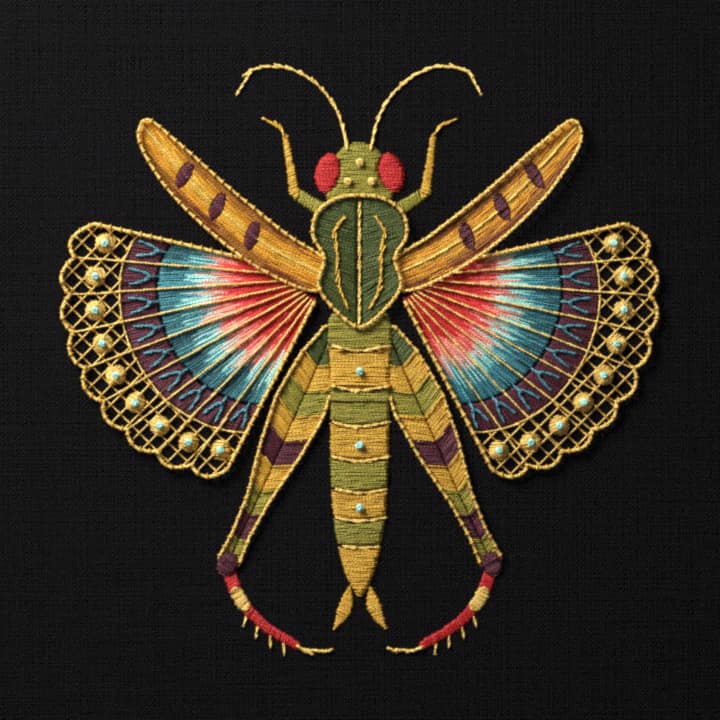
Grasshopper with spread wings hand embroidery pattern
Advanced · 14 colors · 4.6 × 4.5 in · 9 kinds of stitch
Download free PDFPDFPrints on US Letter and A4You may sell what you make from it by hand, in small quantities. The PDF itself is not to be sold or shared. Selling, classes and kits: the rules
A grasshopper seen from above is drawn like a jeweled brooch, an exact mirror on black.
Size and details
Advanced. Uses trellis stitch, long and short stitch, couching, padded satin stitch, 14 colors and a great deal of stitching; from a 5 inch hoop up the widest satin stitches are long.
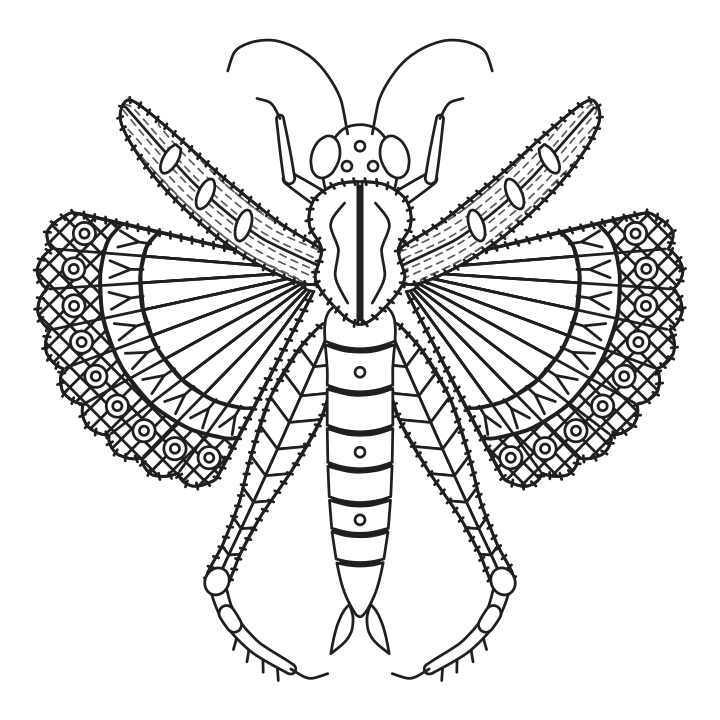
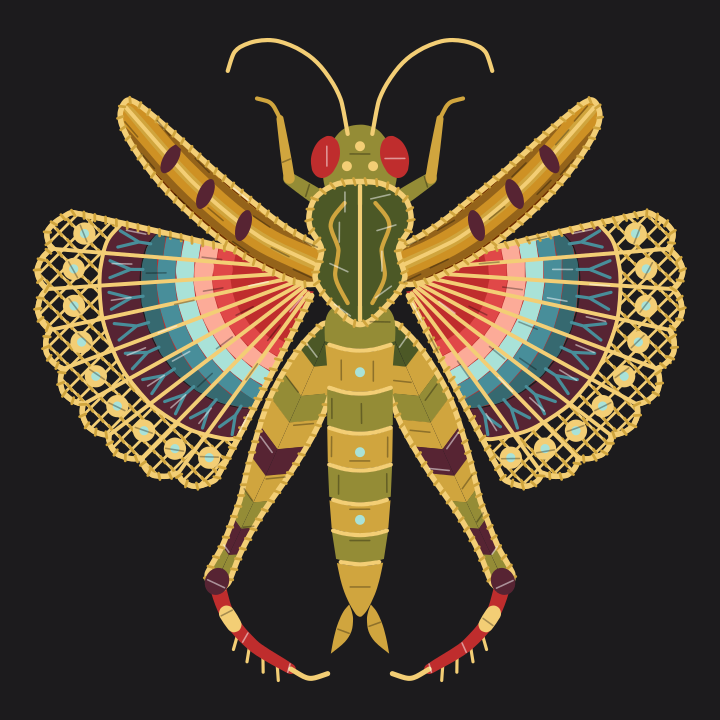
The fan wings and the narrow forewings are long and short stitch, with fly stitch on the plum satin stitch band and gold trellis stitch round the open rim. Each scallop holds a raised gold disc in padded satin stitch with a French knot on it, where a small bead may be sewn instead if you like. The head, shield and body are padded satin stitch, and the jumping legs are satin stitch in chevrons. Couching edges the wings, shield and thighs, stem stitch makes the veins and feelers, and straight stitch makes the spines. It is drawn for black linen. In the picture of where the colors go, the fine lines show which way the stitches lie.
| Hoop | Inches | Centimeters | Satin stitch up to |
|---|---|---|---|
| 3 in (8 cm) | 1.8 × 1.8 in | 4.6 × 4.6 cm | 3/16 in (5 mm) |
| 4 in (10 cm) | 2.8 × 2.7 in | 7.1 × 6.9 cm | 5/16 in (8 mm) |
| 5 in (13 cm) | 3.7 × 3.6 in | 9.4 × 9.1 cm | 3/8 in (10 mm) |
| 6 in (15 cm) | 4.6 × 4.5 in | 11.7 × 11.4 cm | 1/2 in (13 mm) |
| 8 in (20 cm) | 6.5 × 6.3 in | 16.5 × 16 cm | 11/16 in (17 mm) |
- In a 6 or 8 inch hoop the widest satin stitch shape is 1/2 in (13 mm) or more across. Satin stitches longer than about 12 mm (just under 1/2 in) tend to work loose: divide the shape into sections, or work it in long and short stitch.
- In a 3, 4, 5 or 6 inch hoop the French knots are drawn smaller than about 2 mm (a little over 1/16 in). Use one strand of floss for them there, or choose a larger hoop.
What you need
- Fabric
- Plain cotton or linen in black, cut 9 in (23 cm) square. A pencil line does not show on it: see how to transfer a pattern to dark fabric.
- Needle
- Embroidery needle, size 9 for 1 strand, size 7 for 2 or 3, size 5 for 4 (a lower number is a thicker needle).
- Floss
- 14 colors of six-strand cotton, listed below. DMC is a brand: another brand in a like color will do.
- Marker
- A pen or a sheet that suits the fabric: how to transfer a pattern says which.
Floss
- 1DMC 3821 StrawWing rim and wing edges (lighter), wing veins and gold discs and 10 more parts
- 2DMC 729 Medium Old GoldHind legs (lightest), body (lighter), wing edges and wing rim (darker) and 6 more parts
- 3DMC 347 Very Dark SalmonHind wings (dark), shins and eyes
- 4DMC 350 Medium CoralHind wings (middle dark)
- 5DMC 3341 ApricotHind wings (light)
- 6DMC 964 Light SeagreenHind wings (lightest), beads (lighter)
- 7DMC 3810 Dark TurquoiseHind wings (middle light), band veins
- 8DMC 3808 Ultra Very Dark TurquoiseHind wings (darkest)
- 9DMC 154 Very Dark GrapeWing bands, forewing spots and knees, hind legs (darkest)
- 10DMC 936 Very Dark Avocado GreenShield, hind legs (dark)
- 11DMC 732 Olive GreenBody and front legs (darker), hind legs (light), head
- 12DMC 783 Medium TopazForewings (light)
- 13DMC 300 Very Dark MahoganyForewings (darkest)
- 14DMC 780 Ultra Very Dark TopazForewings (dark)
Skeins: 2 of DMC 3821; one of each other color. An estimate for the 6 inch hoop, from the length of each line and the area of each filled shape, with a fifth added for tails.
How to stitch it
- New to hand embroidery? Start here.
- Print at 100%, trace the pattern onto the fabric, and put it in the hoop: inner ring under, drawing up, tight as a drum.
- Floss is six strands. Cut 18 inches (45 cm), pull out the number given one at a time, and lay them together.
- Inside a filled shape start with two or three tiny stitches, which the filling covers. Start a line with a small knot on the back. End each thread by running the needle under the backs of a few stitches.
- Each small ring is one French knot. A fine broken line inside a shape is where two shades meet: trace it, do not stitch it.
- A number under “Where colors go” is a color of the list. The fine lines on the colors show which way the stitches lie.
Stitch in this order
Filled parts from the back of the picture forward, then lines and knots. Where a stitch page names another number of strands, use the number here.
- Trellis stitch 1 strandWing rim
- Long and short stitch 1 strandHind wings, forewings
- Satin stitch 2 strandsWing bands, shins, shin bands, hind legs, front legs, tail points, forewing spots
- Padded satin stitch 2 strandsGold discs, knees, body, head, eyes, shield
- Fly stitch 2 strandsBand veins
- Stem stitch3 strands: feet2 strands: front legs, body rings, antennae, shield edge, shield lines1 strand: band edges, wing veins, forewing veins
- Couching4 strands: shield edge3 or 4 strands: wing edges3 strands: leg edges
- Straight stitch 2 strandsLeg spines
- French knot 2 strands, two wrapsBeads
When it is done, take off any lines that still show and finish the hoop.
More patterns like this
Easy prints 3–14 in · 7 colors
Easy grasshopper on a blade of grass
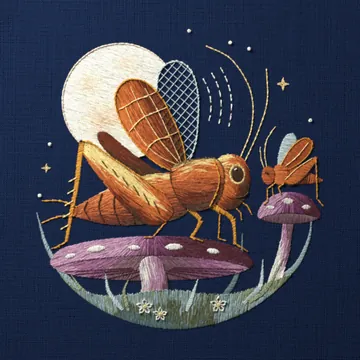
Advanced prints 3–14 in · 20 colors
Crickets singing under the moon
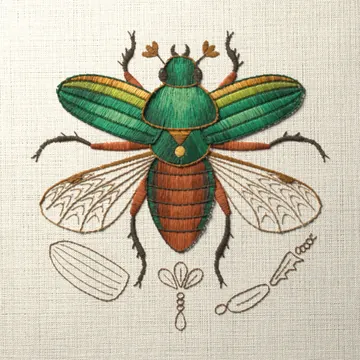
Advanced prints 3–14 in · 14 colors
Anatomical beetle with open wings
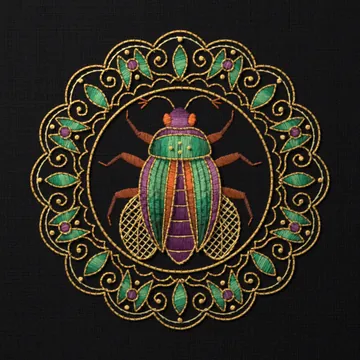
Advanced prints 3–14 in · 14 colors
Jewel beetle Victorian medallion
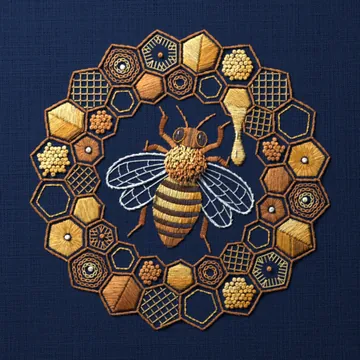
Advanced prints 3–14 in · 13 colors
Bee in honeycomb ring
Advanced 3–8 in hoop · 13 colors
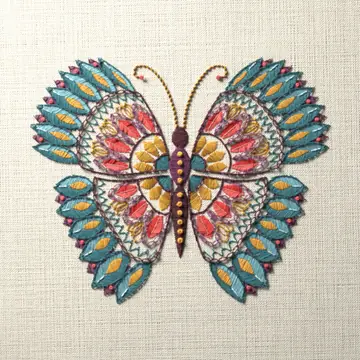
Mandala butterfly
Advanced 3–8 in hoop · 13 colors
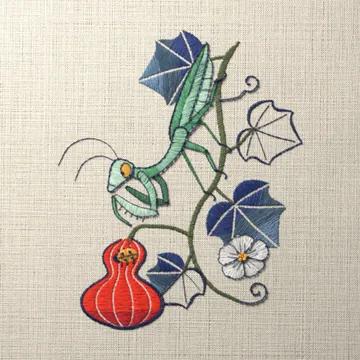
Praying mantis on a gourd vine
Advanced 3–8 in hoop · 16 colors
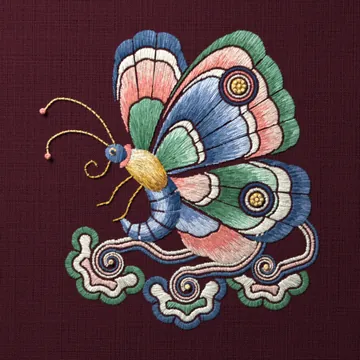
Butterfly with cloud scrolls
New to hand embroidery? Starting hand embroidery, step by step