May the road rise to meet you hand embroidery pattern
Advanced · 21 colors · 8 kinds of stitch
Download free PDFPDF, US Letter · 125 KBFor your own stitching, gifts and handmade pieces you sell. Do not resell or share this PDF. What you may do, in full
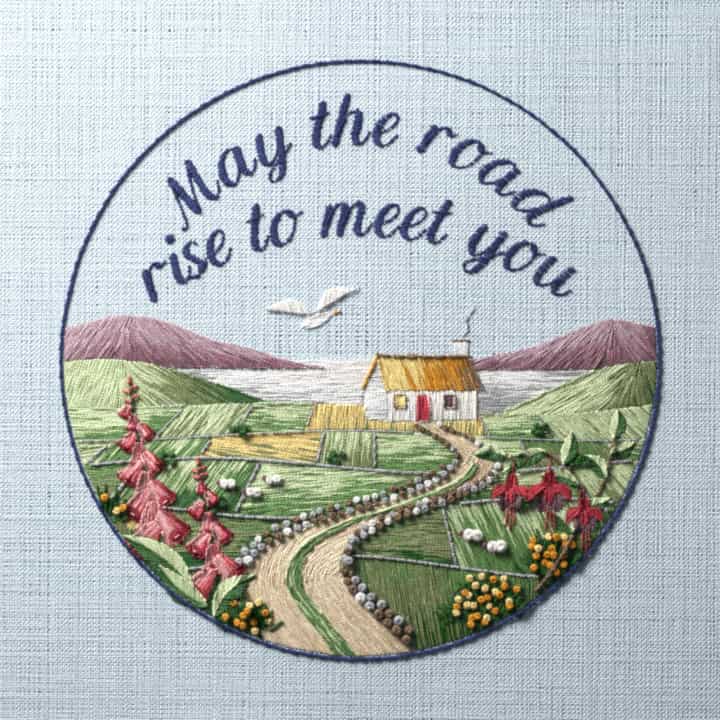
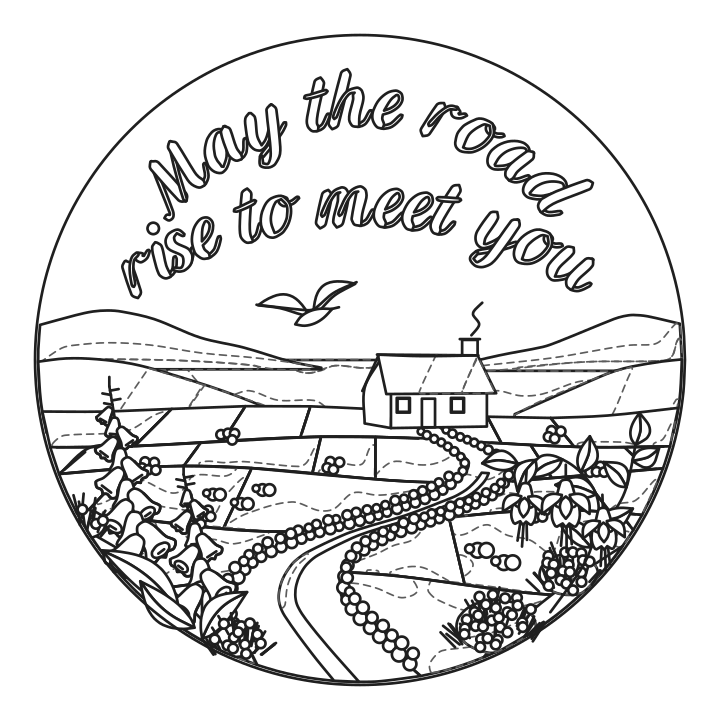
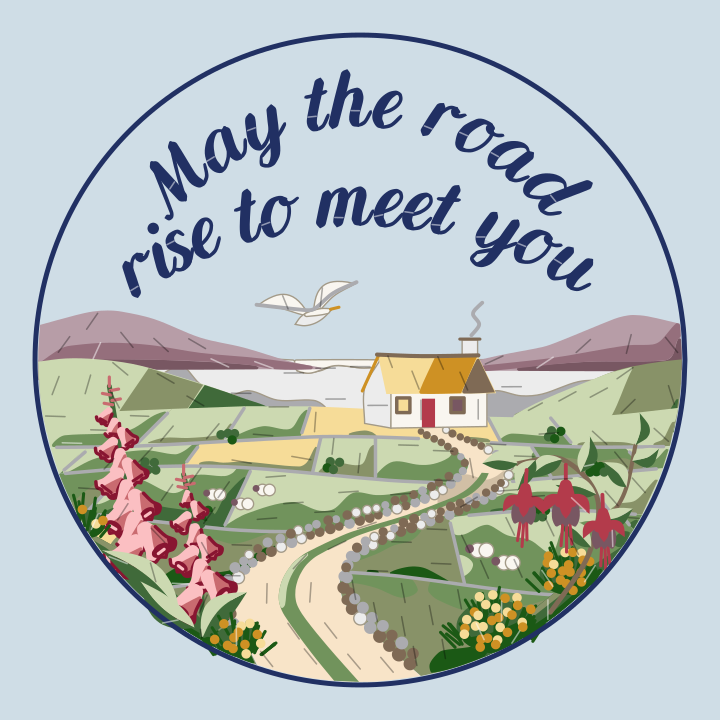
The opening line of a traditional Irish blessing arches across a bare sky above a lane, stone walls, patchwork fields and a whitewashed cottage with one lit window. Fields, hills, lane and thatch are long and short stitch; the bay is worked the same way in level rows. The lane walls, hedge trees, sheep and gorse flowers are French knots, and the letters, cottage walls and fuchsia are satin stitch. Foxglove leaves are fishbone stitch, gorse spines are straight stitch, and the circle is closed all round in stem stitch. It is drawn for pale blue linen. In the picture of where the colors go, the fine lines show which way the stitches lie.
Size and details
Advanced. Uses long and short stitch over much of the design, more than a hundred French knots, 21 colors and a great deal of stitching.
21 colors of floss and 8 kinds of stitch:
- Long and short stitch
- Split stitch
- Back stitch
- French knot
- Satin stitch
- Straight stitch
- Stem stitch
- Fishbone stitch
- Which stitch goes where
| Hoop | Inches | Centimeters | Satin stitch up to |
|---|---|---|---|
| 3 in (8 cm) | 1.9 × 1.9 in | 4.8 × 4.8 cm | 1/8 in (3 mm) |
| 4 in (10 cm) | 2.8 × 2.8 in | 7.1 × 7.1 cm | 1/8 in (3 mm) |
| 5 in (13 cm) | 3.8 × 3.8 in | 9.7 × 9.7 cm | 3/16 in (5 mm) |
| 6 in (15 cm) | 4.7 × 4.7 in | 11.9 × 11.9 cm | 1/4 in (6 mm) |
| 8 in (20 cm) | 6.6 × 6.6 in | 16.8 × 16.8 cm | 3/8 in (10 mm) |
- In a 3, 4 or 5 inch hoop the French knots are drawn smaller than about 2 mm (a little over 1/16 in). Use one strand of floss for them there, or choose a larger hoop.
The pattern is drawn inside a circle about half an inch (1.3 cm) smaller all around than the hoop.
What you need
- DMC 318 Light Steel GrayBay (dark), field walls, gull edges and smoke, lane walls (middle)
- DMC 762 Very Light Pearl GrayBay (middle), lane walls (light), cottage gable and 2 more parts
- DMC 3865 Winter WhiteCottage walls, bay and gull (light), sheep (lighter)
- DMC 3042 Light Antique VioletHills (light)
- DMC 3740 Dark Antique VioletHills (dark), fuchsia skirts and dark window, sheep (darker)
- DMC 3041 Medium Antique VioletHills (middle)
- DMC 3348 Light Yellow GreenFields and headlands (light), fuchsia leaves (lighter) and 2 more parts
- DMC 3346 Hunter GreenGorse bushes (lighter), banks (middle), headlands (dark) and 5 more parts
- DMC 3052 Medium Green GrayFields (middle light), headlands (middle), banks (light)
- DMC 3347 Medium Yellow GreenFields (middle dark), grass strip (darker)
- DMC 3822 Light StrawFields (lightest), thatch (light), gorse flowers (lighter), lit window
- DMC 3345 Dark Hunter GreenGorse spines, fields (darkest), gorse bushes (darker) and 2 more parts
- DMC 739 Ultra Very Light TanLane (lighter)
- DMC 842 Very Light Beige BrownLane (darker)
- DMC 3790 Ultra Dark Beige GrayLane walls and thatch (dark), fuchsia twigs and 3 more parts
- DMC 783 Medium TopazGorse flowers (darker), thatch (middle), gull (dark)
- DMC 326 Very Dark RoseFuchsia sepals, fuchsia tubes and fuchsia stamens and 2 more parts
- DMC 3689 Light MauveFoxglove bells (light), foxglove throats (lighter)
- DMC 3687 MauveFoxglove bells (middle), foxglove buds
- DMC 3685 Very Dark MauveFoxglove edges, foxglove throats (darker), foxglove bells (dark)
- DMC 823 Dark Navy BlueLetters and hoop edge
Skeins: one of each color is enough. An estimate for the largest size, the 8 inch hoop: the length of each line and the area of each filled shape, a fifth added for tails and ends, a tenth of every 8 m (8.7 yd) skein kept spare.
The floss is six-strand cotton; the stitch guide says how many strands to use. You also need a hoop, an embroidery needle (a size 7 to 9 suits two or three strands) and plain cotton or linen fabric. To frame the piece in its hoop, cut a square 3 inches (8 cm) wider than the hoop: a 9 inch (23 cm) square for a 6 inch hoop.
When it is stitched, how to finish a hoop shows how to back it for the wall.
Stitch guide
- Put the pattern on the fabric (how to transfer a pattern) and the fabric in the hoop.
- Stitch the filled parts first, what lies behind before what lies in front of it.
- Then stitch the lines: stems, veins and outlines over the edges of the filled parts.
- Keep the knots for the end, so that the hoop and your hand do not flatten them.
Start each thread with a small knot on the back or one of the knotless starts, and end it by running the needle under the backs of a few stitches (starting and ending a thread). Use the strands this list gives, also where a page about a stitch names another number.
- Long and short stitch 1 strandBay, hills, headlands, fields, lane, grass strip, thatch, banks, foxglove bells, gorse bushes, gull
- Split stitch 1 to 2 strandsField walls, foxglove edges
- Back stitch 1 to 3 strandsField walls, window frames
- French knot 1 to 2 strands, two wrapsLane walls, hedge trees, sheep, gorse flowers
- Satin stitch 2 strandsCottage gable, cottage walls, chimneys, cottage door, lit window, dark window, foxglove throats, and 5 more
- Straight stitch 1 to 3 strandsChimneys, thatch, foxglove throats, foxglove buds, gorse spines, fuchsia stamens, gull
- Stem stitch 1 to 3 strandsThatch ridge, smoke, foxglove stems, fuchsia twigs, fuchsia stalks, gull edges, hoop edge
- Fishbone stitch 2 strandsFoxglove leaves, fuchsia leaves
Getting it onto your fabric
The PDF holds the pattern twice at actual size: once as drawn, and once mirrored for an iron-on transfer pen. Print it at 100% with scaling off and check the one-inch square (25.4 mm) with a ruler before you trace. How to transfer a pattern explains tracing, carbon paper and the other ways. The files are under Downloads.
Downloads
- Download free PDF PDF, US Letter, 3 pages, for a 6 inch (15 cm) hoop
- Download free PDF, A4 PDF, A4, 3 pages, for a 6 inch (15 cm) hoop
More patterns like this
Advanced 3–8 in hoop · 15 colors
Shamrock row edging
Intermediate 3–8 in hoop · 3 colors
Horseshoe with a shamrock
Intermediate 3–8 in hoop · 3 colors
Shamrock in nested lines
Advanced 3–8 in hoop · 24 colors
Dice between two sprigs
Advanced 3–8 in hoop · 15 colors
Irish tree of life in crewel
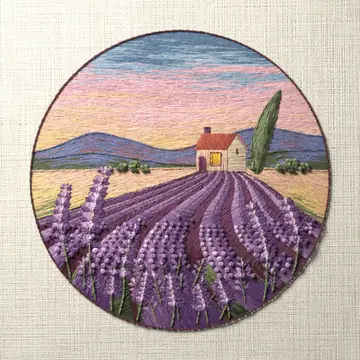
Advanced 3–8 in hoop · 21 colors
Lavender field at sunset
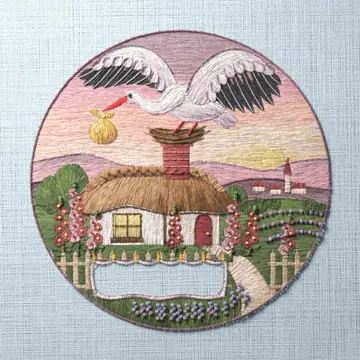
Advanced 3–8 in hoop · 22 colors
Stork on the cottage roof birth record
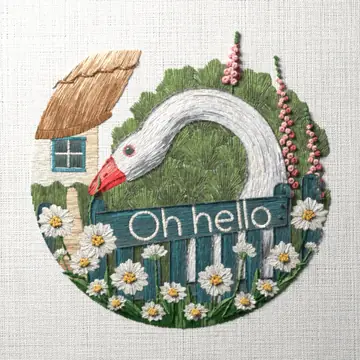
Advanced 3–8 in hoop · 22 colors
Oh hello in daisies
New to hand embroidery? Starting hand embroidery, step by step