Adobe house with a chile ristra hand embroidery pattern
Advanced · 22 colors · 10 kinds of stitch
Download free PDFPDF, US Letter · 60 KBFor your own stitching, gifts and handmade pieces you sell. Do not resell or share this PDF. What you may do, in full
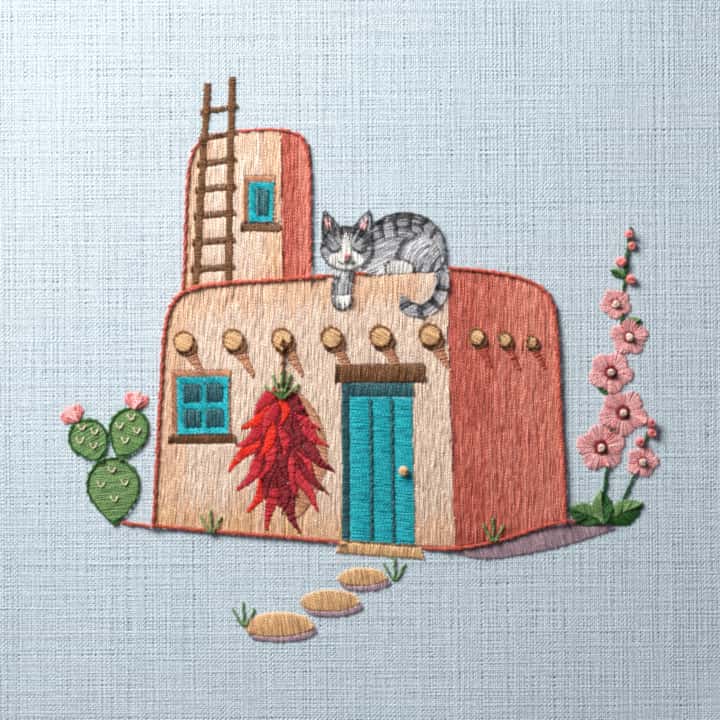
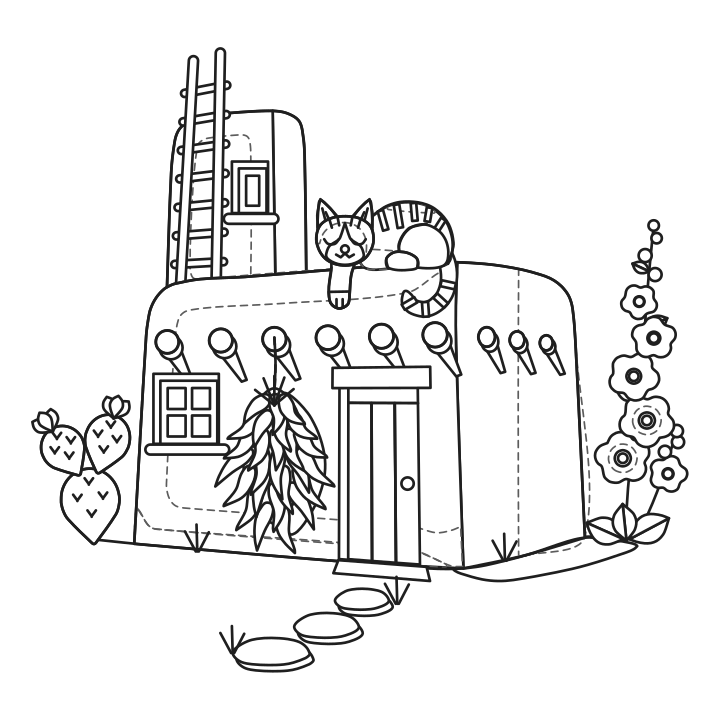
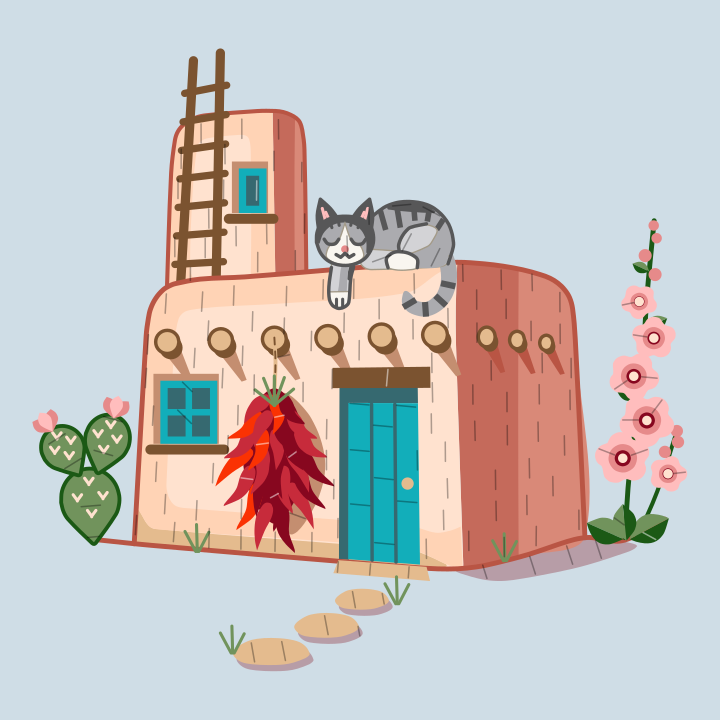
A little adobe house stands on pale blue cloth, its sunny front and clay shaded side worked in upright long and short stitch and outlined in stem stitch. A fat ristra of satin stitch chiles in three reds hangs on a whipped back stitch cord beside a turquoise satin stitch door, with log ends and their shadows in a row above. A ladder leans on the small upper room, and a gray and white tabby cat sleeps along the roof with one paw and its tail over the edge. A prickly pear with fly stitch spines stands on the left, and on the right a tall hollyhock in satin stitch has French knot centers and buds. Three satin stitch stepping stones lead to the doorstep. In the picture of where the colors go, the fine lines show which way the stitches lie.
Size and details
Advanced. Uses long and short stitch over much of the design, satin stitch over about a fifth of the cloth in a 6 inch hoop, 22 colors and a great deal of stitching; from a 6 inch hoop up some of the satin stitches are long.
22 colors of floss and 10 kinds of stitch:
- Satin stitch
- Long and short stitch
- Stem stitch
- Split stitch
- French knot
- Whipped back stitch
- Straight stitch
- Fishbone stitch
- Fly stitch
- Back stitch
- Which stitch goes where
| Hoop | Inches | Centimeters | Satin stitch up to |
|---|---|---|---|
| 3 in (8 cm) | 1.9 × 1.8 in | 4.8 × 4.6 cm | 3/16 in (5 mm) |
| 4 in (10 cm) | 2.8 × 2.7 in | 7.1 × 6.9 cm | 1/4 in (6 mm) |
| 5 in (13 cm) | 3.8 × 3.6 in | 9.7 × 9.1 cm | 5/16 in (8 mm) |
| 6 in (15 cm) | 4.7 × 4.5 in | 11.9 × 11.4 cm | 7/16 in (11 mm) |
| 8 in (20 cm) | 6.6 × 6.3 in | 16.8 × 16 cm | 9/16 in (14 mm) |
- In an 8 inch hoop the widest satin stitch shape is 9/16 in (14 mm) across. Satin stitches longer than about 12 mm (just under 1/2 in) tend to work loose: divide the shape into sections, or work it in long and short stitch.
- In a 3, 4 or 5 inch hoop the French knots are drawn smaller than about 2 mm (a little over 1/16 in). Use one strand of floss for them there, or choose a larger hoop.
The pattern is drawn inside a circle about half an inch (1.3 cm) smaller all around than the hoop.
What you need
- DMC 3042 Light Antique VioletStone shade and ground shade
- DMC 356 Medium Terra CottaSide wall (darker), upper room (darkest)
- DMC 3778 Light Terra CottaSide wall (lighter), upper room (dark)
- DMC 3856 Ultra Very Light MahoganyFront wall (middle), upper room (light)
- DMC 951 Light TawnyFront wall (light), upper room (lightest), spines and hollyhock centers
- DMC 3830 Terra CottaHouse outline and ground, log shadows (darker)
- DMC 3064 Desert SandWindow shade and ristra shade, log shadows (lighter)
- DMC 3844 Dark Bright TurquoiseDoor and window frames
- DMC 3808 Ultra Very Dark TurquoiseDoor shade, window glass and door gaps
- DMC 433 Medium BrownLadder, log sides, log rings, lintel and sills, ristra cord (darker)
- DMC 437 Light TanFront wall (dark), stepping stones, log ends, doorstep and latch, ristra cord (lighter)
- DMC 815 Medium GarnetRistra (dark), hollyhock hearts
- DMC 321 RedRistra (middle)
- DMC 606 Bright Orange-RedRistra (light)
- DMC 3347 Medium Yellow GreenPrickly pear, grass and ristra top, leaves (lighter)
- DMC 3345 Dark Hunter GreenPrickly pear edge and hollyhock stalks, leaves (darker)
- DMC 3716 Very Light RoseHollyhock blooms and prickly pear flowers (lighter), cat ears
- DMC 962 Medium Dusty RoseHollyhock blooms and prickly pear flowers (darker), hollyhock buds and cat nose
- DMC 318 Light Steel GrayCat (middle), cat tail (lighter)
- DMC 413 Dark Pewter GrayCat lines and cat stripes, cat (dark), cat tail (darker)
- DMC 415 Pearl GrayCat (light)
- DMC 3865 Winter WhiteCat face and cat paws
Skeins: 2 for front wall (light), upper room (lightest), spines and hollyhock centers; one of each other color. An estimate for the largest size, the 8 inch hoop: the length of each line and the area of each filled shape, a fifth added for tails and ends, a tenth of every 8 m (8.7 yd) skein kept spare.
The floss is six-strand cotton; the stitch guide says how many strands to use. You also need a hoop, an embroidery needle (a size 7 to 9 suits two or three strands) and plain cotton or linen fabric. To frame the piece in its hoop, cut a square 3 inches (8 cm) wider than the hoop: a 9 inch (23 cm) square for a 6 inch hoop.
When it is stitched, how to finish a hoop shows how to back it for the wall.
Stitch guide
- Put the pattern on the fabric (how to transfer a pattern) and the fabric in the hoop.
- Stitch the filled parts first, what lies behind before what lies in front of it.
- Then stitch the lines: stems, veins and outlines over the edges of the filled parts.
- Keep the knots for the end, so that the hoop and your hand do not flatten them.
Start each thread with a small knot on the back or one of the knotless starts, and end it by running the needle under the backs of a few stitches (starting and ending a thread). Use the strands this list gives, also where a page about a stitch names another number.
- Satin stitch 2 strandsGround shade, window shade, window frames, window glass, sills, ladder, log shadows, door shade, door, lintel, log sides, log ends, and 13 more
- Long and short stitch 1 strandUpper room, side wall, front wall, cat tail, cat
- Stem stitch 1 to 3 strandsHouse outline, ground, hollyhock stalks, prickly pear edge
- Split stitch 1 to 2 strandsDoor gaps, log rings, cat lines
- French knot 1 to 2 strands, two wrapsLatch, hollyhock centers, hollyhock buds, cat nose
- Whipped back stitch 2 strandsRistra cord
- Straight stitch 1 to 3 strandsRistra top, grass, cat lines, cat ears, cat stripes
- Fishbone stitch 2 strandsLeaves
- Fly stitch 1 strandSpines
- Back stitch 1 to 2 strandsCat lines
Getting it onto your fabric
The PDF holds the pattern twice at actual size: once as drawn, and once mirrored for an iron-on transfer pen. Print it at 100% with scaling off and check the one-inch square (25.4 mm) with a ruler before you trace. How to transfer a pattern explains tracing, carbon paper and the other ways. The files are under Downloads.
Downloads
- Download free PDF PDF, US Letter, 3 pages, for a 6 inch (15 cm) hoop
- Download free PDF, A4 PDF, A4, 3 pages, for a 6 inch (15 cm) hoop
More patterns like this
Advanced 3–8 in hoop · 22 colors
Cowgirl riding into a desert sunset
Advanced 3–8 in hoop · 23 colors
Joshua tree at desert sunset
Advanced 3–8 in hoop · 23 colors
West Texas landscape at sunset
Advanced 3–8 in hoop · 23 colors
Mule deer looking back in the sage
Advanced 3–8 in hoop · 24 colors
Southwest pottery and yucca
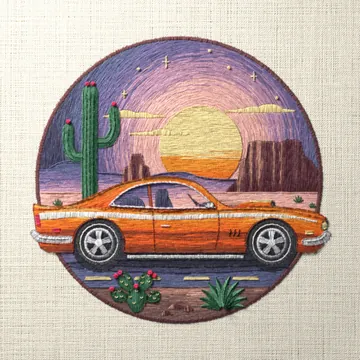
Advanced 3–8 in hoop · 24 colors
Muscle car in the desert
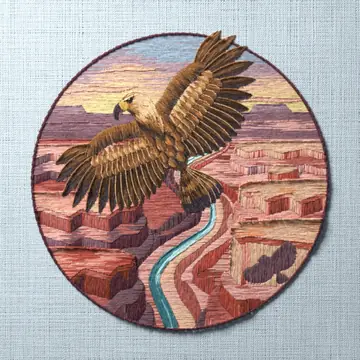
Advanced 3–8 in hoop · 24 colors
Golden eagle over a Southwest canyon
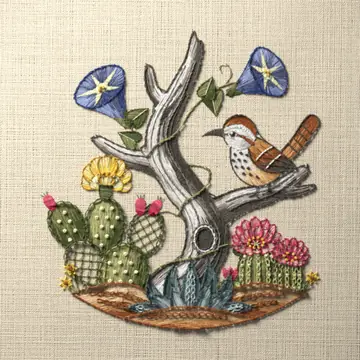
Advanced 3–8 in hoop · 24 colors
Driftwood and desert flowers
New to hand embroidery? Starting hand embroidery, step by step