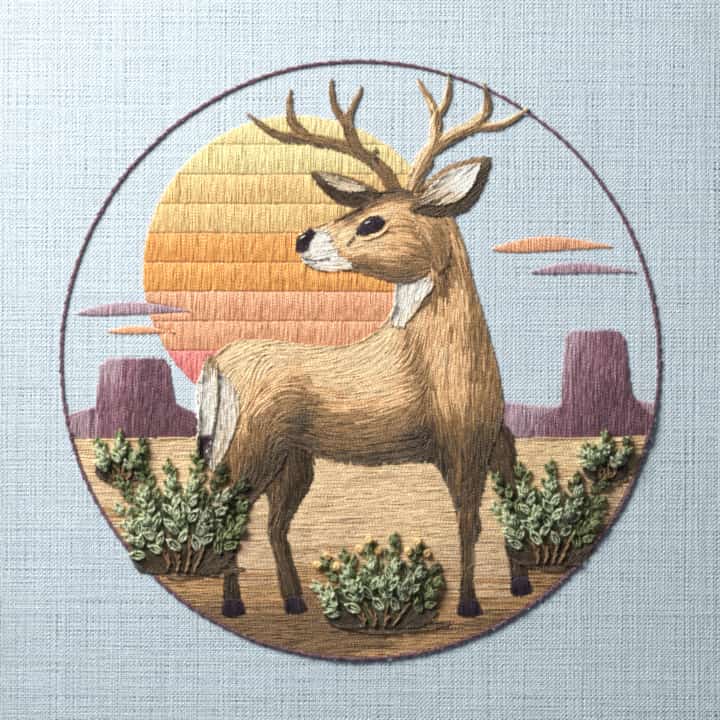
Mule deer looking back in the sage hand embroidery pattern
Advanced · 23 colors · 8 kinds of stitch
Download free PDFPDF, US Letter · 142 KBFor your own stitching, gifts and handmade pieces you sell. Do not resell or share this PDF. What you may do, in full
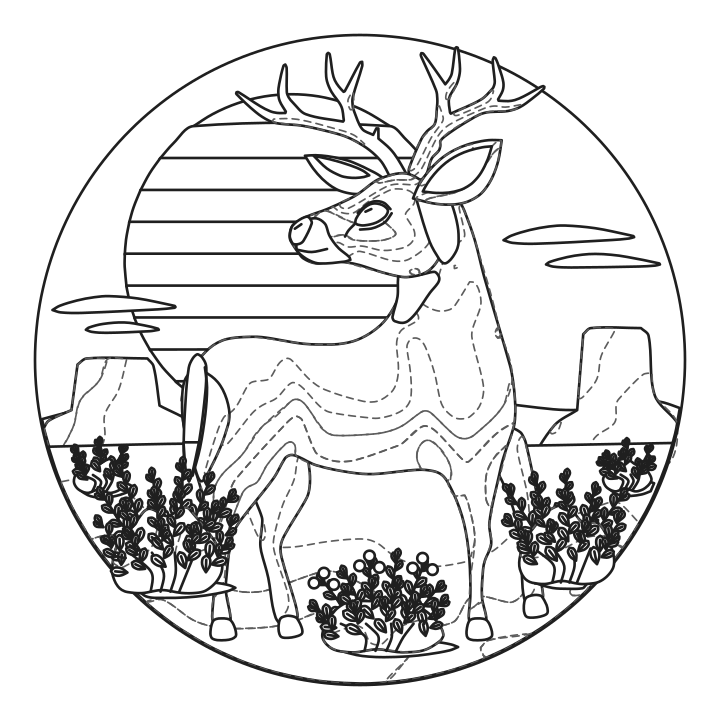
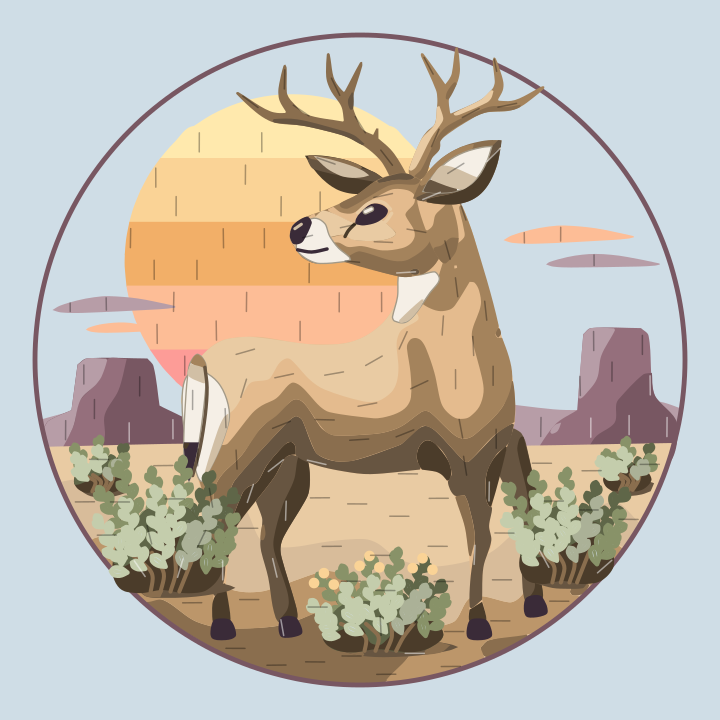
A mule deer buck stands side on in sagebrush country and looks back over his shoulder. His coat, antlers, ears and the buttes and desert floor are long and short stitch, combed the way the hair grows. The sun is worked in bands of satin stitch that run from pale gold to coral, with satin stitch clouds, hills and hooves. The sagebrush leaves are lazy daisy stitch on stem stitch stalks, with French knots of gold bloom on one clump. A stem stitch ring closes the picture, and the antlers reach across it. It is drawn for pale blue linen. In the picture of where the colors go, the fine lines show which way the stitches lie.
Size and details
Advanced. Uses long and short stitch over much of the design, satin stitch over about a quarter of the cloth in a 6 inch hoop, 23 colors and a great deal of stitching.
23 colors of floss and 8 kinds of stitch:
- Satin stitch
- Long and short stitch
- Stem stitch
- Split stitch
- Straight stitch
- Back stitch
- Lazy daisy stitch
- French knot
- Which stitch goes where
| Hoop | Inches | Centimeters | Satin stitch up to |
|---|---|---|---|
| 3 in (8 cm) | 1.9 × 1.9 in | 4.8 × 4.8 cm | 1/8 in (3 mm) |
| 4 in (10 cm) | 2.9 × 2.9 in | 7.4 × 7.4 cm | 3/16 in (5 mm) |
| 5 in (13 cm) | 3.8 × 3.8 in | 9.7 × 9.7 cm | 1/4 in (6 mm) |
| 6 in (15 cm) | 4.8 × 4.8 in | 12.2 × 12.2 cm | 5/16 in (8 mm) |
| 8 in (20 cm) | 6.7 × 6.7 in | 17 × 17 cm | 3/8 in (10 mm) |
- In a 3, 4 or 5 inch hoop the French knots are drawn smaller than about 2 mm (a little over 1/16 in). Use one strand of floss for them there, or choose a larger hoop.
- In a 3, 4, 5 or 6 inch hoop the shortest lazy daisy loops are drawn smaller than about 2 mm (a little over 1/16 in). Use one strand of floss for them there, or choose a larger hoop.
The pattern is drawn inside a circle about half an inch (1.3 cm) smaller all around than the hoop.
What you need
- DMC 745 Light Pale YellowSun (lightest)
- DMC 3855 Light Autumn GoldSun (light), chamisa
- DMC 3854 Medium Autumn GoldSun (dark)
- DMC 3825 Pale PumpkinSun (middle), clouds (lighter)
- DMC 352 Light CoralSun (darkest)
- DMC 3042 Light Antique VioletFar hills, buttes (light), clouds (darker)
- DMC 3740 Dark Antique VioletButtes (dark), border
- DMC 3041 Medium Antique VioletButtes (middle)
- DMC 738 Very Light TanDesert floor, body, head and antlers (lightest), eye rim
- DMC 3862 Dark Mocha BeigeDesert floor and antlers (dark), body (middle dark), ears (light) and 3 more parts
- DMC 3045 Dark Yellow BeigeDesert floor (middle)
- DMC 3046 Medium Yellow BeigeDesert floor (light)
- DMC 839 Dark Beige BrownFar legs (middle), body and ears (dark), desert floor (darkest) and 4 more parts
- DMC 3031 Very Dark Mocha BrownSagebrush (darker), body and ears (darkest), far legs (dark) and 2 more parts
- DMC 3371 Black BrownHooves, eye, nose and mouth, tail tip (darker)
- DMC 437 Light TanBody and head (light)
- DMC 3863 Medium Mocha BeigeBody (middle light), head (middle), antlers (light), ears (lightest), tail (dark)
- DMC 3866 Ultra Very Light MochaRump patch (lighter), tail (lightest), ear lining (light), muzzle and 2 more parts
- DMC 842 Very Light Beige BrownEar lining (middle), rump patch and throat (darker), tail (light), nose light
- DMC 3051 Dark Green GraySagebrush (lighter), woody stems (darker), sage leaves (darkest)
- DMC 3052 Medium Green GraySage leaves (dark)
- DMC 523 Light Fern GreenSage leaves (light)
- DMC 524 Very Light Fern GreenSage leaves (lightest)
Skeins: 2 for desert floor, body, head and antlers (lightest), eye rim; one of each other color. An estimate for the largest size, the 8 inch hoop: the length of each line and the area of each filled shape, a fifth added for tails and ends, a tenth of every 8 m (8.7 yd) skein kept spare.
The floss is six-strand cotton; the stitch guide says how many strands to use. You also need a hoop, an embroidery needle (a size 7 to 9 suits two or three strands) and plain cotton or linen fabric. To frame the piece in its hoop, cut a square 3 inches (8 cm) wider than the hoop: a 9 inch (23 cm) square for a 6 inch hoop.
When it is stitched, how to finish a hoop shows how to back it for the wall.
Stitch guide
- Put the pattern on the fabric (how to transfer a pattern) and the fabric in the hoop.
- Stitch the filled parts first, what lies behind before what lies in front of it.
- Then stitch the lines: stems, veins and outlines over the edges of the filled parts.
- Keep the knots for the end, so that the hoop and your hand do not flatten them.
Start each thread with a small knot on the back or one of the knotless starts, and end it by running the needle under the backs of a few stitches (starting and ending a thread). Use the strands this list gives, also where a page about a stitch names another number.
- Satin stitch 2 strandsSun, clouds, far hills, hooves, nose, eye
- Long and short stitch 1 strandButtes, desert floor, far legs, body, rump patch, tail, tail tip, throat, antlers, ears, ear lining, head, muzzle, sagebrush
- Stem stitch 1 to 3 strandsBorder, woody stems
- Split stitch 1 strandTail, eye rim, tear line
- Straight stitch 1 strandNose light, eye light, sage leaves
- Back stitch 1 strandMouth
- Lazy daisy stitch 2 strandsSage leaves
- French knot 2 strands, two wrapsChamisa
Getting it onto your fabric
The PDF holds the pattern twice at actual size: once as drawn, and once mirrored for an iron-on transfer pen. Print it at 100% with scaling off and check the one-inch square (25.4 mm) with a ruler before you trace. How to transfer a pattern explains tracing, carbon paper and the other ways. The files are under Downloads.
Downloads
- Download free PDF PDF, US Letter, 3 pages, for a 6 inch (15 cm) hoop
- Download free PDF, A4 PDF, A4, 3 pages, for a 6 inch (15 cm) hoop
More patterns like this
Advanced 3–8 in hoop · 23 colors
Joshua tree at desert sunset
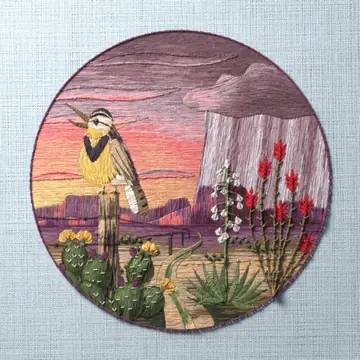
Advanced 3–8 in hoop · 23 colors
West Texas landscape at sunset
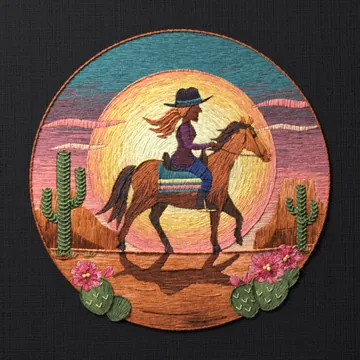
Advanced 3–8 in hoop · 23 colors
Cowgirl at sunset for a jean jacket
Advanced 3–8 in hoop · 24 colors
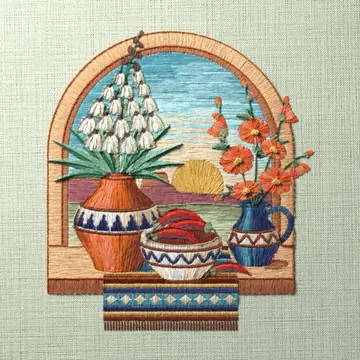
Southwest pottery and yucca
Advanced 3–8 in hoop · 24 colors
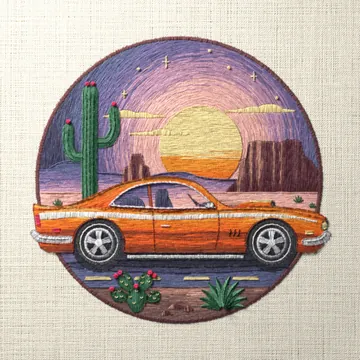
Muscle car in the desert
Advanced 3–8 in hoop · 24 colors
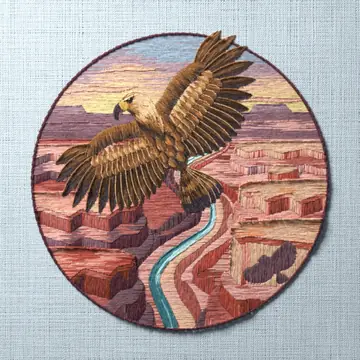
Golden eagle over a Southwest canyon
Advanced 3–8 in hoop · 24 colors
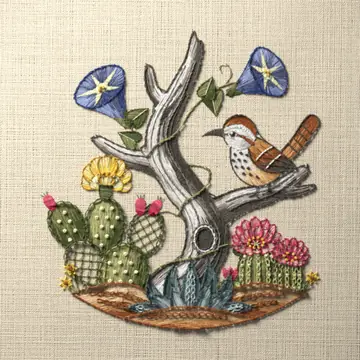
Driftwood and desert flowers
Advanced 3–8 in hoop · 22 colors
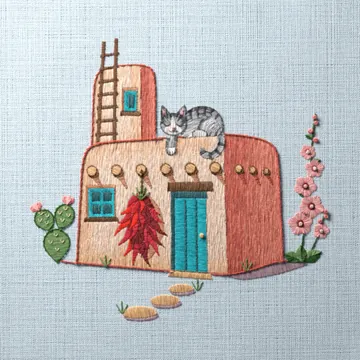
Adobe house with a chile ristra
New to hand embroidery? Starting hand embroidery, step by step