Welcome home yellow ribbon oak hand embroidery pattern
Advanced · 15 colors · 8 kinds of stitch
Download free PDFPDF, US Letter · 80 KBFor your own stitching, gifts and handmade pieces you sell. Do not resell or share this PDF or copies of it. Selling, classes and kits: the rules
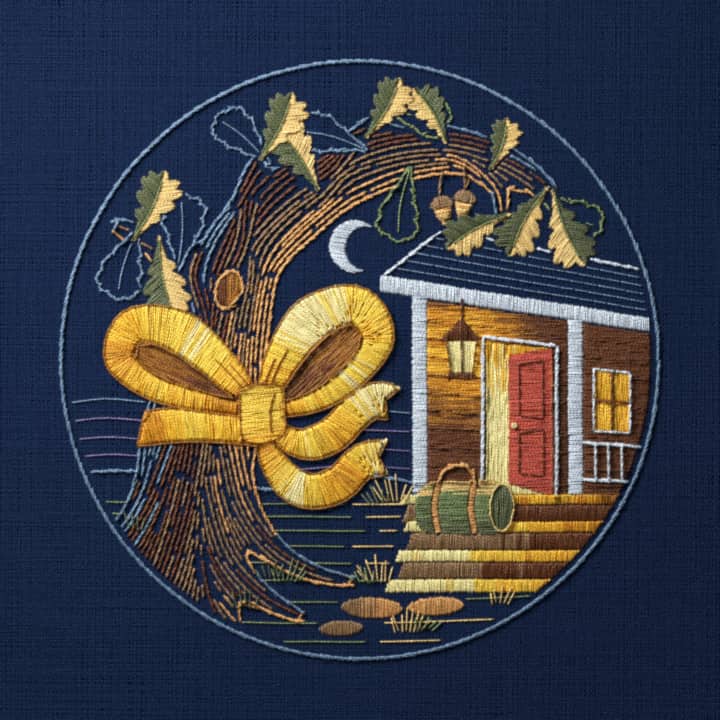
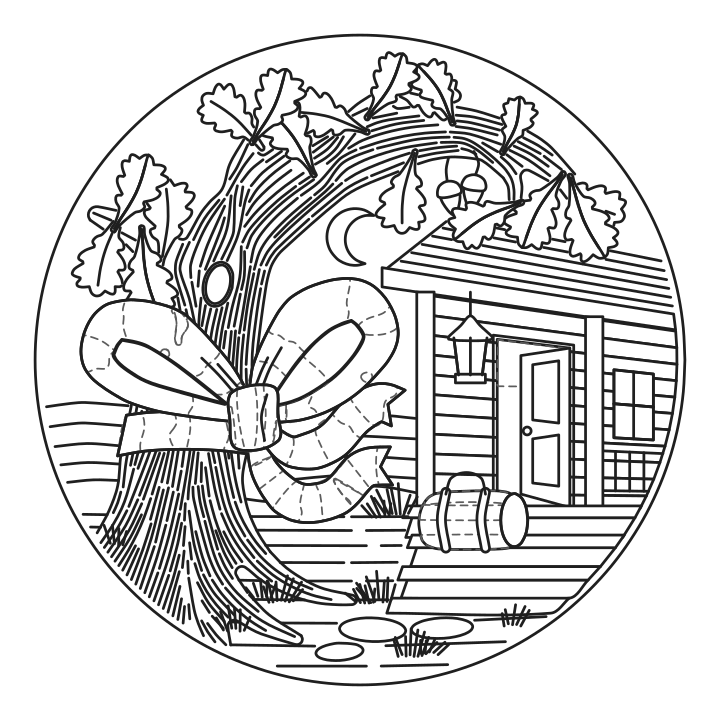
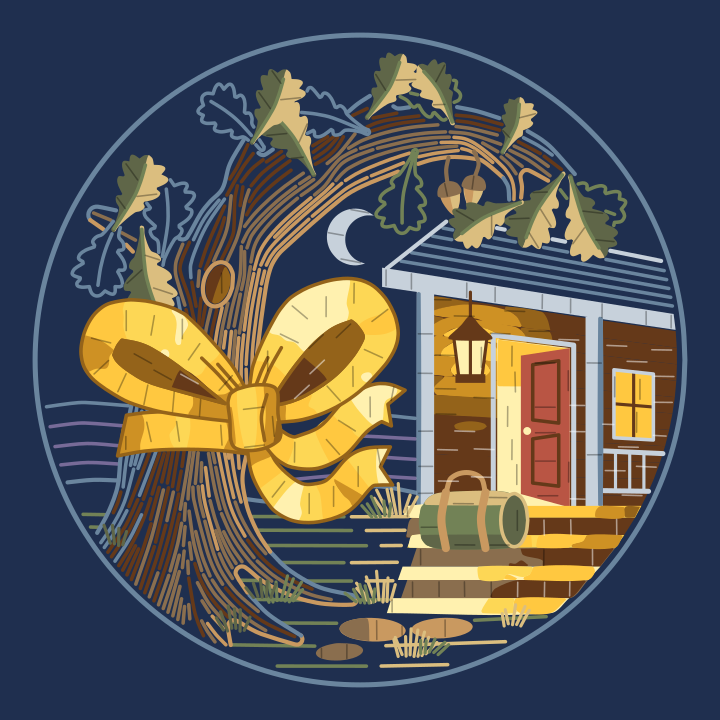
A welcome home picture for a wall: a yellow ribbon is tied round an old oak, the porch lantern is lit, the door stands ajar and a duffel bag has been set down on the step. The bow is raised in padded satin stitch, shaded from deep gold to pale yellow, with a fine split stitch edge. The bark is rows of split stitch that follow the grain, blue on the dusk side and honey on the side turned to the lamp, with stem stitch along the edges. The wall of the house and the open doorway are long and short stitch, the steps, the posts and half of the oak leaves are satin stitch, and the other leaves, the evening sky and the lawn are open lines on dark blue cloth. Grass is straight stitch, the shingles are back stitch and the door knob is a French knot. In the picture of where the colors go, the fine lines show which way the stitches lie.
Size and details
Advanced. Uses long and short stitch, padded satin stitch, satin stitch over about a fifth of the cloth in a 6 inch hoop, 15 colors and a great deal of stitching; from a 6 inch hoop up some of the satin stitches are long.
15 colors of floss and 8 kinds of stitch:
- Split stitch
- Stem stitch
- Satin stitch
- Long and short stitch
- Back stitch
- Straight stitch
- French knot
- Padded satin stitch
- Which stitch goes where
| Hoop | Inches | Centimeters | Satin stitch up to |
|---|---|---|---|
| 3 in (8 cm) | 1.8 × 1.8 in | 4.6 × 4.6 cm | 1/8 in (3 mm) |
| 4 in (10 cm) | 2.8 × 2.8 in | 7.1 × 7.1 cm | 1/4 in (6 mm) |
| 5 in (13 cm) | 3.7 × 3.7 in | 9.4 × 9.4 cm | 5/16 in (8 mm) |
| 6 in (15 cm) | 4.6 × 4.6 in | 11.7 × 11.7 cm | 3/8 in (10 mm) |
| 8 in (20 cm) | 6.5 × 6.5 in | 16.5 × 16.5 cm | 1/2 in (13 mm) |
- In an 8 inch hoop the widest satin stitch shape is 1/2 in (13 mm) across. Satin stitches longer than about 12 mm (just under 1/2 in) tend to work loose: divide the shape into sections, or work it in long and short stitch.
- In a 3 or 4 inch hoop the French knot is drawn smaller than about 2 mm (a little over 1/16 in). Use one strand of floss for it there, or choose a larger hoop.
The pattern is drawn inside a circle about half an inch (1.3 cm) smaller all around than the hoop.
What you need
- DMC 3746 Dark Blue VioletEvening sky (darker)
- DMC 931 Medium Antique BlueRound edge, roof shingles and dusk bark edge, open leaves (lighter) and 5 more parts
- DMC 3752 Very Light Antique BluePorch posts (lighter), porch trim, door frame, moon and porch rail and 2 more parts
- DMC 801 Dark Coffee BrownLamplit wall and bark (darkest), step fronts (darker) and 5 more parts
- DMC 780 Ultra Very Dark TopazRibbon edges, inside of the loops (lighter), lamplit wall (dark) and 7 more parts
- DMC 783 Medium TopazLamplit wall (light), bow loops, ribbon band and ribbon tails (dark) and 2 more parts
- DMC 725 Medium Light TopazBow loops, step tops and ribbon tails (middle), ribbon band (light) and 4 more parts
- DMC 727 Very Light TopazOpen doorway (lighter), step tops and bow loops (lightest) and 3 more parts
- DMC 3830 Terra CottaDoor
- DMC 3862 Dark Mocha BeigeBark (dark), step fronts (lighter), stepping stones (darker) and 2 more parts
- DMC 726 Light TopazBow loops, ribbon tails and step tops (light), bow knot and ribbon band (lightest)
- DMC 3363 Medium Pine GreenDuffel bag and grass (middle), lawn, leaf veins and open leaves (darker)
- DMC 3051 Dark Green GrayLeaves (darker), duffel bag and grass (dark), duffel end
- DMC 834 Very Light Golden OliveLeaves, lawn and acorns (lighter), grass and duffel bag (light), duffel seams
- DMC 436 TanBark (lightest), lit bark edge, stepping stones (lighter) and 4 more parts
Skeins: 2 for lamplit wall and bark (darkest), step fronts (darker) and 5 more parts; one of each other color. An estimate for the largest size, the 8 inch hoop: the length of each line and the area of each filled shape, a fifth added for tails and ends, a tenth of every 8 m (8.7 yd) skein kept spare.
The floss is six-strand cotton; the stitch guide says how many strands to use. You also need a hoop, an embroidery needle (a size 9 or 10 for one strand, 7 to 9 for two or three) and plain cotton or linen fabric. To frame the piece in its hoop, cut a square 3 inches (8 cm) wider than the hoop: a 9 inch (23 cm) square for a 6 inch hoop.
When it is stitched, how to finish a hoop shows how to back it for the wall.
Stitch guide
- Put the pattern on the fabric (how to transfer a pattern) and the fabric in the hoop.
- Stitch the filled parts first, what lies behind before what lies in front of it.
- Then stitch the lines: stems, veins and outlines over the edges of the filled parts.
- Keep the knots for the end, so that the hoop and your hand do not flatten them.
Inside a filled shape start with two or three tiny stitches, which the filling covers: a knot shows as a bump. A line may start with a small knot on the back or one of the knotless starts. End each thread by running the needle under the backs of a few stitches. (Starting and ending a thread shows how.) Use the strands this list gives, and begin as it says, also where a page about a stitch names another number or begins with a knot.
- Split stitch 1 to 2 strandsEvening sky, duffel seams, lawn, bark, open leaves, leaf veins, ribbon edges, folds
- Stem stitch 2 to 3 strandsFar hill, roof edge, door frame, porch rail, duffel handle, knot hole rim, lit bark edge, dusk bark edge, acorn stalks, round edge
- Satin stitch 2 strandsMoon, porch trim, window, door, lantern glass, lantern, porch posts, step fronts, step tops, duffel end, duffel straps, stepping stones, and 2 more
- Long and short stitch 1 strandLamplit wall, open doorway, duffel bag, knot hole, inside of the loops
- Back stitch 1 to 2 strandsRoof shingles, window frame, door panels
- Straight stitch 1 to 2 strandsWindow bars, lantern, porch rail, grass
- French knot 1 strand, two wrapsDoor knob
- Padded satin stitch 2 strandsAcorns, ribbon band, ribbon tails, bow loops, bow knot
Getting it onto your fabric
The PDF holds the pattern twice at actual size: once as drawn, and once mirrored for an iron-on transfer pen. Print it at 100% with scaling off and check the one-inch square (25.4 mm) with a ruler before you trace. How to transfer a pattern explains tracing, carbon paper, the sticky wash-away sheet for knits, denim and dark cloth, and the other ways. The files are under Downloads.
Downloads
- Download free PDF PDF, US Letter, 3 pages, for a 6 inch (15 cm) hoop
- Download free PDF, A4 PDF, A4, 3 pages, for a 6 inch (15 cm) hoop
More patterns like this
Advanced 3–8 in hoop · 13 colors
Military ribbon bar stitch sampler
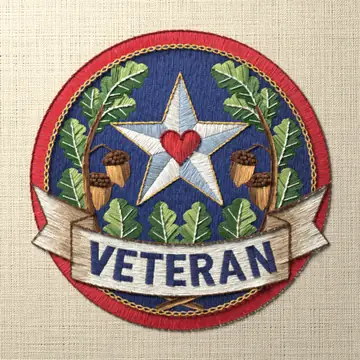
Advanced 3–8 in hoop · 19 colors
Veteran patch with star and oak
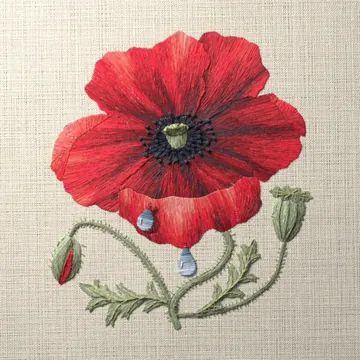
Advanced 3–8 in hoop · 19 colors
Remembrance poppy in the rain
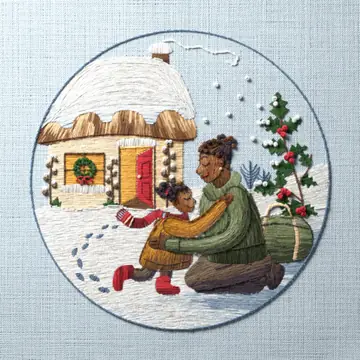
Advanced prints 3–14 in · 24 colors
Soldier mom homecoming in the snow
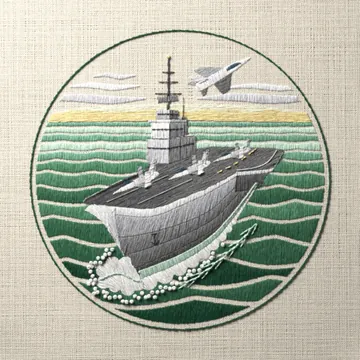
Advanced prints 3–14 in · 16 colors
Aircraft carrier at sea
Advanced prints 3–14 in · 12 colors
Military block alphabet
Advanced 3–8 in hoop · 19 colors
Memorial folded flag with rosemary
Advanced prints 3–14 in · 15 colors
As for me and my house, primitive house
New to hand embroidery? Starting hand embroidery, step by step