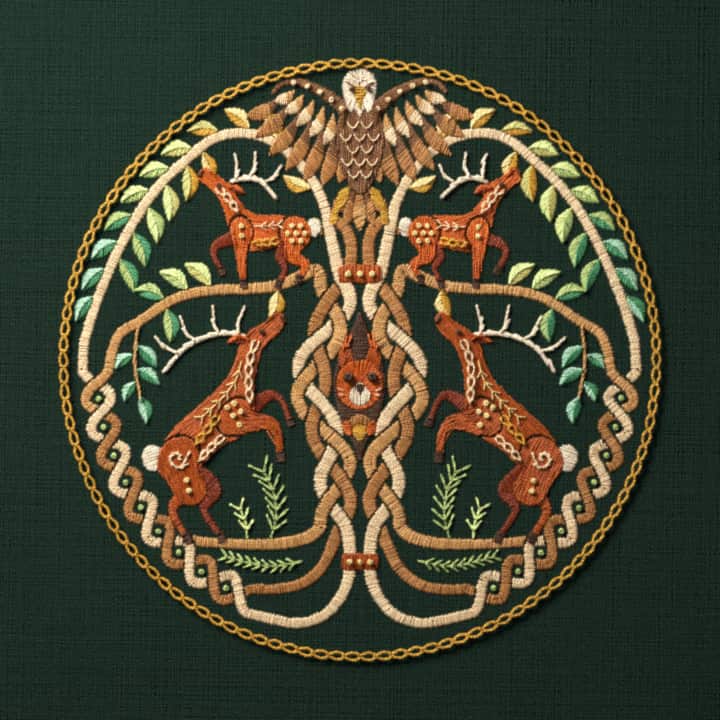
Norse world tree with four stags hand embroidery pattern
Advanced · 16 colors · 9 kinds of stitch

Download free PDFPDF, US Letter · 113 KBFor your own stitching, gifts and handmade pieces you sell. Do not resell or share this PDF. What you may do, in full
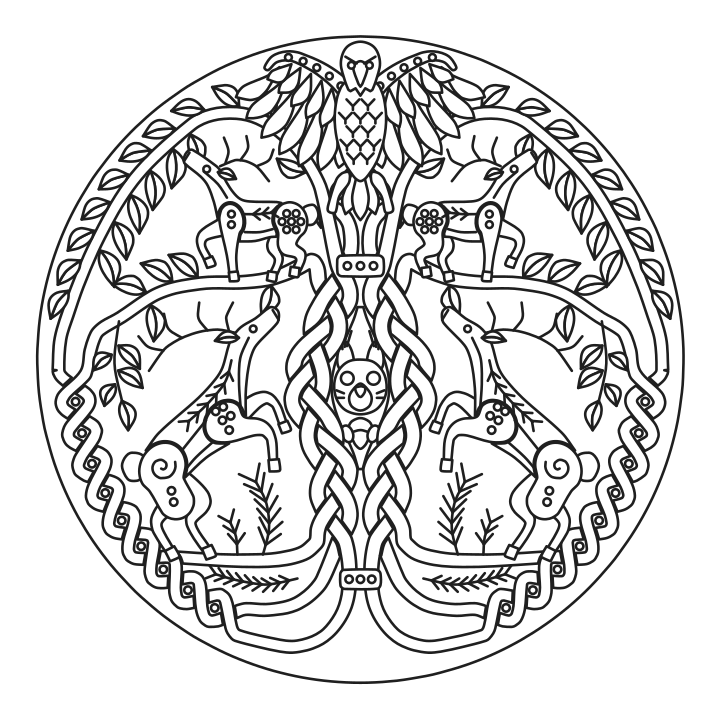
The world tree of Norse myth fills a circle, the same on both sides of its plaited trunk, with boughs arching overhead and roots braided into the lower ring. The trunk, boughs and roots are cords of satin stitch that pass over and under, and the outer ring is chain stitch in gold. Four russet stags in long and short stitch carry bands of chain stitch, sprigs of fern stitch and French knots, with antlers in stem stitch. The leaves are fishbone stitch and turn from jade at the sides to gold near the crown. An eagle with satin stitch feathers and fly stitch scales spreads its wings at the top, and a squirrel with straight stitch ear tufts holds an acorn in the hollow. It is drawn for dark green linen. In the picture of where the colors go, the fine lines show which way the stitches lie.
Size and details
Advanced. Uses long and short stitch, dozens of French knots, satin stitch over about a fifth of the cloth in a 6 inch hoop, 16 colors and a great deal of stitching.
16 colors of floss and 9 kinds of stitch:
- Chain stitch
- Satin stitch
- Straight stitch
- Long and short stitch
- French knot
- Fishbone stitch
- Stem stitch
- Fern stitch
- Fly stitch
- Which stitch goes where
| Hoop | Inches | Centimeters | Satin stitch up to |
|---|---|---|---|
| 3 in (8 cm) | 1.9 × 1.9 in | 4.8 × 4.8 cm | 1/16 in (1.6 mm) |
| 4 in (10 cm) | 2.9 × 2.9 in | 7.4 × 7.4 cm | 1/8 in (3 mm) |
| 5 in (13 cm) | 3.9 × 3.9 in | 9.9 × 9.9 cm | 3/16 in (5 mm) |
| 6 in (15 cm) | 4.9 × 4.9 in | 12.4 × 12.4 cm | 1/4 in (6 mm) |
| 8 in (20 cm) | 6.8 × 6.8 in | 17.3 × 17.3 cm | 5/16 in (8 mm) |
- In a 3, 4 or 5 inch hoop the French knots are drawn smaller than about 2 mm (a little over 1/16 in). Use one strand of floss for them there, or choose a larger hoop.
The pattern is drawn inside a circle about half an inch (1.3 cm) smaller all around than the hoop.
What you need
- DMC 3852 Very Dark StrawOuter ring and eagle talons, leaves (shade 2 of 7) and 3 more parts
- DMC 898 Very Dark Coffee BrownHollow, hooves, squirrel eyes, eyes, noses and squirrel nose
- DMC 920 Medium CopperLower stags, trunk bindings and squirrel ears
- DMC 921 CopperUpper stags, squirrel face, ear tufts and squirrel paws, ears (lighter)
- DMC 739 Ultra Very Light TanAntlers, eagle head, tails, squirrel muzzle and squirrel cheeks
- DMC 435 Very Light BrownTrunk, boughs and roots (dark), eagle wing feathers (lighter) and 2 more parts
- DMC 738 Very Light TanTrunk, boughs and roots (light), eagle short feathers (lighter) and 5 more parts
- DMC 436 TanTrunk, boughs and roots (middle), eagle short feathers (darker), twigs and 1 more part
- DMC 3822 Light StrawStag fern (lighter), leaves (shade 7 of 7), stag knots and binding knots
- DMC 734 Light Olive GreenLeaves (shade 4 of 7)
- DMC 472 Ultra Light Avocado GreenLeaves (shade 6 of 7), ferns (lighter)
- DMC 471 Very Light Avocado GreenFerns (darker), leaves (shade 3 of 7), ring knots
- DMC 562 Medium JadeLeaves (shade 1 of 7)
- DMC 564 Very Light JadeLeaves (shade 5 of 7)
- DMC 918 Dark Red CopperLower stags, far legs and upper stags, far legs, ears (darker)
- DMC 433 Medium BrownEagle body, eagle wings and eagle brows, eagle wing feathers (darker), eagle tail (dark)
Skeins: one of each color is enough. An estimate for the largest size, the 8 inch hoop: the length of each line and the area of each filled shape, a fifth added for tails and ends, a tenth of every 8 m (8.7 yd) skein kept spare.
The floss is six-strand cotton; the stitch guide says how many strands to use. You also need a hoop, an embroidery needle (a size 7 to 9 suits two or three strands) and plain cotton or linen fabric. To frame the piece in its hoop, cut a square 3 inches (8 cm) wider than the hoop: a 9 inch (23 cm) square for a 6 inch hoop.
When it is stitched, how to finish a hoop shows how to back it for the wall.
Stitch guide
- Put the pattern on the fabric (how to transfer a pattern) and the fabric in the hoop.
- Stitch the filled parts first, what lies behind before what lies in front of it.
- Then stitch the lines: stems, veins and outlines over the edges of the filled parts.
- Keep the knots for the end, so that the hoop and your hand do not flatten them.
Start each thread with a small knot on the back or one of the knotless starts, and end it by running the needle under the backs of a few stitches (starting and ending a thread). Use the strands this list gives, also where a page about a stitch names another number.
- Chain stitch 2 to 3 strandsOuter ring, stag chain
- Satin stitch 2 strandsHollow, squirrel ears, squirrel muzzle, squirrel nose, acorn, acorn cup, squirrel paws, trunk, boughs and roots, lower stags, far legs, and 11 more
- Straight stitch 1 to 2 strandsEar tufts, squirrel cheeks, noses, eagle brows
- Long and short stitch 1 strandSquirrel face, lower stags, upper stags, eagle body, eagle head
- French knot 1 to 2 strands, two wrapsSquirrel eyes, ring knots, stag knots, eyes, binding knots, eagle wing knots
- Fishbone stitch 2 strandsLeaves, ears
- Stem stitch 2 to 5 strandsTwigs, antlers, stag scrolls
- Fern stitch 1 to 2 strandsFerns, stag fern
- Fly stitch 1 strandEagle breast
Getting it onto your fabric
The PDF holds the pattern twice at actual size: once as drawn, and once mirrored for an iron-on transfer pen. Print it at 100% with scaling off and check the one-inch square (25.4 mm) with a ruler before you trace. How to transfer a pattern explains tracing, carbon paper and the other ways. The files are under Downloads.
Downloads
- Download free PDF PDF, US Letter, 3 pages, for a 6 inch (15 cm) hoop
- Download free PDF, A4 PDF, A4, 3 pages, for a 6 inch (15 cm) hoop
More patterns like this
Advanced 3–8 in hoop · 23 colors
Viking longship with a striped sail
Advanced 3–8 in hoop · 23 colors
Odin and his ravens at the well in snow
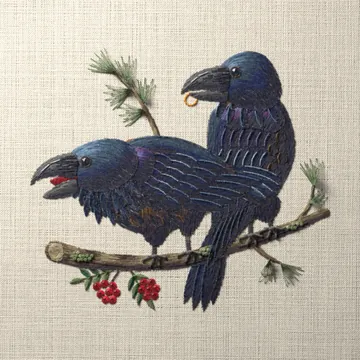
Advanced 3–8 in hoop · 24 colors
Hugin and Munin, Odin’s two ravens
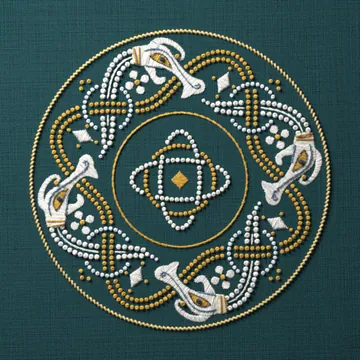
Advanced 3–8 in hoop · 6 colors
Candlewick Viking knot wreath
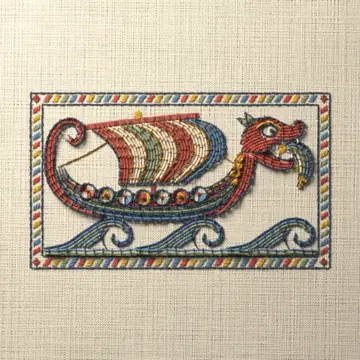
Intermediate 3–8 in hoop · 9 colors
Medieval wool dragon ship
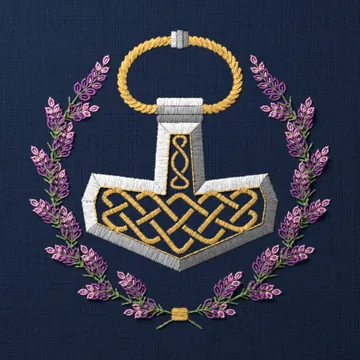
Easy 3–8 in hoop · 7 colors
Thor’s hammer with heather, easy
Advanced 3–8 in hoop · 21 colors
Maple tree scene in fall colors
Advanced 3–8 in hoop · 16 colors
Deer silhouette stitch sampler
New to hand embroidery? Starting hand embroidery, step by step