Rune bookmark with wildflowers hand embroidery pattern
Advanced · 18 colors · 9 kinds of stitch
Download free PDFPDF, US Letter · 64 KBFor your own stitching, gifts and handmade pieces you sell. Do not resell or share this PDF or copies of it. Selling, classes and kits: the rules
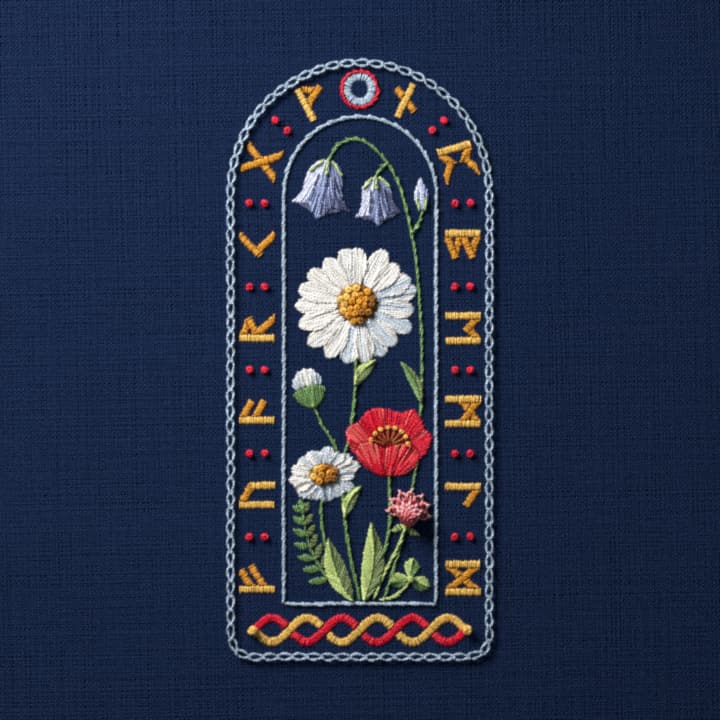
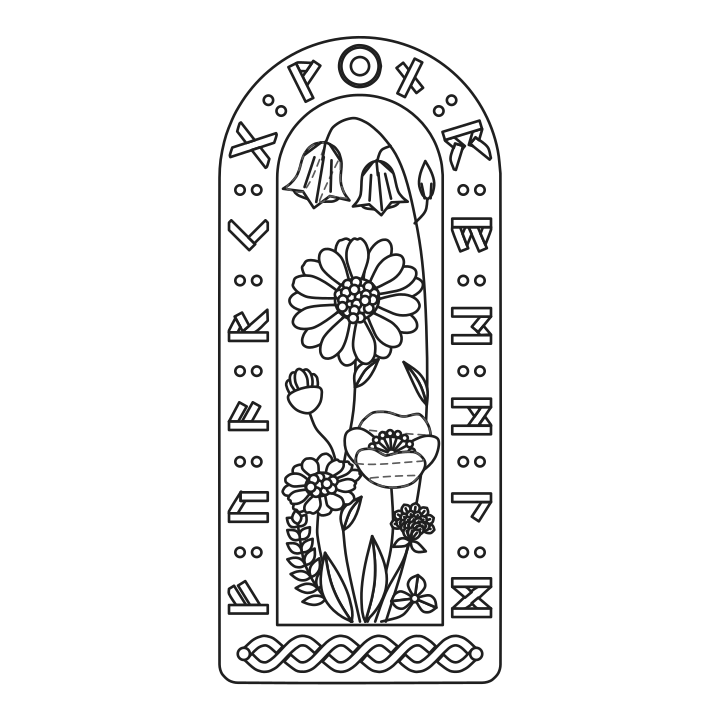
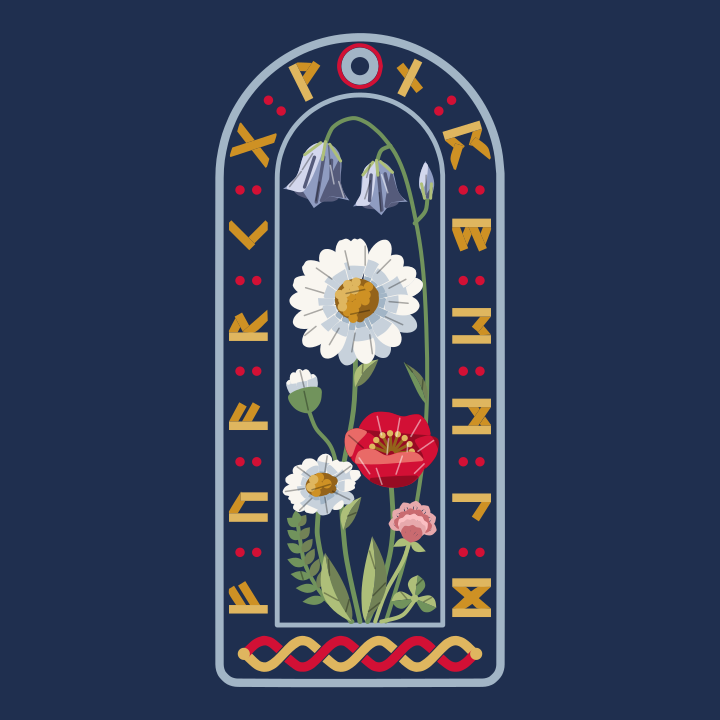
A tall bookmark on dark blue cloth with an arched top, like an old rune stone. Fourteen runes, used only as letters, stand in the band: fehu, uruz, ansuz, raido, kenaz, gebo and wunjo up the left side, then naudiz, perthro, berkano, ehwaz, mannaz, laguz and dagaz down the right. Each rune is made of narrow bars of satin stitch, with pairs of French knots between them, a chain stitch line outside and a stem stitch line inside. The daisies are satin stitch with hearts of French knots, the poppy and harebells are long and short stitch, the clover head is lazy daisy stitch, and the broad leaves are fishbone stitch. A satin stitch eyelet marks the place for a cord, and a gold and red twist in satin stitch closes the foot. In the picture of where the colors go, the fine lines show which way the stitches lie.
Size and details
Advanced. Uses long and short stitch, dozens of French knots and 18 colors; from a 6 inch hoop up the widest satin stitches are long.
18 colors of floss and 9 kinds of stitch:
- Chain stitch
- Satin stitch
- French knot
- Stem stitch
- Fishbone stitch
- Long and short stitch
- Straight stitch
- Back stitch
- Lazy daisy stitch
- Which stitch goes where
| Hoop | Inches | Centimeters | Satin stitch up to |
|---|---|---|---|
| 3 in (8 cm) | 0.8 × 1.9 in | 2 × 4.8 cm | 1/8 in (3 mm) |
| 4 in (10 cm) | 1.3 × 2.9 in | 3.3 × 7.4 cm | 1/4 in (6 mm) |
| 5 in (13 cm) | 1.7 × 3.8 in | 4.3 × 9.7 cm | 5/16 in (8 mm) |
| 6 in (15 cm) | 2.1 × 4.8 in | 5.3 × 12.2 cm | 3/8 in (10 mm) |
| 8 in (20 cm) | 3 × 6.7 in | 7.6 × 17 cm | 1/2 in (13 mm) |
- In an 8 inch hoop the widest satin stitch shape is 1/2 in (13 mm) across. Satin stitches longer than about 12 mm (just under 1/2 in) tend to work loose: divide the shape into sections, or work it in long and short stitch.
- In a 3, 4 or 5 inch hoop the French knots are drawn smaller than about 2 mm (a little over 1/16 in). Use one strand of floss for them there, or choose a larger hoop.
- In a 3 or 4 inch hoop the shortest lazy daisy loops are drawn smaller than about 2 mm (a little over 1/16 in). Use one strand of floss for them there, or choose a larger hoop.
The pattern is drawn inside a circle about half an inch (1.3 cm) smaller all around than the hoop.
What you need
- DMC 932 Light Antique BlueFrame, outer line and frame, inner line, daisy petals (dark) and 2 more parts
- DMC 783 Medium TopazRunes (darker), daisy hearts (middle)
- DMC 3820 Dark StrawRunes, twist and poppy stamens (lighter), daisy hearts (light), twist ends
- DMC 349 Dark CoralPoppy petals (middle), twist and eyelet (darker), dividing dots
- DMC 3347 Medium Yellow GreenStems (darker), fern leaves (lighter), daisy bud cup and fern stems and 2 more parts
- DMC 3363 Medium Pine GreenLeaves, fern leaves and narrow leaves (darker)
- DMC 471 Very Light Avocado GreenLeaves, stems and clover leaves (lighter), harebell sepals and 3 more parts
- DMC 794 Light Cornflower BlueHarebells and harebell bud (middle)
- DMC 792 Dark Cornflower BlueHarebells and harebell bud (dark), harebell ribs
- DMC 3747 Very Light Blue VioletHarebells and harebell bud (light)
- DMC 3752 Very Light Antique BlueDaisy petals and daisy bud (middle)
- DMC 3865 Winter WhiteDaisy petals and daisy bud (light)
- DMC 780 Ultra Very Dark TopazDaisy hearts (dark), poppy stamens (darker)
- DMC 816 GarnetPoppy petals (dark), poppy heart
- DMC 351 CoralPoppy petals (light)
- DMC 3688 Medium MauveClover head (middle)
- DMC 3687 MauveClover head (dark)
- DMC 3689 Light MauveClover head (light)
Skeins: one of each color is enough. An estimate for the largest size, the 8 inch hoop: the length of each line and the area of each filled shape, a fifth added for tails and ends, a tenth of every 8 m (8.7 yd) skein kept spare.
The floss is six-strand cotton; the stitch guide says how many strands to use. You also need a hoop, an embroidery needle (a size 9 or 10 for one strand, 7 to 9 for two or three) and plain cotton or linen fabric. To frame the piece in its hoop, cut a square 3 inches (8 cm) wider than the hoop: a 9 inch (23 cm) square for a 6 inch hoop.
When it is stitched, how to finish a hoop shows how to back it for the wall.
Stitch guide
- Put the pattern on the fabric (how to transfer a pattern) and the fabric in the hoop.
- Stitch the filled parts first, what lies behind before what lies in front of it.
- Then stitch the lines: stems, veins and outlines over the edges of the filled parts.
- Keep the knots for the end, so that the hoop and your hand do not flatten them.
Inside a filled shape start with two or three tiny stitches, which the filling covers: a knot shows as a bump. A line may start with a small knot on the back or one of the knotless starts. End each thread by running the needle under the backs of a few stitches. (Starting and ending a thread shows how.) Use the strands this list gives, and begin as it says, also where a page about a stitch names another number or begins with a knot.
- Chain stitch 2 strandsFrame, outer line
- Satin stitch 2 strandsRunes, eyelet, twist, fern leaves, harebells, daisy petals, daisy hearts, daisy bud, daisy bud cup, poppy heart, clover sepals
- French knot 1 to 2 strands, two wrapsDividing dots, twist ends, clover leaf hearts, daisy hearts, poppy stamens
- Stem stitch 2 to 3 strandsEyelet, frame, inner line, fern stems, stems, clover stems
- Fishbone stitch 2 strandsNarrow leaves, leaves, clover leaves
- Long and short stitch 1 strandHarebell bud, harebells, poppy petals
- Straight stitch 1 to 2 strandsHarebell sepals, poppy stamens, clover head
- Back stitch 1 strandHarebell ribs
- Lazy daisy stitch 2 strandsClover head
Getting it onto your fabric
The PDF holds the pattern twice at actual size: once as drawn, and once mirrored for an iron-on transfer pen. Print it at 100% with scaling off and check the one-inch square (25.4 mm) with a ruler before you trace. How to transfer a pattern explains tracing, carbon paper, the sticky wash-away sheet for knits, denim and dark cloth, and the other ways. The files are under Downloads.
Downloads
- Download free PDF PDF, US Letter, 3 pages, for a 6 inch (15 cm) hoop
- Download free PDF, A4 PDF, A4, 3 pages, for a 6 inch (15 cm) hoop
More patterns like this
Advanced prints 3–14 in · 19 colors
Viking helmet full of daisies
Advanced prints 3–14 in · 16 colors
Norse world tree with four stags
Advanced prints 3–14 in · 21 colors
Fenrir the wolf and the magic ribbon
Advanced prints 3–14 in · 23 colors
Viking longship with a striped sail
Advanced 3–8 in hoop · 23 colors
Valkyrie in a swan feather cloak
Advanced prints 3–14 in · 23 colors
Odin and his ravens at the well in snow
Advanced 3–8 in hoop · 24 colors
Hugin and Munin, Odin’s two ravens
Advanced 3–8 in hoop · 6 colors
Candlewick Viking knot wreath
New to hand embroidery? Starting hand embroidery, step by step