Sleepy tooth tucked in bed hand embroidery pattern
Advanced · 23 colors · 11 kinds of stitch
Download free PDFPDF, US Letter · 61 KBFor your own stitching, gifts and handmade pieces you sell. Do not resell or share this PDF. What you may do, in full
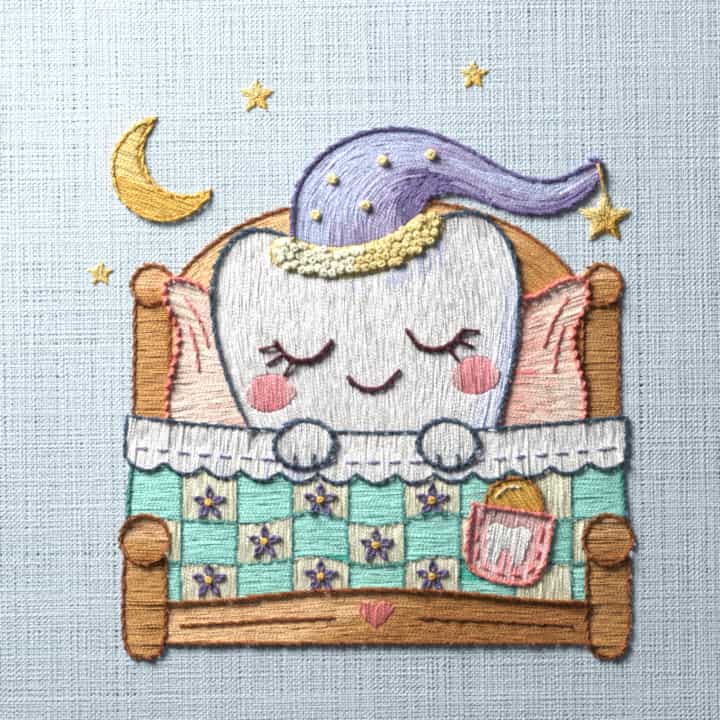
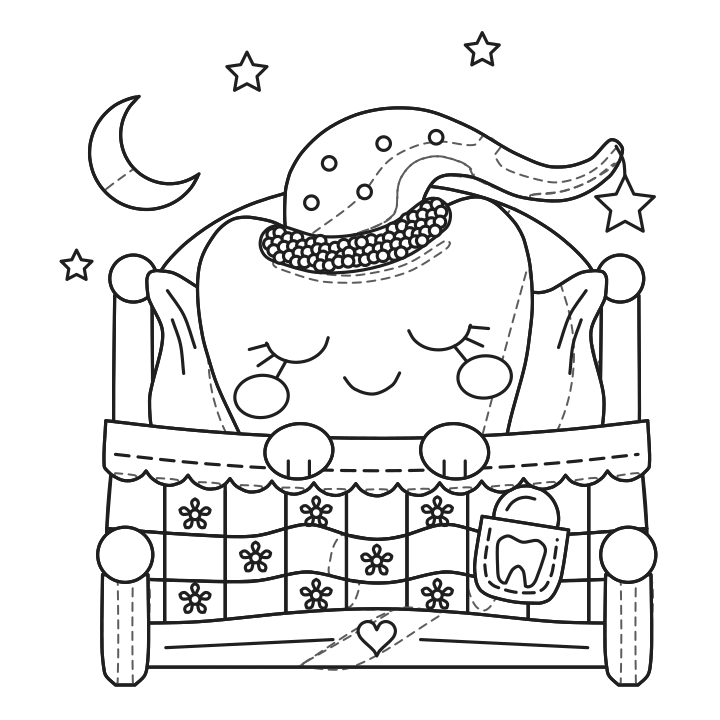
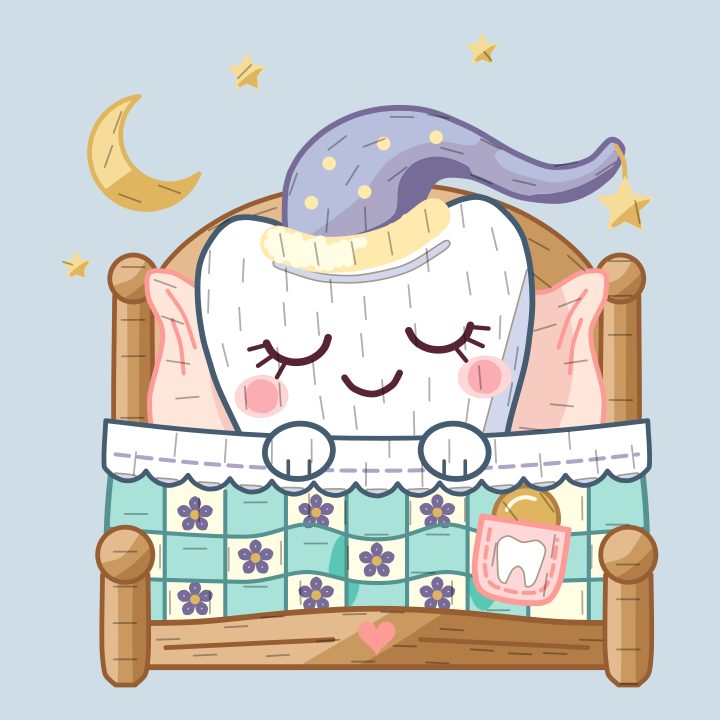
A smiling tooth sleeps with closed lashes and pink cheeks, its head tipped into a peach pillow and two paws over the scalloped sheet. The tooth, night cap, pillow, sheet, headboard, footboard and pink pocket are long and short stitch, and the quilt is mint and cream satin patches with lazy daisy flowers and back stitch seams. The moon, the coin, the paws and the hanging star are padded satin stitch, the cap has a fluffy band of French knots, the pillow is piped in whipped back stitch and most edges are stem stitch. The coin in its pocket suits the front of a tooth fairy pillow. It is drawn for pale blue linen. In the picture of where the colors go, the fine lines show which way the stitches lie.
Size and details
Advanced. Uses long and short stitch over much of the design, padded satin stitch, dozens of French knots, satin stitch over about a fifth of the cloth in a 6 inch hoop, 23 colors and a great deal of stitching; from a 5 inch hoop up some of the satin stitches are long.
23 colors of floss and 11 kinds of stitch:
- Long and short stitch
- Stem stitch
- Satin stitch
- Whipped back stitch
- Split stitch
- Straight stitch
- French knot
- Lazy daisy stitch
- Back stitch
- Padded satin stitch
- Running stitch
- Which stitch goes where
| Hoop | Inches | Centimeters | Satin stitch up to |
|---|---|---|---|
| 3 in (8 cm) | 1.5 × 1.6 in | 3.8 × 4.1 cm | 3/16 in (5 mm) |
| 4 in (10 cm) | 2.2 × 2.4 in | 5.6 × 6.1 cm | 1/4 in (6 mm) |
| 5 in (13 cm) | 2.9 × 3.2 in | 7.4 × 8.1 cm | 3/8 in (10 mm) |
| 6 in (15 cm) | 3.7 × 4 in | 9.4 × 10.2 cm | 7/16 in (11 mm) |
| 8 in (20 cm) | 5.1 × 5.6 in | 13 × 14.2 cm | 5/8 in (16 mm) |
- In an 8 inch hoop the widest satin stitch shape is 5/8 in (16 mm) across. Satin stitches longer than about 12 mm (just under 1/2 in) tend to work loose: divide the shape into sections, or work it in long and short stitch.
- In a 3, 4, 5 or 6 inch hoop the French knots and the shortest lazy daisy loops are drawn smaller than about 2 mm (a little over 1/16 in). Use one strand of floss for them there, or choose a larger hoop.
The pattern is drawn inside a circle about half an inch (1.3 cm) smaller all around than the hoop.
What you need
- DMC 437 Light TanHeadboard, footboard, post knobs and bed posts (light)
- DMC 435 Very Light BrownFootboard, bed posts, headboard and post knobs (dark), coin edge
- DMC 436 TanHeadboard, bed posts, footboard and post knobs (middle)
- DMC 434 Light BrownHeadboard edge and footboard line
- DMC 754 Light PeachPillow (darker)
- DMC 948 Very Light PeachPillow (lighter)
- DMC 352 Light CoralPillow piping, pocket edge, pillow creases, pocket stitching and footboard heart
- DMC B5200 Snow WhiteTooth and sheet (lighter), paws and pocket tooth
- DMC 3747 Very Light Blue VioletTooth and sheet (darker)
- DMC 930 Dark Antique BlueTooth edge, sheet edge and paw lines
- DMC 3326 Light RoseCheeks (darker)
- DMC 963 Ultra Very Light Dusty RosePocket, cheeks (lighter)
- DMC 154 Very Dark GrapeEyes, lashes and smile
- DMC 341 Light Blue VioletNight cap (light)
- DMC 3746 Dark Blue VioletNight cap (dark), night cap edge and quilt flowers
- DMC 340 Medium Blue VioletNight cap (middle), sheet stitching
- DMC 745 Light Pale YellowCap band (darker), cap dots
- DMC 3823 Ultra Pale YellowCream patches and coin light, cap band (lighter)
- DMC 964 Light SeagreenGreen patches (lighter)
- DMC 959 Medium SeagreenGreen patches (darker)
- DMC 3820 Dark StrawCoin, moon edge, flower hearts and star thread, moon, small stars and star (darker)
- DMC 3848 Medium Teal GreenQuilt seams and quilt edge
- DMC 3822 Light StrawMoon, small stars and star (lighter)
Skeins: 2 for headboard, footboard, post knobs and bed posts (light) and 2 for tooth and sheet (lighter), paws and pocket tooth; one of each other color. An estimate for the largest size, the 8 inch hoop: the length of each line and the area of each filled shape, a fifth added for tails and ends, a tenth of every 8 m (8.7 yd) skein kept spare.
The floss is six-strand cotton; the stitch guide says how many strands to use. You also need a hoop, an embroidery needle (a size 7 to 9 suits two or three strands) and plain cotton or linen fabric. To frame the piece in its hoop, cut a square 3 inches (8 cm) wider than the hoop: a 9 inch (23 cm) square for a 6 inch hoop.
When it is stitched, how to finish a hoop shows how to back it for the wall.
Stitch guide
- Put the pattern on the fabric (how to transfer a pattern) and the fabric in the hoop.
- Stitch the filled parts first, what lies behind before what lies in front of it.
- Then stitch the lines: stems, veins and outlines over the edges of the filled parts.
- Keep the knots for the end, so that the hoop and your hand do not flatten them.
Start each thread with a small knot on the back or one of the knotless starts, and end it by running the needle under the backs of a few stitches (starting and ending a thread). Use the strands this list gives, also where a page about a stitch names another number.
- Long and short stitch 1 to 2 strandsHeadboard, pillow, tooth, night cap, pocket, sheet, footboard
- Stem stitch 2 to 5 strandsHeadboard edge, tooth edge, eyes, smile, night cap edge, quilt edge, coin edge, pocket edge, sheet edge, footboard line, star thread, moon edge
- Satin stitch 2 strandsBed posts, post knobs, cheeks, cap band, green patches, cream patches, pocket tooth, footboard heart, small stars
- Whipped back stitch 3 strandsPillow piping
- Split stitch 2 strandsPillow creases
- Straight stitch 2 to 4 strandsLashes, paw lines
- French knot 2 strands, two wrapsCap dots, cap band, flower hearts
- Lazy daisy stitch 2 strandsQuilt flowers
- Back stitch 1 to 2 strandsQuilt seams, coin light
- Padded satin stitch 2 strandsCoin, paws, star, moon
- Running stitch 2 strandsPocket stitching, sheet stitching
Getting it onto your fabric
The PDF holds the pattern twice at actual size: once as drawn, and once mirrored for an iron-on transfer pen. Print it at 100% with scaling off and check the one-inch square (25.4 mm) with a ruler before you trace. How to transfer a pattern explains tracing, carbon paper and the other ways. The files are under Downloads.
Downloads
- Download free PDF PDF, US Letter, 3 pages, for a 6 inch (15 cm) hoop
- Download free PDF, A4 PDF, A4, 3 pages, for a 6 inch (15 cm) hoop
More patterns like this

Advanced 3–8 in hoop · 22 colors
Tooth fairy on the moon

Easy 3–8 in hoop · 4 colors
Tooth with wings
Advanced 3–8 in hoop · 23 colors
Queen bee in a honeycomb wreath
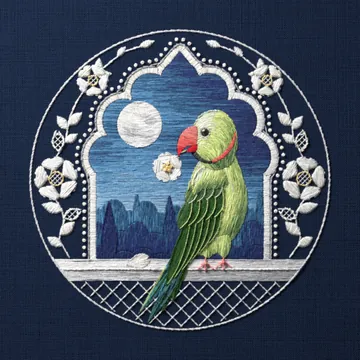
Advanced 3–8 in hoop · 23 colors
Parakeet in a moonlit garden window
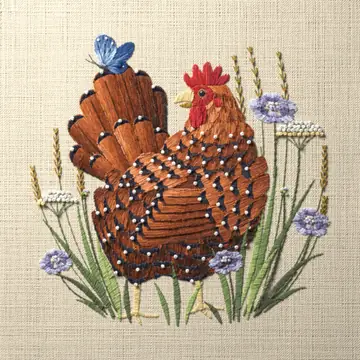
Advanced 3–8 in hoop · 23 colors
Speckled chicken in a meadow
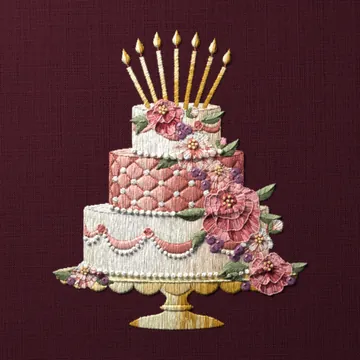
Advanced 3–8 in hoop · 23 colors
Quilted birthday cake
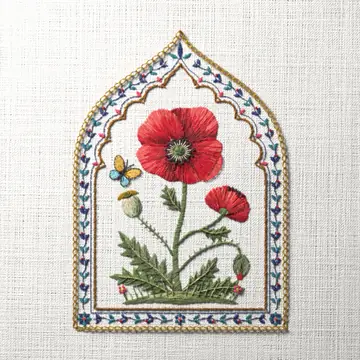
Advanced 3–8 in hoop · 23 colors
Mughal flower motif with a red poppy
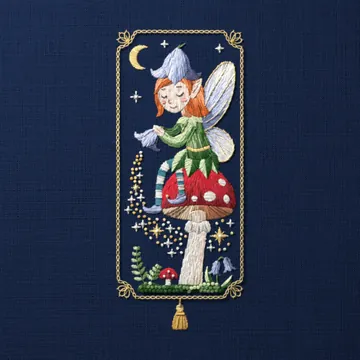
Advanced 3–8 in hoop · 23 colors
Pixie dust bookmark
New to hand embroidery? Starting hand embroidery, step by step