Teddy bear and bee in clover hand embroidery pattern
Advanced · 21 colors · 10 kinds of stitch
Download free PDFPDF, US Letter · 115 KBFor your own stitching, gifts and handmade pieces you sell. Do not resell or share this PDF or copies of it. Selling, classes and kits: the rules
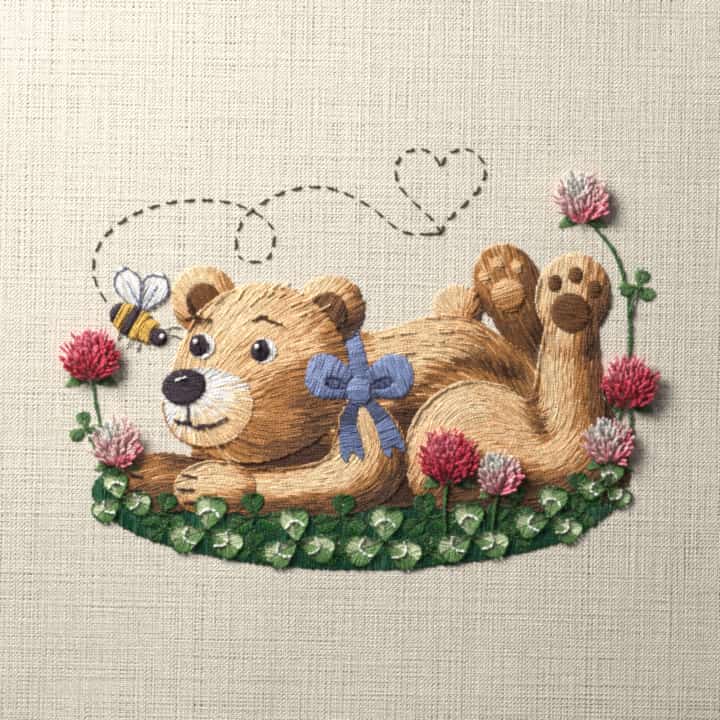
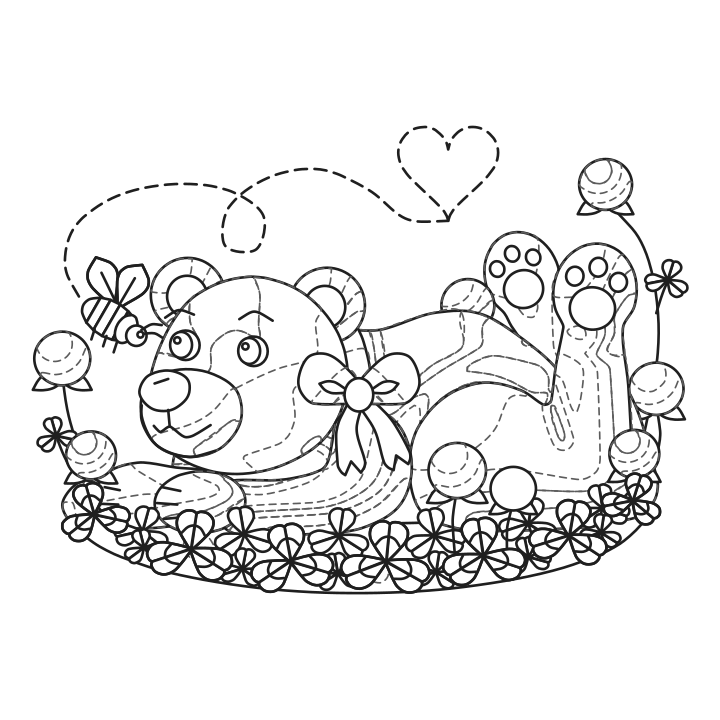
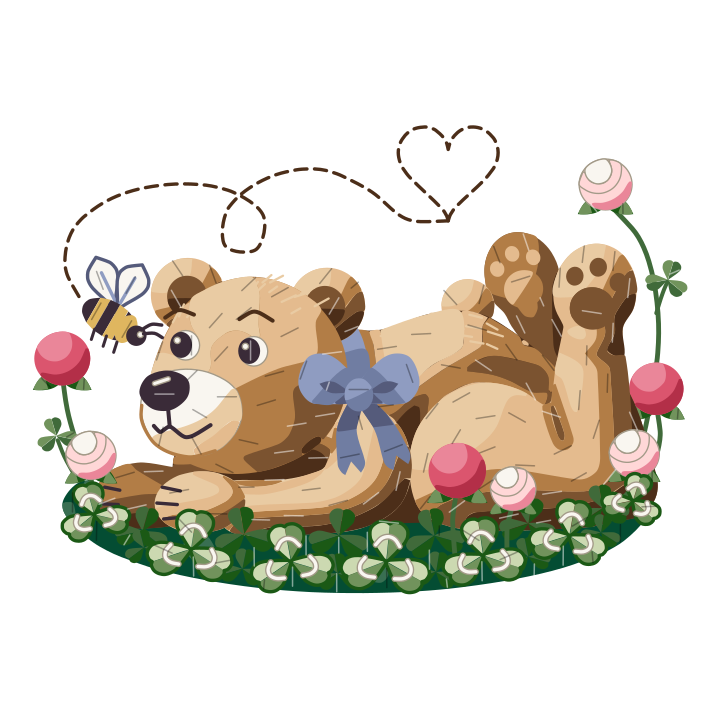
A honey-colored teddy lies on its tummy with its chin on its folded paws, its knees bent and its feet in the air, watching a bee that hovers just off its nose. The fur is short long and short stitch shaded from deep brown to cream, and the bow loops, nose, soles and bee are padded satin stitch. The clover heads are turkey work, left as a soft pile, and each three-part clover leaf is satin stitch with a pale back stitch mark over a long and short bank. The bee’s flight is one line of running stitch that ends in a heart, and the clover stems are stem stitch. In the picture of where the colors go, the fine lines show which way the stitches lie.
Size and details
Advanced. Uses turkey work, long and short stitch over much of the design, padded satin stitch, 21 colors and a great deal of stitching; from a 6 inch hoop up the widest satin stitches are long.
21 colors of floss and 10 kinds of stitch:
- Stem stitch
- Satin stitch
- Turkey work
- Long and short stitch
- Padded satin stitch
- Back stitch
- Split stitch
- Straight stitch
- French knot
- Running stitch
- Which stitch goes where
| Hoop | Inches | Centimeters | Satin stitch up to |
|---|---|---|---|
| 3 in (8 cm) | 1.9 × 1.4 in | 4.8 × 3.6 cm | 1/8 in (3 mm) |
| 4 in (10 cm) | 2.9 × 2.1 in | 7.4 × 5.3 cm | 1/4 in (6 mm) |
| 5 in (13 cm) | 3.8 × 2.8 in | 9.7 × 7.1 cm | 5/16 in (8 mm) |
| 6 in (15 cm) | 4.8 × 3.4 in | 12.2 × 8.6 cm | 3/8 in (10 mm) |
| 8 in (20 cm) | 6.7 × 4.8 in | 17 × 12.2 cm | 1/2 in (13 mm) |
- In an 8 inch hoop the widest satin stitch shape is 1/2 in (13 mm) across. Satin stitches longer than about 12 mm (just under 1/2 in) tend to work loose: divide the shape into sections, or work it in long and short stitch.
- In a 3, 4 or 5 inch hoop the French knots are drawn smaller than about 2 mm (a little over 1/16 in). Use one strand of floss for them there, or choose a larger hoop.
The pattern is drawn inside a circle about half an inch (1.3 cm) smaller all around than the hoop.
What you need
- DMC 3346 Hunter GreenClover leaves (dark), clover stems
- DMC 3345 Dark Hunter GreenLeaf edges, clover leaves (darkest), clover sepals (darker)
- DMC 3347 Medium Yellow GreenClover leaves (light), clover sepals (lighter)
- DMC 3832 Medium RaspberryClover heads (dark)
- DMC 3831 Dark RaspberryClover heads (darkest)
- DMC 3833 Light RaspberryClover heads (middle)
- DMC 963 Ultra Very Light Dusty RoseClover heads (light)
- DMC 3865 Winter WhiteMuzzle and bee wings (light), leaf chevrons, clover heads (lightest) and 4 more parts
- DMC 500 Very Dark Blue GreenClover bank (darker)
- DMC 501 Dark Blue GreenClover bank (lighter)
- DMC 433 Medium BrownFar leg (middle), body, paws, near leg, head and soles (dark) and 4 more parts
- DMC 898 Very Dark Coffee BrownBody, near leg and paws (darkest), far leg (dark), flight line and 6 more parts
- DMC 435 Very Light BrownHead, body, near leg, paws and near arm (middle), far leg (light) and 4 more parts
- DMC 437 Light TanNear leg, head, ears, body, near arm, tail, paws and soles (light), muzzle (dark)
- DMC 738 Very Light TanNear arm, body, near leg, head, paws, ears and tail (lightest), muzzle (middle)
- DMC 794 Light Cornflower BlueBow and neck ribbon (light), bee wings (middle)
- DMC 792 Dark Cornflower BlueBow, bee wings and neck ribbon (dark)
- DMC 793 Medium Cornflower BlueBow and neck ribbon (middle)
- DMC 3371 Black BrownNose, eyes, claw lines, mouth and bee legs, bee (darker)
- DMC 3820 Dark StrawBee (lighter)
- DMC 3348 Light Yellow GreenClover leaves (lightest)
Skeins: 2 for body, near leg and paws (darkest), far leg (dark), flight line and 6 more parts; one of each other color. An estimate for the largest size, the 8 inch hoop: the length of each line and the area of each filled shape, a fifth added for tails and ends, a tenth of every 8 m (8.7 yd) skein kept spare.
The floss is six-strand cotton; the stitch guide says how many strands to use. You also need a hoop, an embroidery needle (a size 9 or 10 for one strand, 7 to 9 for two or three) and plain cotton or linen fabric. To frame the piece in its hoop, cut a square 3 inches (8 cm) wider than the hoop: a 9 inch (23 cm) square for a 6 inch hoop.
When it is stitched, how to finish a hoop shows how to back it for the wall.
Stitch guide
- Put the pattern on the fabric (how to transfer a pattern) and the fabric in the hoop.
- Stitch the filled parts first, what lies behind before what lies in front of it.
- Then stitch the lines: stems, veins and outlines over the edges of the filled parts.
- Keep the raised parts and the knots for the end, so that the hoop and your hand do not flatten them.
Inside a filled shape start with two or three tiny stitches, which the filling covers: a knot shows as a bump. A line may start with a small knot on the back or one of the knotless starts. End each thread by running the needle under the backs of a few stitches. (Starting and ending a thread shows how.) Use the strands this list gives, and begin as it says, also where a page about a stitch names another number or begins with a knot.
- Stem stitch 2 to 3 strandsClover stems, mouth, brows
- Satin stitch 2 strandsClover sepals, clover leaves, neck ribbon, inner ears, eye whites, bow, bee wings
- Turkey work 2 strandsClover heads
- Long and short stitch 1 strandClover bank, far leg, tail, body, near leg, paws, ears, head, muzzle, near arm
- Padded satin stitch 2 strandsSoles, nose, eyes, bow, bee
- Back stitch 1 to 2 strandsClaw lines, bee wings, bee legs, leaf chevrons
- Split stitch 1 strandMuzzle edge, bee wings, leaf edges
- Straight stitch 1 to 2 strandsNose light, bee legs
- French knot 1 strand, two wrapsEye lights, bee eye
- Running stitch 2 strandsFlight line
Getting it onto your fabric
The PDF holds the pattern twice at actual size: once as drawn, and once mirrored for an iron-on transfer pen. Print it at 100% with scaling off and check the one-inch square (25.4 mm) with a ruler before you trace. How to transfer a pattern explains tracing, carbon paper, the sticky wash-away sheet for knits, denim and dark cloth, and the other ways. The files are under Downloads.
Downloads
- Download free PDF PDF, US Letter, 3 pages, for a 6 inch (15 cm) hoop
- Download free PDF, A4 PDF, A4, 3 pages, for a 6 inch (15 cm) hoop
More patterns like this
Advanced prints 3–14 in · 14 colors
Baby teddy bear in a blue flower wreath
Advanced prints 3–14 in · 17 colors
Teddy bear pocket topper
Advanced 3–8 in hoop · 5 colors
Twinkle star teddy bear, gold on black
Advanced 3–8 in hoop · 22 colors
Nursery with a teddy and blocks
Advanced 3–8 in hoop · 22 colors
New baby with a teddy and blocks
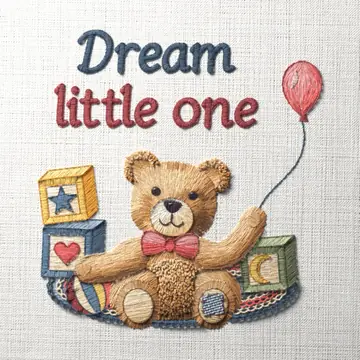
Advanced 3–8 in hoop · 22 colors
Dream little one with a teddy and blocks
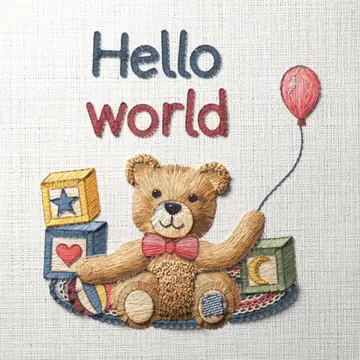
Advanced 3–8 in hoop · 22 colors
Hello world with a teddy and blocks
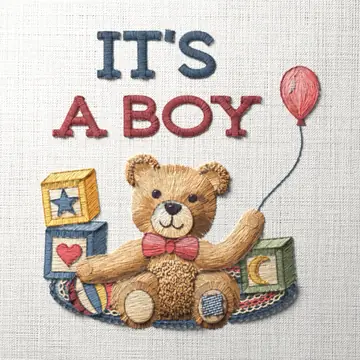
Advanced 3–8 in hoop · 22 colors
It’s a boy with a teddy and blocks
New to hand embroidery? Starting hand embroidery, step by step