Thrive in laurel hand embroidery pattern
Advanced · 21 colors · 4.8 × 4.7 in · 9 kinds of stitch
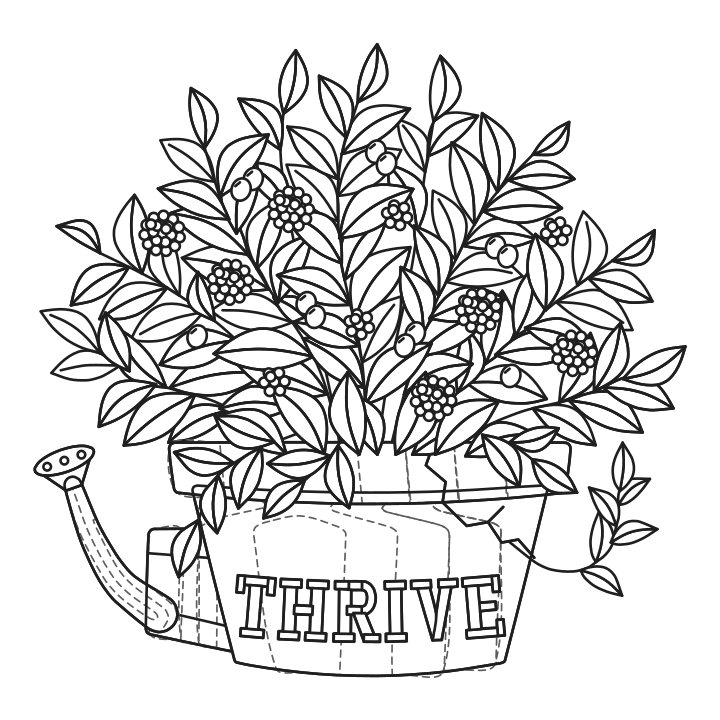
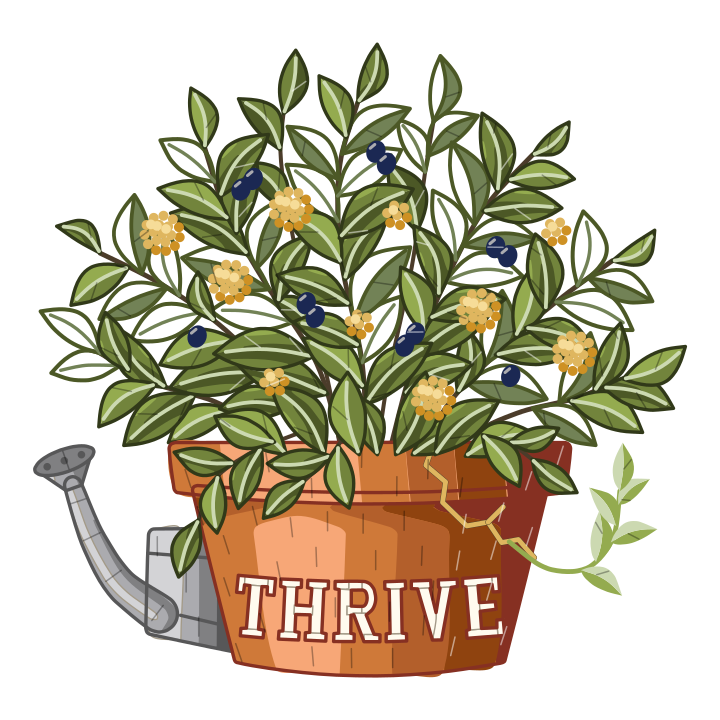
A number is a color of the list. Fine lines show which way the stitches lie: do not stitch them.
Download free PDFPDFPrints on US Letter and A4You may sell what you make from it by hand, in small quantities. The PDF itself is not to be sold or shared. Selling, classes and kits: the rules
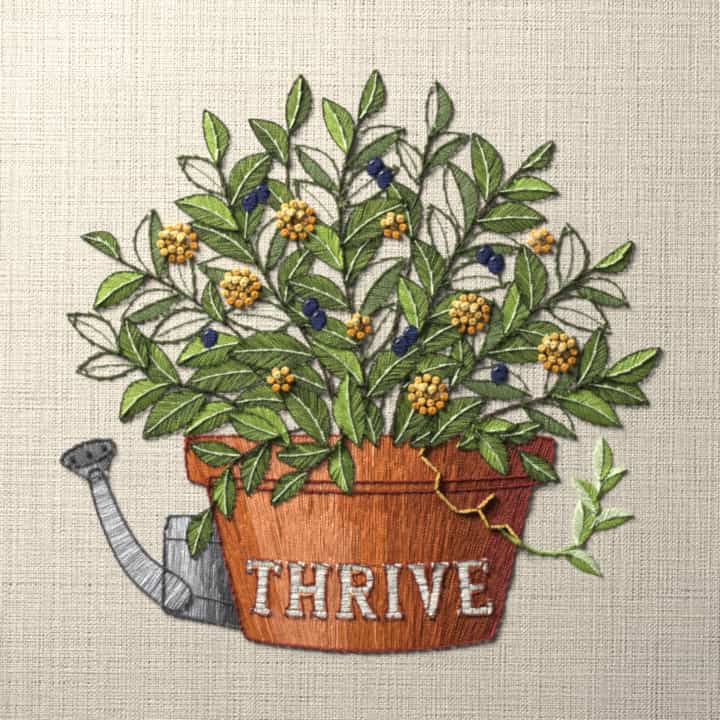
A generous bay laurel fills the hoop above a wide terracotta pot, and its lowest leaves spill over the rim toward the cream word THRIVE. A gold mended crack runs down the pot’s shoulder and one bright new shoot pushes out of its end, while a gray watering can waits behind.
Choose a size
| Hoop | Inches | Centimeters | Satin stitch up to |
|---|---|---|---|
| 3 in (8 cm) | 1.9 × 1.9 in | 4.8 × 4.8 cm | 1/8 in (3 mm) |
| 4 in (10 cm) | 2.9 × 2.8 in | 7.4 × 7.1 cm | 3/16 in (5 mm) |
| 5 in (13 cm) | 3.8 × 3.7 in | 9.7 × 9.4 cm | 3/16 in (5 mm) |
| 6 in (15 cm) | 4.8 × 4.7 in | 12.2 × 11.9 cm | 1/4 in (6 mm) |
| 8 in (20 cm) | 6.7 × 6.5 in | 17 × 16.5 cm | 3/8 in (10 mm) |
- In a 3, 4 or 5 inch hoop the French knots are drawn smaller than about 2 mm (a little over 1/16 in). Use one strand of floss for them there, or choose a larger hoop.
Before you start
- New to this? Try an easy pattern first, or see how to read one.
- Print at actual size (100%, not “fit”), trace the black lines, and put the fabric in the hoop, tight as a drum.
- Print at actual size (100%, not “fit”), tape the sheets and trace all of it. Hoop one part, stitch it, then move the hoop; raised parts and knots last.
- Floss has six strands: cut 18 inches (45 cm), pull out the number named one at a time, and lay them together.
- Start a filling with tiny stitches, a line with a small knot; end under stitches on the back.
- On the drawing a ring is one French knot; a broken line inside a shape is where two shades meet: trace it, do not stitch it.
What you need
- Hoop
- 6 in (15 cm), 4.8 × 4.7 in stitched. Another size
- Fabric
- Plain cotton or linen in a light color, cut 9 in (23 cm) square.
- Needle
- Embroidery needle, size 9, and size 5 for 4 strands.
- Floss
- 21 colors of six-strand cotton. Skeins: one of each color is enough, an estimate for the 6 inch hoop from the drawing’s lines and shapes.
- Also
- Water-soluble pen or sharp pencil, small scissors.
DMC is a brand, the number its color: another brand in a like color will do.
Threads and stitches
- 1DMC 413 Dark Pewter Gray
- 2DMC 414 Dark Steel Gray
- 3DMC 318 Light Steel Gray
- 4DMC 415 Pearl Gray
- 5DMC 3031 Very Dark Mocha Brown
- 6DMC 936 Very Dark Avocado Green
- 7DMC 3363 Medium Pine Green
- 8DMC 469 Avocado Green
- 9DMC 934 Black Avocado Green
- 10DMC 3348 Light Yellow Green
- 11DMC 470 Light Avocado Green
- 12DMC 3776 Light Mahogany
- 13DMC 3777 Very Dark Terra Cotta
- 14DMC 400 Dark Mahogany
- 15DMC 301 Medium Mahogany
- 16DMC 402 Very Light Mahogany
- 17DMC 712 Cream
- 18DMC 3820 Dark Straw
- 19DMC 783 Medium Topaz
- 20DMC 3822 Light Straw
- 21DMC 939 Very Dark Navy Blue
Stitch in this order
Where a stitch page says otherwise, follow this list.
- Stem stitch3 strands: branches, new shoot2 strands: open leaves (color 6)
- Back stitch 1 strandOpen leaves (color 7)
- Long and short stitch2 strands: watering can (color 1), pot, pot rim1 strand: painted leaves (colors 6 and 8)
- Satin stitch 2 strandsWatering can (color 3), spout rose, half filled leaves, letters
- Fishbone stitch 2 strandsPainted leaves (colors 6, 8 and 11), new shoot leaves
- Stem stitch1 strand: edges of the half filled leaves, leaf veins4 strands: mended crack
- Back stitch 1 strandLeaf edges
- Split stitch2 strands: can edges, pot edges1 strand: letter edges
- Straight stitch 1 strandBerry highlights
- Padded satin stitch 2 strandsBerries
- French knot two wraps1 strand: spout holes2 strands: flower puffs
Take out lines that still show, press face down, finish the hoop or sew a pillow.
About this pattern
Advanced. Uses long and short stitch over much of the design, padded satin stitch, more than a hundred French knots, 21 colors and a great deal of stitching.
The pot and many of the leaves are long and short stitch, other leaves are fishbone stitch, and the rest are half filled in satin stitch or left open in stem stitch. The letters are satin stitch edged in split stitch, the flower puffs are French knots and the berries are padded satin stitch.
1 DMC 413: watering can (darkest), can edges and spout holes. 2 DMC 414: watering can (dark), spout rose. 3 DMC 318: watering can (light), berry highlights. 4 DMC 415: watering can (lightest). 5 DMC 3031: branches, mended crack (darker). 6 DMC 936: painted leaves (dark), half filled leaves and open leaves (darker). 7 DMC 3363: half filled leaves and open leaves (lighter). 8 DMC 469: painted leaves (middle). 9 DMC 934: leaf edges. 10 DMC 3348: leaf veins, new shoot leaves (lighter). 11 DMC 470: painted leaves (light), new shoot leaves (darker), new shoot. 12 DMC 3776: pot and pot rim (light). 13 DMC 3777: pot edges and letter edges, pot and pot rim (darkest). 14 DMC 400: pot and pot rim (dark). 15 DMC 301: pot and pot rim (middle). 16 DMC 402: pot rim and pot (lightest). 17 DMC 712: letters. 18 DMC 3820: flower puffs (middle), mended crack (lighter). 19 DMC 783: flower puffs (dark). 20 DMC 3822: flower puffs (light). 21 DMC 939: berries.
A guide to this kind of work: Stitches for letters, words and names.
More patterns like this
Play in the dirt with potted plants
Advanced 3 to 8 in hoop 17 colors
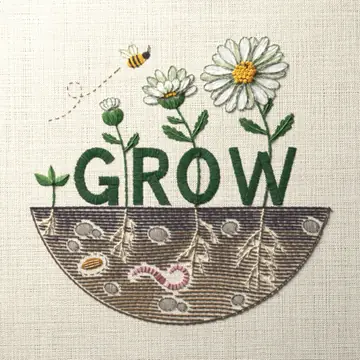
Grow in daisies
Advanced 3 to 14 in 18 colors
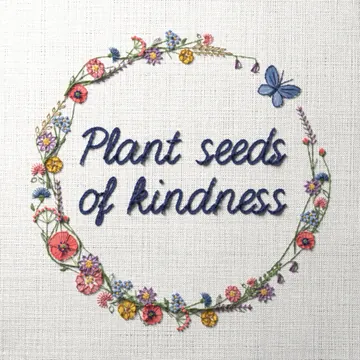
Plant seeds of kindness
Advanced 3 to 14 in 18 colors
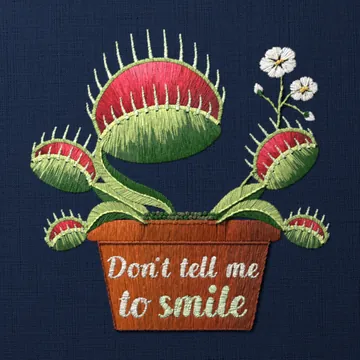
Don’t tell me to smile, Venus flytrap
Advanced 3 to 8 in hoop 20 colors
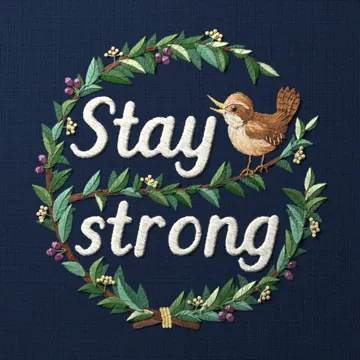
Stay strong in laurel
Advanced 3 to 14 in 21 colors
Stay humble in laurel
Advanced 3 to 14 in 21 colors
Be you
Advanced 3 to 8 in hoop 21 colors
Patience
Advanced 3 to 14 in 21 colors
New to hand embroidery? Starting hand embroidery, step by step