Vegetable garden sampler hand embroidery pattern
Advanced · 23 colors · 12 kinds of stitch
Download free PDFPDF, US Letter · 149 KBFor your own stitching, gifts and handmade pieces you sell. Do not resell or share this PDF. What you may do, in full
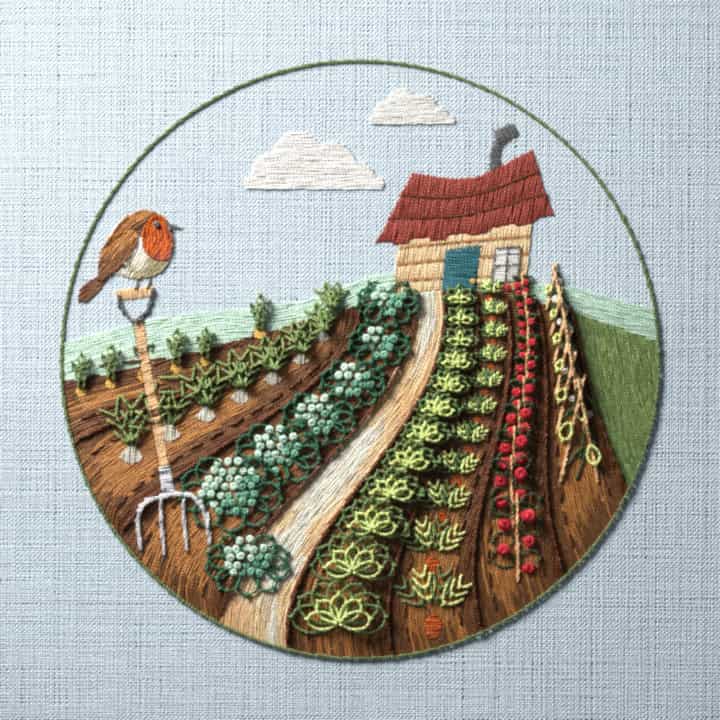
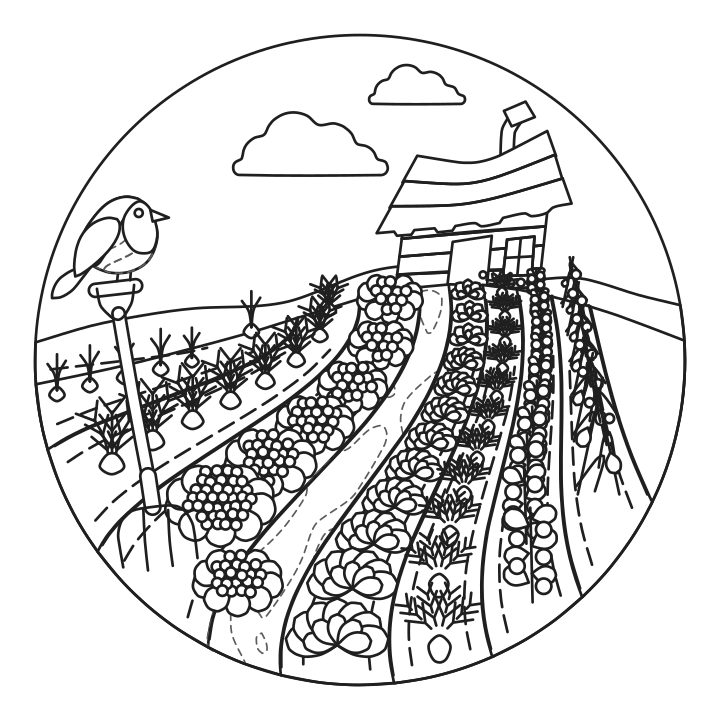
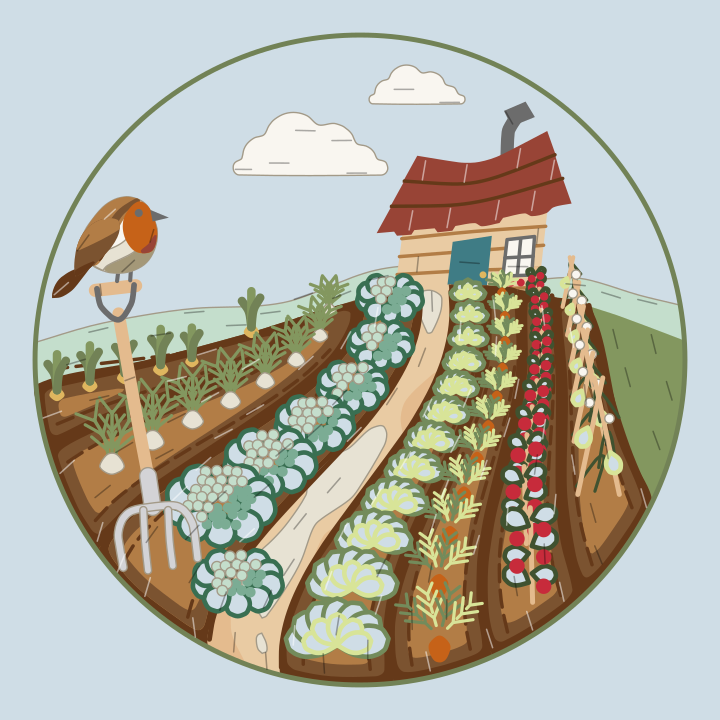
A pale path swings up a small hill to a crooked potting shed under two clouds, with a row of vegetables in each furrow beside it. Every crop is another stitch: French knot cabbages, fly stitch carrot tops, lazy daisy lettuces, chain stitch onions, fern stitch fennel and feather stitch peas on stem stitch sticks, with red French knots for tomatoes. The brown soil is laid in long and short stitch with running stitch furrows. At the front a robin sits on the handle of a fork left standing in the ground. It is drawn for pale blue linen. In the picture of where the colors go, the fine lines show which way the stitches lie.
Size and details
Advanced. Uses long and short stitch over much of the design, more than a hundred French knots, 23 colors and a great deal of stitching.
23 colors of floss and 12 kinds of stitch:
- Long and short stitch
- Satin stitch
- Split stitch
- French knot
- Back stitch
- Stem stitch
- Running stitch
- Lazy daisy stitch
- Fly stitch
- Feather stitch
- Fern stitch
- Chain stitch
- Which stitch goes where
| Hoop | Inches | Centimeters | Satin stitch up to |
|---|---|---|---|
| 3 in (8 cm) | 1.9 × 1.9 in | 4.8 × 4.8 cm | 1/8 in (3 mm) |
| 4 in (10 cm) | 2.8 × 2.8 in | 7.1 × 7.1 cm | 3/16 in (5 mm) |
| 5 in (13 cm) | 3.8 × 3.8 in | 9.7 × 9.7 cm | 1/4 in (6 mm) |
| 6 in (15 cm) | 4.7 × 4.7 in | 11.9 × 11.9 cm | 5/16 in (8 mm) |
| 8 in (20 cm) | 6.6 × 6.6 in | 16.8 × 16.8 cm | 3/8 in (10 mm) |
- In a 3, 4 or 5 inch hoop the French knots are drawn smaller than about 2 mm (a little over 1/16 in). Use one strand of floss for them there, or choose a larger hoop.
- In a 3, 4, 5 or 6 inch hoop the shortest lazy daisy loops are drawn smaller than about 2 mm (a little over 1/16 in). Use one strand of floss for them there, or choose a larger hoop.
The pattern is drawn inside a circle about half an inch (1.3 cm) smaller all around than the hoop.
What you need
- DMC 504 Very Light Blue GreenFar hill, cabbages (light)
- DMC 3865 Winter WhiteClouds, robin belly (light) and 2 more parts
- DMC 738 Very Light TanPath (middle), shed walls
- DMC 435 Very Light BrownSoil (light), shed boards and 2 more parts
- DMC 317 Pewter GrayStovepipe and window bars and 4 more parts
- DMC 355 Dark Terra CottaShed roof, robin breast (darker)
- DMC 801 Dark Coffee BrownSoil (dark), furrows and 4 more parts
- DMC 3809 Very Dark TurquoiseShed door
- DMC 3820 Dark StrawOnions (light), door knob
- DMC 321 RedTomatoes and window box
- DMC 3364 Pine GreenFennel and grass, onions (middle)
- DMC 433 Medium BrownSoil, robin wing and robin back (middle)
- DMC 437 Light TanPea sticks, fork handle and stakes, path (dark)
- DMC 822 Light Beige GrayPath (light), fennel bulbs, robin belly (middle)
- DMC 988 Medium Forest GreenLettuces and carrot tops (darker)
- DMC 472 Ultra Light Avocado GreenLettuces and carrot tops (lighter), pea pods
- DMC 921 CopperCarrots, robin breast (lighter)
- DMC 501 Dark Blue GreenCabbages (dark)
- DMC 503 Medium Blue GreenCabbages (middle)
- DMC 986 Very Dark Forest GreenTomato leaves and peas
- DMC 3363 Medium Pine GreenFrame, onions (dark)
- DMC 415 Pearl GrayFork (lighter)
- DMC 642 Dark Beige GrayRobin belly (dark)
Skeins: 2 for far hill, cabbages (light), 4 for soil (dark), furrows and 4 more parts and 2 for soil, robin wing and robin back (middle); one of each other color. An estimate for the largest size, the 8 inch hoop: the length of each line and the area of each filled shape, a fifth added for tails and ends, a tenth of every 8 m (8.7 yd) skein kept spare.
The floss is six-strand cotton; the stitch guide says how many strands to use. You also need a hoop, an embroidery needle (a size 7 to 9 suits two or three strands) and plain cotton or linen fabric. To frame the piece in its hoop, cut a square 3 inches (8 cm) wider than the hoop: a 9 inch (23 cm) square for a 6 inch hoop.
When it is stitched, how to finish a hoop shows how to back it for the wall.
Stitch guide
- Put the pattern on the fabric (how to transfer a pattern) and the fabric in the hoop.
- Stitch the filled parts first, what lies behind before what lies in front of it.
- Then stitch the lines: stems, veins and outlines over the edges of the filled parts.
- Keep the knots for the end, so that the hoop and your hand do not flatten them.
Start each thread with a small knot on the back or one of the knotless starts, and end it by running the needle under the backs of a few stitches (starting and ending a thread). Use the strands this list gives, also where a page about a stitch names another number.
- Long and short stitch 1 to 2 strandsFar hill, clouds, grass, soil, path, robin tail, and 4 more
- Satin stitch 2 strandsShed walls, stovepipe, shed roof, shed door, window, and 6 more
- Split stitch 1 strandShed boards, roof rows, window bars
- French knot 1 to 2 strands, two wrapsDoor knob, window box, cabbages, tomatoes, and 2 more
- Back stitch 1 strandWindow bars
- Stem stitch 2 to 5 strandsFurrows, stakes, pea sticks, fork, robin legs, frame
- Running stitch 2 strandsFurrows
- Lazy daisy stitch 2 to 3 strandsLettuces, cabbages, tomato leaves, pea pods
- Fly stitch 2 to 3 strandsCarrot tops
- Feather stitch 2 to 3 strandsPeas
- Fern stitch 3 strandsFennel
- Chain stitch 2 strandsOnions
Getting it onto your fabric
The PDF holds the pattern twice at actual size: once as drawn, and once mirrored for an iron-on transfer pen. Print it at 100% with scaling off and check the one-inch square (25.4 mm) with a ruler before you trace. How to transfer a pattern explains tracing, carbon paper and the other ways. The files are under Downloads.
Downloads
- Download free PDF PDF, US Letter, 3 pages, for a 6 inch (15 cm) hoop
- Download free PDF, A4 PDF, A4, 3 pages, for a 6 inch (15 cm) hoop
More patterns like this
Advanced 3–8 in hoop · 22 colors
Garden in laurel
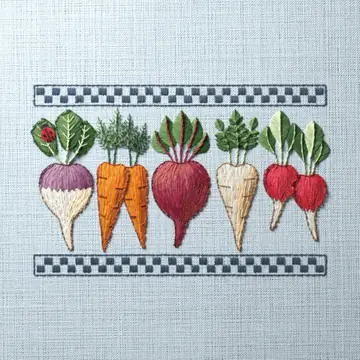
Advanced 3–8 in hoop · 24 colors
Root vegetables tea towel border
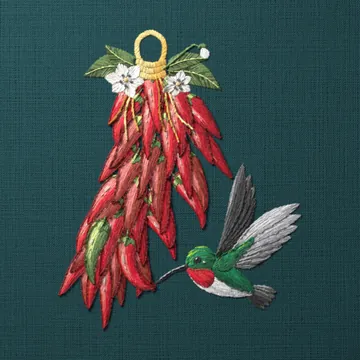
Advanced 3–8 in hoop · 24 colors
Chili peppers with a hummingbird
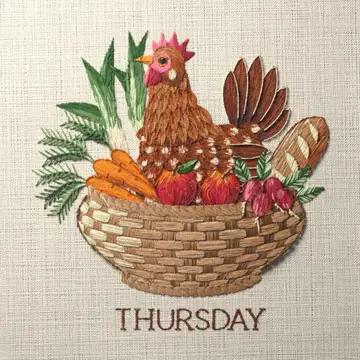
Advanced 3–8 in hoop · 21 colors
Thursday market day
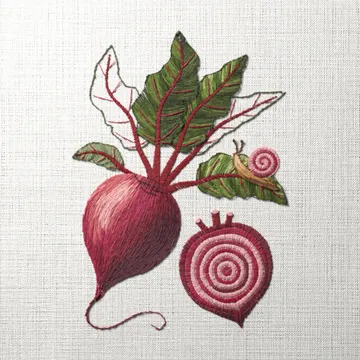
Advanced 3–8 in hoop · 18 colors
Beet with leaves and a cut half
Advanced 3–8 in hoop · 18 colors
Plant powered
Advanced 3–8 in hoop · 14 colors
Vintage wagon of winter vegetables
Advanced 3–8 in hoop · 12 colors
Blue and green artichoke crewel
New to hand embroidery? Starting hand embroidery, step by step