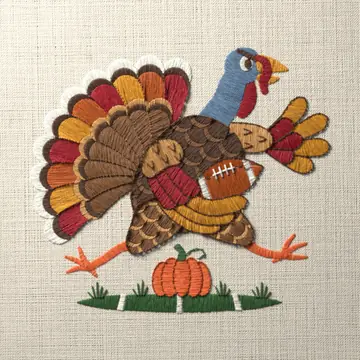
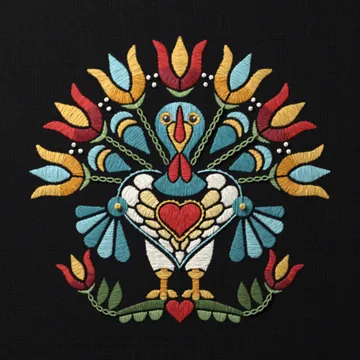
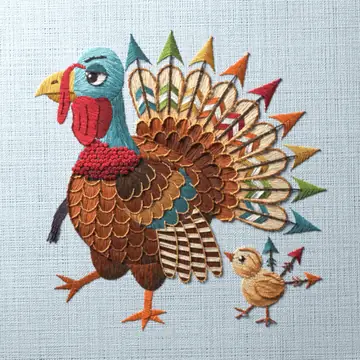
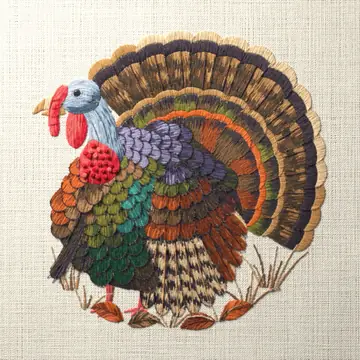
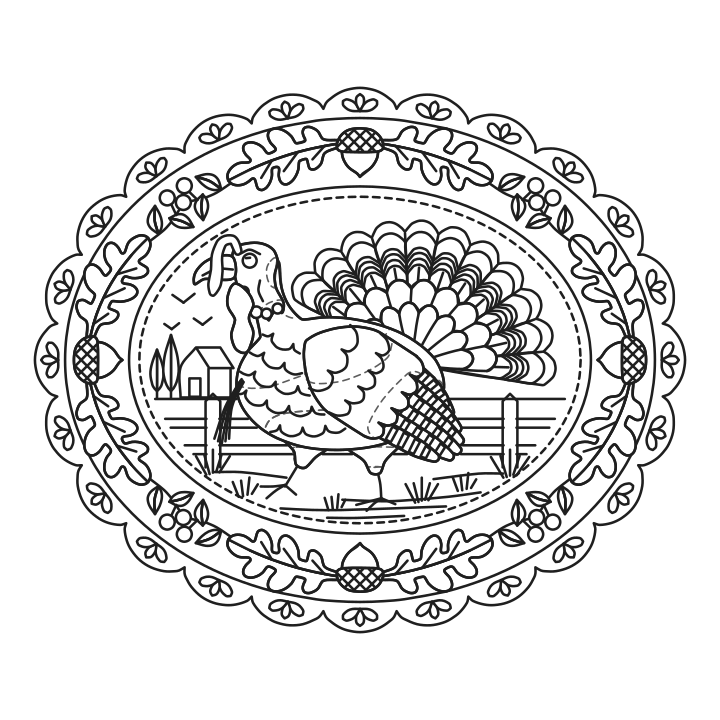
Vintage turkey platter in blue hand embroidery pattern
Advanced · 4 colors · 4.9 × 4.1 in · 11 kinds of stitch
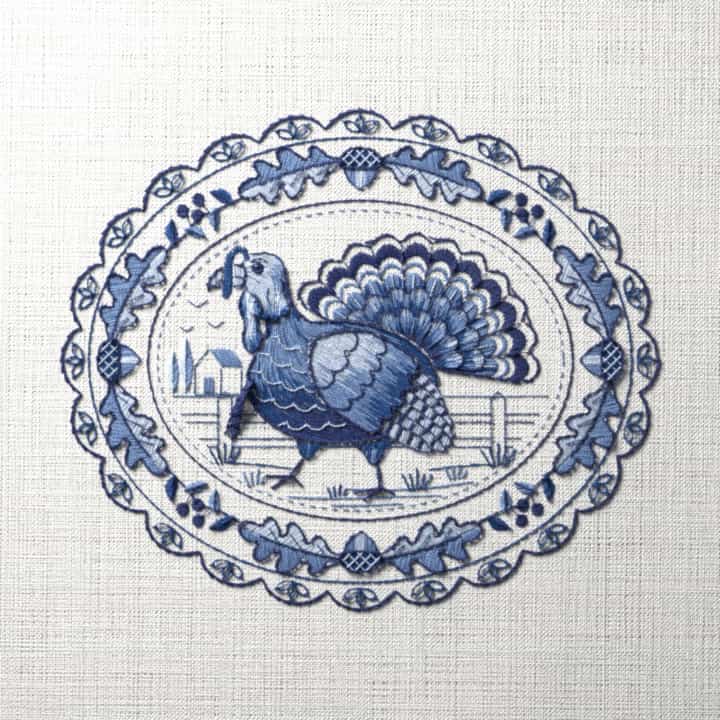
A number is a row of the list. Fine lines show which way the stitches lie: do not stitch them.
Download free PDFPDFYou may sell what you make from it by hand, in small quantities. The PDF itself is not to be sold or shared. Selling, classes and kits: the rules
A wide scalloped platter holds a tom turkey with his tail spread, stepping out before a rail fence, a small barn and two slim trees.
Choose a size
| Hoop | Inches | Centimeters | Satin stitch up to |
|---|---|---|---|
| 3 in (8 cm) | 2 × 1.7 in | 5.1 × 4.3 cm | 1/16 in (1.6 mm) |
| 4 in (10 cm) | 3 × 2.5 in | 7.6 × 6.4 cm | 1/8 in (3 mm) |
| 5 in (13 cm) | 4 × 3.3 in | 10.2 × 8.4 cm | 3/16 in (5 mm) |
| 6 in (15 cm) | 4.9 × 4.1 in | 12.4 × 10.4 cm | 3/16 in (5 mm) |
| 8 in (20 cm) | 6.9 × 5.8 in | 17.5 × 14.7 cm | 5/16 in (8 mm) |
- In a 3, 4 or 5 inch hoop the French knots are drawn smaller than about 2 mm (a little over 1/16 in). Use one strand of floss for them there, or choose a larger hoop.
- In a 3 inch hoop the shortest lazy daisy loops are drawn smaller than about 2 mm (a little over 1/16 in). Use one strand of floss for them there, or choose a larger hoop.
Before you start
- New to this? Try an easy pattern first, or see how to read one.
- Print at actual size (100%, not “fit”), trace the black lines, and put the fabric in the hoop, tight as a drum.
- Print at actual size (100%, not “fit”), tape the sheets and trace all of it. Hoop one part, stitch it, then move the hoop; raised parts and knots last.
- Floss has six strands: cut 18 inches (45 cm), pull out the number named one at a time, and lay them together.
- The back is seen: no knots. Start with tiny stitches; end around the backs of four or five stitches.
- On the drawing a ring is one French knot; a loop is one lazy daisy, begun at its point; a dashed line is running stitch; a finer one inside a shape is where two shades meet: trace it, do not stitch it.
On a towel. 2 to 3 inches (5 to 7.5 cm) above the hem, stitches low. How to embroider a towel
What you need
- Hoop
- 6 in (15 cm), 4.9 × 4.1 in stitched. Another size
- Fabric
- Plain cotton or linen in a light color, cut 9 in (23 cm) square, or a washed cotton tea towel.
- Needle
- Embroidery needle, size 9.
- Floss
- 4 colors of six-strand cotton. Skeins: 2 of DMC 823; one of each other color, an estimate for the 6 inch hoop from the drawing’s lines and shapes.
- Also
- Water-soluble pen or sharp pencil, small scissors.
DMC is a brand, the number its color: another brand in a like color will do.
Threads and stitches
- DMC 823 Dark Navy BlueTail small wing feathers, small wing feathers and wattle (darkest), leaf outlines, platter rim, well line, tail outline, acorn outlines, bird outline, wing bars, berries, wing outline, rim sprigs, beard, legs, head outline and eye, tail feathers, body, thighs and sprig leaves (dark), tail bands, leaf veins, wing feathers, bill and head folds (darker)
- DMC 797 Royal BlueBody, tail feathers, sprig leaves and thighs (middle), rim fans, rim line, fence rails, fence posts, snood, barn, caruncles and far birds, acorn cups, grass and ground (darker), tail small wing feathers, small wing feathers and wattle (dark), leaf veins and head folds (lighter)
- DMC 799 Medium Delft BlueBody, small wing feathers, tail small wing feathers, tail feathers, sprig leaves, wattle and thighs (light), oak leaves, acorns, trees and head (darker), well beading, horizon, barn roof and barn door, tail bands, ground and grass (lighter)
- DMC 800 Pale Delft BlueOak leaves, wing feathers, acorn cups, head, acorns, bill and trees (lighter), small wing feathers, tail small wing feathers and wattle (lightest), breast feathers, feather shafts and eye highlight
Stitch in this order
Where a stitch page says otherwise, follow this list.
- Back stitch 2 strandsRim line
- Stem stitch2 strands: rim sprigs1 strand: lines of the trees
- Fishbone stitch 2 strandsSprig leaves, trees
- Long and short stitch 1 strandTail feathers, tail small wing feathers, thighs, body, small wing feathers, head, wattle
- Satin stitch 2 strandsBerries, oak leaves, acorns, acorn cups, barn roof, barn door, tail bands, wing feathers, wing bars, bill, snood, eye
- Trellis stitch 1 strandEdges of the acorn cups
- Split stitch2 strands: leaf outlines, acorn outlines, edges of the bill1 strand: horizon, tail outline (DMC 823), lines of the tail small wing feathers, bird outline (DMC 823), breast feathers, edges of the wing feathers, head outline, edges of the wattle
- Back stitch2 strands: leaf veins (DMC 823), well line1 strand: barn, fence rails, fence posts, feather shafts, head folds, lines of the bill
- Running stitch 1 strandWell beading
- Straight stitch1 strand: leaf veins (DMC 797), far birds, eye highlight2 strands: grass
- Stem stitch3 strands: platter rim, legs1 strand: edges of the sprig leaves, ground, lines of the small wing feathers2 strands: tail outline (DMC 823), bird outline (DMC 823), wing outline, beard
- Lazy daisy stitch 2 strandsRim fans
- French knot 2 strands, two wrapsCaruncles
Take out lines that still show, press face down, finish the hoop.
About this pattern
Advanced. Uses trellis stitch, long and short stitch and a great deal of stitching.
His body and tail are long and short stitch shaded through the blues, with satin stitch bands across the tail and split stitch scales on his breast. The rim is stem stitch with a lazy daisy fan in every scallop. The oak leaves are satin stitch in two blues, the acorn cups have trellis stitch over satin, and a ring of running stitch lines the middle. Grass is straight stitch and the rails are back stitch.
A guide to this kind of work: Stitches for fur, hair and feathers.