Water well drilling truck over a spring hand embroidery pattern
Advanced · 13 colors · 9 kinds of stitch
Download free PDFPDF, US Letter · 49 KBFor your own stitching, gifts and handmade pieces you sell. Do not resell or share this PDF or copies of it. Selling, classes and kits: the rules
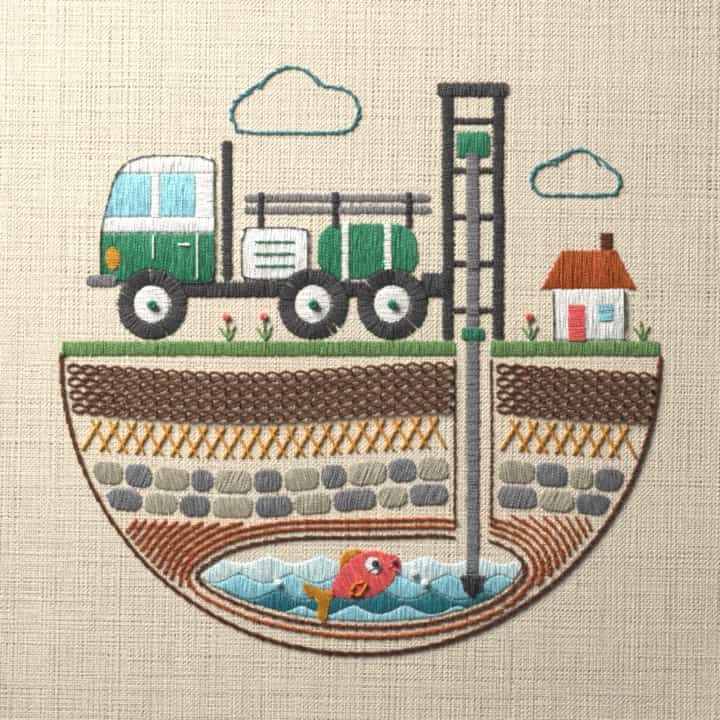
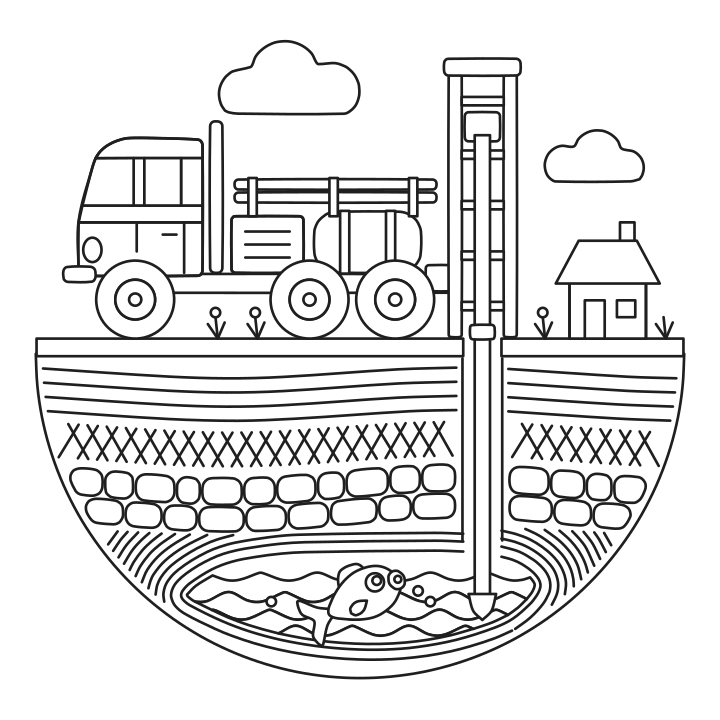
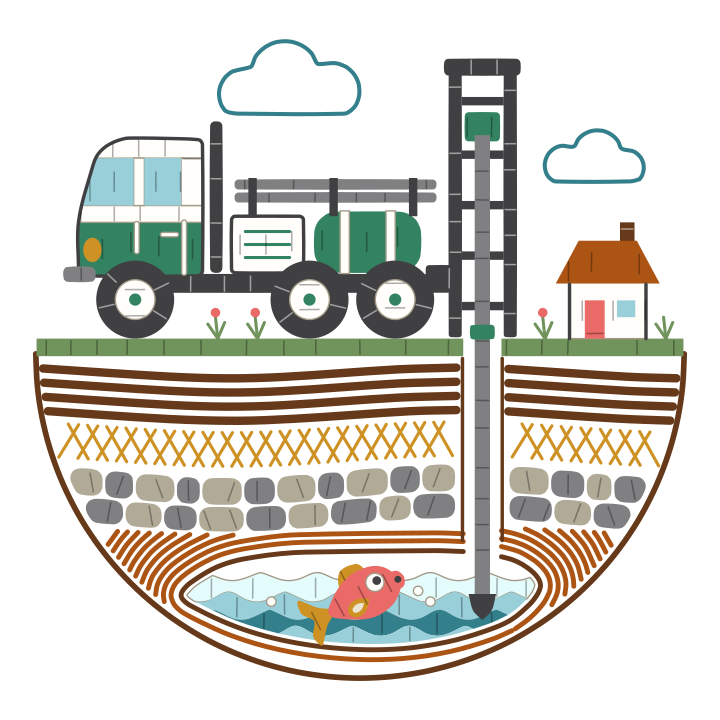
A white and green drilling truck stands level on the grass with its mast raised at the tail, and a small farmhouse waits for water beside it. Below, the ground is cut open: brown topsoil in rows of chain stitch, ochre clay in herringbone stitch, gray stones in satin stitch and rust earth in rows of stem stitch that wrap round the pool. The truck, the pipe, the house and the waves are satin stitch, with fine split stitch edges and back stitch down the well walls. One surprised fish looks up at the drill, with French knot bubbles and a lazy daisy fin. In the picture of where the colors go, the fine lines show which way the stitches lie.
Size and details
Advanced. Satin stitch over about a quarter of the cloth in a 6 inch hoop, 13 colors and a great deal of stitching; from a 5 inch hoop up some of the satin stitches are long.
13 colors of floss and 9 kinds of stitch:
- Satin stitch
- Stem stitch
- Chain stitch
- Herringbone stitch
- Back stitch
- Split stitch
- Straight stitch
- French knot
- Lazy daisy stitch
- Which stitch goes where
| Hoop | Inches | Centimeters | Satin stitch up to |
|---|---|---|---|
| 3 in (8 cm) | 1.9 × 1.9 in | 4.8 × 4.8 cm | 3/16 in (5 mm) |
| 4 in (10 cm) | 2.9 × 2.8 in | 7.4 × 7.1 cm | 1/4 in (6 mm) |
| 5 in (13 cm) | 3.8 × 3.7 in | 9.7 × 9.4 cm | 3/8 in (10 mm) |
| 6 in (15 cm) | 4.8 × 4.7 in | 12.2 × 11.9 cm | 7/16 in (11 mm) |
| 8 in (20 cm) | 6.7 × 6.5 in | 17 × 16.5 cm | 5/8 in (16 mm) |
- In an 8 inch hoop the widest satin stitch shape is 5/8 in (16 mm) across. Satin stitches longer than about 12 mm (just under 1/2 in) tend to work loose: divide the shape into sections, or work it in long and short stitch.
- In a 3, 4, 5 or 6 inch hoop the French knots are drawn smaller than about 2 mm (a little over 1/16 in). Use one strand of floss for them there, or choose a larger hoop.
- In a 3 inch hoop the shortest lazy daisy loops are drawn smaller than about 2 mm (a little over 1/16 in). Use one strand of floss for them there, or choose a larger hoop.
The pattern is drawn inside a circle about half an inch (1.3 cm) smaller all around than the hoop.
What you need
- 1DMC 747 Very Light Sky BlueWater (light)
- 2DMC 3766 Light Peacock BlueWater (middle), windows and house window
- 3DMC 3765 Very Dark Peacock BlueWater (dark), clouds
- 4DMC 801 Dark Coffee BrownTopsoil, bowl edge, hollow edge, well walls and chimney
- 5DMC 783 Medium TopazClay, fish fins and headlamp
- 6DMC 3023 Light Brown GrayStones (lighter)
- 7DMC 414 Dark Steel GrayStones (darker), drill pipe, spare pipes and bumper
- 8DMC 920 Medium CopperRust earth and house roof
- 9DMC 3347 Medium Yellow GreenGrass and grass tufts
- 10DMC 3799 Very Dark Pewter GrayWheels, mast, frame and exhaust stack, cab edge (darker) and 9 more parts
All it stitches
Wheels, mast, frame, exhaust stack, mast crosspieces, mast crown, pipe rack, mast foot and drill bit, cab edge, house, fish eye and fish mouth (darker), tool box (dark) - 11DMC 505 Jade GreenCab and hubs (darker), water tank, drill head and pipe collars, tool box (middle)
- 12DMC BLANC WhiteCab, house, hubs and cab edge (lighter), tool box (light), tank straps and 3 more parts
All it stitches
Cab, house, hubs, cab edge and fish eye (lighter), tool box (light), tank straps, bubbles and door handle - 13DMC 351 CoralFish, house door and flowers, fish mouth (lighter)
Skeins: one of each color is enough. An estimate for the 8 inch hoop, from the length of each line and the area of each filled shape, with a fifth added for tails.
The floss is six-strand cotton; the stitch guide says how many strands to use. You also need a hoop, an embroidery needle (a size 9 or 10 for one strand, 7 to 9 for two or three, and 3 to 5 for four or more) and plain cotton or linen fabric, white or another light color. To frame the piece in its hoop, cut a square 3 inches (8 cm) wider than the hoop: a 9 inch (23 cm) square for a 6 inch hoop.
When it is stitched, how to finish a hoop shows how to back it for the wall.
Stitch guide
- Put the pattern on the fabric (how to transfer a pattern) and the fabric in the hoop.
- Stitch the filled parts first, what lies behind before what lies in front of it.
- Then stitch the lines: stems, veins and outlines over the edges of the filled parts.
- Keep the knots for the end, so that the hoop and your hand do not flatten them.
Inside a filled shape start with two or three tiny stitches, which the filling covers: a knot shows as a bump. A line may start with a small knot on the back or one of the knotless starts. End each thread by running the needle under the backs of a few stitches. (Starting and ending a thread shows how.) Use the strands this list gives, and begin as it says, also where a page about a stitch names another number or begins with a knot.
- Satin stitch 2 strandsWater, stones, grass, frame, cab, windows, headlamp, exhaust stack, tool box, water tank, tank straps, spare pipes, pipe rack, mast foot, mast, mast crosspieces, mast crown, drill head, drill pipe, drill bit, pipe collars, wheels, hubs, bumper, chimney, house, house roof, house door, house window, fish fins, fish, fish eye, fish mouth
- Stem stitch 2 to 4 strands4 strands: bowl edge3 strands: hollow edge, rust earth2 strands: clouds
- Chain stitch 4 strandsTopsoil
- Herringbone stitch 3 strandsClay
- Back stitch 2 strandsWell walls
- Split stitch 1 strandCab edge, tool box, house
- Straight stitch 2 strandsTool box, door handle, grass tufts
- French knot 1 to 2 strands, two wraps2 strands: hubs, flowers, fish eye, bubbles1 strand: fish mouth
- Lazy daisy stitch 2 strandsFish fins
Getting it onto your fabric
The PDF holds the pattern twice at actual size: once as drawn, and once mirrored for an iron-on transfer pen. Print it at 100% with scaling off and check the one-inch square (25.4 mm) with a ruler before you trace. How to transfer a pattern explains tracing, carbon paper, the sticky wash-away sheet for knits, denim and dark cloth, and the other ways. The files are under Downloads.
Downloads
- Download free PDF PDF, US Letter, 3 pages, for a 6 inch (15 cm) hoop
- Download free PDF, A4 PDF, A4, 3 pages, for a 6 inch (15 cm) hoop
More patterns like this
Advanced prints 3–14 in · 20 colors
Excavator construction scene with truck
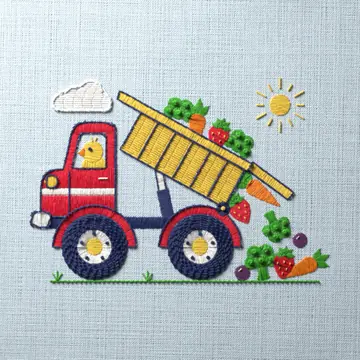
Easy 3–8 in hoop · 7 colors
Easy dump truck bib for a baby boy
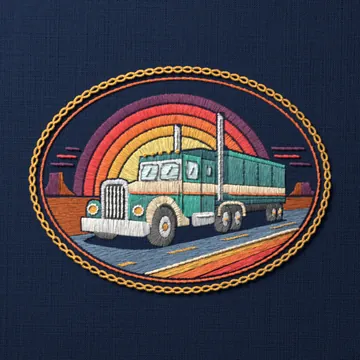
Advanced 3–8 in hoop · 16 colors
Semi truck sunset badge for a cap
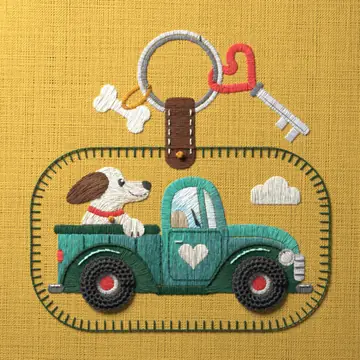
Advanced 3–8 in hoop · 16 colors
Pickup truck keychain
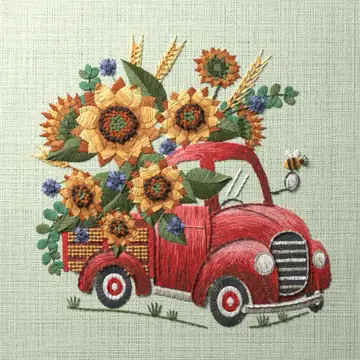
Advanced 3–8 in hoop · 17 colors
Vintage truck with sunflowers
Advanced prints 3–14 in · 23 colors
Monster truck jumping at sunset
Advanced 3–8 in hoop · 16 colors
Birthday cars, trucks and trains
Advanced 3–8 in hoop · 17 colors
Fifth wheel camper border
New to hand embroidery? Starting hand embroidery, step by step