Excavator construction scene with truck hand embroidery pattern
Advanced · 20 colors · 10 kinds of stitch
Download free PDFPDF, US Letter · 71 KBFor your own stitching, gifts and handmade pieces you sell. Do not resell or share this PDF or copies of it. Selling, classes and kits: the rules
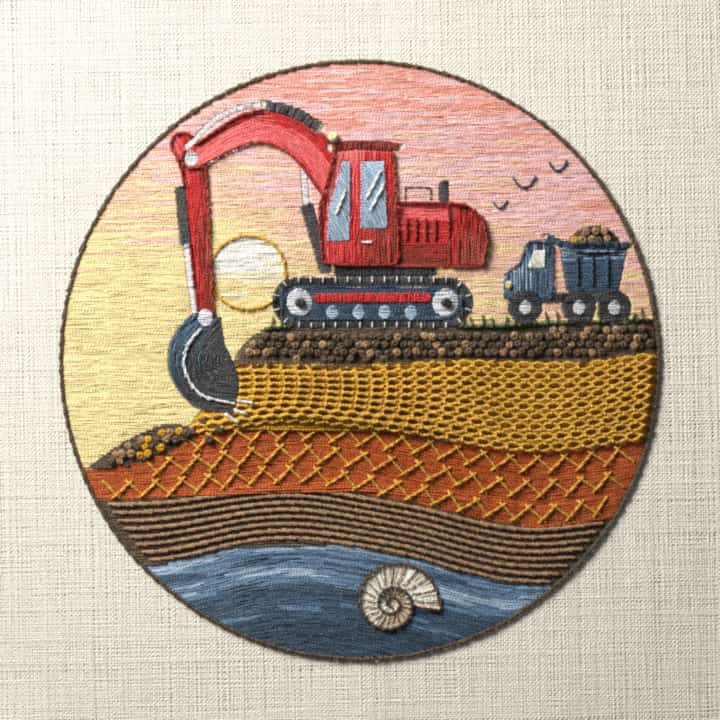
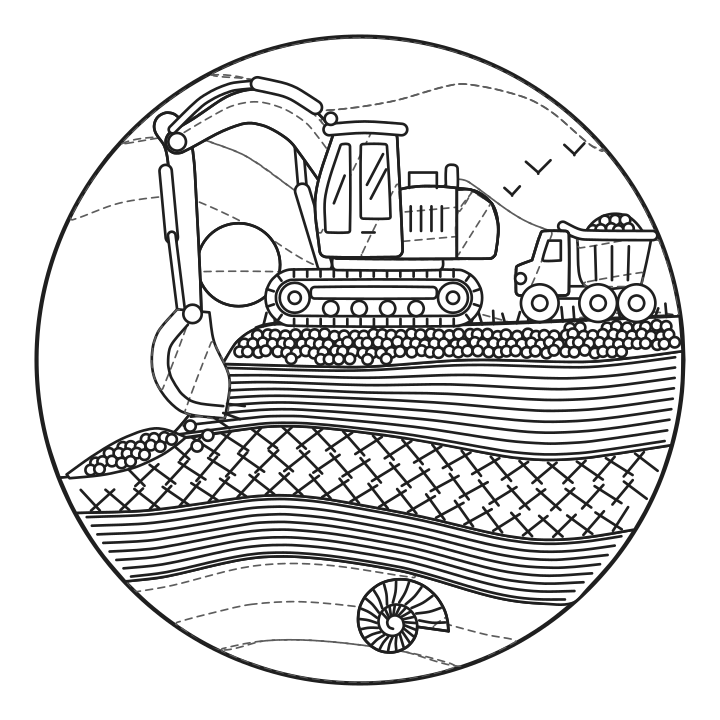
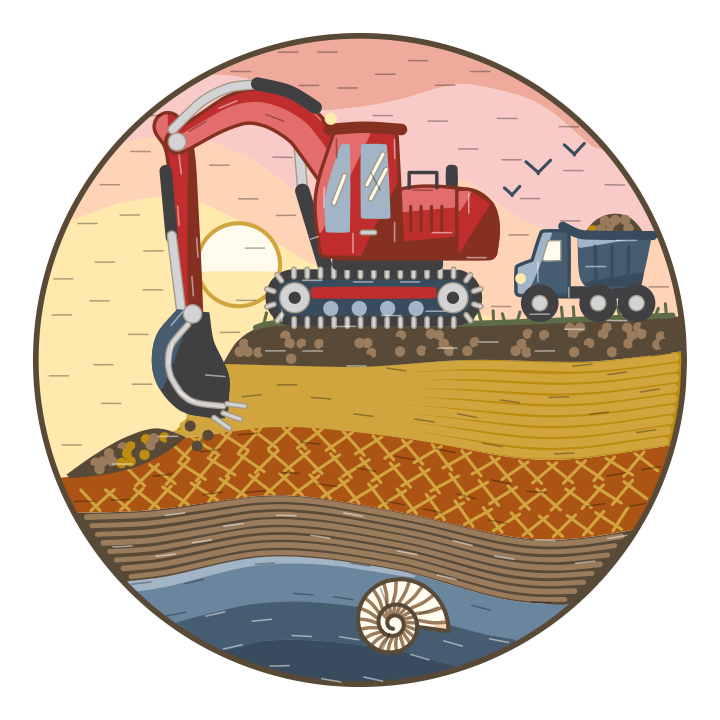
A red excavator in long and short stitch reaches its arm down a cut hillside against a low sun, and a small slate dump truck waits behind with a load of earth. Below, every layer is worked another way: topsoil in French knots, ocher in rows of chain stitch, rust under herringbone stitch, umber in rows of stem stitch and blue clay in long and short stitch. A pale ammonite with back stitch ribs lies curled in the clay. Split stitch edges the machine and stem stitch closes the round. In the picture of where the colors go, the fine lines show which way the stitches lie.
Size and details
Advanced. Uses long and short stitch over much of the design, more than a hundred French knots, 20 colors and a great deal of stitching; from a 5 inch hoop up the widest satin stitches are long.
20 colors of floss and 10 kinds of stitch:
- Long and short stitch
- Stem stitch
- Fly stitch
- Herringbone stitch
- Chain stitch
- French knot
- Straight stitch
- Back stitch
- Satin stitch
- Split stitch
- Which stitch goes where
| Hoop | Inches | Centimeters | Satin stitch up to |
|---|---|---|---|
| 3 in (8 cm) | 1.9 × 1.9 in | 4.8 × 4.8 cm | 3/16 in (5 mm) |
| 4 in (10 cm) | 2.8 × 2.8 in | 7.1 × 7.1 cm | 1/4 in (6 mm) |
| 5 in (13 cm) | 3.8 × 3.8 in | 9.7 × 9.7 cm | 3/8 in (10 mm) |
| 6 in (15 cm) | 4.7 × 4.7 in | 11.9 × 11.9 cm | 7/16 in (11 mm) |
| 8 in (20 cm) | 6.6 × 6.6 in | 16.8 × 16.8 cm | 5/8 in (16 mm) |
- In an 8 inch hoop the widest satin stitch shape is 5/8 in (16 mm) across. Satin stitches longer than about 12 mm (just under 1/2 in) tend to work loose: divide the shape into sections, or work it in long and short stitch.
- In a 3, 4 or 5 inch hoop the French knots are drawn smaller than about 2 mm (a little over 1/16 in). Use one strand of floss for them there, or choose a larger hoop.
The pattern is drawn inside a circle about half an inch (1.3 cm) smaller all around than the hoop.
What you need
- 1DMC 745 Light Pale YellowDawn sky (lightest), rising sun (middle), work light and truck lamp
- 2DMC 758 Very Light Terra CottaDawn sky (darkest)
- 3DMC 3779 Very Light RosewoodDawn sky (dark)
- 4DMC 3856 Ultra Very Light MahoganyDawn sky (light), ammonite (darker)
- 5DMC 712 CreamRising sun (light), ammonite and windows (lighter), window lights
- 6DMC 729 Medium Old GoldOcher layer (lighter), rust layer herringbone, rising sun (dark)
- 7DMC 3750 Very Dark Antique BlueTrack frame (darker), blue clay (darkest) and 5 more parts
All it stitches
Track frame (darker), blue clay (darkest), truck cab and truck bed (dark), bed rim, bed ribs and birds - 8DMC 931 Medium Antique BlueBlue clay (light)
- 9DMC 930 Dark Antique BlueBlue clay (dark), truck bed and truck cab (middle), bucket (lighter)
- 10DMC 932 Light Antique BlueWindows (darker), blue clay (lightest) and 3 more parts
All it stitches
Windows and track wheels (darker), blue clay (lightest), truck cab and truck bed (light) - 11DMC 838 Very Dark Beige BrownUmber layer and topsoil (darker), round edge and 4 more parts
All it stitches
Umber layer and topsoil (darker), round edge, ammonite spiral and falling earth, dug earth and truck load (dark) - 12DMC 840 Medium Beige BrownUmber layer and topsoil (lighter), ammonite ribs and 2 more parts
All it stitches
Umber layer and topsoil (lighter), ammonite ribs, dug earth and truck load (middle) - 13DMC 920 Medium CopperRust layer
- 14DMC 680 Dark Old GoldOcher layer (darker), dug earth and truck load (light)
- 15DMC 3362 Dark Pine GreenTurf
- 16DMC 415 Pearl GrayHydraulic rams and track wheels (lighter), track plates and 5 more parts
All it stitches
Hydraulic rams and track wheels (lighter), track plates, bucket edge, wheel hubs, arm pins, bucket teeth and door handle - 17DMC 3799 Very Dark Pewter GrayTracks and truck wheels, bucket (darker) and 6 more parts
All it stitches
Tracks, truck wheels, turntable, truck chassis, exhaust, handrail and track wheel hubs, bucket and hydraulic rams (darker) - 18DMC 347 Very Dark SalmonEngine house, cab, stick and boom (middle) and 2 more parts
All it stitches
Engine house, cab, stick, boom and counterweight (middle), track frame (lighter) - 19DMC 3777 Very Dark Terra CottaEngine house, stick, counterweight, cab and boom (dark) and 2 more parts
All it stitches
Engine house, stick, counterweight, cab and boom (dark), cab roof and vents - 20DMC 3328 Dark SalmonBoom, cab, engine house, stick and counterweight (light)
Skeins: 2 for dawn sky (lightest), rising sun (middle), work light and truck lamp and 2 for umber layer and topsoil (darker), round edge and 4 more parts; one of each other color. An estimate for the 8 inch hoop, from the length of each line and the area of each filled shape, with a fifth added for tails.
The floss is six-strand cotton; the stitch guide says how many strands to use. You also need a hoop, an embroidery needle (a size 9 or 10 for one strand, 7 to 9 for two or three, and 3 to 5 for four or more) and plain cotton or linen fabric, white or another light color. To frame the piece in its hoop, cut a square 3 inches (8 cm) wider than the hoop: a 9 inch (23 cm) square for a 6 inch hoop.
When it is stitched, how to finish a hoop shows how to back it for the wall.
Stitch guide
- Put the pattern on the fabric (how to transfer a pattern) and the fabric in the hoop.
- Stitch the filled parts first, what lies behind before what lies in front of it.
- Then stitch the lines: stems, veins and outlines over the edges of the filled parts.
- Keep the knots for the end, so that the hoop and your hand do not flatten them.
Inside a filled shape start with two or three tiny stitches, which the filling covers: a knot shows as a bump. A line may start with a small knot on the back or one of the knotless starts. End each thread by running the needle under the backs of a few stitches. (Starting and ending a thread shows how.) Use the strands this list gives, and begin as it says, also where a page about a stitch names another number or begins with a knot.
- Long and short stitch 1 to 2 strands2 strands: dawn sky, rising sun, blue clay, umber layer, rust layer, ocher layer, topsoil, dug earth1 strand: ammonite, stick, boom, bucket, engine house, counterweight, cab, truck bed, truck cab
- Stem stitch 2 to 4 strands4 strands: turf, round edge3 or 4 strands: umber layer2 strands: rising sun, ammonite spiral, bucket edge
- Fly stitch 2 strandsBirds
- Herringbone stitch 2 strandsRust layer herringbone
- Chain stitch 3 strandsOcher layer
- French knot 2 strands, two wrapsTopsoil, dug earth, falling earth, track wheel hubs, work light, truck load, truck lamp
- Straight stitch 1 to 3 strands3 strands: bucket teeth, vents, bed ribs2 strands: turf, window lights, door handle1 strand: track plates
- Back stitch 1 strandAmmonite ribs, handrail
- Satin stitch 2 strandsHydraulic rams, arm pins, tracks, track frame, track wheels, turntable, exhaust, windows, cab roof, truck chassis, truck load, bed rim, truck wheels, wheel hubs
- Split stitch 1 to 2 strands2 strands: stick, boom, engine house, counterweight, cab1 strand: truck cab
Getting it onto your fabric
The PDF holds the pattern twice at actual size: once as drawn, and once mirrored for an iron-on transfer pen. Print it at 100% with scaling off and check the one-inch square (25.4 mm) with a ruler before you trace. How to transfer a pattern explains tracing, carbon paper, the sticky wash-away sheet for knits, denim and dark cloth, and the other ways. The files are under Downloads.
Downloads
- Download free PDF PDF, US Letter, 3 pages, for a 6 inch (15 cm) hoop
- Download free PDF, A4 PDF, A4, 3 pages, for a 6 inch (15 cm) hoop
More patterns like this
Advanced prints 3–14 in · 13 colors
Water well drilling truck over a spring
Easy prints 3–14 in · 7 colors
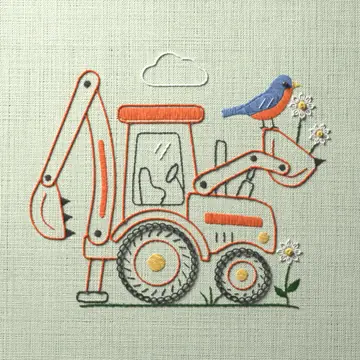
Easy backhoe outline with a little bird
Easy 3–8 in hoop · 6 colors
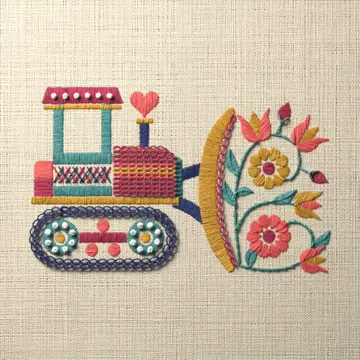
Small bulldozer pushing flowers
Easy 3–8 in hoop · 7 colors
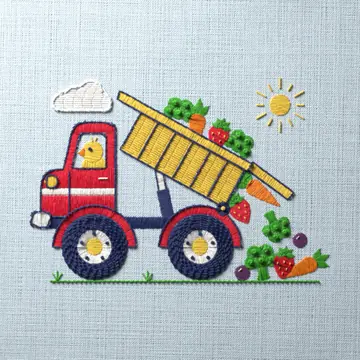
Easy dump truck bib for a baby boy
Advanced prints 3–14 in · 18 colors
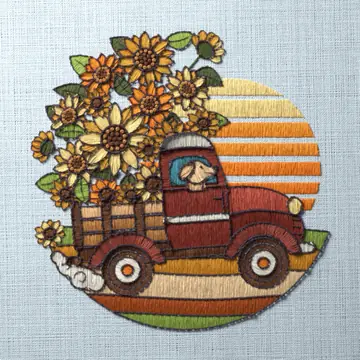
Old truck full of sunflowers
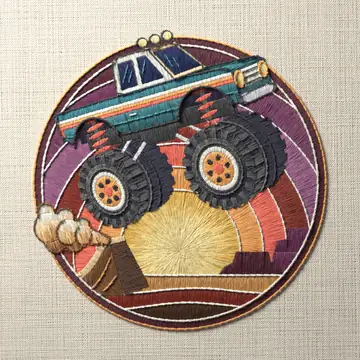
Advanced prints 3–14 in · 23 colors
Monster truck jumping at sunset
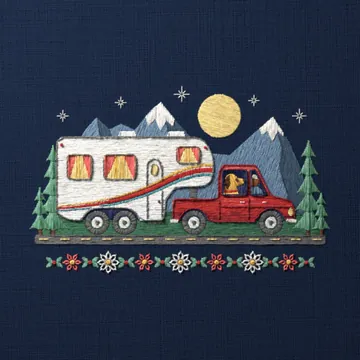
Advanced 3–8 in hoop · 17 colors
Fifth wheel camper border
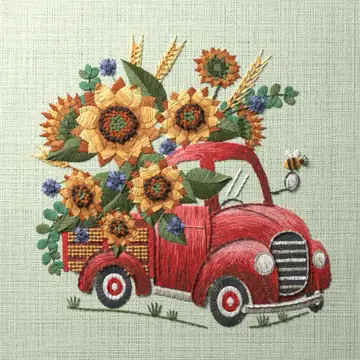
Advanced 3–8 in hoop · 17 colors
Vintage truck with sunflowers
New to hand embroidery? Starting hand embroidery, step by step