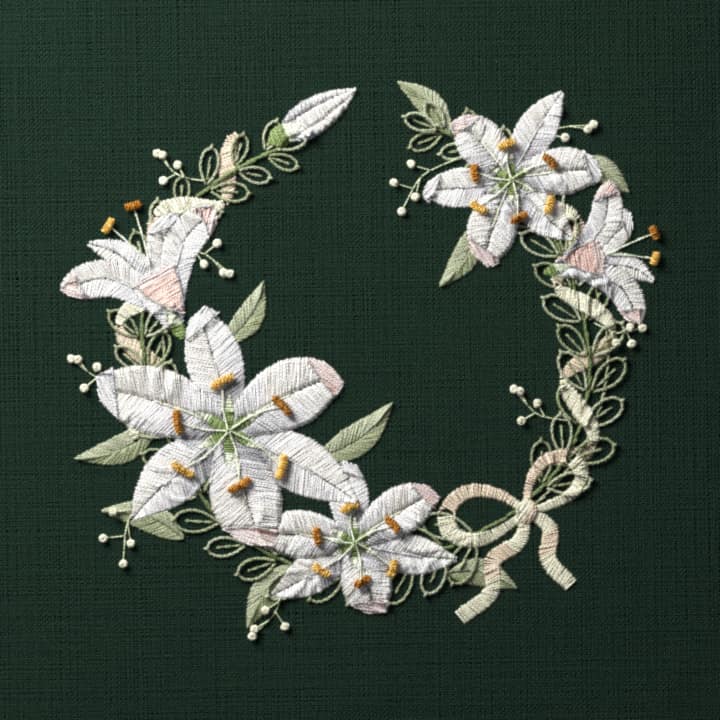
White lily wreath, silk ribbon look hand embroidery pattern
Advanced · 16 colors · 10 kinds of stitch
Download free PDFPDF, US Letter · 102 KBFor your own stitching, gifts and handmade pieces you sell. Do not resell or share this PDF. What you may do, in full
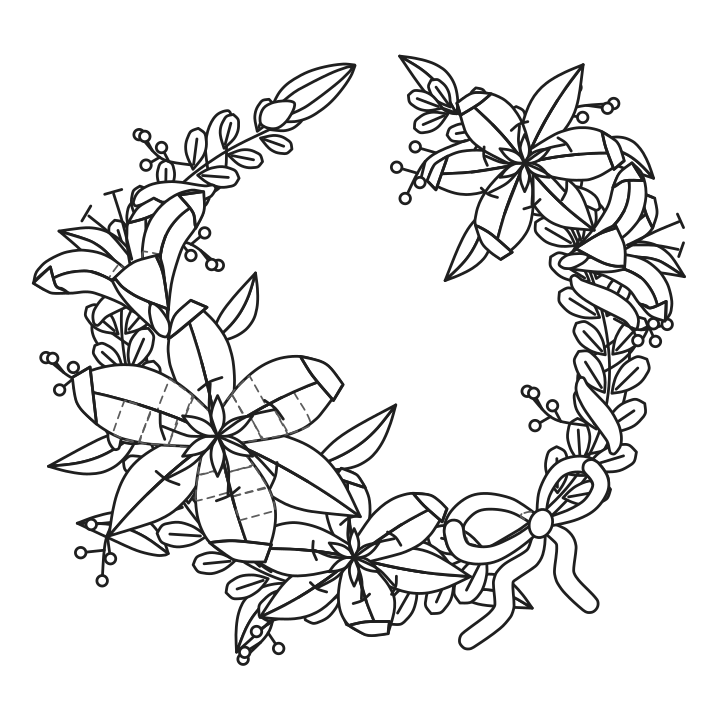
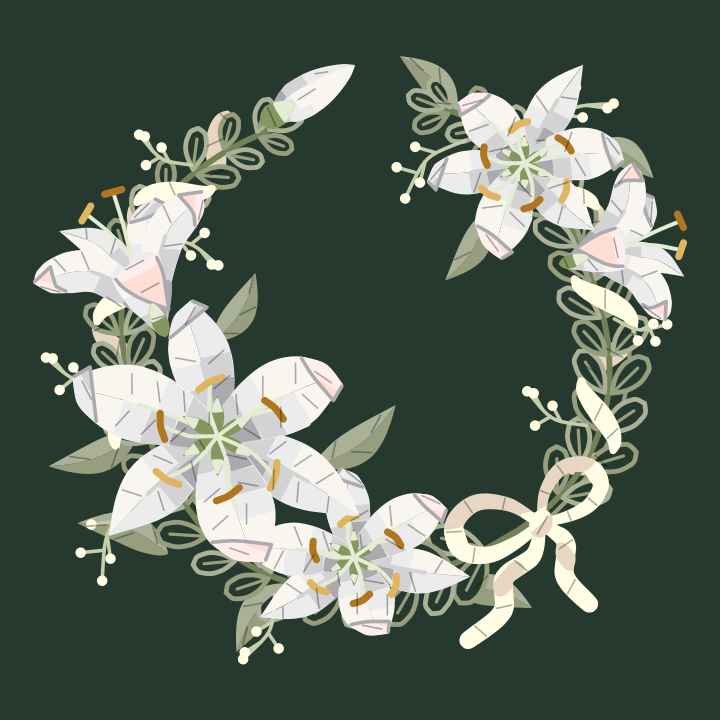
Five white lilies and one bud grow along an open ring of stem stitch. Each petal is two leaning halves of satin stitch, the front ones padded satin stitch, and most tips fold over to show a blush or pearl grey underside edged in split stitch. Anthers are bullion knots on stem stitch. Loop leaves are lazy daisy stitch with a straight stitch inside, the broad leaves are fishbone stitch, and the little sprays are back stitch with French knots. The ivory ribbon and bow are satin stitch. It is drawn for dark green linen. In the picture of where the colors go, the fine lines show which way the stitches lie.
Size and details
Advanced. Uses padded satin stitch, bullion knots, satin stitch over about a quarter of the cloth in a 6 inch hoop, 16 colors and a great deal of stitching; from a 6 inch hoop up some of the satin stitches are long.
16 colors of floss and 10 kinds of stitch:
- Satin stitch
- Fishbone stitch
- Stem stitch
- Lazy daisy stitch
- Straight stitch
- Back stitch
- French knot
- Padded satin stitch
- Split stitch
- Bullion knot
- Which stitch goes where
| Hoop | Inches | Centimeters | Satin stitch up to |
|---|---|---|---|
| 3 in (8 cm) | 1.8 × 1.7 in | 4.6 × 4.3 cm | 3/16 in (5 mm) |
| 4 in (10 cm) | 2.7 × 2.5 in | 6.9 × 6.4 cm | 1/4 in (6 mm) |
| 5 in (13 cm) | 3.6 × 3.4 in | 9.1 × 8.6 cm | 5/16 in (8 mm) |
| 6 in (15 cm) | 4.6 × 4.2 in | 11.7 × 10.7 cm | 3/8 in (10 mm) |
| 8 in (20 cm) | 6.4 × 5.9 in | 16.3 × 15 cm | 9/16 in (14 mm) |
- In an 8 inch hoop the widest satin stitch shape is 9/16 in (14 mm) across. Satin stitches longer than about 12 mm (just under 1/2 in) tend to work loose: divide the shape into sections, or work it in long and short stitch.
- In a 3, 4 or 5 inch hoop the knots are drawn smaller than about 2 mm (a little over 1/16 in). Use one strand of floss for them there, or choose a larger hoop.
The pattern is drawn inside a circle about half an inch (1.3 cm) smaller all around than the hoop.
What you need
- DMC 3047 Light Yellow BeigeRibbon and bow (darker)
- DMC 523 Light Fern GreenLoop leaves and ribbon leaves (lighter)
- DMC 522 Fern GreenLoop leaves and ribbon leaves (darker), stems (lighter)
- DMC 3363 Medium Pine GreenStems (darker)
- DMC 3823 Ultra Pale YellowBow and ribbon (lighter), cream knots
- DMC 524 Very Light Fern GreenKnot sprays
- DMC 762 Very Light Pearl GrayBack petals, front petals, petal undersides and bud (light)
- DMC 318 Light Steel GrayBack petals, front petals and bud (darkest), petal folds
- DMC 415 Pearl GrayBack petals and front petals (dark), petal ribs (darker) and 2 more parts
- DMC 3865 Winter WhiteFront petals, back petals and bud (lightest)
- DMC 3364 Pine GreenLily throats (darker)
- DMC 772 Very Light Yellow GreenStamens, petal ribs and lily throats (lighter)
- DMC 3820 Dark StrawAnthers (lighter)
- DMC 782 Dark TopazAnthers (darker)
- DMC 819 Light Baby PinkPetal undersides (lightest)
- DMC 225 Ultra Very Light Shell PinkPetal undersides (dark)
Skeins: one of each color is enough. An estimate for the largest size, the 8 inch hoop: the length of each line and the area of each filled shape, a fifth added for tails and ends, a tenth of every 8 m (8.7 yd) skein kept spare.
The floss is six-strand cotton; the stitch guide says how many strands to use. You also need a hoop, an embroidery needle (a size 7 to 9 suits two or three strands) and plain cotton or linen fabric. To frame the piece in its hoop, cut a square 3 inches (8 cm) wider than the hoop: a 9 inch (23 cm) square for a 6 inch hoop.
When it is stitched, how to finish a hoop shows how to back it for the wall.
Stitch guide
- Put the pattern on the fabric (how to transfer a pattern) and the fabric in the hoop.
- Stitch the filled parts first, what lies behind before what lies in front of it.
- Then stitch the lines: stems, veins and outlines over the edges of the filled parts.
- Keep the raised parts and the knots for the end, so that the hoop and your hand do not flatten them.
Start each thread with a small knot on the back or one of the knotless starts, and end it by running the needle under the backs of a few stitches (starting and ending a thread). Use the strands this list gives, also where a page about a stitch names another number.
- Satin stitch 2 strandsRibbon, lily throats, back petals, petal undersides, bow
- Fishbone stitch 2 strandsRibbon leaves
- Stem stitch 1 to 4 strandsStems, stamens, petal ribs
- Lazy daisy stitch 3 strandsLoop leaves
- Straight stitch 2 strandsLoop leaves
- Back stitch 1 strandKnot sprays
- French knot 2 strands, two wrapsCream knots
- Padded satin stitch 2 strandsBud, front petals, bow
- Split stitch 1 strandPetal folds
- Bullion knot 3 strandsAnthers
Getting it onto your fabric
The PDF holds the pattern twice at actual size: once as drawn, and once mirrored for an iron-on transfer pen. Print it at 100% with scaling off and check the one-inch square (25.4 mm) with a ruler before you trace. How to transfer a pattern explains tracing, carbon paper and the other ways. The files are under Downloads.
Downloads
- Download free PDF PDF, US Letter, 3 pages, for a 6 inch (15 cm) hoop
- Download free PDF, A4 PDF, A4, 3 pages, for a 6 inch (15 cm) hoop
More patterns like this
Advanced 3–8 in hoop · 16 colors
Brown scapular with heart and lily
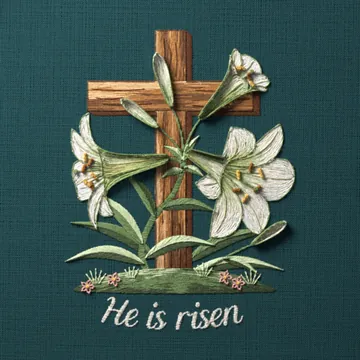
Advanced 3–8 in hoop · 16 colors
He is risen, Easter lilies and cross
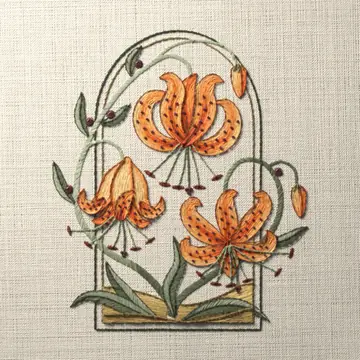
Advanced 3–8 in hoop · 16 colors
Tiger lilies in an Art Nouveau panel
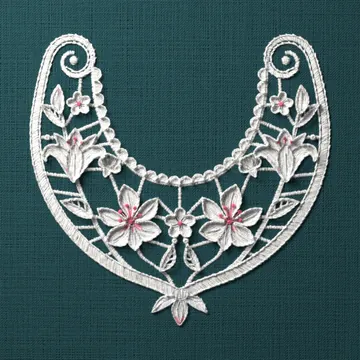
Advanced 3–8 in hoop · 6 colors
Richelieu cutwork blouse neckline
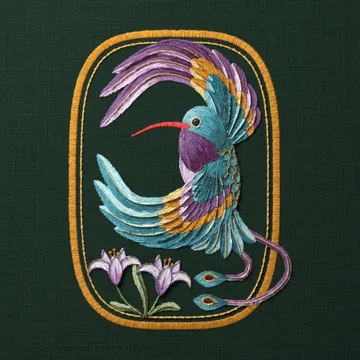
Advanced 3–8 in hoop · 20 colors
Hummingbird with wings forward
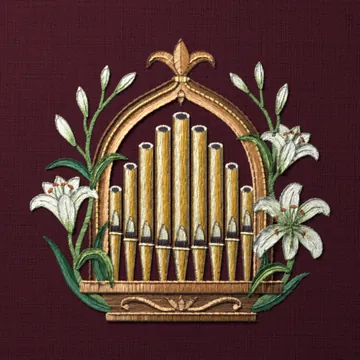
Advanced 3–8 in hoop · 21 colors
Church organ pipes with white lilies
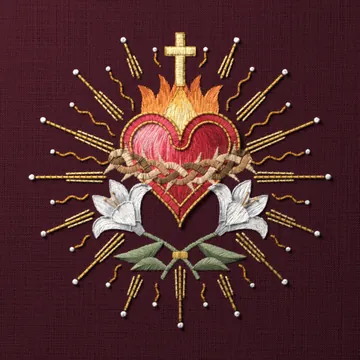
Advanced 3–8 in hoop · 21 colors
French Sacred Heart with gold rays
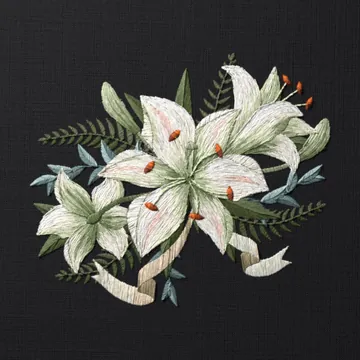
Advanced 3–8 in hoop · 21 colors
White funeral lilies spray
New to hand embroidery? Starting hand embroidery, step by step