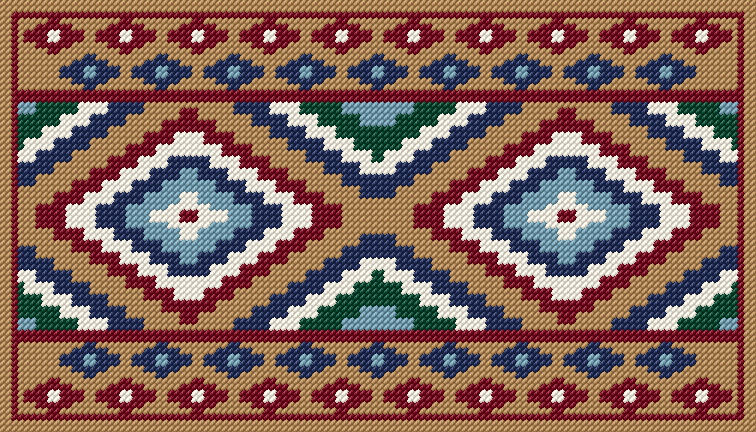
Gaucho wallet with stepped diamonds needlepoint pattern
Needlepoint, 7 × 4 in on 18 mesh, 6 colors, beginner
Download free PDFOptionsPDFPrints on US Letter and A4You may sell what you make from it by hand, in small quantities. The PDF itself is not to be sold or shared. Selling, classes and kits: the rulesNew to it? Next: how to start
Your PDF is ready: look in your downloads. Open the PDF (opens in a new tab)
You will need
- Canvas: blank mono canvas, 18 mesh (18 threads to the inch), cut 11 × 8 in
- Needle: tapestry, size 22. Also masking tape for the cut edges, and small scissors
- Thread: 6 colors of six-strand floss, 4 strands in the needle (5 or 6 if canvas shows), about 10 skeins in all (an estimate)
- Thread: 6 colors of pearl cotton size 5, 1 strand in the needle, about 6 skeins in all (an estimate)
- Thread: 6 colors of Persian wool, 1 strand in the needle, about 6 skeins in all (an estimate)
Make it a wallet. A wallet or clutch with a window this size, or a lining and a closure to sew it up. Measure the window before you stitch. If the piece is small for it, stitch two extra rows all round in DMC 436, the color at its edge. How to press needlepoint into a wallet
A gaucho wallet with two great stepped diamonds in oxblood, cream, navy and sky blue, half diamonds in green between them. The ground is saddle tan with bands of small diamonds inside a thin oxblood line.
Threads
- DMC 436 Tan 3,368 stitches about 23.1 yards 3 skeins
- DMC 815 Medium Garnet 2,164 stitches about 14.9 yards 2 skeins
- DMC 823 Dark Navy Blue 1,624 stitches about 11.2 yards 2 skeins
- DMC 712 Cream 1,108 stitches about 7.6 yards 1 skein
- DMC 519 Sky Blue 448 stitches about 3.1 yards 1 skein
- DMC 500 Very Dark Blue Green 360 stitches about 2.5 yards 1 skein
Skeins are estimates.
Thread colors are approximate screen matches to DMC numbers. Check against real thread before you buy.
How to stitch it
- Each square is one tent stitch, up at 1, down at 2: basketweave for the background, continental for lines.
- Bind the edges. Cut 18 in of thread; start and end it without a knot left behind.
- Mark the middle of the canvas. It is the outlined square: start there. Count threads, not holes.
- Picture first, then border, background last. Gray squares are on two pages: stitch them once.
- A heavier line stands every ten squares: count by them.
- When it is done, block it square.
See the chart on this page
The chart is drawn when this is opened.
It opens in the pattern maker, with your colors and your name on it.
Options
Another mesh, another thread, large print and tools
On another mesh
The chart is 126 × 72 stitches: a wallet on 18 mesh canvas.
| Mesh | Stitched size | Canvas to cut |
|---|---|---|
| 10 | 12.6 × 7.2 in 32 × 18.3 cm | 16.6 × 11.2 in 42.2 × 28.4 cm |
| 12 | 10.5 × 6 in 26.7 × 15.2 cm | 14.5 × 10 in 36.8 × 25.4 cm |
| 13 | 9.7 × 5.5 in 24.6 × 14.1 cm | 13.7 × 9.5 in 34.8 × 24.2 cm |
| 14 | 9 × 5.1 in 22.9 × 13.1 cm | 13 × 9.1 in 33 × 23.2 cm |
| 18 | 7 × 4 in 17.8 × 10.2 cm | 11 × 8 in 27.9 × 20.3 cm |
Mesh is the number of canvas threads to the inch; the row in bold is the mesh this chart is sized for. Canvas to cut includes a margin of 2 in (5.1 cm) of bare canvas on every side.
In another thread
The numbers are DMC color numbers, which its six-strand cotton and its pearl cotton share. Persian wool and silk are numbered differently: match those by eye. Which thread suits which mesh
In large print
The same chart in squares of about 6 mm, on 9 pages.
Another stitch
The chart is in tent stitch. The plain part of the sky can have a texture of its own: try brick stitch or Parisian stitch there, and keep the rest in tent stitch. Stitches for sky and water shows more of them. Another stitch takes another amount of thread: allow a skein more of that color.
How the level is set
Beginner. Few colors and long stretches of one: a good first piece.
Beginner: 6 colors. Changes of color are about 4 stitches apart, leaving out the border. With up to 7 colors, 3.5 or more apart is Beginner and closer is Intermediate.
How the thread is counted
The yards are of thread as it is threaded in the needle: stitched with several strands together, a thread takes that many yards of single strand for every yard counted. For six-strand cotton on 18 mesh, the thread and needle chart gives 4 to 6 strands.
An estimate. The length of thread one stitch uses on the front and back of the canvas, times the number of stitches, plus 30 percent for starting, ending and the tail left in the needle. Each count is estimated as basketweave or continental and rounded up to a tenth of a yard. The 30 percent is this site's own choice. The thread calculator works the same estimate for any count and mesh.
What you may do with it
You may sell what you make from it by hand, in small quantities. The PDF itself is not to be sold or shared. Selling, classes and kits: the rules
More patterns like this
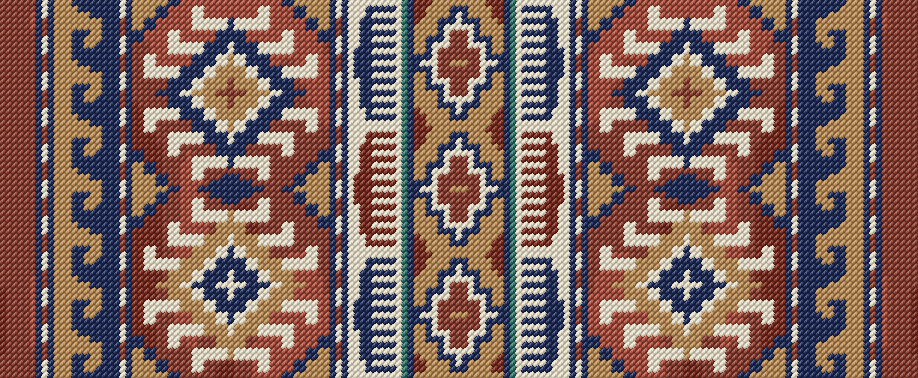
Intermediate 9,639 stitches 8.5 × 3.5 in · 7 colors · 18 mesh
Men's wallet with kilim bands
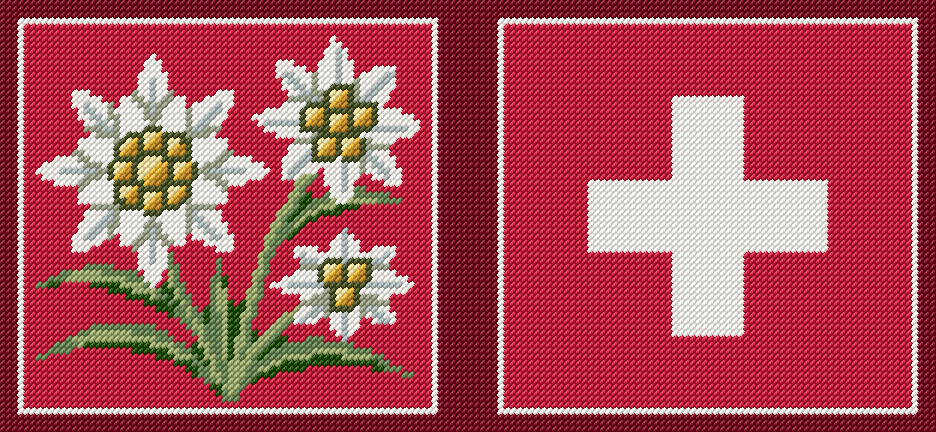
Intermediate 11,232 stitches 8.7 × 4 in · 12 colors · 18 mesh
Swiss flag wallet with edelweiss
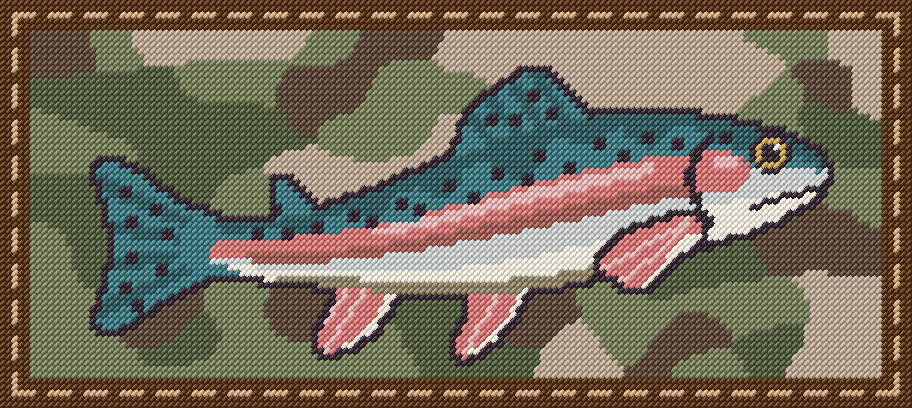
Intermediate 10,336 stitches 8.4 × 3.8 in · 16 colors · 18 mesh
Camo wallet with a rainbow trout
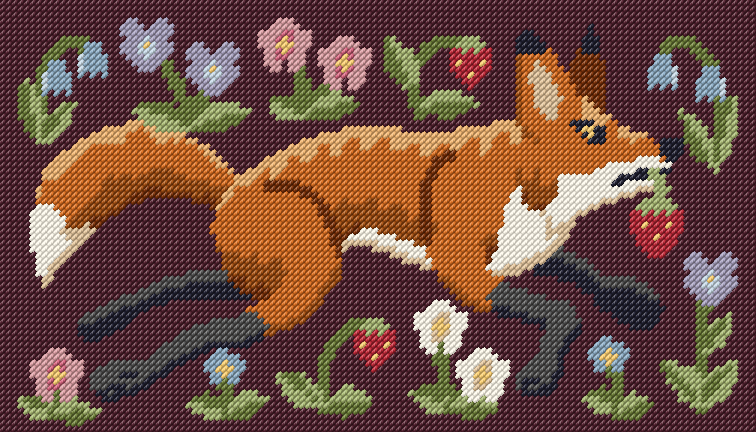
Advanced 9,072 stitches 7 × 4 in · 18 colors · 18 mesh
Fox wallet with woodland flowers
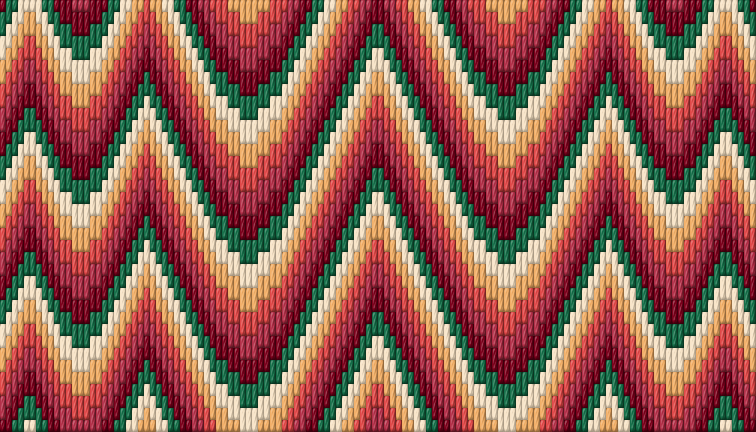
Beginner 2,330 stitches 7 × 4 in · 6 colors · 18 mesh
Flame stitch bargello clutch
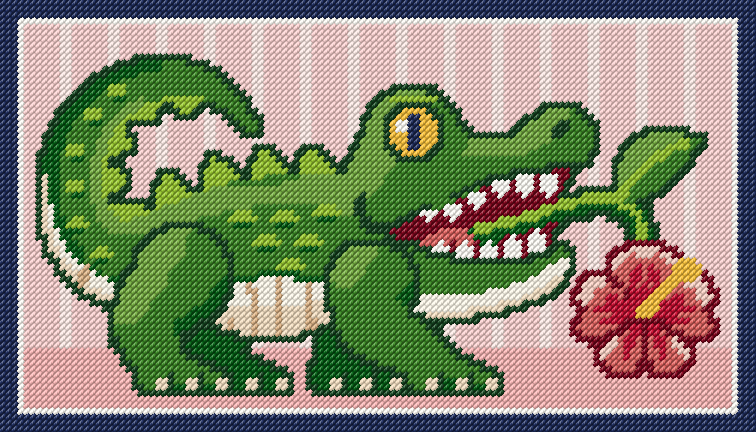
Advanced 9,072 stitches 7 × 4 in · 18 colors · 18 mesh
Alligator or crocodile card wallet
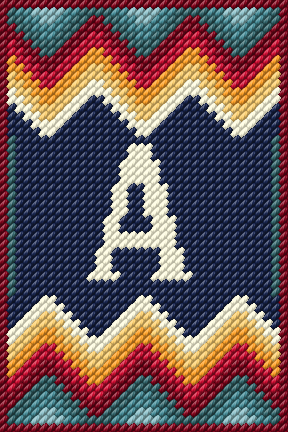
Intermediate 1,944 stitches 2 × 3 in · 9 colors · 18 mesh
Flame initial luggage tag, any letter
Beginner 8,100 stitches 5 × 5 in · 5 colors · 18 mesh
Greek key rows
New to needlepoint? How to needlepoint