Cross stitch when it is hard to see
Five changes help at once: cloth with bigger holes (6, 8 or 11 squares to the inch in place of the usual 14), a lap or table of the opposite shade so the holes show, a strong lamp aimed at the work, a magnifier that leaves both hands free, and a chart printed large. Try them one at a time, and begin with the light.
On this page
- Bigger holes first
- Low counts at a glance
- How wide a chart comes out, in centimeters
- Surfaces that are easier than cloth
- Make the holes show
- Choose thread you can tell apart
- Charts you can read
- Needles and thread
- Working partly by touch
- Keep things where you can find them
- A first piece to try
- When to ask for help
- Common mistakes
- Where to go next
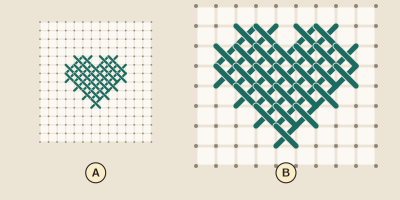
Bigger holes first
The count of a cloth is the number of squares in an inch (2.5 cm). Aida, the usual cloth, is woven in plain squares with a hole at each corner. A lower number means bigger squares, bigger holes and a bigger finished piece from the same chart. On 6 count each square is more than twice as wide as on 14 count.
11 count is the gentlest step down from 14. The stitches are made in the same way, with one strand more, and most designs still come out at a handy size. 8 and 6 count are a bigger change, with more strands and a larger needle.
Cross stitch thread, called floss, is six fine strands that pull apart. The table says how many to put in the needle at once. "4 or more" means begin with four, and add one if the cloth shows through.
Low counts at a glance
| Fabric | Stitches to the inch | 100 stitches measure | Tapestry needle | Strands |
|---|---|---|---|---|
| 6 count Aida | 6 | 16 5/8 in (42.3 cm) | Size 18 | 4 or more |
| 7 count | 7 | 14 1/4 in (36.3 cm) | Size 18 | 4 or more |
| 8 count Aida | 8 | 12 1/2 in (31.8 cm) | Size 20 | 4 or more |
| 10 count | 10 | 10 in (25.4 cm) | Size 20 | 4 or more |
| 11 count Aida | 11 | 9 1/8 in (23.1 cm) | Size 22 | 3 |
| 14 count Aida | 14 | 7 1/8 in (18.1 cm) | Size 24 | 2 |
How wide a chart comes out, in centimeters
| Stitches | 6 count Aida | 8 count Aida | 10 count | 11 count Aida | 14 count Aida |
|---|---|---|---|---|---|
| 20 | 8.5 cm | 6.3 cm | 5.1 cm | 4.6 cm | 3.6 cm |
| 30 | 12.7 cm | 9.5 cm | 7.6 cm | 6.9 cm | 5.4 cm |
| 40 | 16.9 cm | 12.7 cm | 10.2 cm | 9.2 cm | 7.3 cm |
| 50 | 21.2 cm | 15.9 cm | 12.7 cm | 11.5 cm | 9.1 cm |
| 70 | 29.6 cm | 22.2 cm | 17.8 cm | 16.2 cm | 12.7 cm |
| 100 | 42.3 cm | 31.8 cm | 25.4 cm | 23.1 cm | 18.1 cm |
Surfaces that are easier than cloth
- Plastic canvas, 7 count. A stiff plastic grid with large square holes. It needs no hoop, and the bars between the holes can be felt. Use yarn. See plastic canvas.
- Perforated paper and vinyl. Stiff sheets with clean round holes, usually 14 to the inch. The holes are small but sharp-edged.
- Pegboard. Holes an inch (2.5 cm) apart, worked in thick yarn. See cross stitch on pegboard.
- Stamped cloth. The Xs are printed on the cloth, so there is nothing to count. You do need to see the print. See stamped and counted.
- Printed or gridded Aida. Aida with a line every ten squares, woven in, printed on, or sewn in by you and taken out at the end. See gridding.
Make the holes show
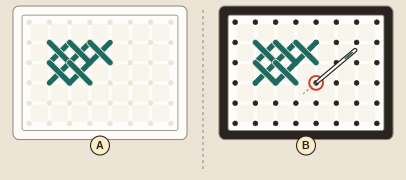
- Aim a lamp at the work. Use one on a flexible arm, about 8 to 12 inches (20 to 30 cm) from the cloth, from the side opposite your stitching hand so that your hand throws no shadow.
- Put the opposite shade underneath. A dark cloth on your lap under white Aida makes each hole a dark dot. Under black or navy cloth put white.
- Choose plain colors round you. A patterned lap cloth or tablecloth confuses the eye. One solid color shows the needle and the scissors too.
- Try a light behind. A small lamp below the work, or a lit tracing pad (a flat panel of light) on your lap, shines up through the holes. Stitching on black fabric has more.
- Stretch the cloth. A hoop or frame opens the holes. On a stand it leaves both hands free.
- Add a magnifier last. One on an arm, on a stand or round the neck keeps your hands free. People often buy a lens when they needed a lamp. Light and magnifiers explains the strengths.
Choose thread you can tell apart
- Contrast with the cloth. Dark or bright thread on white, pale thread on black.
- Few colors, far apart. Two blues that look alike in the skein look more alike at night. The Easy patterns open on the Beginner ones, in a few colors.
- No pale background. White stitches on white cloth are hard for anyone.
- Big blocks of one color. They need less looking back and forth than single scattered stitches.
Charts you can read
Every chart here has a symbol in each square as well as a tint, so it can be read without relying on color.
- Zoom in on a screen. Open the PDF on a tablet or a computer and enlarge it until the symbols are clear.
- Or print it large. Under Download on a cross stitch pattern of this site, open Options and choose Large print: squares of 5.6 mm (about 1/4 inch) or more, in color or in black. A copier can also double a page. How to print a pattern covers the ways. The stitched size does not change.
- Work from one part at a time. Cover the rest with plain card. A ruler along the row keeps your place.
- Do one color at a time. On a spare print of the chart, mark that color's symbol with a bright pen before you begin it.
- Draw your own, large. Copy a small motif with a thick pen onto paper ruled in squares of 1/2 inch (1.3 cm). That is several times larger than the squares of a printed chart.
A chart holder stands the page up close to your eyes, and its strips or its window cover the rest.
Needles and thread
- A larger needle. Low counts take one anyway, and its eye is longer. It must still slip through the hole.
- A threader. A wire loop goes through the eye and pulls the thread back. Stand the needle in a cork or a bar of soap to free your hands.
- A needle that threads itself. The thread is pressed into a slot above the eye. It can slip out if you pull hard, and it can fray some threads, so keep the pull gentle. Many have a sharp point. Aida wants a blunt one, so read the packet, or keep the sharp kind for stamped cloth.
- Several needles ready. Thread one for each color before you sit down, or ask someone to.
- Short lengths. They tangle less. From fingertips to elbow is about 18 inches (46 cm) on many people.
The page on threading a needle shows the fold and the threader step by step.
Working partly by touch
Sight and touch can share the work.
- Stitch on something stiff. Use plastic canvas, or cloth held tight in a hoop on a stand.
- Keep one hand underneath. It feels the point arrive and guides it back.
- Find the hole with the needle. Slide the blunt point gently over the cloth until it drops in.
- Feel for the last stitch. Count the holes on from it with a fingertip or the point of the needle.
- Baste a raised line. To baste is to sew long, loose stitches that come out later. A row of them in thick thread every ten squares can be felt as well as seen. Stitch beside the line, not through it, and draw it out at the end.
- Check by feel. A loop, a gap or a missed stitch in a filled block can be found with a finger.
Work blocks and borders at first: rows of ten, then squares of ten by ten. A pattern you can keep in your head asks for less looking.
Keep things where you can find them
- Put the project, its thread and its chart together in one bag.
- Use a tray with a raised edge, on a non-slip mat.
- Give each color its own bag, with its number in thick black pen. A mark you can feel works as well: a rubber band round the bag, or a braille label.
- Keep the bags in the order of the chart's color list.
- Hang the scissors on a ribbon round your neck.
- Keep a magnet within reach for a dropped needle, and wear shoes in case one is on the floor.
A first piece to try
Choose a mini pattern in two or three strong colors, a piece of white 11 or 8 count Aida, a dark lap cloth and a lamp. On 11 count use a size 22 needle and three strands. On 8 count use size 20 and four. If you have never made a cross, how to cross stitch shows it stitch by stitch. Stitch for a short while in your best light, and stop before your eyes tire. If it goes well, go larger. If it does not, try plastic canvas and yarn before you give up.
When to ask for help
This page is about stitching and gives no medical advice. If your sight has changed, or close work hurts, see an eye doctor. A low vision specialist can try lenses and lamps with you.
Common mistakes
- Buying a stronger lens first. Try a better lamp before it.
- Keeping the lap the same shade as the cloth. Change one of them.
- A light in front of the eyes. It dazzles. Aim it at the cloth, below eye level.
- Two strands on 6 count. Thin stitches are harder to see. Use four or more.
- Evenweave and linen. These are woven in single threads, with no squares. The holes are harder to find than those of Aida. Come back to them later.
Where to go next
11 count Aida and less common counts have the numbers for big squares. Cross stitch with yarn goes bigger still. For company while you learn, see cross stitch groups.