Cross stitch guide
Cross stitch on blankets and afghans
First find out what you can count. Afghan cloth is woven with large plain squares, and you stitch a design in the middle of some of them, counting threads: each cross covers two threads each way. A throw woven in tiny blocks takes one cross to a block. Fleece and other plain blankets have nothing to count, so a small motif is stitched through canvas that comes away.
On this page 16 parts
- Four kinds of blanket
- What you need
- Needle and strands for each weave
- Afghan cloth, and how much fits in a square
- Plan the squares
- Stitch a square, step by step
- Fleece, flannel and plain blankets
- What to do when the stitching is done
- The back shows
- A fringe, a hem or a binding
- Baby blankets
- Names on a blanket
- Washing
- Common mistakes
- Questions people ask
- Where to go next
Four kinds of blanket
The count is the number of threads, or of woven blocks, to the inch (2.5 cm). Lay a ruler on the blanket and look.
| Blanket | What you count | What suits it |
|---|---|---|
| Afghan cloth, also sold as Anne cloth: large plain squares with bands between, 18 threads to the inch (2.5 cm) | Two threads to a cross, 9 crosses to the inch (2.5 cm). This is called working over two | One motif to a square, letters, a scene across several squares |
| A throw or baby blanket woven in tiny blocks, 14 or 16 to the inch (2.5 cm) | One block to a cross, as on Aida, the usual cross stitch cloth | Finer motifs, a border, a name |
| Fleece, flannel, any plain blanket | Nothing: stitch through canvas | A small motif or initials in one corner |
| A knitted or crocheted blanket | Its own stitches | A motif counted on its stitches |
For the first two, go on reading. For the third go down to "Fleece, flannel and plain blankets". A quilt is stitched in blocks, before its layers are put together: see cross stitch quilts. Onto a finished quilt, sew a stitched label, as at the end of that part.
Monk's cloth, a loose basket weave sold at 7 count, is stitched one woven block to a cross. Knitting and crochet have a grid of their own: see cross stitch on crochet and knitting.
What you need
- The blanket, and a chart for each design you want on it. Each symbol on a chart is one cross.
- Cotton floss. It comes as six thin strands lying together, and you stitch with some of them: the table says how many.
- A tapestry needle. Its point is blunt and slips between the threads. A bigger number is a finer needle.
- A hoop of 8 inches (20.3 cm), if you like one, sewing thread and scissors.
Needle and strands for each weave
| Fabric | Stitches to the inch | 100 stitches measure | Tapestry needle | Strands |
|---|---|---|---|---|
| 18 count, over two | 9 | 11 1/8 in (28.2 cm) | Size 20 | 4 or more |
| 20 count, over two | 10 | 10 in (25.4 cm) | Size 20 | 4 or more |
| 16 count Aida | 16 | 6 1/4 in (15.9 cm) | Size 26 | 2 |
| 14 count Aida | 14 | 7 1/8 in (18.1 cm) | Size 24 | 2 |
| 7 count | 7 | 14 1/4 in (36.3 cm) | Size 18 | 4 or more |
Afghan cloth, and how much fits in a square
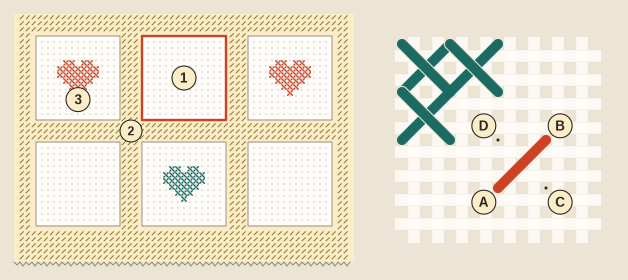
Afghan cloth, most of it cotton, is woven with plain squares (1) divided by bands of another weave (2). It is sold as a whole blanket or by the panel. You stitch in the squares and leave the bands alone.
To find how many crosses fit, multiply the side of the square in inches by the count, and halve it if you stitch over two threads. A design fits if it is that many stitches wide and high, or fewer. These are sizes that shops list:
- 5 inch (12.7 cm) squares of 18 count hold 90 threads, so 45 stitches over two. Leave two or three bare all round: about 40 to use. Another shop counts 86 threads in the same square, which is 43 stitches.
- 3 3/4 inch (9.5 cm) squares of 18 count, on a baby's cloth, hold 33 stitches over two. Its plain center, 25 by 21 inches (63.5 by 53.3 cm), holds 225 by 189.
- 4 3/4 inch (12.1 cm) squares of 16 count hold 76 stitches over one.
- 6 inch (15.2 cm) squares of 14 count hold 84 stitches over one.
The squares on some cloths are taller than they are wide, with room for 47 by 57 stitches or so. Count your own in threads, both ways, before you choose a chart.
Plan the squares
- Spread the cloth out and count the squares across and down.
- Draw the plan. A grid on paper, one box for each square.
- Decide which squares to stitch. Every other one, like a checkerboard, looks calmer than all of them. A ring of squares round the edge, or the four corners and the center, are less to stitch.
- Try the designs. Cut paper to the size each design will be, or print the charts near that size. Lay them in the squares and move them about.
- Settle the colors together. Use the same five or six all over.
- Choose which way is up. On a throw that lies over a chair, every motif faces the same way.
- Start in the middle square and work outward, so that a square more or less at the edge does not spoil the balance.
Stitch a square, step by step
- Wash the cloth if it will shrink. Loose weaves such as monk's cloth do. Test your colors on a damp cloth at the same time.
- Sew over the cut edges so that they do not fray while you work. Use a machine zigzag, or go over and over the edge by hand. If you want a fringe, sew only the very edge: it is cut off later.
- Find the middle of the square. Sew a long, loose stitch from corner to corner each way. The middle is where the two cross.
- Find the middle of the chart. Small arrows on its edges point to it. That is the middle of the square. If the chart is empty there, count to the nearest symbol: two threads of cloth for each square of the chart.
- Thread the needle. Cut 15 to 18 inches (38 to 46 cm) of floss, draw out the strands one at a time, and put as many as you need back together: four to begin with, over two threads of 18 count.
- Come up at A, the lower left corner of the cross. There is no knot: hold an inch (2.5 cm) of thread flat behind the cloth, so that the next stitches cover it.
- Go down at B, two threads across and two up.
- Come up at C, two threads straight below B.
- Go down at D, two threads straight above A. That is one cross, and the hole in its middle is empty.
- Go on along the row. The next cross begins at C. In a long row make only the first legs, A to B, all the way along, and then come back making the second legs, C to D. The same leg lies on top in every cross of the blanket.
- End under the stitches. Run the needle under five or six on the back and cut the thread short. Begin again for the next patch of color: do not carry a thread across bare cloth.
- Take out the two long stitches as you reach them.
On a throw woven in blocks, the steps are the same with one block where this says two threads. How to cross stitch has that in pictures.
An 8 inch (20.3 cm) hoop holds one 5 inch (12.7 cm) square at a time. Let the rest of the blanket lie in your lap or on a table, so that its weight does not pull. Evenweave and over two shows the stitch again on finer cloth.
Fleece, flannel and plain blankets
Use a canvas that comes away, the way it is done on a shirt. It lies on top of the blanket and gives you holes to count. Soluble canvas is a sheet that dissolves in warm water. Waste canvas is dampened, and its threads are pulled out.
Two things to know before you begin:
- Fleece stretches. It is a knit. Before the canvas goes on, tack a light stabilizer (a thin sheet that stops cloth from stretching) behind it. Do not iron one on: fleece can melt. Hold it without pulling it taut, since a tight hoop stretches the cloth and crushes its soft surface, and keep the stitches loose.
- Fleece is furry. Its raised surface is called a nap, and stitches sink into it unless something lies on top. Soluble canvas lies over the nap while you stitch, and solid shapes show better than thin lines. Flannel is flatter and seldom needs it.
- Choose a small motif for one corner. The usual place is 9 to 10 inches (22.9 to 25.4 cm) in from the point of the corner, toward the middle.
- Cut the canvas about an inch (2.5 cm) bigger than the motif on every side. 14 count canvas gives 14 crosses to the inch (2.5 cm).
- Sew it on round its edge with long, loose stitches in sewing thread.
- Stitch through the holes of the canvas and the blanket together, from the middle out, in two strands. Do not pull tight.
- Take out the sewing thread, and then the canvas. Waste canvas has both kinds step by step.
Or sew on a label. Stitch the motif or name on Aida or evenweave, turn its edges under, and sew it to the corner. Nothing shows on the other side but the sewing.
What to do when the stitching is done
Fasten the ends, wash and press it, settle the back, and finish the edge last.
- Fasten the ends under stitches on the back.
- Take out any long marking stitches that are left.
- Wash it if it is soiled, or if you will line it, in cool water with a mild soap. Roll it in a towel, then dry it flat.
- Press a woven blanket face down on a towel, under a cloth, with a warm iron. Keep the iron off fleece, which can melt.
- Settle the back. Leave it bare, or line it: see "The back shows".
- Finish the edge. Fringe or hem a single layer, and bind a lined one: see "A fringe, a hem or a binding".
For a baby's blanket, "Baby blankets" says which back and which edge to choose.
The back shows
A blanket is turned over, so think about its back before you start.
- Leave it, but keep it short and flat. Every end goes under stitches, with no long carries and no knots to feel. On a throw this is the usual way. The back of your cross stitch has the habits.
- Work it double-sided. The double-sided cross stitch looks the same on both faces. It takes more thread and more care, and suits a border or initials better than a whole picture.
- Line it. Sew a soft cotton or flannel to the back. It hides everything and makes the blanket warmer and heavier. Wash both cloths first so that they shrink alike.
How to line and tie a blanket
A lining is a second cloth behind the blanket. Ties, single knotted stitches, hold the two together.
- Cut the lining a little larger than the blanket on every side.
- Lay it face down, smooth, and the blanket on it, face up.
- Pin them with safety pins every few inches, from the middle outward.
- Make a tie. Thread six strands of floss in a sharp needle with a big eye. Go down through both cloths and come up 3/16 inch (5 mm) away. Leave long ends.
- Knot it right over left, then left over right. Trim the ends to 1/2 inch (1.3 cm).
- Go on at the corners of the woven squares, or every 4 inches (10.2 cm) on other cloth.
- Trim the lining level. Then bind the edge.
How to tie a quilt shows the stitch and the knot.
A fringe, a hem or a binding
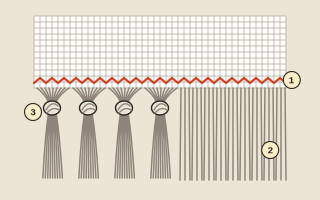
A fringe is made of the cloth's own threads. Afghan cloth has a margin woven for it, about half a square wide, all round the outermost squares.
- Choose the depth. No deeper than the margin: 2 inches (5.1 cm), for instance. Count the same number of threads in from all four edges, and mark that line with long, loose stitches.
- Sew the line (1). Work a machine zigzag along one thread all the way round, or a row of half stitches by hand: one slanting leg after another, each over two threads. Without it the fringe goes on into the blanket.
- Cut off the edge sewing if you sewed over the edges before you began.
- Draw out the threads (2) that run along the edge, one at a time with a needle, starting at a corner, until you reach the line.
- Knot it (3). Take the same number of threads for each bunch, and tie it in one overhand knot: make a loop with the bunch and bring its ends through. Slide the knot up to the line before you pull it tight.
- Trim the ends level against a ruler.
A knot keeps the edge from unraveling. Twisting or braiding each bunch does the same. Where two sides meet, the corner is bare: both sets of threads have been drawn.
A hem stands up to more washing than a fringe. Fold a narrow strip of the edge to the back, fold it once more so that the cut edge is shut inside, and sew it down. Finishing edges shows hems and fringes stitch by stitch.
A binding is a separate strip of cloth folded over the edge and sewn on both sides. It is the finish for a lined blanket, whose layers it holds together. The steps are below.
Joined squares. Separate pieces of Aida or evenweave can be sewn together, backed and bound like a quilt: see cross stitch quilts.
How to bind a blanket
Sew a doubled strip round the front, then turn it over the edge and sew it down behind.
- Cut strips of cotton 2 1/2 inches (6.4 cm) wide, as long as all four sides and 10 inches (25.4 cm) more. Join them end to end.
- Fold the strip in half along its length, good side out, and press.
- Pin it to the front from the middle of a side, its first end turned back, its two raw edges on the raw edge.
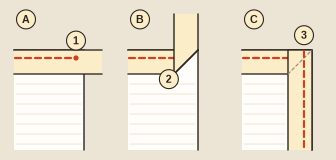
- Sew it 1/4 inch (6 mm) in, as far as 1, 1/4 inch (6 mm) from the corner.
- Turn the corner. Fold the strip up (2), then down along the next side. Sew on from 3.
- Lap the last end over the first.
- Turn the fold to the back and sew it down by hand.
Baby blankets
- No beads, buttons or charms. They are small enough to choke on.
- A soft back, so that thread ends do not scratch. Line the blanket. Or leave it single and iron soft interfacing over the stitches, if its label allows an iron.
- Colors that do not run, because it will be washed often.
- A firm edge. Bind a lined blanket. Hem a single one, or knot its fringe.
The baby blanket and quilt patterns are charts to choose from.
Names on a blanket
At 9 stitches to the inch (2.5 cm), a letter 18 stitches high is 2 inches (5.1 cm) tall. Count the width of the whole name with the gaps before you begin: a name of 90 stitches is 10 inches (25.4 cm) wide, which is all of two 5 inch (12.7 cm) squares, with a woven band cutting it in half. For a long name choose a smaller alphabet or put one letter in each square. Lettering shows how to center it, and the text generator charts it.
Washing
Wash it by hand or on a gentle cold cycle with a mild soap, and dry it flat or over a line. High heat shrinks cotton thread. A fringe goes in a laundry bag.
Common mistakes
- The design is twice the size you planned. It was counted over one and stitched over two. Work the sum again: stitches divided by 9 for 18 count over two.
- The crosses look thin. Use more strands. Try four, then five, in the margin, and take them out again.
- One square is off. Count from the edge of each square, not from the last motif.
- The fringe is eating the blanket. There was no sewn line. Sew one now, just inside where the threads have pulled.
- Shadows show through. A dark thread was carried behind bare cloth.
Questions people ask
Can I stitch on an afghan over one thread? On 14 and 16 count cloth, yes: one woven square to a stitch. On 18 count it gives small, close stitches and a design half as wide.
Do I need a hoop? A small one helps on soft cloth. Take it off when you stop.
How much floss? More than on Aida, since each stitch is bigger and uses four strands or more. Work one motif, see how far a skein goes, and make your estimate from that.
Where to go next
Look at the blanket patterns for motifs that fill a square. Backing has linings. For smaller things to use and wash, see towels and bibs. For all that is sold ready to stitch on, see blanks.