Cross stitch guide
Blanks to cross stitch on
A blank is a finished thing made to be stitched on, such as a towel, a bib or a mug. Some have a panel of cloth woven in squares, and some have rows of holes: you stitch straight onto those. Others have a window: you stitch on a separate piece of cloth and set it in. Count the squares or the holes, or measure the window. The first table says how large a design that takes. Then choose one and stitch.
On this page 14 parts
- Three kinds of blank
- What is sold, and how much fits on it
- How many stitches fit a window or a panel
- What to look at before you choose one
- Choose a pattern that fits
- Needle and strands for each count
- Stitch straight onto a cloth blank
- Stitch on wood, plastic or paper
- Set a piece in a window
- No weave to count
- Make your own blank
- Common mistakes
- Questions people ask
- Where to go next
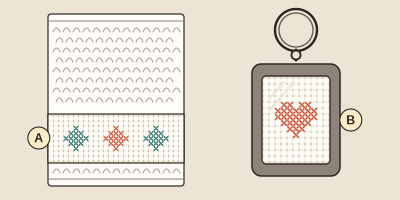
Three kinds of blank
| Kind | Do this first | The largest design | Then |
|---|---|---|---|
| A panel of cloth woven in squares (A) | Count the squares across and down | Four squares fewer each way, so that two stay bare on every side. If there is room, leave three | Stitch on the cloth |
| Rows of holes, in wood, plastic or paper | Count the holes across and down | One fewer than the holes each way. The crosses may fill them all | Stitch in the holes |
| A window (B), in a frame or under a clear cover | Measure the window across and down, in inches or centimeters | Look its size up: the table gives the stitches that fit | Stitch on cloth of your own, such as 14 count Aida, and set it in |
A thing with no squares, no holes and no window takes a canvas that comes away, or a stitched patch: see no weave to count.
Words that this page uses:
- Aida is cotton cloth woven in small squares that have a hole at all four corners. One square takes one cross.
- Count is the number of squares to the inch (2.5 cm). 14 count is the usual one.
- Over two. Some cloth is woven in single threads, with no squares to see. There a cross covers two threads across and two up, so the crosses to the inch are half the count: 14 of them on 28 count.
- A design is the picture you stitch. Its chart is the grid it is drawn on: each square with a symbol in it is one cross, so a design 40 stitches wide covers 40 squares of cloth. A pattern is a chart with its list of threads.
- A template is the piece of card, paper or cork that comes with a window blank, to cut your stitched cloth by. It is as large as the window, or a little larger, so that its edge lies under the rim. Choose the design by the window, and cut the cloth by the template.
For a first try, take a bookmark, a hand towel or a bib with a panel of 14 count Aida in a single layer. Squares of that size are easy to see and to count, your hand reaches the back, and when the last cross is made there is nothing left to cut or to set in.
What is sold, and how much fits on it
These are sizes that sellers list, the width first and the height after it. "Squares" are all the squares there are. "At most" is the largest design, with two of them left bare on every side. Makes differ and labels can be wrong, so count or measure your own before you choose.
Towels, kitchen and table
| Blank | What you stitch on | How much it takes | Check this first | Steps and patterns |
|---|---|---|---|---|
| Hand towel | A band of 14 count near one end | One is listed at 220 by 40 squares: a design 36 high at most | The band's height in squares. It is what limits the design | Towels and bibs, towel patterns |
| Guest or fingertip towel | A narrower band, 14 or 11 count | On 14 count, 172 by 35 squares: 31 high at most. On 11 count, 22 squares high: 18 at most | The count. A band of 11 count takes only a low border | Towels and bibs, towel patterns |
| Kitchen or tea towel (some have a hanging tab) | A band, or plain cotton with nothing to count | One has a 9 count band 30 squares high: 26 high at most | Whether it has squares. If it has none, see no weave to count | Towel patterns |
| Bath towel | A panel across one end, on some | Its squares, less four each way | Which way it hangs. The foot of the design goes toward the hem nearer the panel | Towels and bibs |
| Huck towel | Its band, if it has one. Huck itself has no squares: raised threads float over the others, made for running a needle under | The band's squares, less four each way | Whether there is a band. If there is none, sew on a stitched one | Aida band |
| Pot holder, hot pad, apron | A panel, if it has one | The panel's squares, less four each way | Whether you can reach its back. Do not stitch through the padding | Potholders, aprons |
| Bread cloth, napkin, place mat | The whole cloth, if its weave can be counted | Inches (one is 2.5 cm) times the count, less the hem or fringe. If it is woven in single threads, half of that: the crosses go over two | The count both ways. If the two differ, the design comes out stretched one way | Towels and bibs, bread cloths, place mats |
For a baby, a bed or a chair
| Blank | What you stitch on | How much it takes | Check this first | Steps and patterns |
|---|---|---|---|---|
| Bib: ties, fastens or pulls over the head | A band, panel or pocket, 14 or 16 count | On 14 count, one band is 35 squares high: 31 at most. One pocket of 8 by 5 in (20.3 by 12.7 cm) is 112 by 70 squares: 108 by 66 at most | Its curves. Keep the design inside a rectangle that clears them | Towels and bibs, bib patterns |
| Hooded towel | A panel on the hood, or the hood itself | On 14 count, one panel of 8 by 2 3/4 in (20.3 by 7 cm) is 112 by 38 squares: 108 by 34 at most | Which edge is the top when the hood is worn. Mark it with a thread | Towels and bibs |
| Soft toy with a bib or a shirt | The bib or shirt, if it is Aida | Its squares, less four each way | Whether it comes off. Take it off, so that it lies flat | Small patterns |
| Baby blanket, afghan or throw | Large woven squares, each with room for a whole design | One, in 18 count, has large squares of 3 3/4 in (9.5 cm). Over two, 33 crosses fill one: a design of 29 at most. One, in 14 count, has large squares of 6 in (15.2 cm), woven in 84 small blocks with a cross to each: a design of 80 at most | How many threads or blocks one cross covers. The guide shows both | On blankets, baby blankets, blankets |
| Pillow or cushion cover | A panel on the front, or felt with punched holes | The panel's squares, less four each way. The holes, less one | Whether it opens. A hand has to get behind the panel | Making a pillow, pillow tops |
| Pillowcase or sham | Plain cotton with nothing to count | What your canvas or band holds | Where a face lies. Keep to the hem | Waste canvas, pillowcases |
| Christmas stocking | A cuff or a front of Aida | The cuff's squares where it is narrowest, less four each way | Which way the toe points. The toe of the chart has to point the same way | Stockings, cuffs, minis, large ones |
On anything for a baby or a small child, nothing that can come off: no beads, bells or buttons, which are small enough to choke on.
Bags, bookmarks and things with holes
A row of holes takes one stitch fewer than it has holes, because the crosses sit between them: 21 holes take 20 stitches. None of them has to stay bare.
| Blank | What you stitch on | How much it takes | Check this first | Steps and patterns |
|---|---|---|---|---|
| Tote bag | A panel of 14 count in the front | One of 9 by 9 in (22.9 by 22.9 cm) is 126 by 126 squares: 122 by 122 at most | Whether it is lined. If it is, the lining has to be opened to let your hand in, or a stitched panel sewn on | On a bag, bags |
| Toiletry or vinyl bag | A panel of Aida, if it has one. The vinyl itself is not stitched | Its squares, less four each way | Whether a hand reaches the back of the panel. If not, choose another | On a bag |
| Bookmark | A strip with finished edges | One in 14 count has 1 1/2 in (3.8 cm) to stitch, which is 21 squares: a design 17 wide at most | Where its ends are sewn. Keep the design clear of that | Bookmark guide, bookmarks |
| Wooden shape, key ring or box | Rows of holes | Holes less one, each way | Where the holes stop. On a round shape the outer rows are short | On wood |
| Plastic shape, phone case | Rows of holes | Holes less one, each way | The opening for the camera. Keep the design clear of it | Plastic canvas, phone cases |
| Paper shape, card or tag | Punched holes | Holes less one, each way | Where it will be used. Paper has to stay dry | Perforated paper, gift tags |
| Leather or leather-look cuff | Holes, if they are made ready | Holes less one, each way | Whether there are holes. Leather without them is pricked first | Bracelets |
Things with a window
How the cloth goes in decides where you cut it.
| Blank | How the cloth goes in | How much it takes | Check this first | Steps and patterns |
|---|---|---|---|---|
| Mug or cup | Flat, a strip between two shells | The paper in it is the window: measure that. One of 10 1/8 by 4 1/8 in (25.7 by 10.5 cm) is 141 by 57 squares of 14 count: 135 by 51 at most | How it is washed. Rinse it by hand and never soak it, unless its label says otherwise | A mug, step by step, mugs |
| Coaster, acrylic or glass | Flat, under the clear cover. In a wooden frame, folded over its board | A window of 3 in (7.6 cm) is 42 squares of 14 count: a design of 38 at most. One of 4 in (10.2 cm) is 56: 52 at most | How it closes. Try it empty, and see whether it opens again | Coasters, lids and mugs, coasters |
| Key ring or ornament tag | Flat, in a clear tag. In a frame with an inner disc, folded over the disc | One tag is listed as 2 by 3 in (5.1 by 7.6 cm), and its window may be smaller | The window. Measure the part you see through | Small finishes, key rings |
| Card with an opening | Taped behind the opening | An opening 3 in (7.6 cm) wide is 42 squares of 14 count: a design of 38 at most | Whether it has a third panel, which folds over and hides the back of the stitching | Making cards, cards |
| Fridge magnet | Flat, on card | Measure the window | Whether it has one. If not, the magnet is glued to the back of the piece | Making magnets |
| Jar lid | Gathered over the flat lid | Canning jars: 2 3/8 or 3 in (6 or 7.6 cm), which is 33 or 42 squares of 14 count: a round design of 29 or 38 at most | The screw ring. Measure the hole in it, because it covers the rim of the lid | Coasters, lids and mugs, jars |
| Trinket or pill box | Gathered over the board of its lid | One round box is listed for a design 3 1/2 in (8.9 cm) across. That is 49 squares of 14 count: a round design of 45 at most | Whether a glass and a board come with it. If there is no board, cut one from thin card | Box lids |
| Tray, clock or light switch cover | On the card inside, flat or folded behind it | Measure the part that shows | Its holes. Keep the design clear of a clock's hands, or of the switch and its screws | Trays, clocks, switch covers |
| Pendant, earring, brooch, button | Gathered over a disc | 1 in (2.5 cm) is 14 squares of 14 count: a round design of 10 at most | How deep the setting is. The cloth and its card have to fit under the rim | Jewelry |
How many stitches fit a window or a panel
Find your width, and read the number under your count. It is the widest design that fits: two squares stay bare at each side, and no stitch lies under a rim. The bare squares are off already, so take nothing more from it. Then do the same for the height. If there is room, leave three squares bare.
| Width or height | On 11 count | On 14 count | On 16 count | On 18 count |
|---|---|---|---|---|
| 1 in (2.5 cm) | 7 stitches | 10 stitches | 12 stitches | 14 stitches |
| 1 1/2 in (3.8 cm) | 12 stitches | 17 stitches | 20 stitches | 23 stitches |
| 2 in (5.1 cm) | 18 stitches | 24 stitches | 28 stitches | 32 stitches |
| 2 3/8 in (6 cm) | 22 stitches | 29 stitches | 34 stitches | 38 stitches |
| 2 3/4 in (7 cm) | 26 stitches | 34 stitches | 40 stitches | 45 stitches |
| 3 in (7.6 cm) | 29 stitches | 38 stitches | 44 stitches | 50 stitches |
| 3 1/2 in (8.9 cm) | 34 stitches | 45 stitches | 52 stitches | 59 stitches |
| 4 in (10.2 cm) | 40 stitches | 52 stitches | 60 stitches | 68 stitches |
| 5 in (12.7 cm) | 51 stitches | 66 stitches | 76 stitches | 86 stitches |
| 6 in (15.2 cm) | 62 stitches | 80 stitches | 92 stitches | 104 stitches |
| 8 in (20.3 cm) | 84 stitches | 108 stitches | 124 stitches | 140 stitches |
| 9 in (22.9 cm) | 95 stitches | 122 stitches | 140 stitches | 158 stitches |
For another size, multiply the inches by the count, and take off four. A panel 2 1/4 by 7 1/2 inches (5.7 by 19.1 cm) of 14 count is 31 by 105 squares, so its largest design is 27 by 101. The fabric calculator, set to a space of 3 by 3 inches (7.6 cm), gives the squares that fill a space in inches or centimeters. From its number take off the four yourself.
A round or oval window cuts the corners off a square design. A round design may be as wide as the table says. For a square one take 7 tenths of that number. On 14 count a round window of 3 inches (7.6 cm) takes a round design of 38, or a square one of 26.
What to look at before you choose one
- The count. Lay a ruler on the panel and count the squares in an inch (2.5 cm), across and then down. The two should be the same.
- The squares. Count them from edge to edge, and size the design by that. A label's inches can mislead: 3 inches (7.6 cm) of 14 count ought to be 42 squares, and the hand towel's band above, 3 inches deep by its label, is listed at 40.
- The layers. A single layer lets you reach the back. Behind a pocket you need a card to stop the needle. A lining that is sewn shut has to be opened.
- The care label. If it will be washed, the cloth and your thread both have to stand that wash.
- The kind of grid. Woven squares are counted from a chart. Crosses printed on plain cotton are covered, and nothing is counted: that is a stamped linen.
- The contrast. Hold your palest thread and your darkest against the panel. If one of them all but disappears, change that thread, or choose a blank of another color.
- The back. On a towel, a napkin or an open bag both sides are seen: keep the back tidy.
- The template. For a window, look for one in the packet or a size in its description. If there is none, "Common mistakes" says how to make one.
Choose a pattern that fits
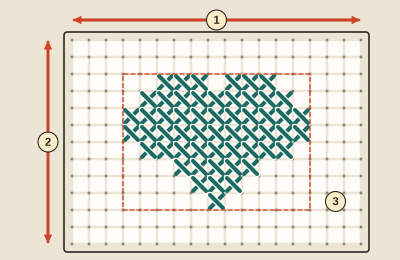
- Find the largest design. On a panel, count across (1) and down (2), and take off the bare squares (3): two or three on every side, which is four to six each way. For holes, take one from each number. For a window, look in "How many stitches fit", and take nothing off.
- Look at the size on the pattern's page. Every pattern here gives its width and height in stitches.
- Compare both numbers. A design that fits one way and not the other does not fit.
- Change the pattern, not the blank. Take one motif out of a larger design, leave off a border, or set words of your own with the text generator. Personalizing a pattern shows how to fit a name.
Pages here that are sorted by size:
| Patterns | Stitches | Good for |
|---|---|---|
| Key rings | 20 or fewer each way | Tags, magnets and other small windows |
| Gift tags | 28 or fewer each way | Tags, small box lids |
| Towels | 30 high or less | Towel bands, hems |
| Bibs | 42 wide and 28 high, or less | Bib panels, hooded towels |
| Coasters | 30 to 40 each way | Square coasters: up to 38 for a window of 3 in (7.6 cm), any of them for 3 1/2 in (8.9 cm) |
| Cards | Most 42 by 56 or less, either way up | Card openings, bag panels |
| Small patterns | 700 crosses or fewer in all, no side over 56 | Anything small |
Needle and strands for each count
| Fabric | Stitches to the inch | 100 stitches measure | Tapestry needle | Strands |
|---|---|---|---|---|
| 9 count | 9 | 11 1/8 in (28.2 cm) | Size 20 | 4 or more |
| 11 count Aida | 11 | 9 1/8 in (23.1 cm) | Size 22 | 3 |
| 14 count Aida | 14 | 7 1/8 in (18.1 cm) | Size 24 | 2 |
| 16 count Aida | 16 | 6 1/4 in (15.9 cm) | Size 26 | 2 |
| 18 count Aida | 18 | 5 1/2 in (14.1 cm) | Size 26 | 1 or 2 |
| 18 count, over two | 9 | 11 1/8 in (28.2 cm) | Size 20 | 4 or more |
How to read that table
Strands are the thin threads of floss that go into the needle together. Where the table leaves a choice, start with two on 18 count Aida, and with four where it says 4 or more. Make three or four crosses and look. If the cloth shows through them, add a strand. If the needle is hard to pull through, take one away. How many strands has the rest.
"18 count, over two" is for a blanket whose crosses cover two threads each way, 9 crosses to the inch (2.5 cm).
Stitch straight onto a cloth blank
For a towel, a bib, a bag or anything else with a panel of Aida. You need the blank, a chart, sewing thread, six-strand cotton floss and a tapestry needle, which has a blunt point. Floss is a thread of six thin strands that come apart, and you use only some of them at a time.
You need no hoop, which is two rings that hold the cloth flat between them. A band or a bib is easy to hold in the hand. If you like one, on the panel of a bag for instance, keep it off loops and fur, which it can crush, and take it off when you stop.
- Wash it first if it will be washed later, and press it flat. Terry, the looped cloth of towels, shrinks in its first wash, and other cotton can.
- Test the strong colors. Press a damp white tissue on each thread. If color comes off, choose another.
- Turn it the right way up, as it will be seen. On a towel the hem nearer the band is the foot.
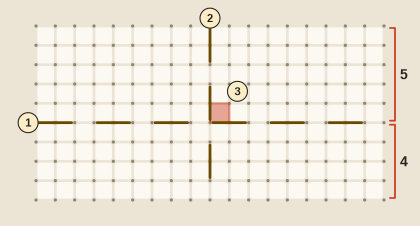
- Find the middle, side to side. Fold the panel in half and pinch the fold. On a towel, bring the long edges of the whole towel together.
- Find the middle, top to foot. Count the squares of the panel and halve them. 40 are 20 and 20. If the number is odd, leave the odd one above: 35 are 18 above and 17 below.
- Sew the level line (1) between the two halves, right across the panel: long loose stitches in and out along that line of holes, in sewing thread of a color that you can just see. A strong color can leave fluff behind.
- Sew the upright line (2) along the pinch. If the pinch is inside a square, use the line of holes at that square's left.
- Find the middle of the chart. Follow the arrows on its edges to where they meet. If they meet on a square, that is the middle square. If they meet between squares, it is the one above and to the right.
- Find the first stitch. The chart's middle square goes in the square just above your level line and to the right of your upright one (3). If it has a symbol, begin there. If it is empty, count from it to the nearest symbol, and count the same squares on the panel. How to start shows the count.
- Stop the needle. If there is a pocket behind the panel, slip a piece of card in, so that you stitch through the Aida only. If there is a lining that is sewn shut, open a few inches of it first, as for a lined bag.
- Thread the needle. Cut about 18 inches (46 cm) of floss. Draw the strands out of it one at a time, as many as the table above says for your count (two on 14 count), and thread them side by side. Make no knot.
- Come up through the hole at the lower left of the first square, and leave an inch (2.5 cm) of thread behind. Hold that inch flat on the back with a finger, pointing the way your next stitches will go. They cross over it, and after five or six it holds.
- Make a cross. Take the needle across the square and down through its upper right hole. Bring it up at the lower right hole and down at the upper left. The second slanted stitch lies on top, and leans the same way in every cross. How to cross stitch has the cross and the row in pictures.
- Pull out the marking lines a little at a time, just before your stitches reach them.
- End each thread on the back. Run the needle under the last five or six stitches there, and cut the thread close. Do not take it across bare cloth to the next patch of color, where it can show through. End it, and start again.
- Press it from the back, laid face down on a thick towel.
Towels and bibs shows a band, a bib and a corner hood.
Stitch on wood, plastic or paper
The needle goes through the holes, and one cross covers the square between four of them. There is nothing to wash, fold or iron. You need no hoop, the rings that hold cloth flat: the piece is stiff enough to hold.
- Count the holes across and down, and take one from each. A chart no larger than that, in whole crosses, fits. Nothing has to stay bare.
- Find the first square. Take the width of the design from the squares across, and leave half of what is over bare at the left: a design of 14 on 20 squares leaves 6, so 3 stay bare. Do the same from the top. The top left corner of the chart goes there. Count from it to the first symbol. A round shape has no corner to count from: put the middle of the chart at the middle of its holes, and count from there.
- Start without a knot. Come up through the lower left hole of that square, and hold an inch (2.5 cm) of thread flat on the back, pointing the way you will stitch, for the next stitches to cross.
- Make each cross as on cloth, and stop as soon as it lies flat. A hard pull tears paper.
- Keep behind the crosses. A thread that runs behind bare holes shows through them. End it, and start again.
- End on the back, under five or six stitches.
The strands, the needle and the cutting out are in wood, plastic canvas and perforated paper.
Set a piece in a window
First see how the cloth goes into your blank, because that says where to cut it. The line is the outline of the template.
| How the cloth goes in | Such as | Where to cut |
|---|---|---|
| Flat, shut between a clear cover and a back | A clear coaster, a clear tag, a mug | On the line |
| Folded over a board or a disc that comes out of the blank | A coaster in a wooden frame, a key ring with an inner disc | 3/8 inch (1 cm) outside the line |
| Gathered over a lid or a disc | A jar lid or a box lid. A pendant | 3/4 inch (2 cm) outside the line for a lid, 1/2 inch (1.3 cm) for a pendant |
| Taped behind an opening | A card | 3/8 inch (1 cm) or more outside the opening |
Not sure which yours is? Cut 3/4 inch (2 cm) outside the line first. Cloth can still be trimmed closer to the line, and cloth that is cut away cannot be put back.
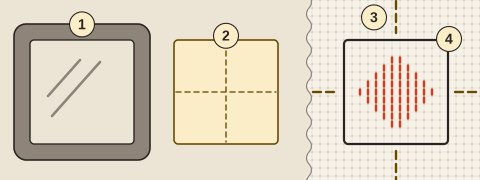
- Cut the cloth large: at least 2 inches (5 cm) more than the window (1) on every side. Stitch the design in its middle, as on a panel.
- Keep the ends of the marking lines (3). Snip both lines an inch (2.5 cm) in from each edge of the cloth, and draw out what lies between. The four ends that stay mark the middle.
- Wash and press it now. It is not washed again.
- Iron interfacing to the back. It is a thin cloth with glue on one side. Cut it a little larger than the template, so that it stops short of the four ends. The glue side goes down on the back of the stitching, with the iron as hot as its packet says. It holds the threads when you cut.
- Center the template (2) on the back. Rule a line through its middle each way, and lay it so that those lines point at the four ends. Hold the two up to the light: as many bare squares should show at one side of the stitching as at the other.
- Draw round it on the back, in pencil (4).
- Cut where the table says. The four ends come off with the spare cloth.
- Try it in the window before you stick anything.
- If it goes in flat, stick its back to thin card the size of the template, with double-sided tape or the card's own sticky face. Some packets have that card in them. If yours has none, cut one. The strip of a mug has to bend, so it goes in with no card.
- If it is folded, lay the board on the back, inside the line. Fold the spare cloth over its edge, and tape it down behind. On a curve, snip the spare cloth every 1/2 inch (1.3 cm), not quite to the line, so that it lies flat.
- If it is gathered, sew in and out round the edge of the cloth with strong thread, and leave a long end at the start. Lay the lid or the disc in the middle of the back, pull both ends of the thread until the cloth closes over it, and knot them.
- Put it in, the stitching toward the window. See that its rows are level, and close the blank.
Coasters, jar lids and mugs has each one step by step.
No weave to count
Plain cotton, denim, felt and microfiber have no squares. There are three ways:
- Soluble canvas. Tack it on with long loose stitches, stitch through its holes and the cloth together, and it dissolves in warm or hot water, as its packet says.
- Waste canvas. Tack it on, stitch through it, then damp it and draw its threads out one by one.
- A patch or a band. Stitch on Aida and sew that on. It is the easiest of the three on terry, whose loops get in the way of a needle, on velour, which is furry, and on anything slippery.
Waste canvas has the steps. Glass, china, metal and hard plastic with no holes cannot be stitched at all. Choose one with an insert, or tie a stitched band round it.
Make your own blank
- A band. Stitch on Aida band, turn its two ends under, and sew it to a towel, a cuff or an apron, or join its ends round a jar.
- A panel. Stitch on a square of Aida, turn the edges under along a row of holes, and sew it to a bag, a bib or a pot holder before that is lined.
- A front. A stitched panel with strips of cotton sewn round it becomes the front of a pillow.
The fabric calculator gives the piece to cut for a panel. It opens here on 126 by 126 squares, 9 inches (22.9 cm) each way on 14 count, with an inch (2.5 cm) on every side to turn under. Put your own numbers in. For a set of coasters or magnets from one length of cloth, see how much fabric to buy.
Common mistakes
- Sized from the label. The design is two rows too tall for the band. Count the squares, and leave out two rows: one of the border at the top and one at the foot.
- Stitches under the rim. The design was as large as the window. Unpick the outer row, or choose a larger blank.
- A pocket sewn shut. Some crosses caught the lining. Take those out and make them again, with a card in the pocket: a wrong cross farther back shows how to lift a cross out and fasten the ends.
- The panel puckers. The blank was not washed first, and it shrank. Press it damp, face down on a towel, and wash the next one before you start.
- Colors ran. Removing stains says what to do. Next time, test the reds first.
- No template. Draw round the opening on thin card, cut it out, and trim it a sliver at a time until it drops in.
Questions people ask
Is a blank the same as a kit? No. A blank is the thing alone, though some carry a small chart on the label. A kit has thread, needle and chart.
Can I use any pattern? Any that fits. On wood, plastic or paper it must be in whole crosses: a quarter stitch goes down in the middle of a square, where there is no hole. Every cross stitch pattern on this site is in whole crosses.
What words find a blank for this? The name of the thing with one of these: blank, stitchable, ready to stitch, with an Aida band, 14 count panel, with insert, prefinished.
Are they all white? No. Towels of 14 count are listed in black, red, ivory and gray as well, and bibs in blue, in apricot and in gray with dots. A colored blank may still have a white panel.
Do blanks go in the washing machine? Go by the label. A cotton bib or towel is washed, and the tote above is listed for hand washing. A mug with a strip inside is rinsed by hand. Everything else with a window is wiped with a damp cloth. None of those is soaked: water gets in and marks the cloth.
What if it is 11, 16 or 18 count? The sums are the same with that number in them. "Needle and strands for each count" gives the needle and the strands.
Where to go next
Start with the guide for your blank: towels and bibs, coasters, jar lids and mugs, bags, blankets, jewelry or wood. Then look through the small patterns. A covered button or a small magnet blank also makes the top of a needle minder.