Hippie floral border for jeans hand embroidery pattern
Advanced · 19 colors · 10 kinds of stitch
Download free PDFPDF, US Letter · 50 KBFor your own stitching, gifts and handmade pieces you sell. Do not resell or share this PDF. What you may do, in full
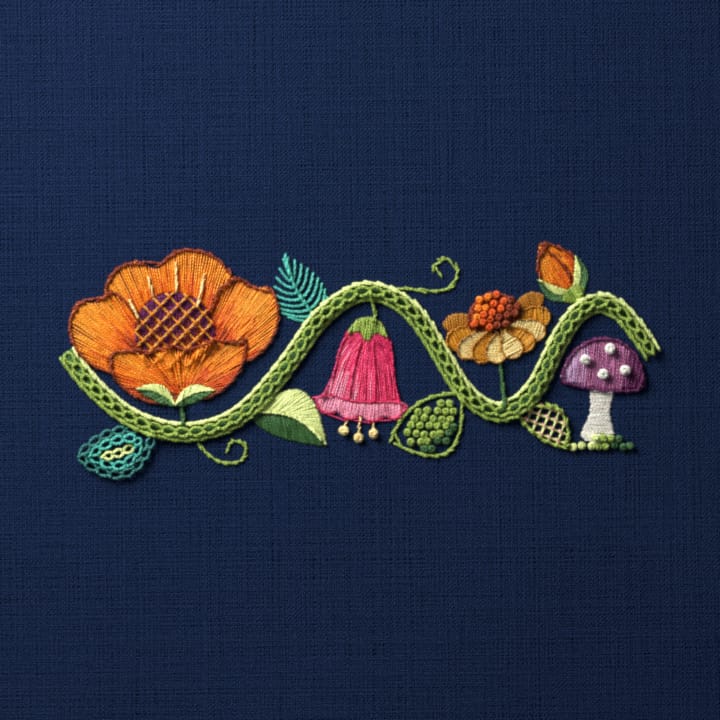
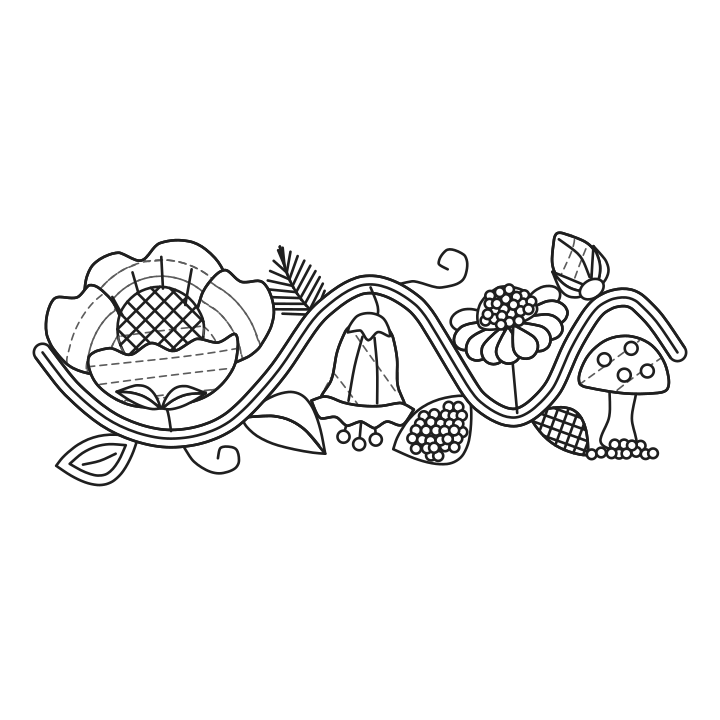
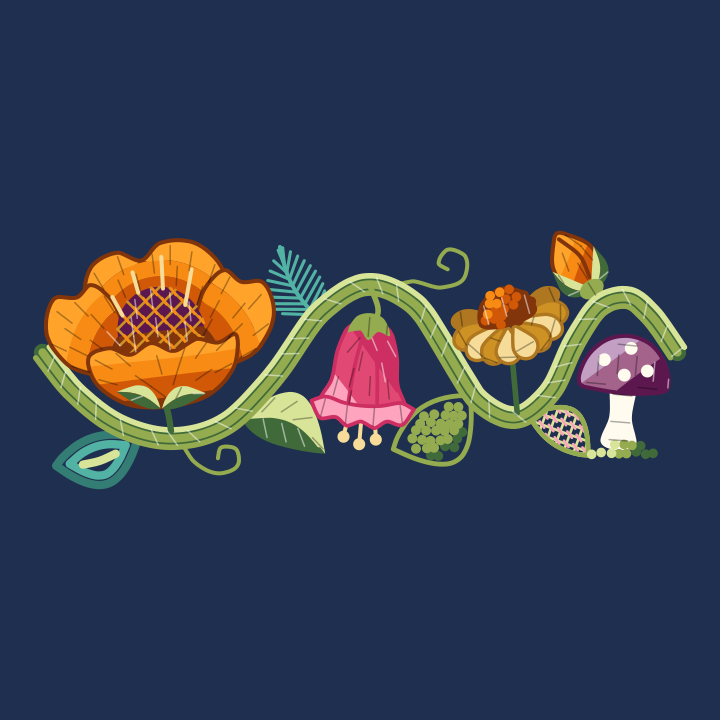
A thick green vine rolls across the band and ends at the height where it began, so the border can be repeated along a hem or a sleeve. An orange poppy in long and short stitch has a trellis throat with pale leads in stem stitch; after it come a pink bell, a mustard daisy turned sideways in satin stitch with a center of French knots, an orange bud and a purple mushroom in padded satin under the last curve. The leaves are fishbone, chain, knots, fly and trellis, each another filling. The vine is a rope of chain stitch between rows of stem stitch. It is drawn for indigo linen. In the picture of where the colors go, the fine lines show which way the stitches lie.
Size and details
Advanced. Uses trellis stitch, long and short stitch, padded satin stitch, dozens of French knots and 19 colors; from a 6 inch hoop up the widest satin stitches are long.
19 colors of floss and 10 kinds of stitch:
- Stem stitch
- Fishbone stitch
- Chain stitch
- French knot
- Fly stitch
- Trellis stitch
- Long and short stitch
- Satin stitch
- Split stitch
- Padded satin stitch
- Which stitch goes where
| Hoop | Inches | Centimeters | Satin stitch up to |
|---|---|---|---|
| 3 in (8 cm) | 1.9 × 0.8 in | 4.8 × 2 cm | 3/16 in (5 mm) |
| 4 in (10 cm) | 2.9 × 1.1 in | 7.4 × 2.8 cm | 1/4 in (6 mm) |
| 5 in (13 cm) | 3.8 × 1.5 in | 9.7 × 3.8 cm | 5/16 in (8 mm) |
| 6 in (15 cm) | 4.8 × 1.9 in | 12.2 × 4.8 cm | 7/16 in (11 mm) |
| 8 in (20 cm) | 6.7 × 2.7 in | 17 × 6.9 cm | 9/16 in (14 mm) |
- In an 8 inch hoop the widest satin stitch shape is 9/16 in (14 mm) across. Satin stitches longer than about 12 mm (just under 1/2 in) tend to work loose: divide the shape into sections, or work it in long and short stitch.
- In a 3, 4 or 5 inch hoop the French knots are drawn smaller than about 2 mm (a little over 1/16 in). Use one strand of floss for them there, or choose a larger hoop.
The pattern is drawn inside a circle about half an inch (1.3 cm) smaller all around than the hoop.
What you need
- DMC 470 Light Avocado GreenVine (middle), knot leaf (lighter), tendrils and knot leaf edge and 5 more parts
- DMC 3346 Hunter GreenVine and bud cup (dark), fishbone leaf and poppy sepals (darker) and 3 more parts
- DMC 472 Ultra Light Avocado GreenVine (light), trellis leaf, fishbone leaf and poppy sepals (lighter) and 3 more parts
- DMC 3847 Dark Teal GreenChain leaf (darker)
- DMC 3849 Light Teal GreenFly leaf, chain leaf (lighter)
- DMC 603 CranberryBell lip, bell (light), trellis leaf (darker)
- DMC 970 Light PumpkinPoppy petals, bud and daisy center (light), poppy throat lattice (lighter)
- DMC 918 Dark Red CopperPoppy petals (darkest), poppy edges, poppy throat (lighter) and 3 more parts
- DMC 900 Dark Burnt OrangePoppy petals and bud (dark), daisy center (middle)
- DMC 741 Medium TangerinePoppy petals and bud (lightest)
- DMC 550 Very Dark VioletPoppy throat (darker), mushroom edge, mushroom cap (dark)
- DMC 783 Medium TopazPoppy throat lattice (darker), daisy petals (middle)
- DMC 3822 Light StrawDaisy petals (light), bell stamens, throat leads and bell stamen knots
- DMC 602 Medium CranberryBell (middle)
- DMC 600 Very Dark CranberryBell edge and bell ribs, bell (dark)
- DMC 782 Dark TopazDaisy edges, daisy petals (dark)
- DMC 712 CreamMushroom stalk and mushroom spots
- DMC 553 VioletMushroom cap (middle)
- DMC 210 Medium LavenderMushroom cap (light)
Skeins: one of each color is enough. An estimate for the largest size, the 8 inch hoop: the length of each line and the area of each filled shape, a fifth added for tails and ends, a tenth of every 8 m (8.7 yd) skein kept spare.
On clothes. Wash and dry the garment first. Denim and twill need no backing and take a sharp needle, embroidery or chenille; T-shirts, sweatshirts and other knits need a stabilizer that sticks or irons on. How to embroider on clothes has every step, and the placement chart says where a design goes.
In a hoop. The floss is six-strand cotton; the stitch guide says how many strands to use. You also need a hoop, an embroidery needle (a size 7 to 9 suits two or three strands) and plain cotton or linen fabric. To frame the piece in its hoop, cut a square 3 inches (8 cm) wider than the hoop: a 9 inch (23 cm) square for a 6 inch hoop.
When it is stitched, how to finish a hoop shows how to back it for the wall.
Stitch guide
- Put the pattern on the fabric (how to transfer a pattern) and the fabric in the hoop.
- Stitch the filled parts first, what lies behind before what lies in front of it.
- Then stitch the lines: stems, veins and outlines over the edges of the filled parts.
- Keep the knots for the end, so that the hoop and your hand do not flatten them.
Start each thread with a small knot on the back or one of the knotless starts, and end it by running the needle under the backs of a few stitches (starting and ending a thread). Use the strands this list gives, also where a page about a stitch names another number.
- Stem stitch 1 to 5 strandsTendrils, fishbone leaf, knot leaf edge, fly leaf, trellis leaf edge, side stems, bud edge, vine, poppy edges, throat leads, bell stamens, and 3 more
- Fishbone stitch 2 to 3 strandsFishbone leaf, bud cup, poppy sepals
- Chain stitch 3 to 4 strandsChain leaf, chain leaf vein, vine
- French knot 2 strands, two wrapsKnot leaf, bell stamen knots, daisy center, mushroom spots, moss
- Fly stitch 3 strandsFly leaf
- Trellis stitch 2 strandsTrellis leaf, poppy throat lattice
- Long and short stitch 1 strandBud, poppy petals, poppy throat, bell
- Satin stitch 2 to 3 strandsBud cup, vine, bell lip, bell cap, daisy petals, daisy center, mushroom stalk
- Split stitch 1 strandDaisy edges
- Padded satin stitch 2 strandsMushroom cap
Getting it onto your fabric
The PDF holds the pattern twice at actual size: once as drawn, and once mirrored for an iron-on transfer pen. Print it at 100% with scaling off and check the one-inch square (25.4 mm) with a ruler before you trace. How to transfer a pattern explains tracing, carbon paper and the other ways. The files are under Downloads.
Downloads
- Download free PDF PDF, US Letter, 3 pages, for a 6 inch (15 cm) hoop
- Download free PDF, A4 PDF, A4, 3 pages, for a 6 inch (15 cm) hoop
More patterns like this
Easy 3–8 in hoop · 7 colors
Easy wildflower border for sleeves
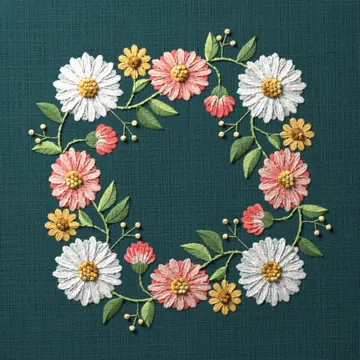
Advanced 3–8 in hoop · 16 colors
Modern flower border of daisies
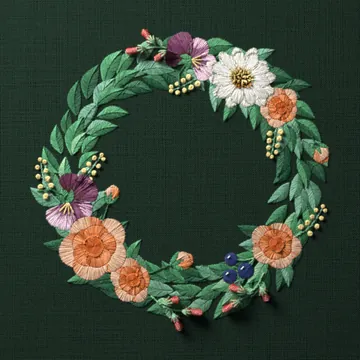
Advanced 3–8 in hoop · 23 colors
Flower ring frame
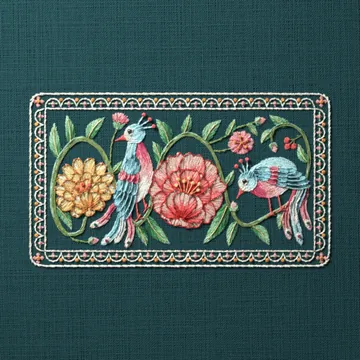
Advanced 3–8 in hoop · 23 colors
Parsi style flower border
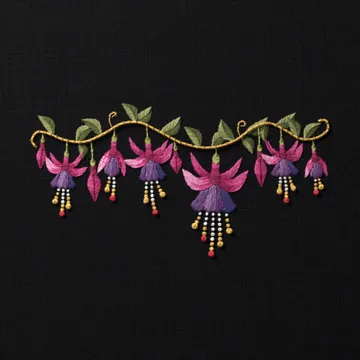
Advanced 3–8 in hoop · 15 colors
Fuchsia flower border for beads
Advanced 3–8 in hoop · 15 colors
Roller skate patch for kids jeans
Advanced 3–8 in hoop · 19 colors
Crest pocket emblem, room for initial
Advanced 3–8 in hoop · 19 colors
Flowers spilling from a pocket
New to hand embroidery? Starting hand embroidery, step by step