Running borzoi in the wind hand embroidery pattern
Advanced · 20 colors · 8 kinds of stitch
Download free PDFPDF, US Letter · 88 KBFor your own stitching, gifts and handmade pieces you sell. Do not resell or share this PDF. What you may do, in full
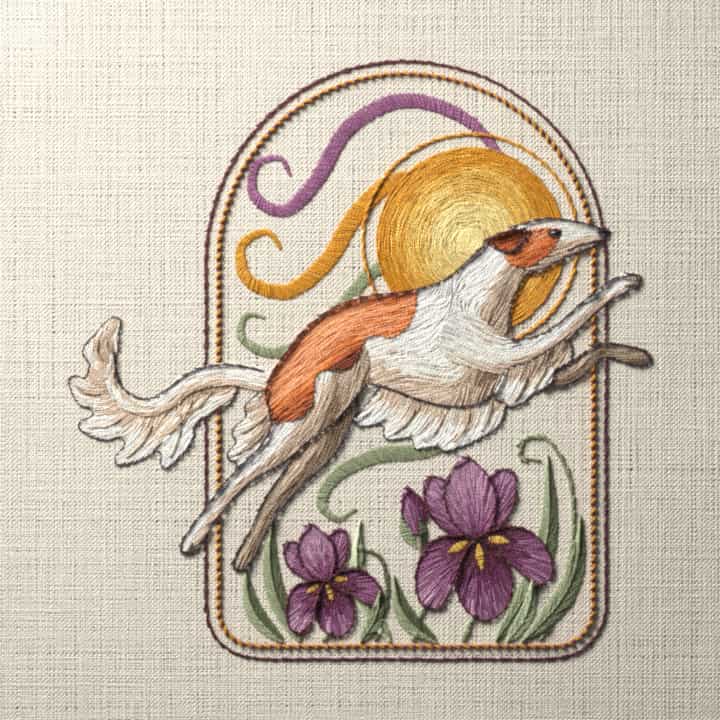
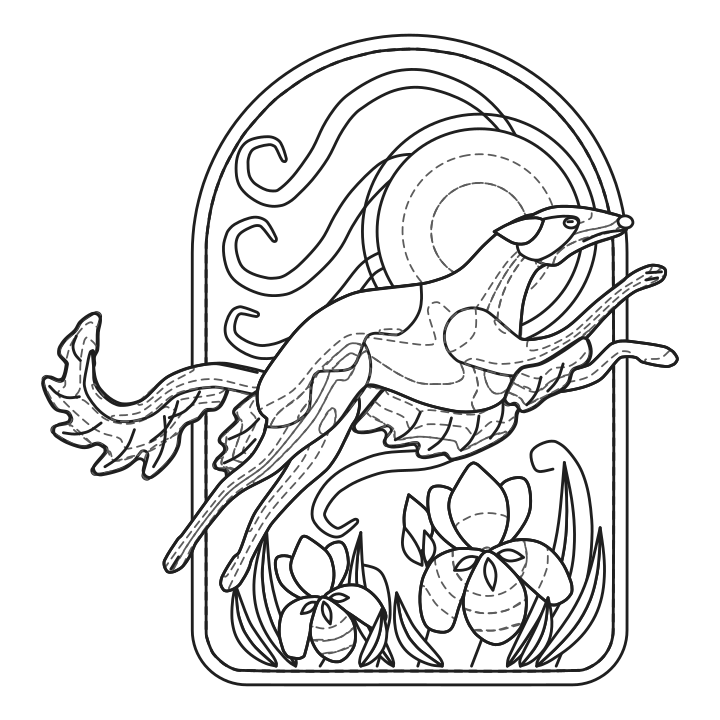
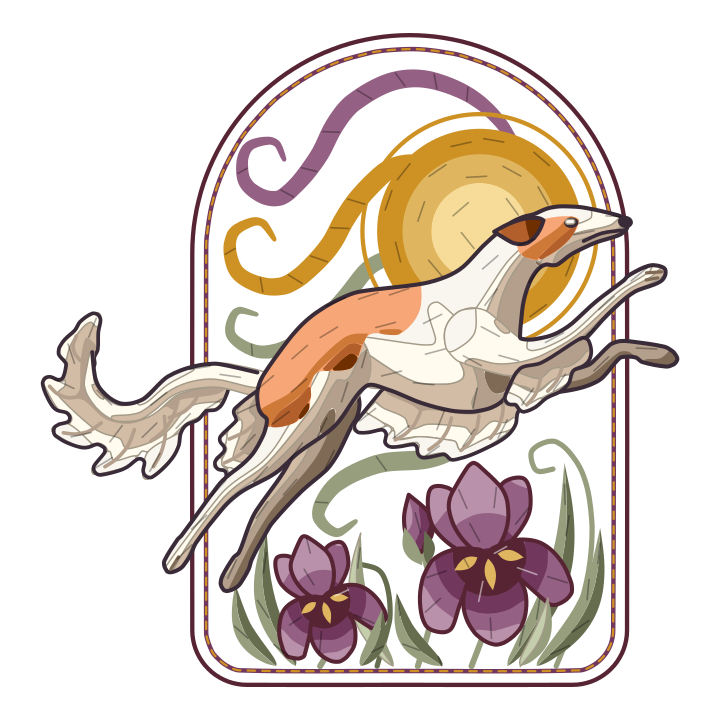
A borzoi runs on a rising slant with all four feet off the ground, its plume tail streaming past the left edge of the panel and its front paws past the right. The coat, the sun and the iris petals are long and short stitch. Fine stem stitch draws the dark contours, back stitch goes round the long feathering, and split stitch marks the locks of hair. The wind ribbons are satin stitch, the iris leaves are fishbone stitch, and the grasses are stem stitch. The arched frame is whipped back stitch inside a line of stem stitch. In the picture of where the colors go, the fine lines show which way the stitches lie.
Size and details
Advanced. Uses long and short stitch over much of the design, 20 colors and a great deal of stitching.
20 colors of floss and 8 kinds of stitch:
- Satin stitch
- Long and short stitch
- Stem stitch
- Whipped back stitch
- Fishbone stitch
- Split stitch
- Back stitch
- Straight stitch
- Which stitch goes where
| Hoop | Inches | Centimeters | Satin stitch up to |
|---|---|---|---|
| 3 in (8 cm) | 1.7 × 1.8 in | 4.3 × 4.6 cm | 1/16 in (1.6 mm) |
| 4 in (10 cm) | 2.6 × 2.7 in | 6.6 × 6.9 cm | 1/16 in (1.6 mm) |
| 5 in (13 cm) | 3.5 × 3.6 in | 8.9 × 9.1 cm | 1/8 in (3 mm) |
| 6 in (15 cm) | 4.4 × 4.5 in | 11.2 × 11.4 cm | 1/8 in (3 mm) |
| 8 in (20 cm) | 6.1 × 6.3 in | 15.5 × 16 cm | 3/16 in (5 mm) |
The pattern is drawn inside a circle about half an inch (1.3 cm) smaller all around than the hoop.
What you need
- DMC 3835 Medium GrapeIris petals (light), wind ribbons (dark)
- DMC 783 Medium TopazSun (dark), frame and wind ribbons (light), sun ring
- DMC 522 Fern GreenWind ribbons and iris leaves (middle), grasses (lighter), iris stems
- DMC 3820 Dark StrawSun (middle), iris beards
- DMC 3822 Light StrawSun (light)
- DMC 520 Dark Fern GreenIris leaves (dark), grasses (darker)
- DMC 3834 Dark GrapeFrame (middle), iris petals (dark)
- DMC 154 Very Dark GrapeIris contour, frame (dark), iris petals (darkest)
- DMC 524 Very Light Fern GreenIris leaves (light)
- DMC 3836 Light GrapeIris petals (lightest)
- DMC 3032 Medium Mocha BrownFar legs (middle), body (dark), plume tail and breeches (darkest) and 6 more parts
- DMC 3790 Ultra Dark Beige GrayFar legs (dark), body and near hind leg (darkest), toes
- DMC 3782 Light Mocha BrownPlume tail and body feathering (dark), body and near hind leg (middle) and 5 more parts
- DMC 3371 Black BrownContour, mouth, nose and eye
- DMC 712 CreamNear foreleg, plume tail, body and near hind leg (lightest) and 4 more parts
- DMC 3865 Winter WhiteBody, near hind leg, head, plume tail and near foreleg (light) and 4 more parts
- DMC 402 Very Light MahoganySaddle (lightest), head marking (light)
- DMC 300 Very Dark MahoganySaddle (darkest), ear (dark)
- DMC 301 Medium MahoganySaddle and head marking (dark), ear (middle)
- DMC 3776 Light MahoganySaddle and ear (light), head marking (middle)
Skeins: one of each color is enough. An estimate for the largest size, the 8 inch hoop: the length of each line and the area of each filled shape, a fifth added for tails and ends, a tenth of every 8 m (8.7 yd) skein kept spare.
The floss is six-strand cotton; the stitch guide says how many strands to use. You also need a hoop, an embroidery needle (a size 7 to 9 suits two or three strands) and plain cotton or linen fabric. To frame the piece in its hoop, cut a square 3 inches (8 cm) wider than the hoop: a 9 inch (23 cm) square for a 6 inch hoop.
When it is stitched, how to finish a hoop shows how to back it for the wall.
Stitch guide
- Put the pattern on the fabric (how to transfer a pattern) and the fabric in the hoop.
- Stitch the filled parts first, what lies behind before what lies in front of it.
- Then stitch the lines: stems, veins and outlines over the edges of the filled parts.
Start each thread with a small knot on the back or one of the knotless starts, and end it by running the needle under the backs of a few stitches (starting and ending a thread). Use the strands this list gives, also where a page about a stitch names another number.
- Satin stitch 2 strandsWind ribbons, iris leaves, iris beards, eye, nose
- Long and short stitch 1 strandSun, iris petals, far legs, plume tail, breeches, body feathering, body, near hind leg, near foreleg, saddle, head, head marking, and 2 more
- Stem stitch 1 to 4 strandsSun ring, grasses, frame, iris stems, iris contour, contour
- Whipped back stitch 3 strandsFrame
- Fishbone stitch 2 strandsIris leaves
- Split stitch 1 strandFeathering lines, mouth
- Back stitch 1 strandContour
- Straight stitch 1 strandEye light, toes
Getting it onto your fabric
The PDF holds the pattern twice at actual size: once as drawn, and once mirrored for an iron-on transfer pen. Print it at 100% with scaling off and check the one-inch square (25.4 mm) with a ruler before you trace. How to transfer a pattern explains tracing, carbon paper and the other ways. The files are under Downloads.
Downloads
- Download free PDF PDF, US Letter, 3 pages, for a 6 inch (15 cm) hoop
- Download free PDF, A4 PDF, A4, 3 pages, for a 6 inch (15 cm) hoop
More patterns like this
Advanced 3–8 in hoop · 20 colors
Dalmatian with a fire hose
Advanced 3–8 in hoop · 21 colors
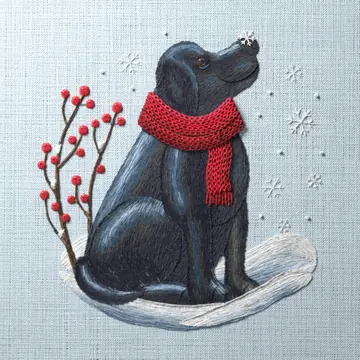
Black Lab in the snow
Advanced 3–8 in hoop · 21 colors
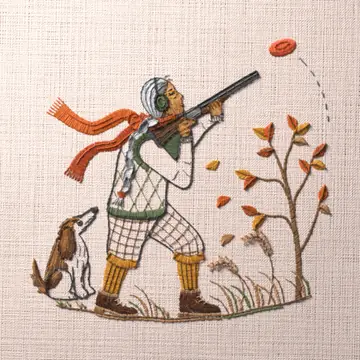
Woman clay shooting in autumn
Advanced 3–8 in hoop · 21 colors
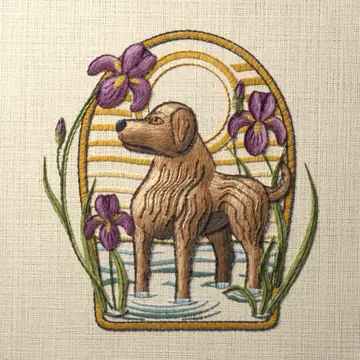
Chesapeake Bay retriever among irises
Advanced 3–8 in hoop · 19 colors
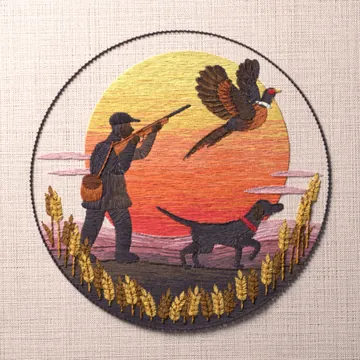
Hunter silhouette with pheasant
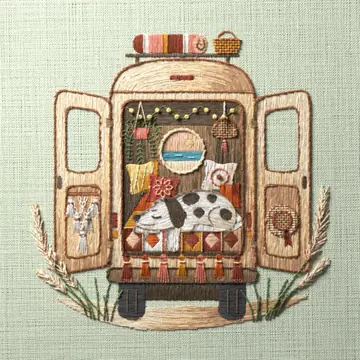
Advanced 3–8 in hoop · 22 colors
Campervan with open back doors
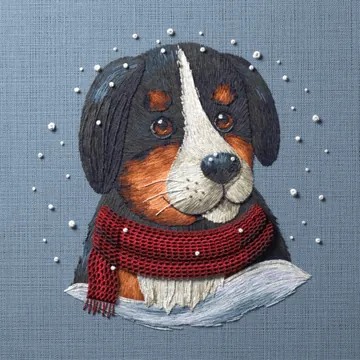
Advanced 3–8 in hoop · 22 colors
Realistic dog portrait in snow
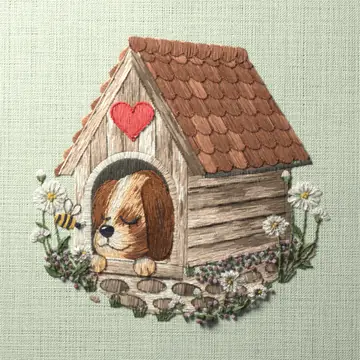
Advanced 3–8 in hoop · 22 colors
Dog house with a heart
New to hand embroidery? Starting hand embroidery, step by step