Cross stitch guide
Selling what you stitch
Two questions decide whether a finished piece may be sold: what the pattern's own terms say, and whose picture, words or mark is on it. Pieces you stitch by hand from a pattern on this site may be sold in small quantities. For any other pattern, read its terms first.
On this page 14 parts
- If the pattern is one of ours
- If the pattern came from somewhere else
- What copyright covers
- Work that is yours to sell
- Work out a price
- A piece made to order
- Having a piece stitched or charted for you
- The piece, its picture and its card
- At a table, or to a shop
- For a raffle, an auction or a charity
- Packing and mailing
- Common mistakes
- Questions people ask
- Where to go next
If the pattern is one of ours
This is what the terms of use say, in plain words. The terms themselves are what counts.
| What you want to do | What our terms say |
|---|---|
| Stitch it and keep it, or give it away | Yes. |
| Stitch it for a charity | Yes. |
| Sell a piece you stitched by hand yourself | Yes, in small quantities, as long as you do not suggest that Floss Field made it or endorses it. |
| Stitch it many times to sell | Ask first for a larger number. "Small quantities" is not a number, so if you cannot tell whether yours is small, ask too, and say how many. |
| Sell pieces that other people or a machine stitched | Not covered: the yes is for pieces you stitched by hand yourself. Ask. |
| Print more copies for your own stitching | Yes. |
| Print copies for a class | Ask. Or send everyone the link, so that each person downloads a copy. Links are always welcome. |
| Sell, rent or share the chart or the PDF, free or paid | No, not the whole and not a part. |
| Put the chart in a kit or a bundle | No. A kit may hold the cloth, the thread and the address of the pattern's page. |
| Use our preview picture as a picture of your own work | No. Show your own piece. |
| Show one of our patterns on your own site | Yes, with the code under "Embed" on the pattern's page and its link left in place. It shows our picture and never the chart. |
| Show a picture of your own finished piece | Nothing in the terms is against it. Show the stitching and never the chart. |
An open typeface is a set of letters whose makers let anyone use them, under a license of its own. Where a letter in a pattern was made from one, that license counts for the letter wherever it allows more than our terms do. So a piece with a name on it may be sold just as the table says. The typeface credits name each one.
Where the table says ask, open the terms, follow "ask for permission" there, say which pattern, what for and how many, and leave an email address to be answered at.
If the pattern came from somewhere else
A chart you bought, or downloaded free, is a copy to stitch from. The rights in the drawing stay with whoever made it. Some designers let you sell finished pieces and some do not, so look before you stitch the first one.
- Read the chart. Look at the first page, the last page, and the small print under the key (the list that says which thread each symbol stands for).
- Read where you got it. Look at the listing, the maker's site, or the front pages of the book or magazine.
- Find the sentence about finished pieces. The table below gives the words to look for.
- Save it. Keep a copy of the page with the date, beside your receipt.
- Ask when it is not clear. Write to the designer or the publisher named on the chart.
- Wait for a yes in writing. No answer is not a yes.
| Words on a chart | What they tell you |
|---|---|
| "Personal use only", "not for commercial use" | Stitch it for yourself or as a gift. Do not sell the piece without asking. |
| "Finished pieces may be sold" | A yes to the pieces. Read on for its limits. |
| "Up to" a number of pieces | Count them, and stop there. |
| "With credit to the designer" | Put the designer's name on the card that goes with the piece, and wherever you offer it for sale. |
| "Commercial license" | A separate permission. Read what it covers: a number, a time, a place. |
| "All rights reserved" | Nothing is given beyond stitching the piece. Ask. |
| Nothing at all | Not a yes. A chart with no mark on it is still protected. Ask. |
The message you write in step 5 can be five lines. The first one asks:
May I sell pieces that I stitch by hand from your pattern, and on what terms?
Pattern: the name on the chart, its number, and where I got it
What I will make: a framed piece, an ornament, a bag
How many: one, five, or up to ten in a year
Where they will be sold: a school fair, a shop in my town, my own page
What copyright covers
This is general information, not legal advice. For a case of your own, ask the owner of the work or a lawyer. Each line below says whose law it comes from.
| Subject | United States | United Kingdom |
|---|---|---|
| The chart and its picture | Artwork is protected as soon as it is set down. No mark and no registration is needed for that. | The same: protection is automatic, with the © sign or without it. |
| A stitch, a method, an idea, a style | Not protected. | Not protected. |
| A name, a title, a short phrase, a slogan | Not protected by copyright. It may be a trademark. | It may be a trademark. |
| A logo, a team mark, a brand's sign | May be a trademark, and its artwork may be protected too. | May be a trademark. |
| How long it lasts | As a general rule the author's life and 70 years more. For older works it varies. As of 2026, works published before 1931 are free to use. | The author's life and 70 years more. After that it is free to use. |
| A photograph | It belongs to the one who took it, as a rule, not to the person in it. | The one who made the picture is usually the first owner. |
| A changed copy | Only the owner may allow a new version, however much is changed. | Changing a pattern does not make it free. Changing it for your own use is unlikely to be a problem. |
| Owning the chart | Owning a copy is not owning the rights in it. Rights pass in writing, signed. | The same: a signed agreement in writing. |
Pieces stitched from a pattern. British guidance is written for knitting and sewing patterns, and says that some of it fits cross stitch too. Broadly, it says that making a thing from a pattern you came by lawfully, and selling it, does not infringe copyright. Then it names what can still stop a sale. The pattern may carry a picture that is itself protected as art, such as a cartoon figure or any other decorative image, or the finished piece may count as art. And the pattern's terms may say personal use only, and then a sale may break those terms. A cross stitch chart is nearly always a picture, so the first of these matters here.
A chart made from someone's picture. A painting, a photograph, pixel art, a film or game figure, the cover of a book: the chart is a copy of it in another form. In both countries only the owner may allow a copy or a new version, so ask, unless its time is up. A converter does not change whose picture it is.
A finished piece you admire. Drawing a chart from it, by counting or from a photograph, can be copying too. British guidance says it is likely to infringe where the finished work is itself protected as art.
A chart for a friend. British guidance says that a copy of a pattern may not be passed on, on paper or as a file, and that if you pass on the printed one you keep no copy of it. A British stitchers' guild says that enlarging a chart of your own, so that you can read it, is fine.
Words. A short phrase is free of copyright in the United States. A poem, a verse of a song or a page of a book is written work, protected in both countries until its time is up. Thanking the writer on the piece is not permission.
Work that is yours to sell
- You drew it. A drawing of your own, charted by you, is yours. How to make a pattern shows how to chart one.
- You took the photograph. A picture you took of your dog, your street or your garden is yours to chart. A portrait by a photographer is the photographer's. A photograph of a painting or a film poster still holds someone's art.
- It is old enough. Work whose copyright has ended may be used by anyone. Check the date it was published and when its author died, in your own country. What is free is the old picture itself. A chart that somebody drew from it lately is theirs, so chart it yourself. Where to find patterns has a section on old charts.
Our terms say of the tools here: "Charts you draw, convert from your own pictures or customize are yours." They also say to convert or save only pictures you have the right to use. If what you changed is one of our own patterns, the part that is ours still may not be sold or shared as a chart. Ask before you do either.
Work out a price
A price has four parts: what went into the piece, what selling it costs, a share of what you pay whether you sell or not, and your own time. A fee that is a share of the price comes last, because you cannot know it before. Fill in the blanks with your own figures. Use whole skeins, since to use part of one you had to buy all of it; amounts of thread are estimates (how much floss).
| Letter | What it is | Yours |
|---|---|---|
| M | Cloth, thread in whole skeins (an estimate), needle, beads, backing, frame or hoop, what it cost to have them sent | ____ |
| F | What selling this piece costs whatever its price: a fixed fee, box, board, tissue, card and postage you pay | ____ |
| S | This piece's share of running costs: lamp, scissors, table rent, repairs. A year's costs divided by the pieces you make in a year | ____ |
| H | Your hours: choosing, preparing, stitching, washing, finishing, taking its picture, packing | ____ |
| R | The rate for one hour that you choose | ____ |
| P | Fees that are a share of the price (the place you sell, the card or payment fee), added together and written as a decimal: 10 in every 100 is 0.10. If there are none, 0 | ____ |
M + F + S = what the piece costs you
H x R = your time
M + F + S + (H x R) = what you need to be left with
what you need / (1 - P) = the price
How the last line works. The figures here only show the sum. Say you need to be left with 90, and the fees take 10 in every 100, so P is 0.10. Then 1 - 0.10 = 0.90, and 90 / 0.90 = 100. Check it: a tenth of 100 is 10, and 90 is left. If you only add a tenth to 90 you get 99. The fee on that is 9.90, and 89.10 is left: too little. With no such fee, P is 0 and the price is what you need.
- Hours come from your own record. Write them in a project journal as you go. Nobody else's hours fit your hands.
- Some places take both kinds of fee. The fixed one goes in F and the share goes in P. Read whether the share is also taken from the postage the buyer pays.
- What others ask is a place to look, not a reason. They have other costs. Know yours first.
- Sometimes the sum comes out higher than people will pay. Then choose a smaller piece, or one with fewer stitches, next time. That changes H, and leaves your rate as it is.
What lowers the hours: fewer squares filled, open cloth behind the design, fewer colors, fewer scattered single squares, a smaller finish. What does not: a finer cloth for the same chart, which has just as many crosses.
Money you are paid may be taxed, and the rules differ by place: ask your tax office. Pricing your hand embroidery works through the same sum for surface work.
A piece made to order
Agree these in writing before the first stitch. A message you both answer "yes" to is enough to look back at.
- The picture and who owns it. If the buyer sends one, the buyer says who took or drew it.
- The pattern, and that its terms allow a sale.
- The size in stitches and in inches or centimeters, the cloth, and its count: how many stitches it gives to the inch (2.5 cm). The same chart comes out smaller on a higher count (what count means).
- The colors, and whether you may swap one that cannot be had.
- The words, letter by letter. The buyer writes out every name and date, sees them on the chart, and agrees to that chart. Personalizing a pattern shows how to fit them in.
- The finish: framed, in a hoop, or the bare piece.
- The date, with room for trouble.
- The payment: what is paid first, what is paid at the end, and when.
- Changes. How many are in the price, and when it is too late for one.
- If either of you stops: what is kept and what is paid back.
- Who may show it. Whether you may post its picture. A family name or a child's date is private until they say otherwise.
- How it is sent, and who bears a loss on the way.
- The rights. Paying for a piece does not by itself pass on the rights in the drawing. If the buyer wants those too, that is a signed paper of its own.
Having a piece stitched or charted for you
Ask these before you pay anyone.
| Ask | Why |
|---|---|
| Whose chart will it be, and may a piece from it be sold to you? | So that you are not given a copied design. |
| How many stitches wide and high, on cloth of which count (stitches to the inch, 2.5 cm)? | Stitches divided by the count are the inches (one is 2.5 cm) on your wall. |
| Full crosses over the whole cloth, or cloth left open? | It changes the look and the work. |
| Which thread, and how many strands? | So that it can be mended one day. |
| May I see the chart, with my words on it, before you start? | A spelling mistake is free to mend on paper. |
| What do you need from me? | A sharp, light photograph and the exact words, usually. |
| How is it finished, packed and sent? | So that it comes flat and clean. |
| If I only want a chart: what file, which thread numbers, how many colors? | So that you can stitch from it. |
If a chart of a photograph is what you want, the picture to pattern converter makes one on this site, free.
The piece, its picture and its card
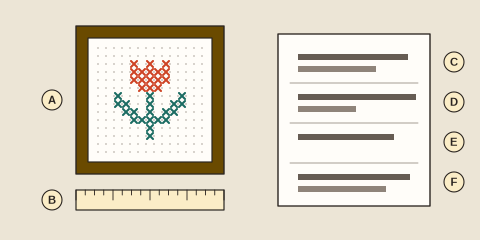
The picture. Take it yourself, of the very piece you are selling (A). Use daylight from one side, hold the camera square to the piece, and lay a ruler by it (B) in one picture. Show the edge and the back in another. Stay far enough off that nobody could count the chart from it.
The card. Four entries do: what it is and its size (C), the cloth and the thread (D), the pattern's name and whose it is (E), and how to look after it (F). For a pattern of ours, write the name at the top of the pattern's page and then "flossfield.com". Our terms do not ask for this line. What they do ask is that nothing reads as if Floss Field made or endorses the piece.
The care note, to copy in your own words:
- For a framed piece: "Keep out of direct sun and away from damp. Dust the glass and the frame."
- For an unframed piece: "Wash by hand in cool water with a little mild soap. Do not wring. Dry flat. Press face down on a towel." Say this only when the thread and cloth can take it: how to wash lists what cannot.
In the United States the federal care label rule speaks to makers and importers of clothing, and of fabric sold by the piece for sewing clothing. A framed picture is neither. A stitched shirt is clothing, so read the rule before you sell one.
At a table, or to a shop
- Set out things people can pick up. Magnets, cards, ornaments and other small finishes show well and travel well.
- Stand one large piece up at the back where it can be seen from across the room, out of the sun.
- Put a card with each piece, and the price on the back of the card.
- Bring a cloth for the table, a light, stands, bags and tissue, a ruler, a pen, change, a book to write each sale in, and something to work on.
- Ask the fair first whose work may be sold there, what a table costs, and what you must bring.
- To a shop, bring a few finished pieces, a list of them with sizes, and the terms of each pattern. Agree in writing whether the shop buys them or holds them for you, who sets the price, and what happens to one that is damaged.
For a raffle, an auction or a charity
Our terms let you stitch any pattern here for charity. With a pattern from elsewhere, read its terms: some designers allow charity and nothing else, some allow neither. Give a card with the piece, so that whoever takes it home knows what it is. Donating supplies is about thread and cloth.
Packing and mailing
Take a last picture, front and back, before you close the box. Then never fold it: flat between boards if it is small, rolled if it is large, boxed if it is framed. Finishing cross stitch has each of the three ways step by step, under "Sending a finished piece by mail".
Common mistakes
- A kit with our PDF inside. The chart may not go in a kit. Give the pattern's address, and each buyer downloads a copy. Put together a kit says what may go in.
- A famous figure, because everyone does it. Others doing it is not a permission. Draw one of your own.
- A price from the thread alone. Thread is only one line of the sum. Count the hours.
- A promise of a day. Give a date with room in it, and write sooner if you see you will be late.
- The wrong name on a finished piece. Have the buyer read the chart letter by letter first.
- No picture before mailing. Without one you cannot show what left your hands.
- A chart readable in the listing. Show the piece, and leave the chart in its folder.
Questions people ask
May I sell a piece I stitched from a pattern I bought? Only its terms can tell you. Some say yes, some up to a number, and many say personal use only. If they say nothing, ask.
May I stitch one pattern again and again to sell? Ours in small quantities. Another, as its terms say; some set a number.
What is an angel policy? A maker's own statement that you may sell what you make by hand with its designs, and on what conditions. Makers of stamps for making cards publish theirs under that name. On a pattern, the terms do the same job. Look for three things: who must do the work (you, by hand), how many pieces you may sell (some set a limit and some do not), and what you are to say about the maker. It covers that maker's designs and nobody else's. Where there is none, ask. For ours, see the table at the top of this page. You may sell cards and other pieces you stitched by hand yourself, in small quantities, as long as nothing suggests that Floss Field made or endorses them. If you are unsure, ask. The terms themselves are what counts.
Are free patterns free to sell from? Free means there was nothing to pay. Free patterns are normally for personal use unless they say more.
May I sell old patterns and magazines I own? British guidance speaks of passing on or selling the printed pattern you own, as long as you keep no copy of it. It says that a file you downloaded may not be shared with somebody else.
Does changing the colors make it mine? No. Neither does making it smaller, turning it round or adding a name. It is still a version of somebody's design.
Are letters and quotes protected? In the United States lettering and short phrases are not protected by copyright. A charted alphabet page, with its layout and pictures, can be. Poems, songs and long passages are protected until their time is up.
May I post a picture of my finished piece? Look at the pattern's terms for any word on it. Name the pattern, and show the stitching and not the chart. For ours, see the table above.
May I teach a class with your pattern? Yes, when each person opens the page and downloads a copy. For printed copies, ask through the link in the terms.
Do I have to put the designer's name on it? When the terms say so. It is fair in any case, and never as if the designer made the piece.
May I put a team's badge on a gift? The badge may be a trademark and its drawing may be protected. Ask its owner, and do not sell it without a yes.
Where to go next
Sign the piece small and neat: how to sign your work. If you would rather show than sell, fairs and judging says how pieces are entered. To find a chart whose terms you can read, start with the patterns here, all under one set of terms.