Chamomile napkin corner with a bee hand embroidery pattern
Advanced · 13 colors · 3.5 × 3.5 in · 9 kinds of stitch · one of a set of 4
Download free PDFPDFPrints on US Letter and A4You may sell what you make from it by hand, in small quantities. The PDF itself is not to be sold or shared. Selling, classes and kits: the rules
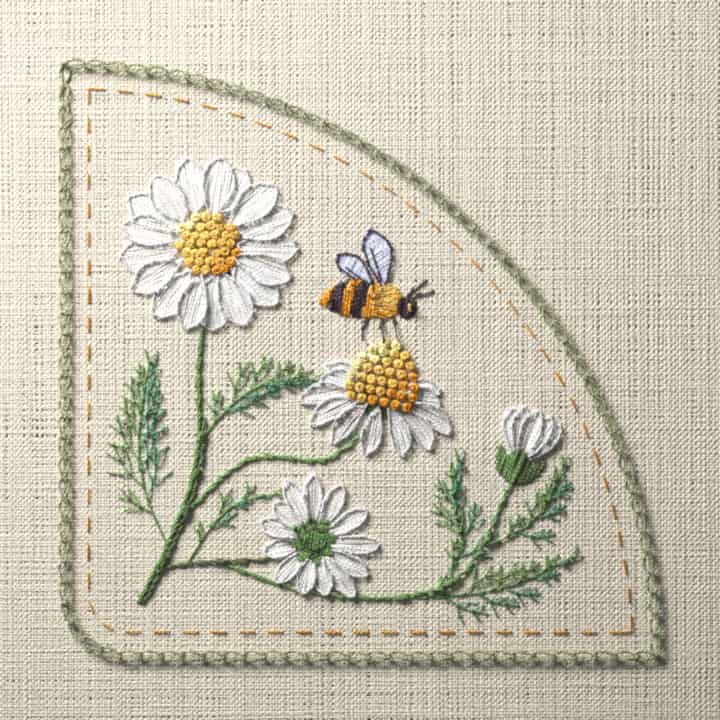
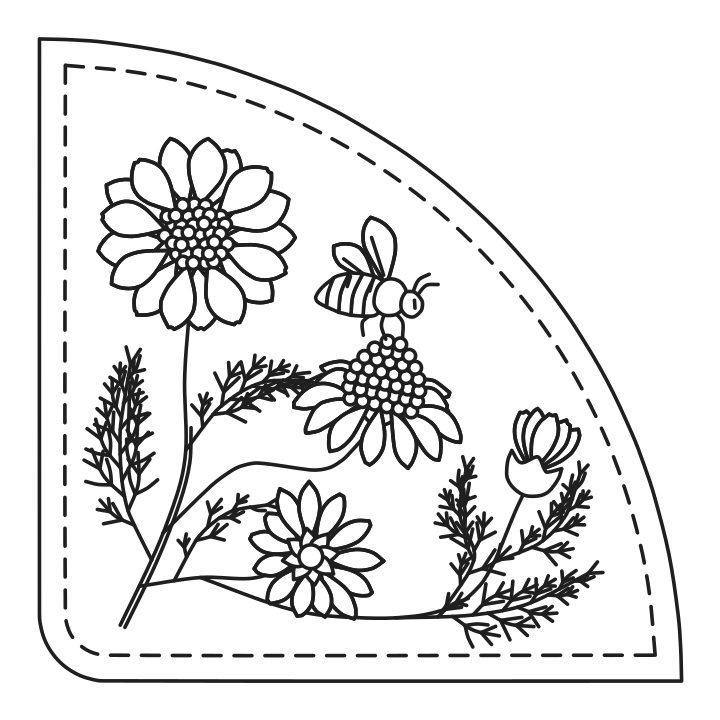
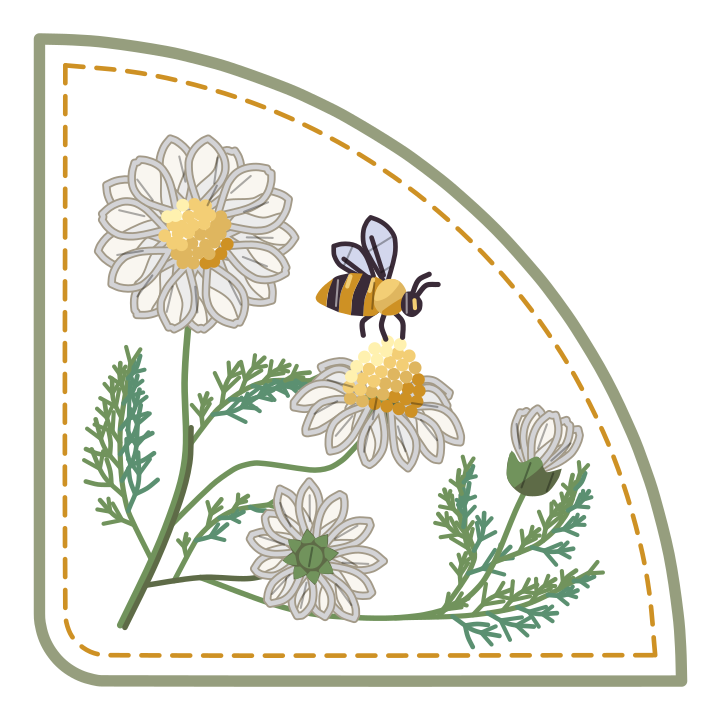
A branching chamomile plant opens one bloom full face, one in profile with drooping petals round a tall gold cone, one seen from behind with its green cup, and one bud. A bee stands on the cone.
Size and details
Advanced. Dozens of French knots and 13 colors; from a 6 inch hoop up the widest satin stitches are long.
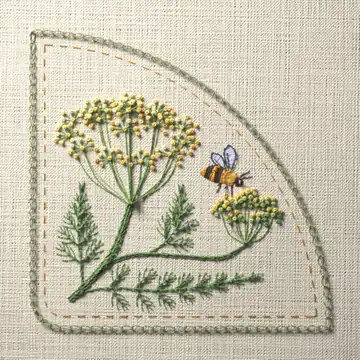
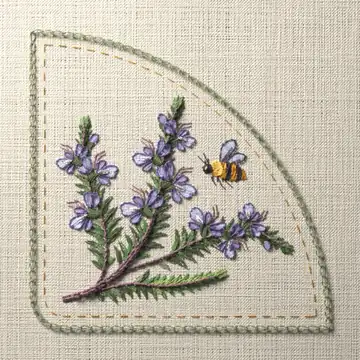
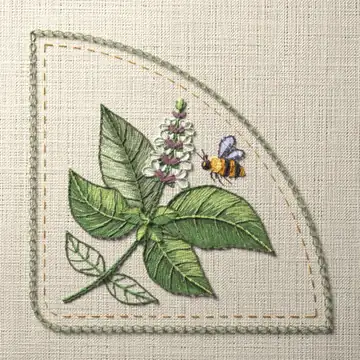
The petals are satin stitch in whites and a cool gray with a fine split stitch edge, and the cones are French knots from lemon in the light to topaz in the shade. The stems are stem stitch and the feathery leaves are stem stitch, back stitch and straight stitch in single strands. The bee has satin stitch stripes, a shaded body in long and short stitch, and pale satin stitch wings edged in split stitch. The frame is a quarter-round in chain stitch with a fine line of running stitch inside it. Trace it at 2.8 inches (7 cm) along both hems, one inch (2.5 cm) inside the edges of the napkin. It is one of four herb corners that share the frame (basil, chamomile, dill and rosemary), and each has its bee. In the picture of where the colors go, the fine lines show which way the stitches lie.
| Hoop | Inches | Centimeters | Satin stitch up to |
|---|---|---|---|
| 3 in (8 cm) | 1.4 × 1.4 in | 3.6 × 3.6 cm | 1/8 in (3 mm) |
| 4 in (10 cm) | 2.1 × 2.1 in | 5.3 × 5.3 cm | 1/4 in (6 mm) |
| 5 in (13 cm) | 2.8 × 2.8 in | 7.1 × 7.1 cm | 5/16 in (8 mm) |
| 6 in (15 cm) | 3.5 × 3.5 in | 8.9 × 8.9 cm | 3/8 in (10 mm) |
| 8 in (20 cm) | 4.9 × 4.9 in | 12.4 × 12.4 cm | 1/2 in (13 mm) |
- In an 8 inch hoop the widest satin stitch shape is 1/2 in (13 mm) across. Satin stitches longer than about 12 mm (just under 1/2 in) tend to work loose: divide the shape into sections, or work it in long and short stitch.
- In a 3, 4 or 5 inch hoop the French knots are drawn smaller than about 2 mm (a little over 1/16 in). Use one strand of floss for them there, or choose a larger hoop.
On linens. Wash and press the piece first. A corner design goes in one corner, its two arms along the two hems, the same distance from each: mark that corner with a ruler before you trace. On a pillow cover measure from the seam, which takes half an inch (1.3 cm) of the cut edge. On a dinner napkin keep to 1 to 2½ inches (2.5 to 6.5 cm): the size stands under each hoop. Press face down on soft cloth. How to embroider pillowcases and napkins has the sizes and the places, and the placement chart says how far in.
What you need
- Fabric
- Plain cotton or linen, cut 9 in (23 cm) square.
- Needle
- Embroidery needle, size 9 for 1 strand, size 7 for 2 or 3 (a lower number is a thicker needle).
- Floss
- 13 colors of six-strand cotton, listed below. DMC is a brand: another brand in a like color will do.
- Marker
- A pen or a sheet that suits the fabric: how to transfer a pattern says which.
Floss
- 1DMC 522 Fern GreenFrame
- 2DMC 783 Medium TopazInner line, flower hearts (darkest), bee (dark)
- 3DMC 3347 Medium Yellow GreenLeaves, stems and cups (lighter)
- 4DMC 502 Blue GreenLeaves (darker)
- 5DMC 3362 Dark Pine GreenCups and stems (darker)
- 6DMC 3865 Winter WhitePetals (light)
- 7DMC 762 Very Light Pearl GrayPetals (middle)
- 8DMC 415 Pearl GrayPetals (dark)
- 9DMC 3820 Dark StrawFlower hearts (dark), bee (middle)
- 10DMC 3821 StrawFlower hearts and bee (light), bee eye
- 11DMC 727 Very Light TopazFlower hearts (lightest)
- 12DMC 3747 Very Light Blue VioletBee wings (lighter)
- 13DMC 3371 Black BrownBee wings (darker), bee stripes, bee legs and bee head
Skeins: one of each color is enough. An estimate for the 6 inch hoop, from the length of each line and the area of each filled shape, with a fifth added for tails.
How to stitch it
- New to hand embroidery? Start here.
- Print at 100%, trace the pattern onto the fabric, and put it in the hoop: inner ring under, drawing up, tight as a drum.
- Floss is six strands. Cut 18 inches (45 cm), pull out the number given one at a time, and lay them together.
- Begin with no knot on the back where it is seen and washed, as on a towel, a napkin or clothes; for a piece in a hoop a small knot is fine. End each thread by whipping it around the backs of four or five stitches, with one small hitch.
- Each small ring is one French knot. A dashed line is running stitch.
- A number under “Where colors go” is a color of the list. The fine lines on the colors show which way the stitches lie.
Stitch in this order
Filled parts from the back of the picture forward, then lines and knots. Where a stitch page names another number of strands, use the number here.
- Satin stitch 2 strandsPetals, cups, bee wings, bee, bee stripes, bee head
- Long and short stitch 1 strandBee
- Chain stitch 2 strandsFrame
- Running stitch 1 strandInner line
- Stem stitch2 or 3 strands: stems1 strand: leaves, bee legs
- Back stitch 1 strandLeaves, bee wings
- Straight stitch2 strands: bee eye1 strand: leaves, bee
- Split stitch 1 strandPetals, bee wings
- French knot 2 strands, two wrapsFlower hearts
When it is done, take off any lines that still show and finish the hoop.
The rest of this set
More patterns like this
Intermediate prints 3–14 in · 13 colors
Squirrel outline for napkin corners
Easy prints 3–14 in · 7 colors
Easy vintage martini napkin corner
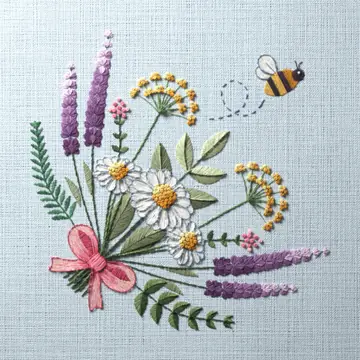
Advanced prints 3–14 in · 23 colors
Herb corner for a baby quilt
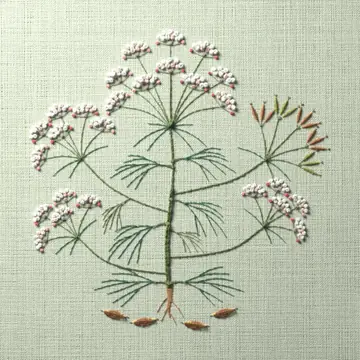
Intermediate prints 3–14 in · 16 colors
Cumin plant in flower
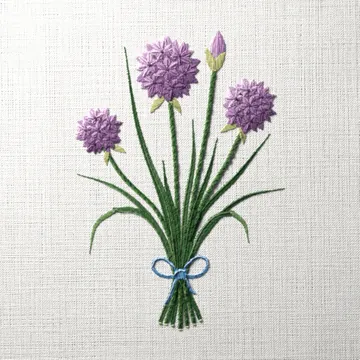
Advanced prints 3–14 in · 12 colors
Chives in bloom for a kitchen towel
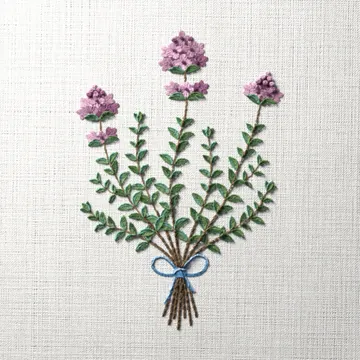
Intermediate prints 3–14 in · 11 colors
Thyme sprig for a kitchen towel
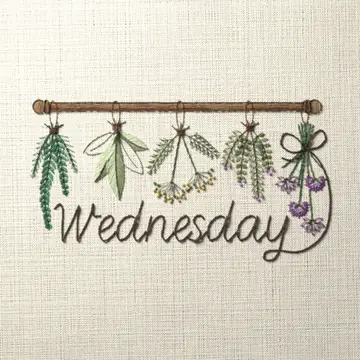
Advanced 3–8 in hoop · 15 colors
Wednesday with hanging herbs
New to hand embroidery? Starting hand embroidery, step by step