Dill napkin corner with a bee hand embroidery pattern
Intermediate · 10 colors · 3.5 × 3.5 in · 9 kinds of stitch · one of a set of 4
Download free PDFPDFPrints on US Letter and A4You may sell what you make from it by hand, in small quantities. The PDF itself is not to be sold or shared. Selling, classes and kits: the rules
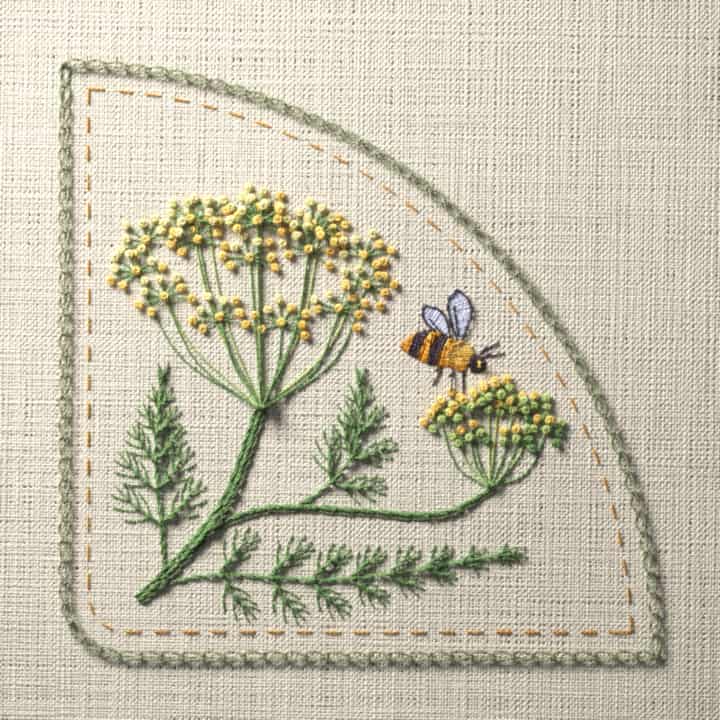
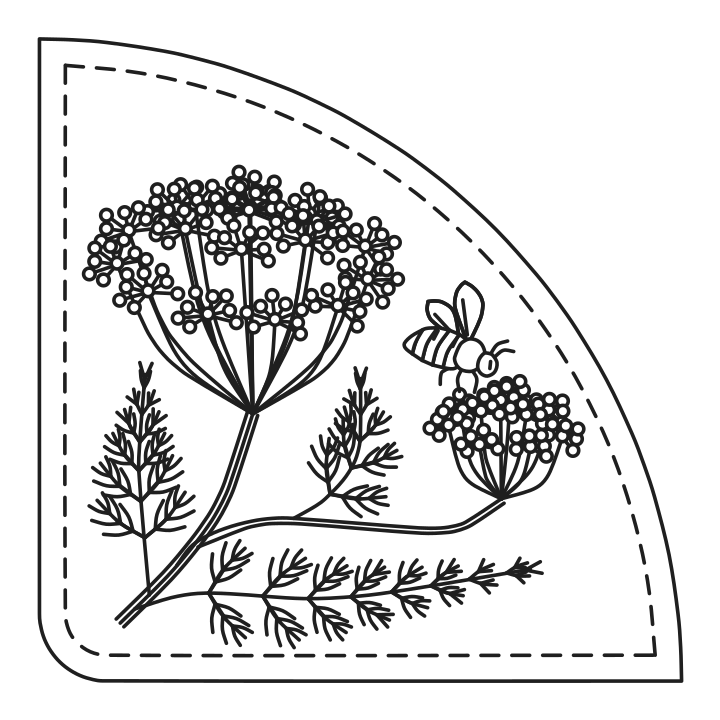
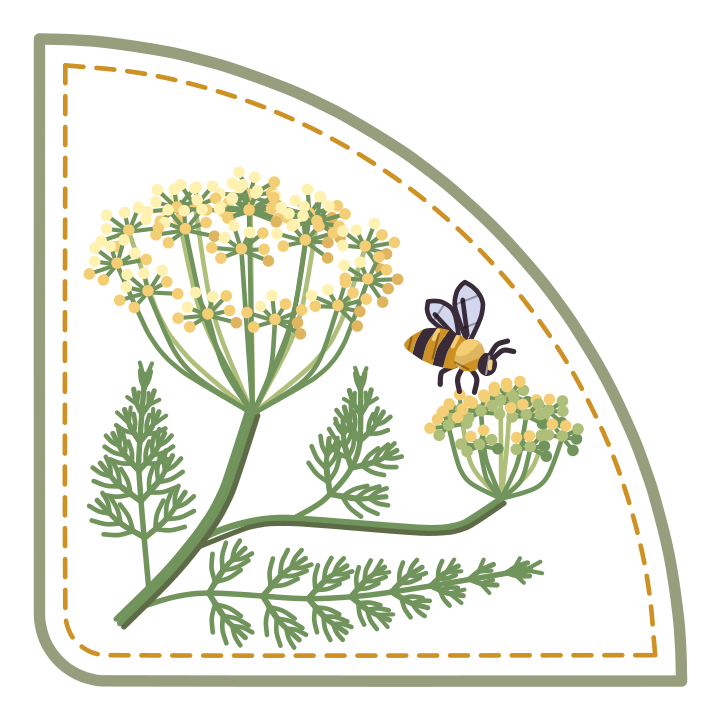
A dill stem rises out of the corner to a wide yellow flower head whose fine rays all spring from one point. A side stem carries a smaller, greener head, where a bee alights. Three feathery leaves branch from the stems.
Size and details
Intermediate. More than a hundred French knots and ten colors.
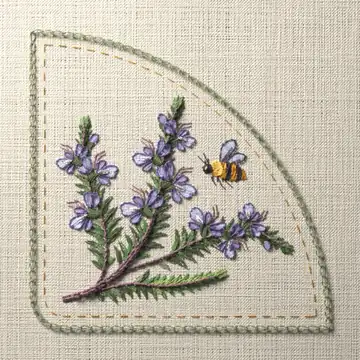
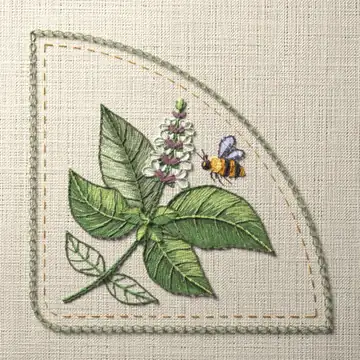
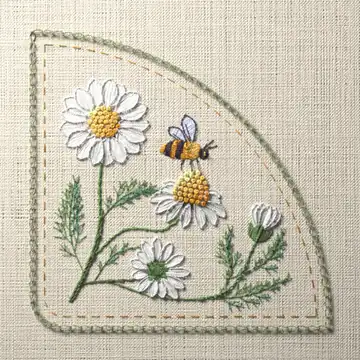
The stems and leaf branches are stem stitch, the rays are split stitch, and each little cluster is straight stitches tipped with French knots, lemon in the light and gold below. The finest leaf threads are back stitch and straight stitch in single strands. The bee has satin stitch stripes, a shaded body in long and short stitch, and pale satin stitch wings edged in split stitch. The frame is a quarter-round in chain stitch with a fine line of running stitch inside it. Trace it at 2.8 inches (7 cm) along both hems, one inch (2.5 cm) inside the edges of the napkin. It is one of four herb corners that share the frame (basil, chamomile, dill and rosemary), and each has its bee. In the picture of where the colors go, the fine lines show which way the stitches lie.
| Hoop | Inches | Centimeters | Satin stitch up to |
|---|---|---|---|
| 3 in (8 cm) | 1.4 × 1.4 in | 3.6 × 3.6 cm | 1/16 in (1.6 mm) |
| 4 in (10 cm) | 2.1 × 2.1 in | 5.3 × 5.3 cm | 1/8 in (3 mm) |
| 5 in (13 cm) | 2.8 × 2.8 in | 7.1 × 7.1 cm | 3/16 in (5 mm) |
| 6 in (15 cm) | 3.5 × 3.5 in | 8.9 × 8.9 cm | 3/16 in (5 mm) |
| 8 in (20 cm) | 4.9 × 4.9 in | 12.4 × 12.4 cm | 5/16 in (8 mm) |
- In a 3 or 4 inch hoop the French knots are drawn smaller than about 2 mm (a little over 1/16 in). Use one strand of floss for them there, or choose a larger hoop.
On linens. Wash and press the piece first. A corner design goes in one corner, its two arms along the two hems, the same distance from each: mark that corner with a ruler before you trace. On a pillow cover measure from the seam, which takes half an inch (1.3 cm) of the cut edge. On a dinner napkin keep to 1 to 2½ inches (2.5 to 6.5 cm): the size stands under each hoop. Press face down on soft cloth. How to embroider pillowcases and napkins has the sizes and the places, and the placement chart says how far in.
What you need
- Fabric
- Plain cotton or linen, cut 9 in (23 cm) square.
- Needle
- Embroidery needle, size 9 for 1 strand, size 7 for 2 or 3 (a lower number is a thicker needle).
- Floss
- 10 colors of six-strand cotton, listed below. DMC is a brand: another brand in a like color will do.
- Marker
- A pen or a sheet that suits the fabric: how to transfer a pattern says which.
Floss
- 1DMC 522 Fern GreenFrame
- 2DMC 783 Medium TopazInner line, bee (dark)
- 3DMC 3347 Medium Yellow GreenFloret rays, leaf threads, leaves and stems, flower rays (darker), florets (darkest)
- 4DMC 3362 Dark Pine GreenStem shadow
- 5DMC 471 Very Light Avocado GreenFlower rays (lighter), florets (dark)
- 6DMC 3821 StrawFlorets and bee (light), bee eye
- 7DMC 3820 Dark StrawFlorets and bee (middle)
- 8DMC 727 Very Light TopazFlorets (lightest)
- 9DMC 3747 Very Light Blue VioletBee wings (lighter)
- 10DMC 3371 Black BrownBee wings (darker), bee legs, bee stripes and bee head
Skeins: one of each color is enough. An estimate for the 6 inch hoop, from the length of each line and the area of each filled shape, with a fifth added for tails.
How to stitch it
- New to hand embroidery? Start here.
- Print at 100%, trace the pattern onto the fabric, and put it in the hoop: inner ring under, drawing up, tight as a drum.
- Floss is six strands. Cut 18 inches (45 cm), pull out the number given one at a time, and lay them together.
- Begin with no knot on the back where it is seen and washed, as on a towel, a napkin or clothes; for a piece in a hoop a small knot is fine. End each thread by whipping it around the backs of four or five stitches, with one small hitch.
- Each small ring is one French knot. A dashed line is running stitch.
- A number under “Where colors go” is a color of the list. The fine lines on the colors show which way the stitches lie.
Stitch in this order
Filled parts from the back of the picture forward, then lines and knots. Where a stitch page names another number of strands, use the number here.
- Satin stitch 2 strandsBee wings, bee, bee stripes, bee head
- Long and short stitch 1 strandBee
- Chain stitch 2 strandsFrame
- Running stitch 1 strandInner line
- Back stitch 1 strandLeaf threads, bee wings
- Straight stitch2 strands: bee eye1 strand: leaf threads, floret rays, bee
- Stem stitch2 or 3 strands: stems1 or 2 strands: leaves, stem shadow1 strand: bee legs
- Split stitch 1 strandFlower rays, bee wings
- French knot 1 strand, two wrapsFlorets
When it is done, take off any lines that still show and finish the hoop.
The rest of this set
More patterns like this
Intermediate prints 3–14 in · 13 colors
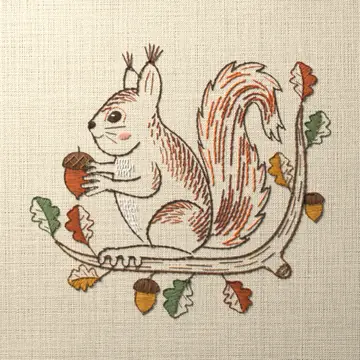
Squirrel outline for napkin corners
Easy prints 3–14 in · 7 colors
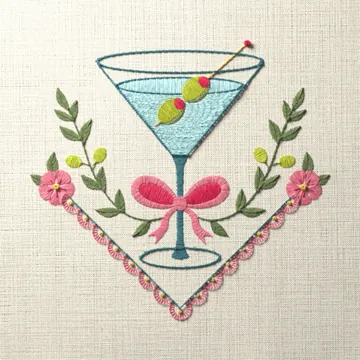
Easy vintage martini napkin corner
Intermediate prints 3–14 in · 7 colors
Star row corner
Intermediate prints 3–14 in · 7 colors
Two hearts handkerchief corner
Advanced prints 3–14 in · 12 colors
Continuous line swirl border corner
Intermediate prints 3–14 in · 5 colors
Diamond chain corner
Easy prints 3–14 in · 7 colors
Small Turkish oya flower corner
New to hand embroidery? Starting hand embroidery, step by step