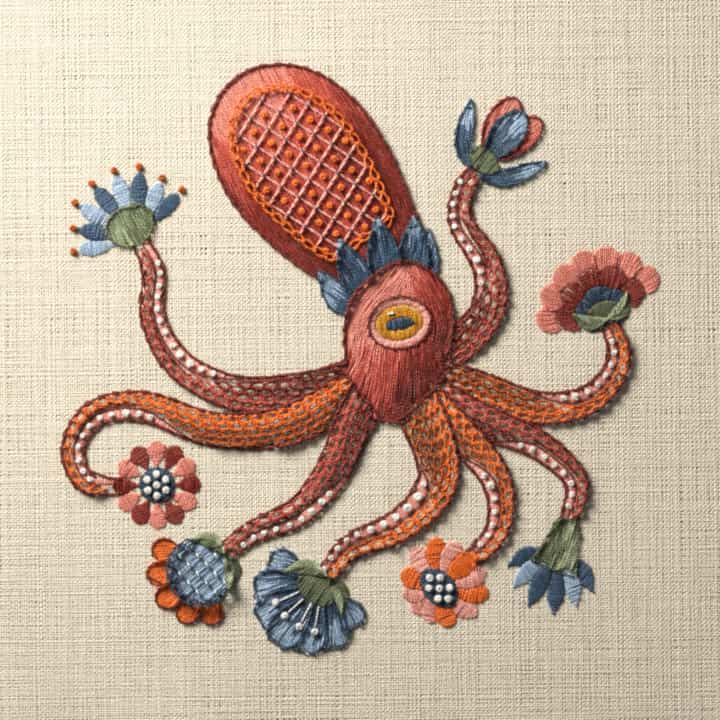
Jacobean octopus with sea flowers hand embroidery pattern
Advanced · 14 colors · 9 kinds of stitch
Download free PDFPDF, US Letter · 99 KBFor your own stitching, gifts and handmade pieces you sell. Do not resell or share this PDF or copies of it. Selling, classes and kits: the rules
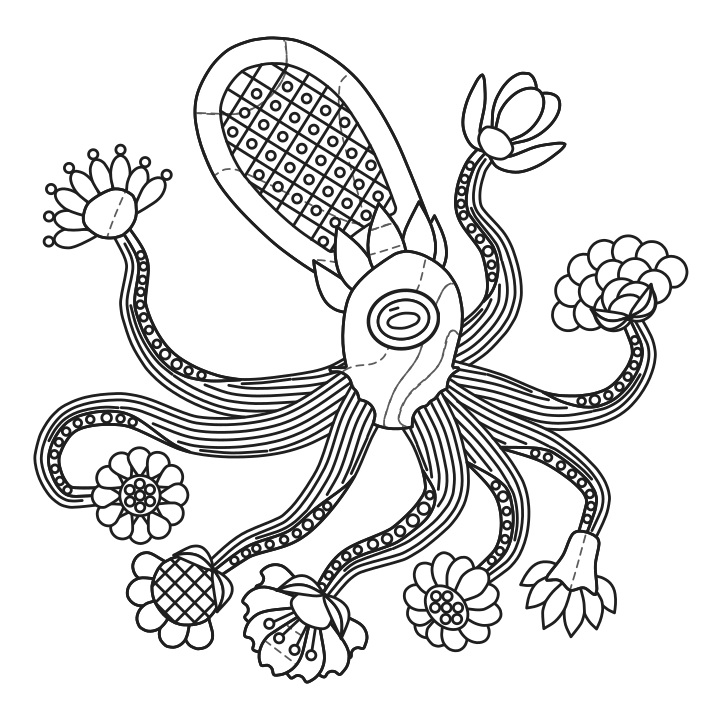
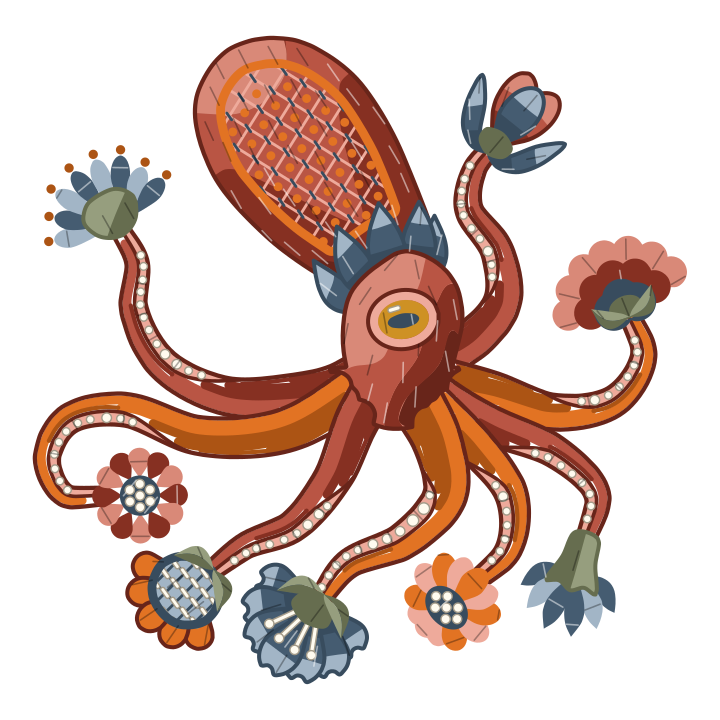
An octopus drawn like an old crewel flower: the mantle leans left above eight scrolling arms, and every arm ends in its own sea flower in indigo, madder, rust and sage. The mantle and head are shaded in long and short stitch, with trellis stitch and French knots over the mantle and a chain stitch band around it. The arms are rows of chain stitch edged in stem stitch, and the turned undersides are satin stitch with French knot suckers. The flowers use satin stitch, long and short stitch and fishbone stitch, with a trellis heart in one and straight stitch stamens in another. The one eye is mustard satin stitch. In the picture of where the colors go, the fine lines show which way the stitches lie.
Size and details
Advanced. Uses long and short stitch, trellis stitch, more than a hundred French knots, 14 colors and a great deal of stitching; from a 5 inch hoop up the widest satin stitches are long.
14 colors of floss and 9 kinds of stitch:
- Satin stitch
- Chain stitch
- Stem stitch
- Split stitch
- French knot
- Long and short stitch
- Trellis stitch
- Straight stitch
- Fishbone stitch
- Which stitch goes where
| Hoop | Inches | Centimeters | Satin stitch up to |
|---|---|---|---|
| 3 in (8 cm) | 1.8 × 1.8 in | 4.6 × 4.6 cm | 3/16 in (5 mm) |
| 4 in (10 cm) | 2.7 × 2.7 in | 6.9 × 6.9 cm | 1/4 in (6 mm) |
| 5 in (13 cm) | 3.6 × 3.6 in | 9.1 × 9.1 cm | 3/8 in (10 mm) |
| 6 in (15 cm) | 4.5 × 4.5 in | 11.4 × 11.4 cm | 7/16 in (11 mm) |
| 8 in (20 cm) | 6.3 × 6.3 in | 16 × 16 cm | 5/8 in (16 mm) |
- In an 8 inch hoop the widest satin stitch shape is 5/8 in (16 mm) across. Satin stitches longer than about 12 mm (just under 1/2 in) tend to work loose: divide the shape into sections, or work it in long and short stitch.
- In a 3, 4, 5 or 6 inch hoop the French knots are drawn smaller than about 2 mm (a little over 1/16 in). Use one strand of floss for them there, or choose a larger hoop.
The pattern is drawn inside a circle about half an inch (1.3 cm) smaller all around than the hoop.
What you need
- 1DMC 758 Very Light Terra CottaArm undersides and eyelid, mantle trellis (light), anemone petals (lighter)
- 2DMC 3830 Terra CottaMantle, arms and head (light), tulip petals (middle light)
- 3DMC 3777 Very Dark Terra CottaMantle and head (dark), arms (darkest), scallop petals (middle) and 2 more parts
All it stitches
Mantle, head and tulip petals (dark), arms (darkest), scallop petals (middle), round petals (darker) - 4DMC 3857 Dark RosewoodArm edges, mantle edge and crown petals edge, mantle (darkest) and 4 more parts
All it stitches
Arm edges, mantle edge, crown petals edge, head edge and eyelid edge, mantle and head (darkest), tulip petals edge (darker) - 5DMC 712 CreamSuckers, heart knots, stamens, stamen knots and eye light, flower trellis (lighter)
- 6DMC 922 Light CopperArms (lightest), crown petals (light), anemone petals (darker) and 2 more parts
All it stitches
Arms (lightest), crown petals (light), anemone petals (darker), mantle band, mantle trellis (middle) - 7DMC 920 Medium CopperArms and crown petals (dark), flower knots
- 8DMC 3778 Light Terra CottaHead and mantle (lightest), scallop petals (light) and 2 more parts
All it stitches
Head and mantle (lightest), scallop petals and tulip petals (light), round petals (lighter) - 9DMC 3750 Very Dark Antique BlueCalyx leaves (dark), carnation petals edge and calyx edge and 12 more parts
All it stitches
Calyx leaves, scallop petals, carnation petals, mantle trellis and turned petals (dark), carnation petals edge, calyx edge, turned petals edge, oval heart, flower heart, flower band and pupil, flower trellis (darker), tulip petals edge (lighter), tulip petals (darkest) - 10DMC 930 Dark Antique BlueCarnation petals and calyx leaves (middle), crown petals (darkest) and 3 more parts
All it stitches
Carnation petals, calyx leaves and turned petals (middle), crown petals (darkest), ray petals (darker), tulip petals (middle dark) - 11DMC 932 Light Antique BlueCarnation petals (light), flower ground, ray petals (lighter) and 4 more parts
All it stitches
Carnation petals, calyx leaves and turned petals (light), flower ground, ray petals (lighter), crown petals and tulip petals (lightest) - 12DMC 783 Medium TopazEye
- 13DMC 522 Fern GreenTube, flower cup and sepals (lighter)
- 14DMC 520 Dark Fern GreenFlower cup, sepals and tube (darker), tube edge and flower cup edge
Skeins: one of each color is enough. An estimate for the 8 inch hoop, from the length of each line and the area of each filled shape, with a fifth added for tails.
The floss is six-strand cotton; the stitch guide says how many strands to use. You also need a hoop, an embroidery needle (a size 9 or 10 for one strand, 7 to 9 for two or three) and plain cotton or linen fabric, white or another light color. To frame the piece in its hoop, cut a square 3 inches (8 cm) wider than the hoop: a 9 inch (23 cm) square for a 6 inch hoop.
When it is stitched, how to finish a hoop shows how to back it for the wall.
Stitch guide
- Put the pattern on the fabric (how to transfer a pattern) and the fabric in the hoop.
- Stitch the filled parts first, what lies behind before what lies in front of it.
- Then stitch the lines: stems, veins and outlines over the edges of the filled parts.
- Keep the knots for the end, so that the hoop and your hand do not flatten them.
Inside a filled shape start with two or three tiny stitches, which the filling covers: a knot shows as a bump. A line may start with a small knot on the back or one of the knotless starts. End each thread by running the needle under the backs of a few stitches. (Starting and ending a thread shows how.) Use the strands this list gives, and begin as it says, also where a page about a stitch names another number or begins with a knot.
- Satin stitch 2 strandsArm undersides, eyelid, eye, pupil, ray petals, round petals, flower heart, flower ground, flower cup, anemone petals, oval heart, crown petals, scallop petals
- Chain stitch 2 strandsArms, mantle band, flower band
- Stem stitch 1 to 2 strands2 strands: arms, arm edges, mantle edge, head edge1 strand: calyx edge, eyelid edge, flower cup edge, crown petals edge, carnation petals edge, tube edge, tulip petals edge, turned petals edge
- Split stitch 1 strandArm edges
- French knot 1 to 2 strands, two wraps2 strands: flower knots, heart knots, stamen knots1 or 2 strands: suckers1 strand: mantle trellis
- Long and short stitch 1 strandMantle, calyx leaves, head, flower cup, crown petals, carnation petals, tube, tulip petals, turned petals
- Trellis stitch 1 to 2 strands2 strands: mantle trellis1 strand: flower trellis
- Straight stitch 1 to 2 strands2 strands: eye light1 strand: stamens
- Fishbone stitch 2 strandsSepals
Getting it onto your fabric
The PDF holds the pattern twice at actual size: once as drawn, and once mirrored for an iron-on transfer pen. Print it at 100% with scaling off and check the one-inch square (25.4 mm) with a ruler before you trace. How to transfer a pattern explains tracing, carbon paper, the sticky wash-away sheet for knits, denim and dark cloth, and the other ways. The files are under Downloads.
Downloads
- Download free PDF PDF, US Letter, 3 pages, for a 6 inch (15 cm) hoop
- Download free PDF, A4 PDF, A4, 3 pages, for a 6 inch (15 cm) hoop
More patterns like this
Advanced prints 3–14 in · 8 colors
Octopus for a bath towel
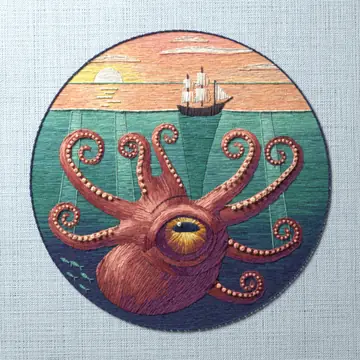
Advanced prints 3–14 in · 18 colors
Kraken beneath a sailing ship
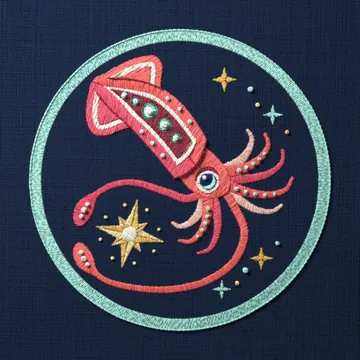
Advanced 3–8 in hoop · 10 colors
Glowing squid patch
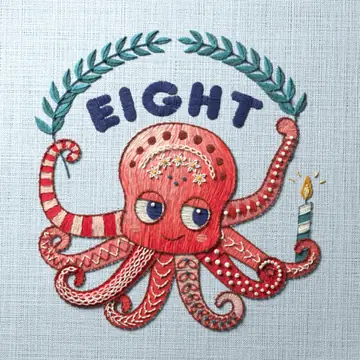
Advanced prints 3–14 in · 15 colors
Eight in laurel
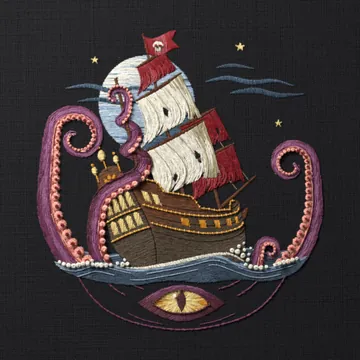
Advanced prints 3–14 in · 17 colors
Pirate ship and kraken
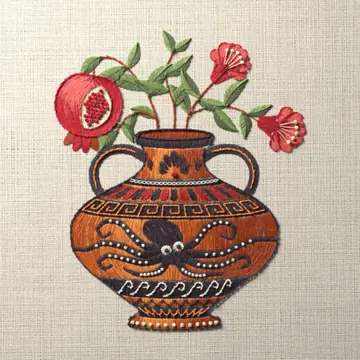
Advanced 3–8 in hoop · 9 colors
Greek vase with pomegranate branches
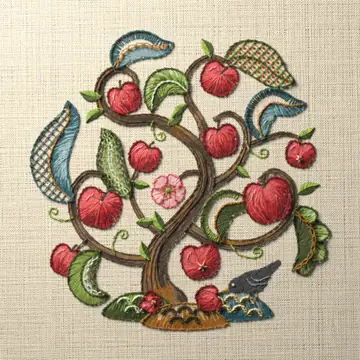
Advanced prints 3–14 in · 14 colors
Apple tree with red apples
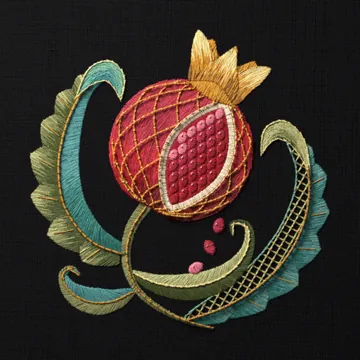
Advanced 3–8 in hoop · 15 colors
Jacobean pomegranate
New to hand embroidery? Starting hand embroidery, step by step