Hooray in daisies hand embroidery pattern
Advanced · 22 colors · 14 kinds of stitch

Download free PDFPDF, US Letter · 182 KBFor your own stitching, gifts and handmade pieces you sell. Do not resell or share this PDF. What you may do, in full
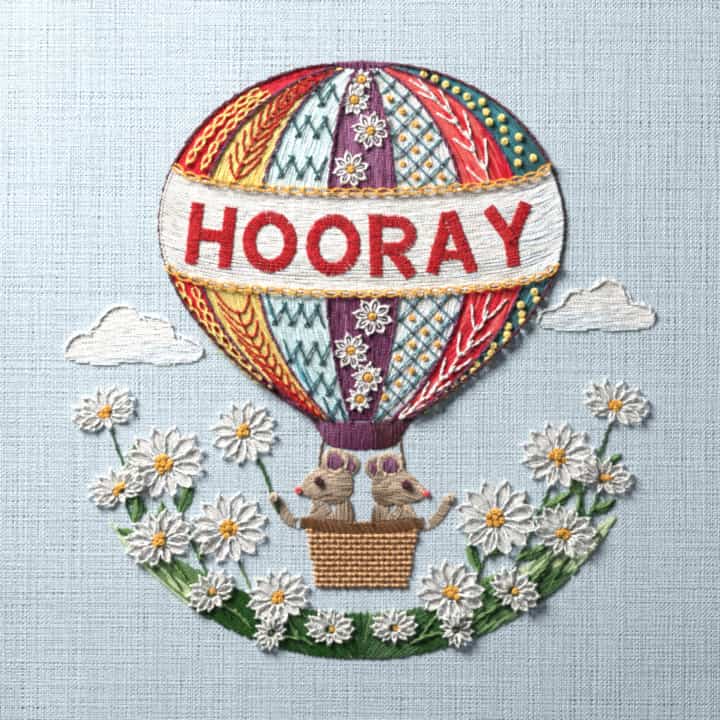
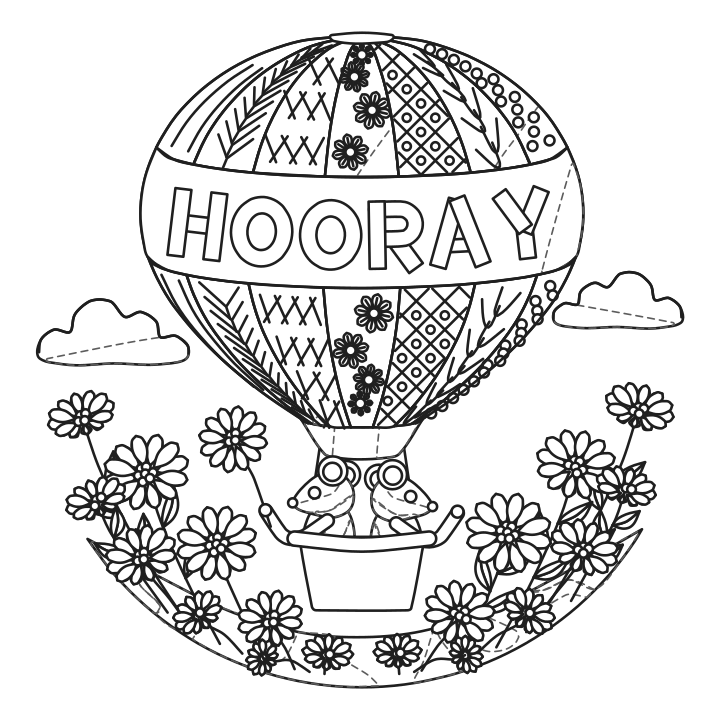
A hot-air balloon lifts off from a green meadow while the daisies lean out to both sides. Its seven gores are worked over long and short stitch in chain stitch, fly stitch, herringbone, lazy daisies, trellis, feather stitch and French knots. HOORAY is in satin stitch on a white sash edged with chain stitch. Two mice look out of a basket in woven filling, and one waves a daisy. It is drawn for pale blue linen. In the picture of where the colors go, the fine lines show which way the stitches lie.
Size and details
Advanced. Uses long and short stitch over much of the design, trellis stitch, more than a hundred French knots, 22 colors and a great deal of stitching.
22 colors of floss and 14 kinds of stitch:
- Long and short stitch
- Stem stitch
- Back stitch
- Satin stitch
- Chain stitch
- Fly stitch
- Herringbone stitch
- Lazy daisy stitch
- Straight stitch
- French knot
- Trellis stitch
- Feather stitch
- Woven filling stitch
- Fishbone stitch
- Which stitch goes where
| Hoop | Inches | Centimeters | Satin stitch up to |
|---|---|---|---|
| 3 in (8 cm) | 1.9 × 1.9 in | 4.8 × 4.8 cm | 1/8 in (3 mm) |
| 4 in (10 cm) | 2.9 × 2.9 in | 7.4 × 7.4 cm | 1/8 in (3 mm) |
| 5 in (13 cm) | 3.8 × 3.9 in | 9.7 × 9.9 cm | 3/16 in (5 mm) |
| 6 in (15 cm) | 4.8 × 4.9 in | 12.2 × 12.4 cm | 1/4 in (6 mm) |
| 8 in (20 cm) | 6.7 × 6.8 in | 17 × 17.3 cm | 5/16 in (8 mm) |
- In a 3, 4 or 5 inch hoop the French knots are drawn smaller than about 2 mm (a little over 1/16 in). Use one strand of floss for them there, or choose a larger hoop.
- In a 3, 4, 5, 6 or 8 inch hoop the shortest lazy daisy loops are drawn smaller than about 2 mm (a little over 1/16 in). Use one strand of floss for them there, or choose a larger hoop.
The pattern is drawn inside a circle about half an inch (1.3 cm) smaller all around than the hoop.
What you need
- DMC BLANC WhiteDaisies and 6 more parts
- DMC 3753 Ultra Very Light Antique BlueClouds and sash (darker)
- DMC 433 Medium BrownBasket rim and ropes
- DMC 3834 Dark GrapeRibs and 4 more parts
- DMC 154 Very Dark GrapeRim and eyes, skirt (dark)
- DMC 3835 Medium GrapeGore grounds (shade 4 of 10) and 2 more parts
- DMC 349 Dark CoralGore grounds (shade 3 of 10)
- DMC 744 Pale YellowGore grounds (shade 8 of 10) and 2 more parts
- DMC 817 Very Dark Coral RedLetters and fly gore
- DMC 742 Light TangerineSash edges and 4 more parts
- DMC 747 Very Light Sky BlueGore grounds (shade 9 of 10)
- DMC 3808 Ultra Very Dark TurquoiseHerringbone gore and 1 more part
- DMC 3810 Dark TurquoiseTrellis gore (middle) and 1 more part
- DMC 351 CoralGore grounds (shade 6 of 10), noses
- DMC 3782 Light Mocha BrownMice (light), ears (lighter), paws
- DMC 3790 Ultra Dark Beige GrayMice (dark)
- DMC 3032 Medium Mocha BrownMice (middle), arms, ears (darker)
- DMC 435 Very Light BrownBasket
- DMC 3346 Hunter GreenMeadow (dark) and 3 more parts
- DMC 895 Very Dark Hunter GreenMeadow (darkest)
- DMC 3347 Medium Yellow GreenMeadow (light) and 2 more parts
- DMC 3348 Light Yellow GreenMeadow (lightest)
Skeins: 2 for daisies and 6 more parts; one of each other color. An estimate for the largest size, the 8 inch hoop: the length of each line and the area of each filled shape, a fifth added for tails and ends, a tenth of every 8 m (8.7 yd) skein kept spare.
The floss is six-strand cotton; the stitch guide says how many strands to use. You also need a hoop, an embroidery needle (a size 7 to 9 suits two or three strands) and plain cotton or linen fabric. To frame the piece in its hoop, cut a square 3 inches (8 cm) wider than the hoop: a 9 inch (23 cm) square for a 6 inch hoop.
When it is stitched, how to finish a hoop shows how to back it for the wall.
Stitch guide
- Put the pattern on the fabric (how to transfer a pattern) and the fabric in the hoop.
- Stitch the filled parts first, what lies behind before what lies in front of it.
- Then stitch the lines: stems, veins and outlines over the edges of the filled parts.
- Keep the knots for the end, so that the hoop and your hand do not flatten them.
Start each thread with a small knot on the back or one of the knotless starts, and end it by running the needle under the backs of a few stitches (starting and ending a thread). Use the strands this list gives, also where a page about a stitch names another number.
- Long and short stitch 1 to 2 strandsClouds, gore grounds, sash, mice, meadow
- Stem stitch 2 to 3 strandsCloud edges, ribs, rim, waved daisy, stems
- Back stitch 2 strandsRopes
- Satin stitch 2 strandsSkirt, crown, letters, ears, and 4 more
- Chain stitch 2 strandsChain gore, sash edges
- Fly stitch 2 strandsFly gore
- Herringbone stitch 2 strandsHerringbone gore
- Lazy daisy stitch 2 strandsDaisy gore, daisies
- Straight stitch 1 strandDaisy gore
- French knot 1 to 2 strands, two wrapsDaisy gore, trellis gore, knot gore, and 4 more
- Trellis stitch 2 strandsTrellis gore
- Feather stitch 2 strandsFeather gore
- Woven filling stitch 3 strandsBasket
- Fishbone stitch 2 strandsLeaves
Getting it onto your fabric
The PDF holds the pattern twice at actual size: once as drawn, and once mirrored for an iron-on transfer pen. Print it at 100% with scaling off and check the one-inch square (25.4 mm) with a ruler before you trace. How to transfer a pattern explains tracing, carbon paper and the other ways. The files are under Downloads.
Downloads
- Download free PDF PDF, US Letter, 3 pages, for a 6 inch (15 cm) hoop
- Download free PDF, A4 PDF, A4, 3 pages, for a 6 inch (15 cm) hoop
More patterns like this
Advanced 3–8 in hoop · 22 colors
Welcome baby
Advanced 3–8 in hoop · 24 colors
Follow your dreams
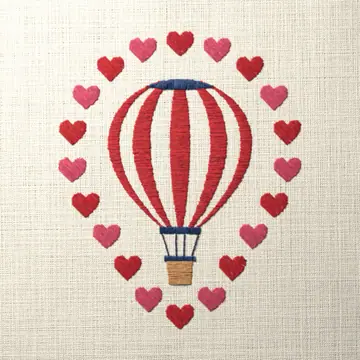
Intermediate 3–8 in hoop · 4 colors
Hot-air balloon with hearts
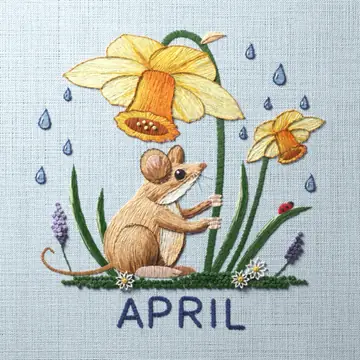
Advanced 3–8 in hoop · 23 colors
April
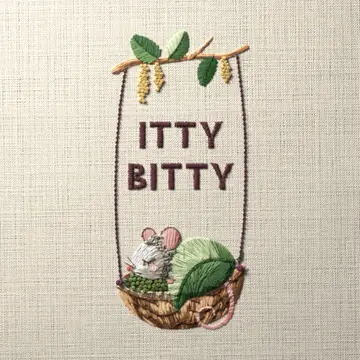
Advanced 3–8 in hoop · 23 colors
Itty bitty
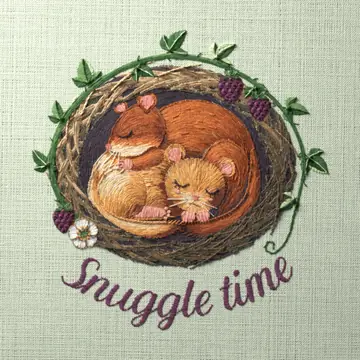
Advanced 3–8 in hoop · 24 colors
Snuggle time
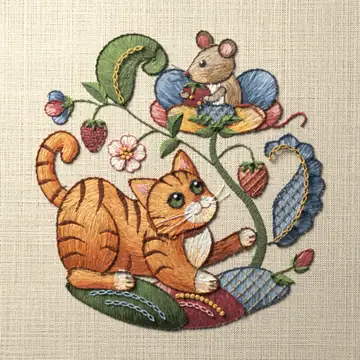
Advanced 3–8 in hoop · 23 colors
Ginger cat and mouse
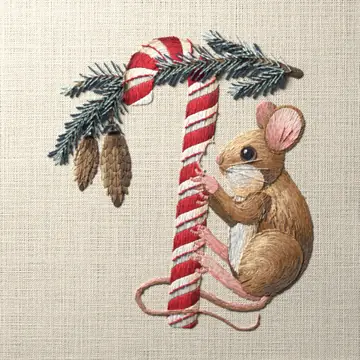
Advanced 3–8 in hoop · 23 colors
Mouse with a candy cane
New to hand embroidery? Starting hand embroidery, step by step