Monarch butterfly on milkweed hand embroidery pattern
Advanced · 17 colors · 3.9 × 4.7 in · 8 kinds of stitch
Download free PDFPDFPrints on US Letter and A4You may sell what you make from it by hand, in small quantities. The PDF itself is not to be sold or shared. Selling, classes and kits: the rules
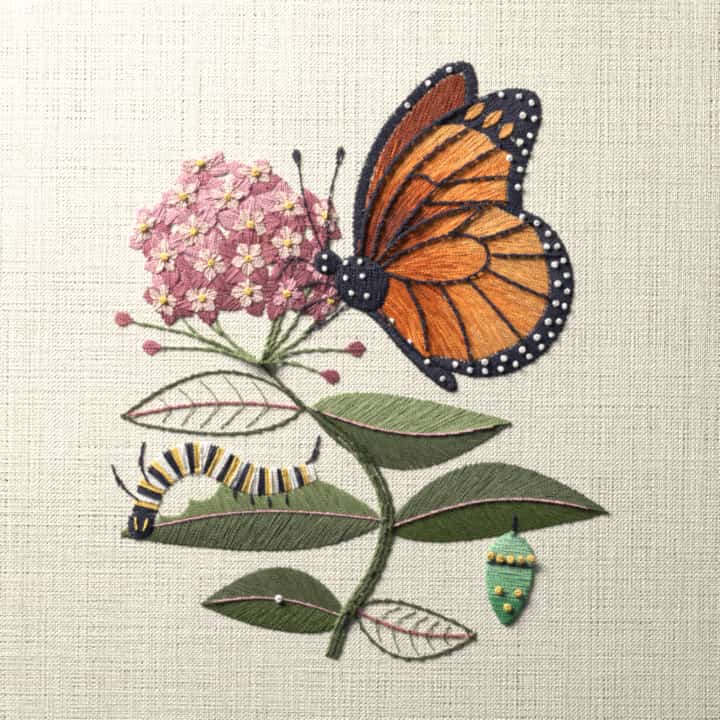
The whole life of a monarch sits on one milkweed stem: an egg on the lowest leaf, a banded caterpillar on a chewed edge, a jade chrysalis hanging under a leaf and the butterfly on the flowers.
Size and details
Advanced. Uses padded satin stitch, long and short stitch, dozens of French knots, satin stitch over about a fifth of the cloth in a 6 inch hoop, 17 colors and a great deal of stitching; from a 5 inch hoop up some of the satin stitches are long.
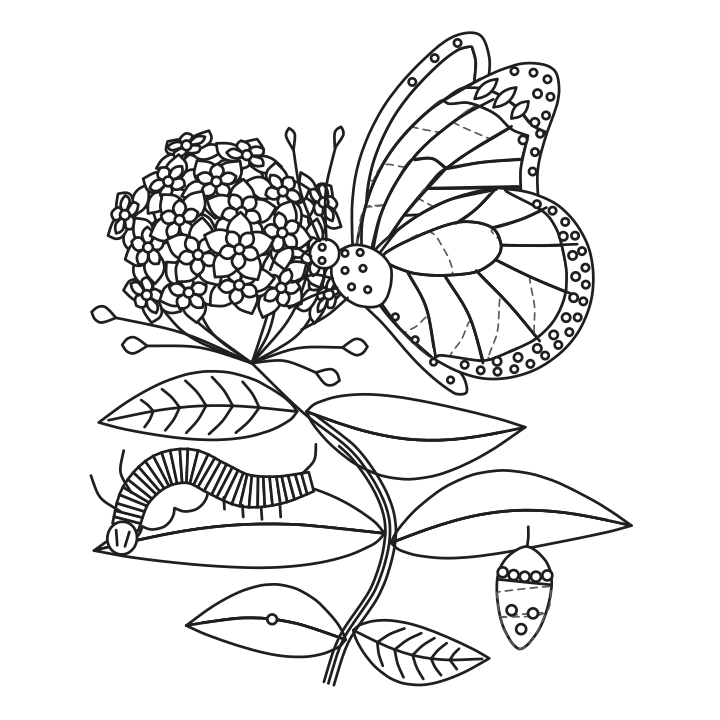
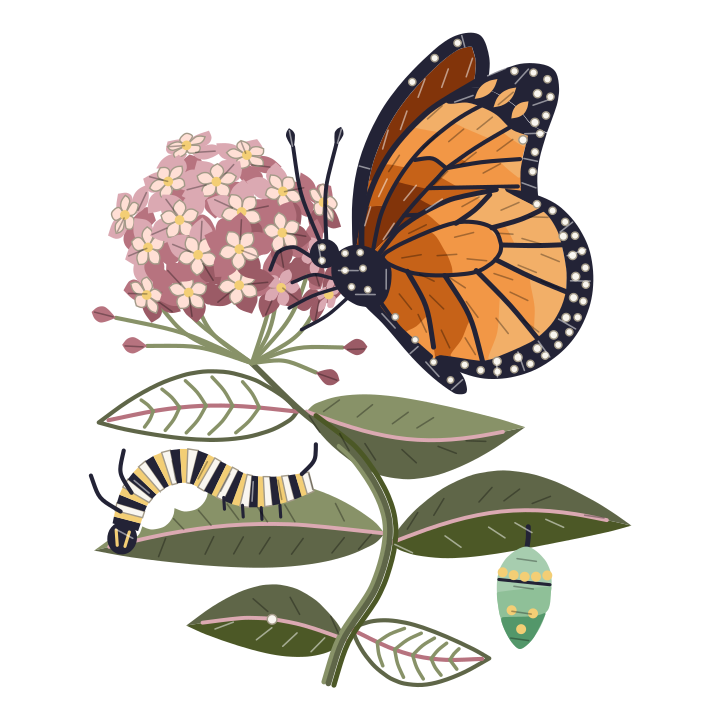
The wing panes are shaded in long and short stitch, the veins between them are stem stitch, and the wing margins are black satin stitch with white French knots. The bodies, the caterpillar’s head and the chrysalis are padded satin stitch so that they stand up from the cloth, with gold French knots on the chrysalis. The milkweed flowers are small satin stitch stars with a French knot in each heart. Fishbone stitch leaves alternate with open ones in stem stitch and back stitch. In the picture of where the colors go, the fine lines show which way the stitches lie.
| Hoop | Inches | Centimeters | Satin stitch up to |
|---|---|---|---|
| 3 in (8 cm) | 1.5 × 1.9 in | 3.8 × 4.8 cm | 3/16 in (5 mm) |
| 4 in (10 cm) | 2.3 × 2.8 in | 5.8 × 7.1 cm | 1/4 in (6 mm) |
| 5 in (13 cm) | 3.1 × 3.7 in | 7.9 × 9.4 cm | 3/8 in (10 mm) |
| 6 in (15 cm) | 3.9 × 4.7 in | 9.9 × 11.9 cm | 7/16 in (11 mm) |
| 8 in (20 cm) | 5.4 × 6.5 in | 13.7 × 16.5 cm | 5/8 in (16 mm) |
- In an 8 inch hoop the widest satin stitch shape is 5/8 in (16 mm) across. Satin stitches longer than about 12 mm (just under 1/2 in) tend to work loose: divide the shape into sections, or work it in long and short stitch.
- In a 3, 4 or 5 inch hoop the French knots are drawn smaller than about 2 mm (a little over 1/16 in). Use one strand of floss for them there, or choose a larger hoop.
What you need
- Fabric
- Plain cotton or linen, cut 9 in (23 cm) square.
- Needle
- Embroidery needle, size 9 for 1 strand, size 7 for 2 or 3, size 5 for 4 (a lower number is a thicker needle).
- Floss
- 17 colors of six-strand cotton, listed below. DMC is a brand: another brand in a like color will do.
- Marker
- A pen or a sheet that suits the fabric: how to transfer a pattern says which.
Floss
- 1DMC 3051 Dark Green GrayLeaves (dark), open leaves, stem (middle)
- 2DMC 3052 Medium Green GrayLeaves and stem (light), flower stalks, leaf veins (middle)
- 3DMC 3727 Light Antique MauveFlower petals and leaf veins (light), leaves (lightest), flower crowns (darker)
- 4DMC 316 Medium Antique MauveFlower petals (middle), leaf veins (dark), flower buds (lighter)
- 5DMC 936 Very Dark Avocado GreenLeaves (darkest), stem (dark)
- 6DMC 310 BlackWing margins, wing veins, body and antennae, caterpillar bands (dark) and 7 more parts
- 7DMC 564 Very Light JadeChrysalis (light)
- 8DMC 562 Medium JadeChrysalis (dark)
- 9DMC 563 Light JadeChrysalis (middle)
- 10DMC 3821 StrawCaterpillar bands (middle), flower hearts and gold dots, caterpillar head (lighter)
- 11DMC 3865 Winter WhiteCaterpillar bands (light), margin dots, body spots and egg
- 12DMC 3726 Dark Antique MauveFlower petals (dark), flower buds (darker)
- 13DMC 225 Ultra Very Light Shell PinkFlower crowns (lighter)
- 14DMC 918 Dark Red CopperForewing panes (darkest), far wing (darker)
- 15DMC 921 CopperHindwing panes and forewing panes (dark), far wing (lighter)
- 16DMC 3853 Dark Autumn GoldHindwing panes (middle), forewing panes (light)
- 17DMC 3854 Medium Autumn GoldHindwing panes (light), forewing panes (lightest), wing tip spots
Skeins: one of each color is enough. An estimate for the 6 inch hoop, from the length of each line and the area of each filled shape, with a fifth added for tails.
How to stitch it
- New to hand embroidery? Start here.
- Print at 100%, trace the pattern onto the fabric, and put it in the hoop: inner ring under, drawing up, tight as a drum.
- Floss is six strands. Cut 18 inches (45 cm), pull out the number given one at a time, and lay them together.
- Inside a filled shape start with two or three tiny stitches, which the filling covers. Start a line with a small knot on the back. End each thread by running the needle under the backs of a few stitches.
- Each small ring is one French knot. A fine broken line inside a shape is where two shades meet: trace it, do not stitch it.
- A number under “Where colors go” is a color of the list. The fine lines on the colors show which way the stitches lie.
Stitch in this order
Filled parts from the back of the picture forward, then lines and knots. Where a stitch page names another number of strands, use the number here.
- Fishbone stitch 2 strandsLeaves
- Satin stitch2 strands: caterpillar bands, flower buds, flower petals, flower crowns, wing margins, wing tip spots, antennae1 strand: leaves
- Padded satin stitch 2 strandsChrysalis, caterpillar head, body
- Long and short stitch 1 strandFar wing, forewing panes, hindwing panes
- Stem stitch3 or 4 strands: stem2 to 4 strands: wing veins3 strands: chrysalis stalk2 strands: open leaves, caterpillar horns, flower stalks1 or 2 strands: leaf veins1 strand: leaves, antennae, tongue
- Back stitch2 strands: legs1 strand: leaf veins
- Straight stitch 2 strandsChrysalis band, caterpillar head, caterpillar feet
- French knot two wraps2 strands: gold dots, flower hearts, egg1 strand: margin dots, body spots
When it is done, take off any lines that still show and finish the hoop.
More patterns like this
Advanced prints 3–14 in · 22 colors
Believe in yourself
Advanced prints 3–14 in · 23 colors
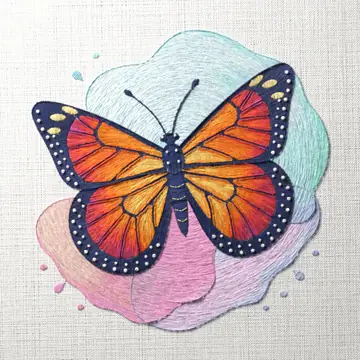
Watercolor monarch with open wings
Advanced 3–8 in hoop · 21 colors
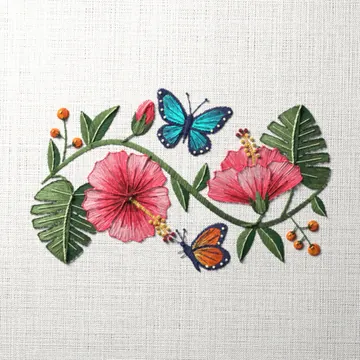
Tropical border with butterflies
Advanced 3–8 in hoop · 22 colors
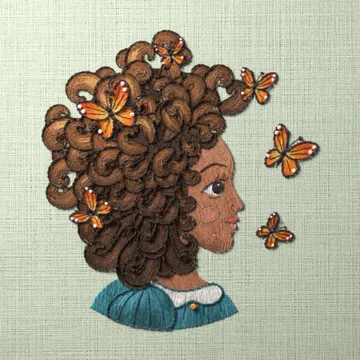
Girl with curly hair and butterflies
Advanced 3–8 in hoop · 17 colors
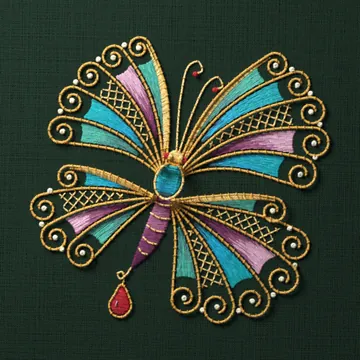
Fancy butterfly
Advanced 3–8 in hoop · 16 colors
Celestial butterfly
Advanced 3–8 in hoop · 16 colors
Butterfly with cloud scrolls
Advanced prints 3–14 in · 19 colors
Wreath of Chinese butterflies
New to hand embroidery? Starting hand embroidery, step by step