Cross stitch guide
How much cross stitch fabric to buy
Divide the design's stitches by the stitches to the inch of your cloth, across and then down. The answers are inches. On Aida, the usual cloth, the stitches to the inch are its count: 14 count has 14 to the inch (2.5 cm). Add the margin twice to each answer, once for each side. A design of 112 by 140 stitches on 14 count, with 3 inches (7.5 cm) round it for framing, needs a piece 14 by 16 inches (36 by 41 cm). Then buy the smallest size sold that it fits in, here 15 by 18 inches (38 by 46 cm).
On this page 14 parts
- The words you need first
- You want this, buy that
- How to buy the cloth, step by step
- The largest design a piece holds
- The words cloth is sold by
- How wide the cloth is
- How many pieces a length gives
- What to ask, and what to look at
- Wide, round and long pieces
- What an offcut still holds
- Keep it, and whether to wash it first
- Common mistakes
- Questions people ask
- Where to go next
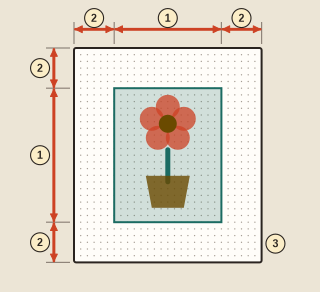
Open the fabric calculator on that example and put your own numbers in, in inches or in centimeters. Fabric sizes has charts with the sum already done, for every common count.
In centimeters, multiply each answer by 2.54 before you add the margin. 112 divided by 14 is 8, and 8 times 2.54 is 20.3 cm. Add 7.5 cm twice, which makes 35.3, and round up: 36 cm.
The words you need first
- Count is the number of squares, or of threads, to the inch (2.5 cm).
- Aida is woven in small squares, and a square takes one cross. Its count is its stitches to the inch: 14 on 14 count.
- Evenweave and linen are woven in single threads, and most crosses go over two of them. The stitches to the inch are then half the count: 14 on 28 count.
- The bolt is the roll of cloth that a shop cuts lengths from.
- A fat quarter is a piece half a yard long and half as wide as the bolt, so it is nearly square. An ordinary quarter yard is a long strip, 9 inches (23 cm) deep and as wide as the bolt.
You want this, buy that
These are for 14 count Aida, or for 28 count evenweave or linen over two threads, which comes to the same. "Buy" names a size that is sold and that the piece fits in.
| You want | Stitches | The piece you need | Buy |
|---|---|---|---|
| An ornament or a card | 40 × 40 | 6 by 6 in (16 by 16 cm) | The smallest piece there is, or an offcut |
| Six ornaments | 50 × 50 each | 7 by 7 in (18 by 18 cm) each | One fat quarter: 18 by 25 in (46 by 64 cm) of Aida, or 18 by 27 in (46 by 69 cm) of evenweave or linen |
| A piece for a small hoop | 56 × 56 | 8 by 8 in (21 by 21 cm) | 12 by 18 in (30 by 46 cm), which gives two |
| A small framed piece | 70 × 84 | 11 by 12 in (28 by 31 cm) | 12 by 18 in (30 by 46 cm) |
| A framed picture | 112 × 140 | 14 by 16 in (36 by 41 cm) | 15 by 18 in (38 by 46 cm) |
| A large picture | 168 × 224 | 18 by 22 in (46 by 56 cm) | 18 by 25 in (46 by 64 cm), which it fills exactly one way, or 20 by 24 in (51 by 61 cm) |
| A very large picture | 250 × 350 | 24 by 31 in (61 by 79 cm) | 25 by 36 in (64 by 91 cm) |
| A full coverage picture, stitched all over | 350 × 490 | 31 by 41 in (79 by 104 cm) | A yard, 36 by 43 in (91 by 109 cm) |
An exact fit is enough for a frame. A crooked edge takes a little off one margin, and 2 inches (5 cm) a side still frames it. A larger piece only makes the work easier to hold.
The margin for each finish
| How it will be finished | Bare cloth on every side |
|---|---|
| In a frame | 3 in (7.5 cm) |
| In a hoop | 2 in (5 cm) |
| An ornament, a card or a bookmark | 1 1/2 in (4 cm) |
| A pillow, a stocking or a bag | 2 in (5 cm), measured from the edge of the finished front and not from the design |
The first three are the fabric calculator's. A pillow, a stocking or a bag is cut out of the cloth and sewn, with a seam of half an inch (1.3 cm) or less: the rest is there to hold while you stitch. So a pillow front 14 inches (35.6 cm) square takes a piece 18 by 18 inches (46 by 46 cm). If strips of cotton go round the stitching, as in making a pillow, the front to measure is the stitched panel alone.
How to buy the cloth, step by step
- Find the design's size in stitches. The pattern's page gives both numbers.
- Choose the count. Take the one the pattern names. A pattern's page here lets you choose, and opens on 14. If you are new, take 14 count Aida: it is the usual cloth, and its squares are easy to see and count.
- Choose the finish now. It sets the margin on each side. Frame sizes works back from a frame you own.
- Widen the margin for what will show. An inch (2.5 cm) of bare cloth round the stitching, or of a mat, which is the card border inside a frame, makes a frame's margin 4 inches (10 cm) and not 3 (7.5 cm). Cloth that is hand dyed, will be washed first, or could not be bought again wants that wider margin too.
- Work out the piece. Across: the stitches divided by the stitches to the inch, plus the margin twice. Down: the same. Round both numbers up to whole inches or, after the sum in centimeters above, to whole centimeters.
- Find a size that is sold in your cloth and that both numbers fit in, one way up or the other. The table of pieces lists them, small to large. A piece of 19 by 21 inches (48 by 53 cm) does not fit in 18 by 25 (46 by 64 cm), because both its numbers are over 18. It fits in 20 by 24 (51 by 61 cm).
- For a set, buy all of it at one time, and several yards or meters as one unbroken length. Two lengths of one color can differ.
- Ask the questions under what to ask. When the cloth comes, write its count on a tag and keep the two together.
The largest design a piece holds
This is the sum run backward, for a framed piece with 3 inches (7.5 cm) left on every side. Look only at the pieces that are sold in your cloth. Take the first of those whose two numbers, under your count, are both as large as your design's or larger. You may swap the two: that is the piece turned on its side. For example, a design of 98 by 160 on 14 count Aida is too wide for 12 by 18 inches (30.5 by 45.7 cm), whose numbers are 84 and 168. The next piece is sold only in evenweave and linen. The one after it, 15 by 18 (38.1 by 45.7 cm), takes it.
| Piece | Sold as | 14 count, or 28 over two | 16 count, or 32 over two | 18 count, or 36 over two |
|---|---|---|---|---|
| 12 by 18 in (30.5 by 45.7 cm) | A packaged piece of Aida | 84 × 168 | 96 × 192 | 108 × 216 |
| 13 by 18 in (33 by 45.7 cm) | A fat eighth of evenweave or linen | 98 × 168 | 112 × 192 | 126 × 216 |
| 15 by 18 in (38.1 by 45.7 cm) | A packaged piece of Aida | 126 × 168 | 144 × 192 | 162 × 216 |
| 18 by 21 in (45.7 by 53.3 cm) | A fat quarter of Aida | 168 × 210 | 192 × 240 | 216 × 270 |
| 18 by 25 in (45.7 by 63.5 cm) | A fat quarter of Aida | 168 × 266 | 192 × 304 | 216 × 342 |
| 18 by 27 in (45.7 by 68.6 cm) | A fat quarter of evenweave or linen | 168 × 294 | 192 × 336 | 216 × 378 |
| 20 by 24 in (50.8 by 61 cm) | A packaged piece of Aida | 196 × 252 | 224 × 288 | 252 × 324 |
| 25 by 30 in (63.5 by 76.2 cm) | Cut for you from a bolt | 266 × 336 | 304 × 384 | 342 × 432 |
| 25 by 36 in (63.5 by 91.4 cm) | A fat half of wide Aida | 266 × 420 | 304 × 480 | 342 × 540 |
| 27 by 36 in (68.6 by 91.4 cm) | A fat half of evenweave or linen | 294 × 420 | 336 × 480 | 378 × 540 |
| 36 by 43 in (91.4 by 109.2 cm) | A yard of Aida | 420 × 518 | 480 × 592 | 540 × 666 |
| 36 by 55 in (91.4 by 139.7 cm) | A yard of evenweave or linen | 420 × 686 | 480 × 784 | 540 × 882 |
For a piece of another size, open the calculator on cloth you have, here 15 by 18 inches (38.1 by 45.7 cm), and change the numbers.
The words cloth is sold by
| Word | What it is | In Aida | In evenweave and linen | Good for |
|---|---|---|---|---|
| Precut or packaged piece | Cut by the maker, folded flat or rolled in a tube | 12 by 18, 15 by 18 or 20 by 24 in (30 by 46, 38 by 46 or 51 by 61 cm) | 13 by 18 in (33 by 46 cm) | One small or medium design |
| Fat quarter | Half a yard long, half the width | 18 by 21 or 18 by 25 in (46 by 53 or 46 by 64 cm) | 18 by 27 in (46 by 69 cm) | One picture, or several small pieces |
| Fat eighth | Half a fat quarter | 9 by 21 in (23 by 53 cm) | 9 by 27, or 13 by 18 in (23 by 69, or 33 by 46 cm) | Bookmarks, ornaments, a band |
| Quarter yard | A strip of the full width | 9 by 43 in (23 by 109 cm) | 9 by 55 in (23 by 140 cm) | Borders and bands. Too shallow for most designs |
| Half yard | A strip of the full width | 18 by 43 in (46 by 109 cm) | 18 by 55 in (46 by 140 cm) | A set of small pieces |
| Fat half | A yard long, half the width | 25 by 36 in (64 by 91 cm) from wide cloth | 27 by 36 in (69 by 91 cm) | A large picture |
| Yard | 36 inches (91.4 cm) of the full width | 36 by 43, 36 by 51 or 36 by 59 in (91 by 109, 91 by 130 or 91 by 150 cm) | 36 by 55 in (91 by 140 cm) | Full coverage, a tablecloth, a group |
| Meter | 100 cm (39 3/8 inches) of the full width | 100 by 110 cm (39 by 43 in) | 100 by 140 cm (39 by 55 in) | The same, a little longer |
| Off the bolt | Cut for you, to the length you ask | Any length, by the full width | Any length, by the full width | Whatever the sums say |
| Roll | The whole length from the mill | One is listed at about 50 meters (54.7 yards), 59 in (150 cm) wide, with no stiffening in it | Ask | A shop, a class or a dyer |
| Remnant or short cut | What is left of a bolt | The full width by 6 to 34 in (15 to 86 cm), as listed | The full width by an odd length | Small pieces, if the count is marked |
What a fat quarter is is drawn in the guide to sizes.
How wide the cloth is
The longest side is for a framed design on 14 count. It is the longest that can lie across the cloth: the width, less 6 inches (15.2 cm) for two margins, times 14.
| Cloth | Width of the bolt | Half of it | Longest side across it |
|---|---|---|---|
| Aida | 43 in (110 cm) | 21 1/2 in (55 cm) | 518 stitches |
| Aida, wider | 51 in (130 cm) | 25 1/2 in (65 cm) | 630 stitches |
| Aida, the widest listed, in a few colors | 59 in (150 cm) | 29 1/2 in (75 cm) | 742 stitches |
| Evenweave and linen | About 55 in (140 cm) | 27 1/2 in (70 cm) | 686 stitches, over two threads of 28 count |
| Band | 1 to 4 in (2.5 to 10.2 cm) and wider, by the length | Not halved: it is a strip | Count its squares: Aida band |
| Afghan cloth | By the panel: one is 45 by 57 in (114 by 145 cm) | Not halved: it is a panel | Count its squares: on blankets |
The bolt limits only the shorter side of a design. The longer side runs along the length, and that is as long as you care to buy. A design whose shorter side is still too much for the bolt takes a finer count, or two pieces joined.
How many pieces a length gives
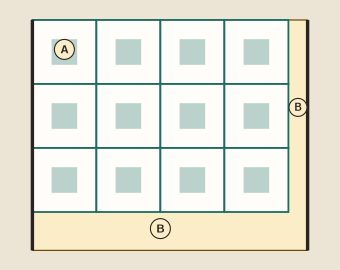
These are for pieces that are all alike. A number in brackets stands where the pieces fill the cloth exactly: it is how many whole ones are left when a selvage or a crooked cut takes an inch (2.5 cm) off each way. The selvage is the finished edge along each side of the bolt. For framed pieces take the first number, and cut each a little smaller if you have to: their margin has room. If every piece has to be its full size, buy by the number in brackets.
From Aida
| Piece | Fat quarter, 18 by 21 in (45.7 by 53.3 cm) | Fat quarter, 18 by 25 in (45.7 by 63.5 cm) | Half yard, 43 in (110 cm) wide | Yard, 43 in (110 cm) wide |
|---|---|---|---|---|
| 7 by 7 in (17.8 by 17.8 cm) | 6 (4) | 6 | 12 | 30 |
| 8 by 8 in (20.3 by 20.3 cm) | 4 | 6 | 10 | 20 |
| 10 by 10 in (25.4 by 25.4 cm) | 2 | 2 | 4 | 12 |
| 12 by 12 in (30.5 by 30.5 cm) | 1 | 2 | 3 | 9 (6) |
| 12 by 18 in (30.5 by 45.7 cm) | 1 | 2 (1) | 3 (2) | 6 (4) |
| 14 by 18 in (35.6 by 45.7 cm) | 1 | 1 | 3 (2) | 6 (4) |
| 16 by 20 in (40.6 by 50.8 cm) | 1 | 1 | 2 | 4 |
| 18 by 22 in (45.7 by 55.9 cm) | 0 | 1 (0) | 1 (0) | 2 |
From evenweave or linen
| Piece | Fat quarter, 18 by 27 in (45.7 by 68.6 cm) | Half yard, 55 in (140 cm) wide | Yard, 55 in (140 cm) wide |
|---|---|---|---|
| 7 by 7 in (17.8 by 17.8 cm) | 6 | 14 | 35 |
| 8 by 8 in (20.3 by 20.3 cm) | 6 | 12 | 24 |
| 10 by 10 in (25.4 by 25.4 cm) | 2 | 5 | 15 |
| 12 by 12 in (30.5 by 30.5 cm) | 2 | 4 | 12 (8) |
| 12 by 18 in (30.5 by 45.7 cm) | 2 (1) | 4 (3) | 9 (6) |
| 14 by 18 in (35.6 by 45.7 cm) | 1 | 3 | 6 |
| 16 by 20 in (40.6 by 50.8 cm) | 1 | 2 | 4 |
| 18 by 22 in (45.7 by 55.9 cm) | 1 (0) | 2 (0) | 4 (3) |
How it is counted
See how many whole pieces go across the cloth and how many go down, and multiply. Then turn the piece on its side and do it again, and take the better answer. A piece may be turned, because the weave is the same both ways.
What to ask, and what to look at
- Is the count the same both ways? Count an inch (2.5 cm) across and an inch down. If they differ, a circle comes out an oval. Find a count with a ruler or a printed gauge.
- How wide is the bolt, and does the size include the selvage?
- Is it cut straight? The edge should follow one line of holes. Whatever is crooked has to come off.
- Are there faults in the weave? Look for a missing thread, a knot or a thick line. In linen, thick and thin threads are the nature of the cloth.
- Is there a fold down the middle? Starched cloth holds a crease. A piece rolled in a tube has none.
- Is the fold faded? Hold it beside the inside of the cloth. Light fades color.
- Stiff or soft? Aida is stiff with starch, which some like in the hand. Evenweaves differ from one to the next.
- Which side is the front? Printed cloth is printed on one side only. On plain cloth, turn the better side up.
- Was it measured before it was dyed? Hand-dyed cloth shrinks a little in the dyeing, so a piece can come up short.
Wide, round and long pieces
- Wider than the bolt. Turn the design so that its shorter side lies across the cloth.
- Round. Buy a square as wide as the circle and two hems. With a 1 inch (2.5 cm) hem, a circle 24 inches (61 cm) across comes from a square of 26 inches (66 cm), and one 36 inches (91 cm) across from 38 inches (96.5 cm).
- Oval. Buy a rectangle: its length and its width, each with two hems.
- Long and narrow. A bell pull or a runner is cut along the length, beside the selvage, so that it needs only a narrow strip of a long piece. Band is sold ready woven for the narrowest ones.
What an offcut still holds
On 14 count, with a margin on both sides:
- A strip 5 inches (12.7 cm) wide, less 1 1/2 inches (3.8 cm) a side: 2 inches (5.1 cm), which is 28 stitches. A bookmark.
- A strip 6 inches (15.2 cm) wide, less 1 1/2 inches (3.8 cm) a side: 3 inches (7.6 cm), which is 42 stitches. An ornament.
- A strip 8 inches (20.3 cm) wide, less 2 inches (5.1 cm) a side: 4 inches (10.2 cm), which is 56 stitches. A small picture in a hoop. For a card, less 1 1/2 inches (3.8 cm) a side, it holds 70.
What to do with offcuts has other uses. The small patterns fit most of them, and so do the windows of coasters, key rings and other blanks.
Keep it, and whether to wash it first
Roll it, do not fold it. Lay it on acid-free tissue and roll the two up together, or cover a tube with the tissue first, because plain card can discolor cloth. Keep it dry and out of the light, and not shut in plastic for years, because plastic traps damp. Keep a note with it: the count, the size, the color and where it came from.
Most cloth is stitched as it comes. Wash it first if it has to be softer, if a fold will not press out, if a strong color may run, or if the finished thing will be washed often. It shrinks a little, so count it again and cut it afterward. Preparing fabric and how to wash have the steps.
Common mistakes
- The margin is added once. It goes on two sides. Add it twice across and twice down.
- Bought by the finished size. A picture of 8 by 10 inches (20.3 by 25.4 cm) cannot be framed on cloth of that size. Sew strips of cotton to the edges, or start again on a larger piece.
- An ordinary quarter yard. It is 9 inches (23 cm) deep. Ask for a fat quarter.
- The count of a linen used as its stitches. Over two threads, 112 stitches on 28 count are 8 inches (20.3 cm) wide and not 4 (10.2 cm), so a piece cut for 4 is too small. Halve the count before you divide.
- Color chosen from a screen. Ask for a small sample, or choose the threads to suit the cloth when it arrives.
Questions people ask
How much is on a bolt? It varies. One roll of Aida is listed at about 50 meters (54.7 yards), give or take. A shop may have far less left on its own, so for a long piece ask first.
Is a fat quarter the same size everywhere? No. It is half a yard, or half a meter, by half the width, and widths differ. Read the measurements.
May I turn the piece? Yes, as long as the count is the same both ways. On printed or hand-dyed cloth look which way its pattern runs.
How much cloth do I need for a kit for ten people? For ten pieces of 8 by 8 inches (20.3 cm), half a yard of 43 inch (110 cm) Aida. For ten of 10 by 10 inches (25.4 cm), a whole yard, which gives twelve. Make a kit has the rest.
What is the largest piece I can have, and is there cloth 60 inches (about 150 cm) wide? As wide as the bolt, and as long as you like. Evenweave and linen are about 55 inches (140 cm) wide. Most Aida is listed at 43 inches (110 cm) and some at 51 inches (130 cm). The widest is sold as 59 or 60 inches (about 150 cm), in a few colors, by the yard as well as by the roll.
A large piece often needs no wide cloth. One of 40 by 60 inches (102 by 152 cm) is cut with its 40 inches (102 cm) across a bolt of 43 (110 cm). One of 48 by 64 inches (122 by 163 cm) takes a bolt of 51 inches (130 cm) or more. For 60 by 60 inches (152 by 152 cm) ask whether a bolt measures a full 60, or join two lengths.
Can I buy a square yard? Cloth is sold by length. A yard of Aida is 36 inches long by the width of the bolt, so it is 36 by 43 inches (91 by 109 cm) or more.
What is 110 cm in inches? 110 cm is a little over 43 inches. It is the usual width of Aida.
What does 55 squares to 10 cm (3.94 inches) mean on a label? It is 14 count, said in metric. In the same way 43 is 11 count, 63 is 16 count and 71 is 18 count. Find a count has the sum.
Where to go next
For the cloth itself, read Aida, linen or stitching over two, and for the dyed kinds hand-dyed fabric. Planning something big? The large patterns give their size in stitches on every page. When the cloth comes, cut it and bind its edges.