Cross stitch guide
Cross stitch fabric gauge and ruler
To find the count of a cloth, lay a ruler along a row of its squares and count how many lie in 1 inch (2.54 cm). That number is the count. On evenweave and linen count the threads instead, and remember that over two threads they make half as many stitches.
On this page 13 parts
- What to count on each cloth
- Find the count with a ruler
- What the numbers mean, count by count
- What 10, 20, 50 and 100 stitches measure
- Read the charts backward
- Use graph paper as a gauge
- Gauges and rulers you can buy
- Grid sheets and overlays
- From a count to a size
- When the numbers disagree
- Common mistakes
- Questions people ask
- Where to go next
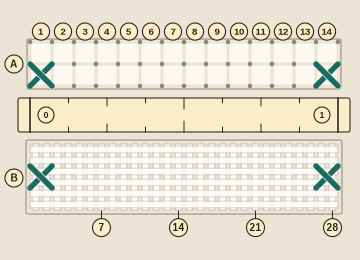
What to count on each cloth
| Cloth | How to know it | Count these, along 1 inch (2.54 cm) | Stitches to the inch |
|---|---|---|---|
| Aida | Small woven squares with a hole at each corner. Each square is a group of threads | The squares | The same number |
| Evenweave | Single threads, all of one thickness. No squares | The threads | Half, over two threads |
| Linen | Single threads, some thick and some thin | The threads, thick and thin alike | Half, over two threads |
| Hardanger | Small squares like Aida's, but each one is woven of pairs of threads | The squares | The same over one square, half over two |
| Waste canvas | An open, stiff canvas laid over other cloth to stitch through, then pulled out. Its threads lie in pairs | Each pair, as one | The number of pairs |
| Perforated paper | Thin card with rows of punched holes | The spaces between the holes | The same number |
"Over two threads" means that each cross covers two threads across and two down, as on B in the picture.
If the squares or threads are easy to see, go straight to the ruler below. If they are hard to see, count under a magnifier, or use printed graph paper as a gauge, further down: there you match lines to holes and count nothing.
Find the count with a ruler
- Lay the cloth flat on a table in good light, and smooth it without pulling.
- Pick a straight row of squares or threads, away from a crease or the edge.
- Put the 0 line of the ruler on the left side of a square, or on the gap before a thread. Use the 0 of the inch scale, wherever it is printed on the ruler.
- Put a pin in the cloth at 0 and another at the 1 inch (2.54 cm) line. Now you can let go of the ruler.
- Count from pin to pin. Touch each square, or each thread, with the point of a needle as you say its number.
- Write the number down. Fourteen squares is 14 count. Twenty-eight threads is 28 count.
- Turn the ruler and count the other way. The two numbers should be the same.
Three ways to make it easier or surer:
- Half an inch, doubled. On a small scrap, count half an inch (1.27 cm) and multiply by two. Seven squares in the half inch is 14 count. An odd count, such as 11, ends on half a square: count that half too.
- Two inches, halved. On a fine cloth, count 2 inches (5.08 cm) and divide by two. Fifty-six threads is 28 count.
- A ruler in centimeters only. Count the squares in 10 cm (3.94 inches) and multiply by 0.254. Fifty-five squares in 10 cm is 14 count: 55 times 0.254 is 13.97.
What the numbers mean, count by count
| Fabric | Stitches to the inch | 100 stitches measure | Tapestry needle | Strands |
|---|---|---|---|---|
| 11 count Aida | 11 | 9 1/8 in (23.1 cm) | Size 22 | 3 |
| 14 count Aida | 14 | 7 1/8 in (18.1 cm) | Size 24 | 2 |
| 16 count Aida | 16 | 6 1/4 in (15.9 cm) | Size 26 | 2 |
| 18 count Aida | 18 | 5 1/2 in (14.1 cm) | Size 26 | 1 or 2 |
| 20 count Aida | 20 | 5 in (12.7 cm) | Size 28 | 1 or 2 |
| 22 count Hardanger, over one | 22 | 4 1/2 in (11.5 cm) | Size 28 | 1 or 2 |
| 25 count evenweave or linen, over two | 12.5 | 8 in (20.3 cm) | Size 24 | 2 |
| 28 count evenweave or linen, over two | 14 | 7 1/8 in (18.1 cm) | Size 24 | 2 |
| 32 count evenweave or linen, over two | 16 | 6 1/4 in (15.9 cm) | Size 26 | 2 |
| 36 count evenweave or linen, over two | 18 | 5 1/2 in (14.1 cm) | Size 28 | 1 or 2 |
| 40 count evenweave or linen, over two | 20 | 5 in (12.7 cm) | Size 28 | 1 or 2 |
What 10, 20, 50 and 100 stitches measure
| Stitches | 11 count Aida | 14 count Aida | 16 count Aida | 18 count Aida | 20 count Aida | 22 count Hardanger, over one | 25 count evenweave or linen, over two |
|---|---|---|---|---|---|---|---|
| 10 | 2.3 cm | 1.8 cm | 1.6 cm | 1.4 cm | 1.3 cm | 1.2 cm | 2.0 cm |
| 20 | 4.6 cm | 3.6 cm | 3.2 cm | 2.8 cm | 2.5 cm | 2.3 cm | 4.1 cm |
| 50 | 11.5 cm | 9.1 cm | 7.9 cm | 7.1 cm | 6.3 cm | 5.8 cm | 10.2 cm |
| 100 | 23.1 cm | 18.1 cm | 15.9 cm | 14.1 cm | 12.7 cm | 11.5 cm | 20.3 cm |
Read the charts backward
You can also measure a run of squares and find the count in the two charts above.
- Count fifty squares along a straight row, and put a pin at each end. On Aida one square is one stitch.
- Measure between the pins, in centimeters.
- Find 50 stitches in the chart "What 10, 20, 50 and 100 stitches measure".
- Find your measurement among the ones given for 50. The cloth named with it has your count.
Fifty squares that measure 7.9 cm (3 1/8 inches) are 16 count. Fifty that measure 9.1 cm (3 5/8 inches) are 14 count.
With a ruler in inches only, count a hundred squares and look for what they measure under "100 stitches measure" in "What the numbers mean, count by count". A hundred that measure 6 1/4 inches (15.9 cm) are 16 count.
A long run tells neighbors apart better than a short one. Ten squares of 16 count and ten of 18 differ by less than 0.2 cm (under 1/12 inch), and fifty differ by 0.9 cm (about 1/3 inch).
On evenweave and linen, count two threads as one square: fifty squares are a hundred threads. Then double the count you find. A measurement given for 14 count is 28 count, for 16 count it is 32, for 18 count 36 and for 20 count 40. Do not double the one for evenweave over two: it is for 25 count cloth already.
Use graph paper as a gauge
Our graph paper prints at true size, with 10, 11, 14, 16, 18, 22, 25, 28 or 32 squares to the inch (2.54 cm) and a heavy line every ten squares. So a sheet is a gauge for the cloth that has the same count.
- Print the count you think you have. Most unmarked Aida is worth trying on 14 count paper first. The table further down says which paper goes with which cloth.
- Choose "actual size" or 100% in the print window.
- Check the sheet with a ruler. Five times the paper's number of squares must measure 5 inches (12.7 cm): 50 squares on the 10 paper, 55 on the 11, 70 on the 14, 80 on the 16, 90 on the 18, 110 on the 22, 125 on the 25, 140 on the 28 and 160 on the 32. The printed numbers do the counting for you. If it does not measure that, the printer has changed the size: print it again.
- Cut the sheet across, along one of its light lines, so that the upright lines run down to the cut edge. Keep the upper piece, with the numbers.
- Lay the cut edge on the cloth, along a row of holes. On evenweave and linen the holes are the gaps between the threads.
- Slide it until a heavy line meets a hole (A).
- Look along the edge from A. Where every line of the paper meets a hole, as in view 1, as far as the paper goes, and no hole is left over between two lines, that is the count.
- If holes and lines drift apart, try another sheet. Look at the first few holes after A. If they fall to the left of their lines, the cloth is finer, as in view 2: go up a count. If they fall to the right, it is coarser: go down.
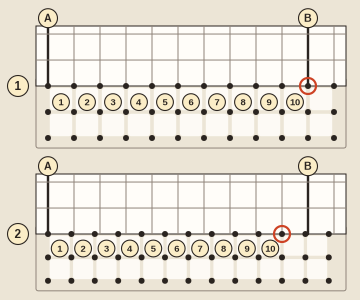
If the squares are large enough to count, look at the hole at the end of the tenth square (the red ring). Number the squares from A, as in the picture: the hole on A itself is zero. On a match the ring is on B. The sheet's outside line is heavy too and may not be a tenth line, so go by the printed numbers.
Work out the count from a sheet that does not match
- Find the first line after A with a hole exactly on it. In view 2 it is the line at the red ring.
- Count the squares of the cloth from A to that hole. In view 2 there are 10.
- Count the squares of the paper from A to that line. In view 2 there are 9.
- Check it. The same two numbers again, counted on from there, must end on a hole and a line together. If they do not, the first was a near miss: go on to the next line that meets a hole.
- Multiply the paper's count by the cloth's squares, and divide by the paper's squares. 18 times 10, divided by 9, is 20: the cloth is 20 count.
What spoils a printed gauge
"Fit to page" does. It makes the whole page a little larger or smaller to suit the printer, and every square with it. How to print a pattern shows where the setting is. A chart does not mind; a gauge does.
Which paper for which cloth
The table also says what lies between one line of the paper and the next. Where it is more than one square or thread, every line still meets a hole on a match, with one or more holes left over between the lines. Where the paper is finer than the cloth, every hole meets a line, with lines left over between the holes.
| Cloth | Print this paper | Each square of the paper covers |
|---|---|---|
| 10, 11, 14, 16, 18 or 22 count Aida or Hardanger | The same number | One square |
| 6 count Aida | 18 | A third of a square, so three of the paper's to one of the cloth's |
| 7 count | 14 | Half a square, so two of the paper's to one of the cloth's |
| 8 count Aida | 16 | Half a square, so two of the paper's to one of the cloth's |
| 20 count Aida | 10 | Two squares |
| 25, 28 or 32 count evenweave or linen | The same number | One thread |
| 28 count, easier to see | 14 | Two threads |
| 30 count | 10 | Three threads |
| 32 count, easier to see | 16 | Two threads |
| 36 count | 18 | Two threads |
| 40 count | 10 | Four threads |
For a count that is not here, 12, 24 or 27 for instance, use the ruler.
Make a strip to keep
- Print the papers you use most, at actual size, with "Number every tenth line" ticked.
- Check each sheet with a ruler, as in step 3 above.
- Cut along the fifth light line below the top of the grid, right across. The strip has its numbers along the top, and the cut edge is the one you lay on the cloth.
- Write the count on the back of each strip.
- Tape each strip to thin card, with its cut edge level with the edge of the card.
- Punch a hole in one end.
- Tie the strips together.
Each strip measures stitches too. Lay the 14 strip on stitching on 14 count cloth, and the numbers on it say how many stitches long it is.
Gauges and rulers you can buy
Nothing here is needed if you have a ruler. This is what each kind does.
| Tool | What it does | What it does not do |
|---|---|---|
| Stitch gauge: a flat strip with a scale for each count, from about 11 to 36 or 40 | Find the scale whose marks fall in step with the holes. Read a number of stitches as a length | Tell you about a count that has no scale on it |
| Stitch gauge with openings | Shows a measured piece of the cloth, so the eye does not stray while you count | Count for you |
| Plain ruler, in inches and centimeters | Finds the count of any cloth, and measures a piece | Magnify, or read a length in stitches |
| Magnifier with a scale | Makes fine threads large enough to count, with the measure beside them | Take in a long run at once |
| Corner gauge: an L-shaped ruler, or an L built into a straight one | Measures in from two edges at once, and shows whether the corner is square | Find a count, unless a count scale is printed on it |
Cross stitch fabric says more about what a count means and how to choose one.
How to use a stitch gauge
- Lay the cloth flat in good light.
- Lay the gauge on it, with the edge of one scale along a row of holes. Try the 14 scale first. Each scale has its count printed beside it.
- Slide it until the first mark meets a hole. On evenweave and linen, use the gap between two threads.
- Look along the scale to its end. If every mark meets a hole and no hole is left over, that is the count.
- If the marks and the holes drift apart, try the next scale.
A hole left over between every two marks means that the count is double: under the 14 scale it is 28.
If the gauge has openings instead, lay one over the cloth with its left end on a hole, count the squares or threads you can see in it, and divide by the opening's length in inches. Fourteen in an opening of 1 inch (2.54 cm) is 14 count. Seven in half an inch (1.27 cm) is 14 count too.
How to use an L-shaped ruler
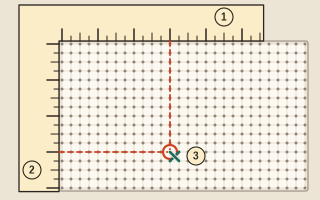
- Find where the ruler's 0 is. In the picture both scales start at the inside corner of the L, so the arms lie outside the cloth.
- Set the inside corner of the L on the corner of the cloth, with an arm along each edge (1 and 2).
- Find your margin on arm 1. It is at least 3 inches (7.5 cm) for a piece to be framed.
- Follow the row of holes straight down into the cloth from that mark.
- Find the same margin on arm 2.
- Follow the row of holes straight across from that mark.
- Put a pin where the two rows meet (3). For a design begun at the top left corner, the first stitch goes there.
If your ruler's numbers start at the outside corner, lay that corner on the corner of the cloth, with the arms on top of the cloth, and measure in the same way.
If the rows of holes do not run along the arms, the cloth was cut off its grain. Measure from a row of holes and not from the cut edge.
Grid sheets and overlays
The words cover three different things.
- A grid over a picture, to make a chart of it. Lay squared paper over the picture on a light box or a bright window and trace it square by square: how to make a pattern. To do it on a screen, see patterns in an image editor.
- A grid over plain cloth, such as a T-shirt, that has no squares of its own. This is a layer you stitch through and take away after: waste canvas, soluble canvas, or a stick-on sheet printed with a grid. See waste canvas.
- A grid over counted cloth, to keep count. A sheet laid on top checks a count and shows where the tens will fall. It slides, and it leaves no mark, so it cannot guide the needle. For lines that stay put, draw them or baste them (sew long, loose stitches that come out later): gridding.
From a count to a size
- How big will it be? Divide the stitches by the stitches to the inch. 98 stitches on 14 count are 7 inches (17.8 cm).
- How many stitches fit? Multiply the space by the stitches to the inch. 5 inches (12.7 cm) of 16 count hold 80 stitches.
- Where is the center? Half the width in stitches, counted from either side. On 14 count, a design 98 wide has its center 49 squares, or 3 1/2 inches (8.9 cm), in from its edge.
The fabric calculator, opened on 98 by 70 stitches on 14 count, does the first sum both ways and adds the margin.
When the numbers disagree
| What you find | What to do |
|---|---|
| The two ways of the cloth give different counts | Trust both. Work out the width with one and the height with the other. Circles and squares will come out a little long one way |
| The count falls between two numbers | Count 2 inches (5.08 cm) and halve it, or measure fifty squares. Then use the number you get: the calculator takes a count such as 13.5, under "Another count" |
| A linen gives a different number in each place | Its threads vary. Count 2 inches (5.08 cm) in three places and take the middle number |
| The cloth was washed, and the count is higher than the label | It has shrunk a little. Use the count it has now |
| A soft cloth gives a lower count than you expect | It may be pulled out of shape. Let it lie flat without a hoop, then count again |
| The ruler and the graph paper disagree | Check the paper against the ruler first: the printer may have changed its size |
Common mistakes
- Counting the holes at both ends. Fourteen squares have fifteen holes. Count the squares, or call the first hole zero.
- Starting at the end of the ruler. Start at the 0 line.
- Reading a linen's count as its stitches. Over two threads it is half.
- Counting each thread of Aida. A square of Aida is a bundle of several threads. It counts as one.
- Counting inside a hoop. A cloth stretched tight gives a low count.
- Measuring one way only. Turn the ruler.
Questions people ask
Is gauge the same as count? No. The count is a number that belongs to the cloth. The gauge is the tool that finds it.
What is 14 count in centimeters? About five and a half squares to 1 cm (0.39 inch), or 55 squares to 10 cm (3.94 inches).
How do I tell 14 count from 16? Measure fifty squares. On 14 count they are 3 5/8 inches (9.1 cm), and on 16 count 3 1/8 inches (7.9 cm).
How do I find the count of a piece that is already stitched? Count the crosses in 1 inch (2.54 cm). On Aida that is the count. On evenweave and linen worked over two threads, double it.
How do I count the stitches in a finished piece? Count the crosses in 1 inch (2.54 cm), measure the width, and multiply. Seven inches (17.8 cm) at 14 to the inch is 98 stitches, give or take one or two. For the exact number, count in tens and put a pin after each.
Can I hold the cloth up to my screen? No. A picture of a ruler on a screen changes size with the screen and the zoom. Use a ruler, or a sheet you have printed and checked.
Where to go next
Look up your count in the fabric size chart or among the less common counts. If the cloth turned out to be evenweave, read how to stitch over two threads. If it is not the count your pattern names, resizing a pattern shows what changes. Then count out the first stitch. If you are buying cloth of that count, see how much fabric to buy.