Nine monster faces sampler hand embroidery pattern
Advanced · 16 colors · 13 kinds of stitch
Download free PDFPDF, US Letter · 116 KBFor your own stitching, gifts and handmade pieces you sell. Do not resell or share this PDF or copies of it. Selling, classes and kits: the rules
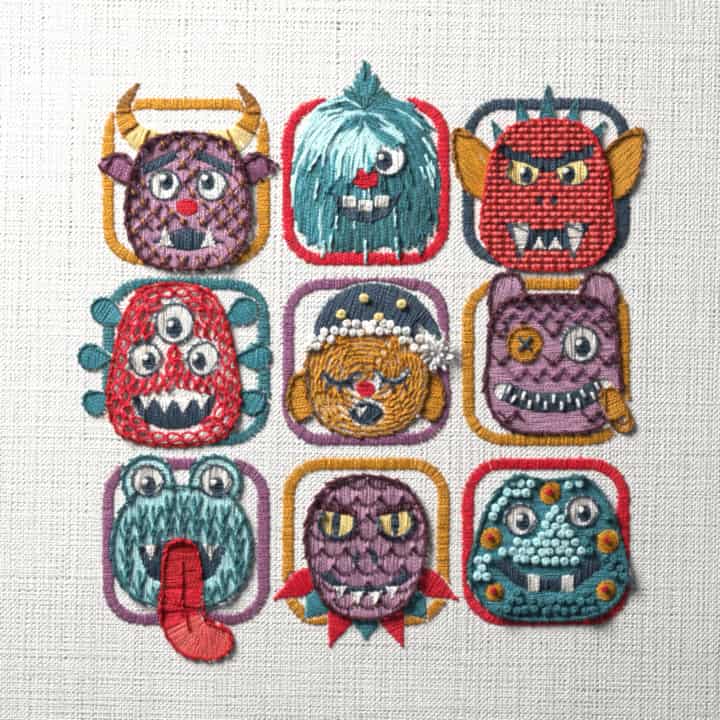
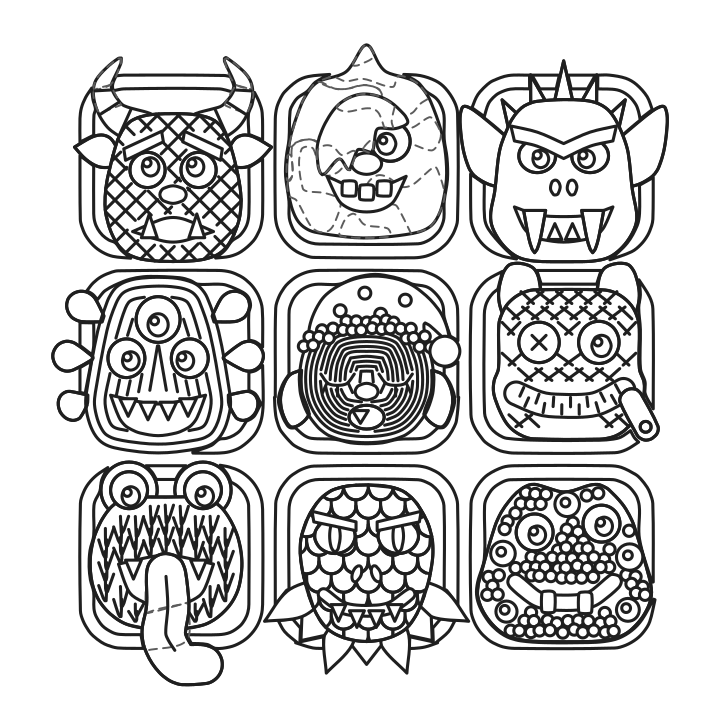
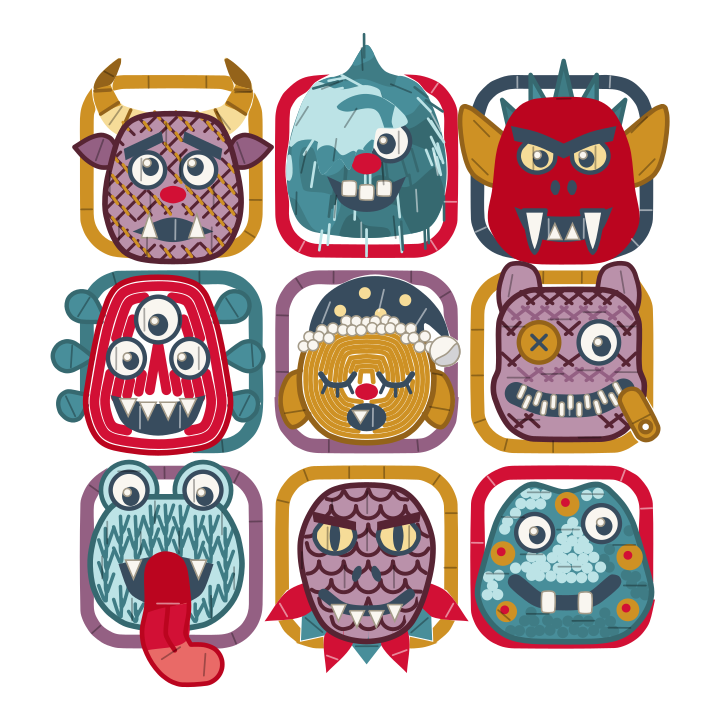
Nine monster heads push out of nine soft squares edged in satin stitch, with the sleeper in its nightcap in the middle. The horned face is trellis stitch, the shaggy one long and short stitch, the fanged one woven filling stitch and the three-eyed one rows of chain stitch. The sleeper is rows of stem stitch, the zipper mouth herringbone stitch, the long tongued one feather stitch. The scaly face is small satin stitch scales edged in back stitch, and the warty one is French knots with padded satin stitch warts. A turkey work pompom ends the nightcap. In the picture of where the colors go, the fine lines show which way the stitches lie.
Size and details
Advanced. Uses long and short stitch, trellis stitch, padded satin stitch, more than a hundred French knots, satin stitch over about a quarter of the cloth in a 6 inch hoop, 16 colors and a great deal of stitching; from a 6 inch hoop up some of the satin stitches are long.
16 colors of floss and 13 kinds of stitch:
- Satin stitch
- Straight stitch
- Stem stitch
- Long and short stitch
- Trellis stitch
- French knot
- Woven filling stitch
- Chain stitch
- Turkey work
- Herringbone stitch
- Feather stitch
- Back stitch
- Padded satin stitch
- Which stitch goes where
| Hoop | Inches | Centimeters | Satin stitch up to |
|---|---|---|---|
| 3 in (8 cm) | 1.6 × 1.7 in | 4.1 × 4.3 cm | 1/8 in (3 mm) |
| 4 in (10 cm) | 2.3 × 2.5 in | 5.8 × 6.4 cm | 3/16 in (5 mm) |
| 5 in (13 cm) | 3.1 × 3.3 in | 7.9 × 8.4 cm | 5/16 in (8 mm) |
| 6 in (15 cm) | 3.9 × 4.1 in | 9.9 × 10.4 cm | 3/8 in (10 mm) |
| 8 in (20 cm) | 5.5 × 5.8 in | 14 × 14.7 cm | 1/2 in (13 mm) |
- In an 8 inch hoop the widest satin stitch shape is 1/2 in (13 mm) across. Satin stitches longer than about 12 mm (just under 1/2 in) tend to work loose: divide the shape into sections, or work it in long and short stitch.
- In a 3, 4 or 5 inch hoop the French knots are drawn smaller than about 2 mm (a little over 1/16 in). Use one strand of floss for them there, or choose a larger hoop.
The pattern is drawn inside a circle about half an inch (1.3 cm) smaller all around than the hoop.
What you need
- DMC 783 Medium TopazSoft squares (lightest) and 7 more parts
- DMC 349 Dark CoralSoft squares (dark), frill (darker) and 4 more parts
- DMC 3750 Very Dark Antique BlueMouths, eye rims and nightcap and 8 more parts
- DMC 3809 Very Dark TurquoiseShaggy face (dark), tongue face (middle) and 3 more parts
- DMC 3835 Medium GrapeSoft squares, zipped face and ears (middle)
- DMC 3822 Light StrawHorns (light), eyes (darker), cap dots
- DMC 780 Ultra Very Dark TopazEars (dark), sleeping face (darker) and 4 more parts
- DMC 154 Very Dark GrapeHorned face and zipped face (dark) and 4 more parts
- DMC 3836 Light GrapeScales, zipped face and horned face (light), ears (lightest)
- DMC 3865 Winter WhiteEyes (lighter), teeth and cap brim and 3 more parts
- DMC 3808 Ultra Very Dark TurquoiseShaggy face (darkest), tongue face (dark) and 3 more parts
- DMC 3810 Dark TurquoiseWarty face and shaggy face (light) and 3 more parts
- DMC 3811 Very Light TurquoiseTongue face (light), shaggy face and warty face (lightest)
- DMC 817 Very Dark Coral RedFanged face, tongue (dark) and 2 more parts
- DMC 415 Pearl GrayPompom (darker)
- DMC 351 CoralTongue (light)
Skeins: one of each color is enough. An estimate for the largest size, the 8 inch hoop: the length of each line and the area of each filled shape, a fifth added for tails and ends, a tenth of every 8 m (8.7 yd) skein kept spare.
On children’s clothes. Wash and dry the garment first. A T-shirt or a sweatshirt needs a stabilizer that sticks or irons on. Keep to flat stitches: tall raised ones and long loose threads catch. How to embroider on clothes has every step, and How to embroider a shirt says where and with which stitches.
In a hoop. The floss is six-strand cotton; the stitch guide says how many strands to use. You also need a hoop, an embroidery needle (a size 9 or 10 for one strand, 7 to 9 for two or three, and 3 to 5 for four or more) and plain cotton or linen fabric. To frame the piece in its hoop, cut a square 3 inches (8 cm) wider than the hoop: a 9 inch (23 cm) square for a 6 inch hoop.
When it is stitched, how to finish a hoop shows how to back it for the wall.
Stitch guide
- Put the pattern on the fabric (how to transfer a pattern) and the fabric in the hoop.
- Stitch the filled parts first, what lies behind before what lies in front of it.
- Then stitch the lines: stems, veins and outlines over the edges of the filled parts.
- Keep the raised parts and the knots for the end, so that the hoop and your hand do not flatten them.
Inside a filled shape start with two or three tiny stitches, which the filling covers: a knot shows as a bump. A line may start with a small knot on the back or one of the knotless starts. End each thread by running the needle under the backs of a few stitches. (Starting and ending a thread shows how.) Use the strands this list gives, and begin as it says, also where a page about a stitch names another number or begins with a knot.
- Satin stitch 2 to 3 strandsSoft squares, horns, ears, eyes, pupils, brows, noses, mouths, teeth, and 11 more
- Straight stitch 2 to 3 strandsHorn rings, closed eyes, button thread, zipper teeth
- Stem stitch 1 to 3 strandsEars, horned face, eye rims, crest, fanged face, tooth edges, gills, and 12 more
- Long and short stitch 1 to 2 strandsHorned face, shaggy face, zipped face, tongue face, warty face
- Trellis stitch 2 strandsHorned face
- French knot 1 to 2 strands, two wrapsEye lights, cap dots, cap brim, warty face, wart tips
- Woven filling stitch 4 strandsFanged face
- Chain stitch 3 strandsThree-eyed face
- Turkey work 2 strandsPompom
- Herringbone stitch 2 strandsZipped face
- Feather stitch 2 strandsTongue face
- Back stitch 1 strandScale edges
- Padded satin stitch 2 strandsWarts
Getting it onto your fabric
The PDF holds the pattern twice at actual size: once as drawn, and once mirrored for an iron-on transfer pen. Print it at 100% with scaling off and check the one-inch square (25.4 mm) with a ruler before you trace. How to transfer a pattern explains tracing, carbon paper, the sticky wash-away sheet for knits, denim and dark cloth, and the other ways. The files are under Downloads.
Downloads
- Download free PDF PDF, US Letter, 3 pages, for a 6 inch (15 cm) hoop
- Download free PDF, A4 PDF, A4, 3 pages, for a 6 inch (15 cm) hoop
More patterns like this
Advanced prints 3–14 in · 21 colors
Monster patch for kids jeans
Advanced 3–8 in hoop · 22 colors
Little monster birthday cake
Advanced 27 letters · 14 colors
Friendly monster letters
Advanced prints 3–14 in · 24 colors
Goblin gathering mushrooms
Intermediate 3–8 in hoop · 12 colors
Funny Bigfoot silhouette bookmark
Easy prints 3–14 in · 2 colors
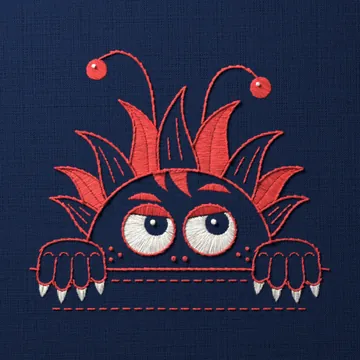
Easy monster pocket peeker
Advanced prints 3–14 in · 22 colors
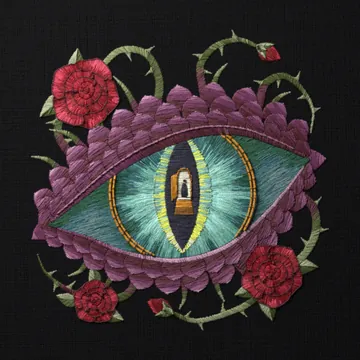
Scary monster eye with thorns
Advanced 3–8 in hoop · 23 colors
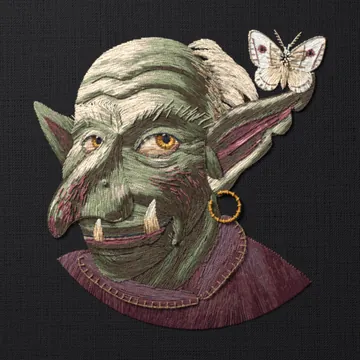
Realistic goblin head with a moth
New to hand embroidery? Starting hand embroidery, step by step