Sushi roll sampler in nine stitches hand embroidery pattern
Advanced · 12 colors · 3.9 × 3.9 in · 13 kinds of stitch
Download free PDFPDFPrints on US Letter and A4You may sell what you make from it by hand, in small quantities. The PDF itself is not to be sold or shared. Selling, classes and kits: the rules
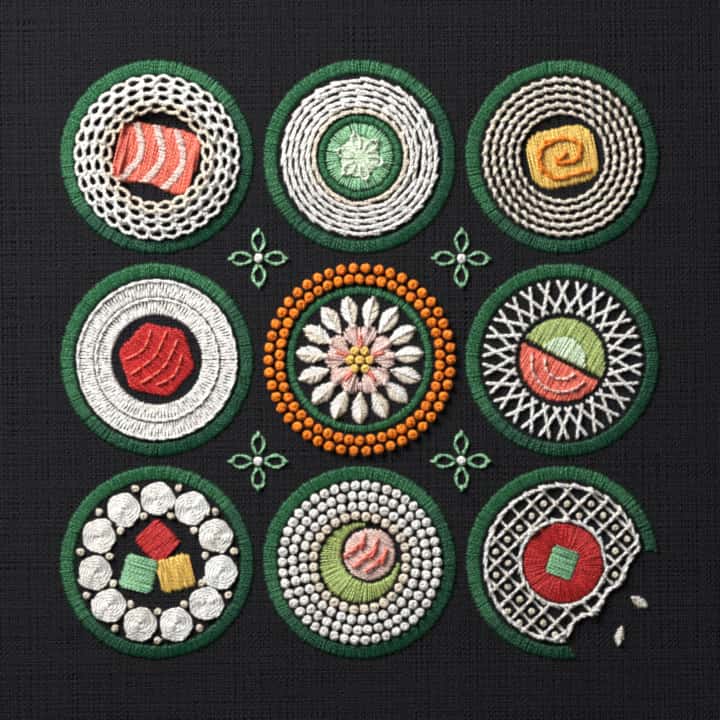
Nine cut sushi rolls lie in rows of three, seen from above, with green satin stitch rims.
Size and details
Advanced. Uses woven wheels, trellis stitch, more than a hundred French knots, twelve colors and a great deal of stitching; from a 5 inch hoop up the widest satin stitches are long.
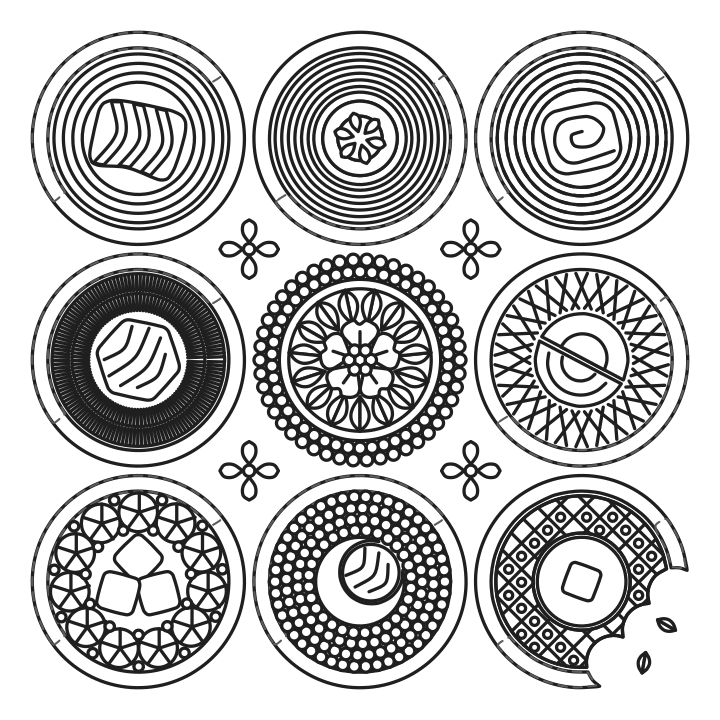
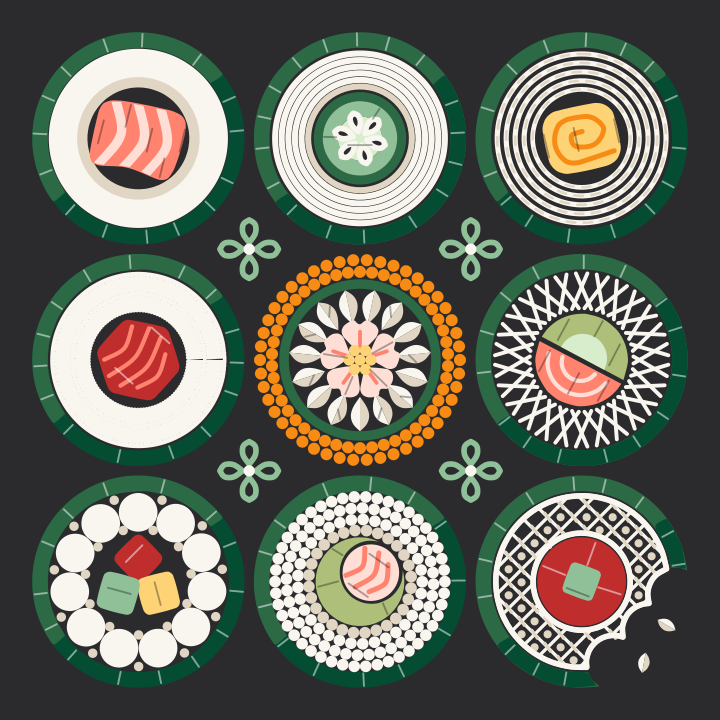
The rice is worked in chain stitch, stem stitch, whipped back stitch, buttonhole stitch, fishbone stitch, herringbone stitch, woven wheels, French knots and trellis stitch. Every heart is different: salmon, cucumber, rolled egg, tuna, avocado, prawn and a flower of salmon petals. The middle roll is rimmed with orange roe in French knots, or glass seed beads if you like, and somebody has taken a bite of the last. It is drawn for charcoal linen. In the picture of where the colors go, the fine lines show which way the stitches lie.
| Hoop | Inches | Centimeters | Satin stitch up to |
|---|---|---|---|
| 3 in (8 cm) | 1.5 × 1.5 in | 3.8 × 3.8 cm | 3/16 in (5 mm) |
| 4 in (10 cm) | 2.3 × 2.3 in | 5.8 × 5.8 cm | 1/4 in (6 mm) |
| 5 in (13 cm) | 3.1 × 3.1 in | 7.9 × 7.9 cm | 3/8 in (10 mm) |
| 6 in (15 cm) | 3.9 × 3.9 in | 9.9 × 9.9 cm | 7/16 in (11 mm) |
| 8 in (20 cm) | 5.4 × 5.4 in | 13.7 × 13.7 cm | 5/8 in (16 mm) |
- In an 8 inch hoop the widest satin stitch shape is 5/8 in (16 mm) across. Satin stitches longer than about 12 mm (just under 1/2 in) tend to work loose: divide the shape into sections, or work it in long and short stitch.
- In a 3, 4 or 5 inch hoop the French knots are drawn smaller than about 2 mm (a little over 1/16 in). Use one strand of floss for them there, or choose a larger hoop.
- In a 3 or 4 inch hoop the shortest lazy daisy loops are drawn smaller than about 2 mm (a little over 1/16 in). Use one strand of floss for them there, or choose a larger hoop.
What you need
- Fabric
- Plain cotton or linen in charcoal, cut 9 in (23 cm) square. On white cloth its palest threads do not show: choose other colors under Options. A pencil line does not show on it: see how to transfer a pattern to dark fabric.
- Needle
- Embroidery needle, size 9 for 1 strand, size 7 for 2 or 3 (a lower number is a thicker needle).
- Floss
- 12 colors of six-strand cotton, listed below. DMC is a brand: another brand in a like color will do.
- Marker
- A pen or a sheet that suits the fabric: how to transfer a pattern says which.
Floss
- 1DMC 500 Very Dark Blue GreenNori rims (darker)
- 2DMC 561 Very Dark JadeNori rims (lighter), cucumber skin
- 3DMC 3865 Winter WhiteButtonhole stitch rice, trellis stitch rice (lighter) and 10 more parts
- 4DMC 3033 Very Light Mocha BrownWhipped back stitch rice and trellis stitch rice (darker) and 6 more parts
- 5DMC 3340 Medium ApricotSalmon and tuna grain, prawn and salmon petals (darker)
- 6DMC 967 Very Light ApricotSalmon petals and prawn (lighter), salmon stripes
- 7DMC 563 Light JadeCucumber, corner flowers (darker)
- 8DMC 369 Very Light Pistachio GreenCucumber heart and avocado heart
- 9DMC 743 Medium YellowEgg (lighter)
- 10DMC 970 Light PumpkinRoe, egg (darker)
- 11DMC 347 Very Dark SalmonTuna
- 12DMC 471 Very Light Avocado GreenAvocado
Skeins: 2 of DMC 500 and 2 of DMC 3865; one of each other color. An estimate for the 6 inch hoop, from the length of each line and the area of each filled shape, with a fifth added for tails.
How to stitch it
- New to hand embroidery? Start here.
- Print at 100%, trace the pattern onto the fabric, and put it in the hoop: inner ring under, drawing up, tight as a drum.
- Floss is six strands. Cut 18 inches (45 cm), pull out the number given one at a time, and lay them together.
- Inside a filled shape start with two or three tiny stitches, which the filling covers. Start a line with a small knot on the back. End each thread by running the needle under the backs of a few stitches.
- Each small ring is one French knot. Each small loop is one lazy daisy: come up at its point. A dashed line is whipped back stitch. A fine broken line inside a shape is where two shades meet: trace it, do not stitch it.
- A number under “Where colors go” is a color of the list. The fine lines on the colors show which way the stitches lie.
Stitch in this order
Filled parts from the back of the picture forward, then lines, loops, knots and raised parts. Where a stitch page names another number of strands, use the number here.
- Satin stitch 2 strandsNori rims, salmon, salmon stripes, cucumber skin, cucumber, cucumber heart, egg, tuna, salmon petals, avocado, avocado heart, prawn
- Buttonhole stitch 2 strandsButtonhole stitch rice
- Fishbone stitch 2 strandsFishbone stitch rice, crumbs
- Trellis stitch 2 strandsTrellis stitch rice
- Chain stitch 3 strandsChain stitch rice
- Stem stitch3 strands: stem stitch rice2 strands: egg, prawn, trellis stitch rice
- Whipped back stitch 2 to 3 strandsWhipped back stitch rice
- Back stitch2 strands: salmon stripes1 strand: tuna grain
- Straight stitch 2 strandsSalmon petals
- Herringbone stitch 3 strandsHerringbone stitch rice
- Lazy daisy stitch2 strands: corner flowers1 strand: seeds
- French knot two wraps2 strands: roe, egg, french knot rice, corner flowers1 strand: rice grains between, trellis stitch rice
- Woven wheel stitch 3 strandsWoven wheel rice
When it is done, take off any lines that still show and finish the hoop. A guide to this kind of work: How to make a stitch sampler.
More patterns like this
Advanced prints 3–14 in · 18 colors
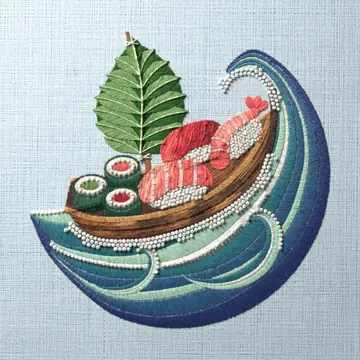
Sushi boat on the waves
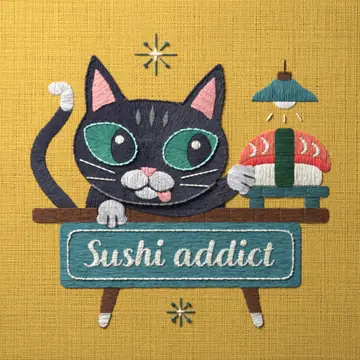
Advanced prints 3–14 in · 13 colors
Sushi addict cat
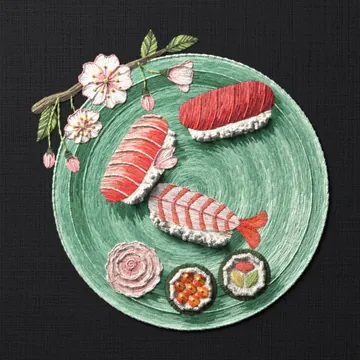
Advanced 3–8 in hoop · 24 colors
Sushi platter with cherry blossom
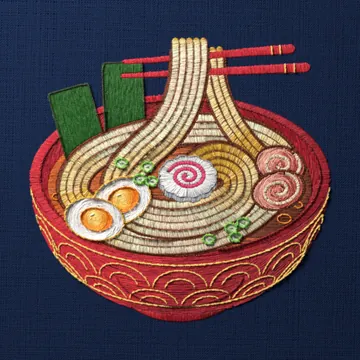
Advanced 3–8 in hoop · 23 colors
Ramen bowl with egg and swirling noodles
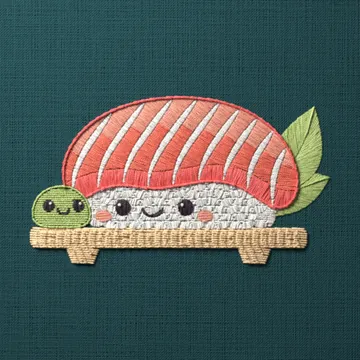
Easy 3–8 in hoop · 7 colors
Small easy salmon nigiri sushi
Advanced 3–8 in hoop · 11 colors
Year of the rooster with peony
Advanced 3–8 in hoop · 15 colors
Sewing notions stitch sampler
Advanced 3–8 in hoop · 16 colors
Nine monster faces sampler
New to hand embroidery? Starting hand embroidery, step by step