Patchwork fields stitch texture sampler hand embroidery pattern
Advanced · 23 colors · 4.7 × 4.7 in · 16 kinds of stitch
Download free PDFPDFPrints on US Letter and A4You may sell what you make from it by hand, in small quantities. The PDF itself is not to be sold or shared. Selling, classes and kits: the rules
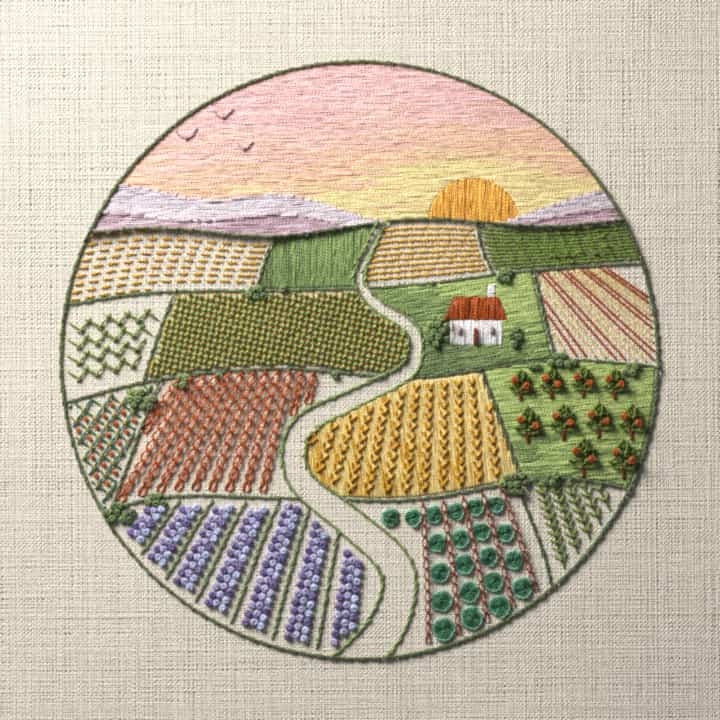
A lane of bare cloth winds up a slope of patchwork fields, past a tiny white cottage, to a low honey sun in a peach sky.
Size and details
Advanced. Uses long and short stitch over much of the design, trellis stitch, woven wheels, more than a hundred French knots, 23 colors and a great deal of stitching; from a 5 inch hoop up the widest satin stitches are long.
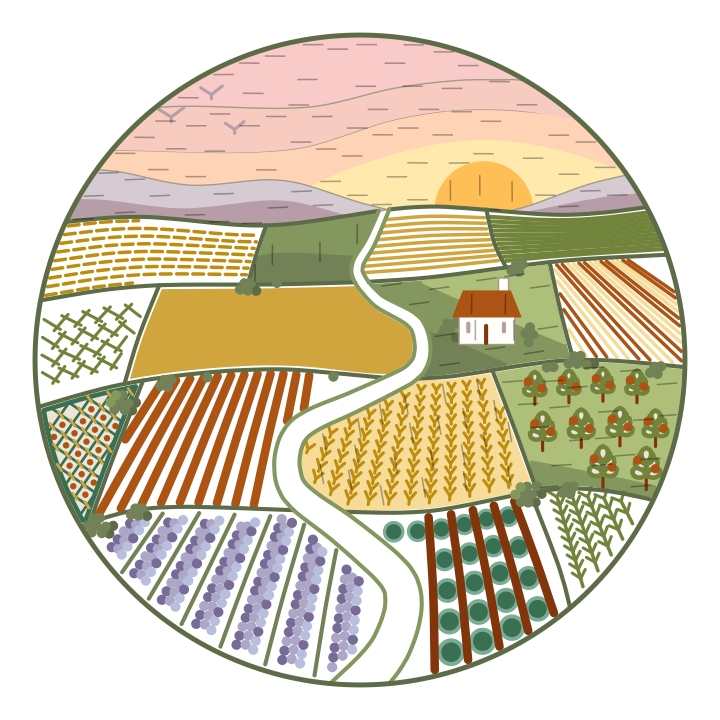
Every field is another texture: lavender in French knots, cabbages in woven wheel stitch, furrows in chain stitch, barley in fly stitch, an orchard in lazy daisy stitch and hay in woven filling stitch. Bean rows are herringbone stitch, the vines are trellis stitch, and the far fields are running, back, stem, split and satin stitch. The sky is level long and short stitch, and the hedges are stem stitch with French knot bushes. In the picture of where the colors go, the fine lines show which way the stitches lie.
| Hoop | Inches | Centimeters | Satin stitch up to |
|---|---|---|---|
| 3 in (8 cm) | 1.9 × 1.9 in | 4.8 × 4.8 cm | 3/16 in (5 mm) |
| 4 in (10 cm) | 2.8 × 2.8 in | 7.1 × 7.1 cm | 1/4 in (6 mm) |
| 5 in (13 cm) | 3.8 × 3.8 in | 9.7 × 9.7 cm | 3/8 in (10 mm) |
| 6 in (15 cm) | 4.7 × 4.7 in | 11.9 × 11.9 cm | 7/16 in (11 mm) |
| 8 in (20 cm) | 6.6 × 6.6 in | 16.8 × 16.8 cm | 5/8 in (16 mm) |
- In an 8 inch hoop the widest satin stitch shape is 5/8 in (16 mm) across. Satin stitches longer than about 12 mm (just under 1/2 in) tend to work loose: divide the shape into sections, or work it in long and short stitch.
- In a 3, 4 or 5 inch hoop the French knots and the shortest lazy daisy loops are drawn smaller than about 2 mm (a little over 1/16 in). Use one strand of floss for them there, or choose a larger hoop.
What you need
- Fabric
- Plain cotton or linen, cut 9 in (23 cm) square.
- Needle
- Embroidery needle, size 9 for 1 strand, size 7 for 2 or 3, size 3 for 4 or 5 (a lower number is a thicker needle).
- Floss
- 23 colors of six-strand cotton, listed below. DMC is a brand: another brand in a like color will do.
- Marker
- A pen or a sheet that suits the fabric: how to transfer a pattern says which.
Floss
- 1DMC 745 Light Pale YellowSky (lightest)
- 2DMC 3779 Very Light RosewoodSky (dark)
- 3DMC 754 Light PeachSky (darkest)
- 4DMC 3856 Ultra Very Light MahoganySky (light)
- 5DMC 3042 Light Antique VioletNear hills, birds and windows
- 6DMC 742 Light TangerineSun
- 7DMC 3743 Very Light Antique VioletFar hills
- 8DMC 680 Dark Old GoldBarley and stubble field
- 9DMC 3364 Pine GreenHome meadow (middle), far meadow (lighter), lane edge and 2 more parts
- 10DMC 3363 Medium Pine GreenHedge trees (middle), lavender leaves, far meadow (darker), home meadow (dark)
- 11DMC 729 Medium Old GoldHay field and wheat field, vine field (light)
- 12DMC 469 Avocado GreenGrass field, orchard trees, kale rows and bean rows
- 13DMC 471 Very Light Avocado GreenOrchard grass (lighter), home meadow (light)
- 14DMC 3822 Light StrawBarley ground, striped field (lighter)
- 15DMC 920 Medium CopperFurrows, cottage roof and apples, striped field (darker), vine field (middle)
- 16DMC 501 Dark Blue GreenVine field (dark), cabbages (darker)
- 17DMC 918 Dark Red CopperCabbage furrows, orchard trunks and door
- 18DMC 3746 Dark Blue VioletLavender (dark)
- 19DMC 340 Medium Blue VioletLavender (middle)
- 20DMC 341 Light Blue VioletLavender (light)
- 21DMC 503 Medium Blue GreenCabbages (lighter)
- 22DMC 3362 Dark Pine GreenHedges and edge, hedge trees (dark)
- 23DMC BLANC WhiteCottage wall and chimney
Skeins: one of each color is enough. An estimate for the 6 inch hoop, from the length of each line and the area of each filled shape, with a fifth added for tails.
How to stitch it
- New to hand embroidery? Start here.
- Print at 100%, trace the pattern onto the fabric, and put it in the hoop: inner ring under, drawing up, tight as a drum.
- Floss is six strands. Cut 18 inches (45 cm), pull out the number given one at a time, and lay them together.
- Inside a filled shape start with two or three tiny stitches, which the filling covers. Start a line with a small knot on the back. End each thread by running the needle under the backs of a few stitches.
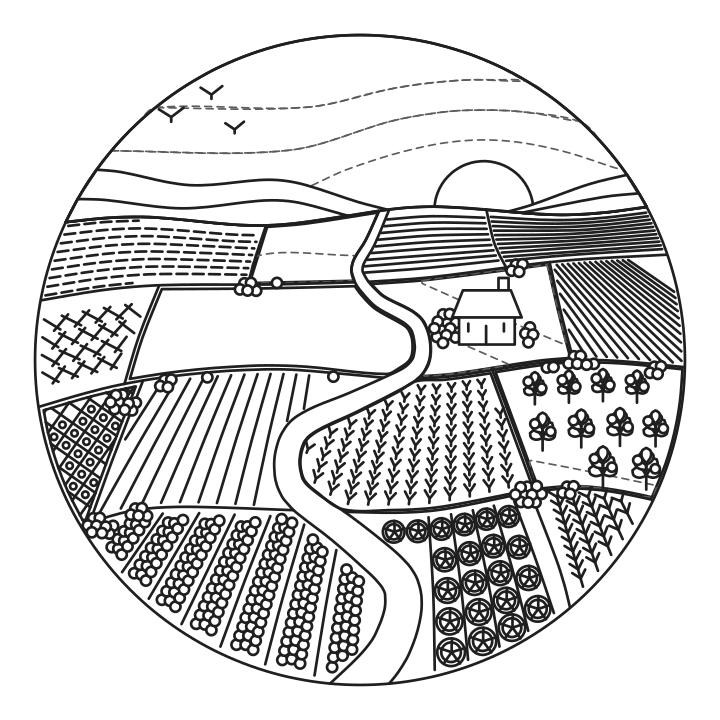
- Each small ring is one French knot. Each small loop is one lazy daisy: come up at its point. A dashed line is running stitch. A fine broken line inside a shape is where two shades meet: trace it, do not stitch it.
- A number under “Where colors go” is a color of the list. The fine lines on the colors show which way the stitches lie.
Stitch in this order
Filled parts from the back of the picture forward, then lines, loops, knots and raised parts. Where a stitch page names another number of strands, use the number here.
- Long and short stitch 2 strandsSky, far hills, near hills, home meadow, barley ground, orchard grass
- Satin stitch 2 strandsSun, far meadow, chimney, cottage wall, cottage roof
- Woven filling stitch 3 strandsHay field
- Trellis stitch 2 strandsVine field
- Fern stitch 2 strandsKale rows
- Fly stitch 2 strandsBirds, barley
- Running stitch 2 strandsStubble field
- Back stitch 2 strandsWheat field
- Stem stitch3 strands: edge2 strands: grass field, lavender leaves, hedges, lane edge
- Herringbone stitch 2 strandsBean rows
- Split stitch 2 strandsStriped field
- Chain stitch2 strands: furrows1 strand: cabbage furrows
- Straight stitch5 strands: door, windows3 strands: orchard trunks
- Lazy daisy stitch 2 strandsOrchard trees
- French knot two wraps2 strands: apples, lavender, hedge trees1 strand: vine field
- Woven wheel stitch 4 strandsCabbages
When it is done, take off any lines that still show and finish the hoop. Guides to this kind of work: How to make a stitch sampler and How to embroider a landscape.
More patterns like this
Advanced prints 3–14 in · 19 colors
Tractor and fields linework sampler
Intermediate prints 3–14 in · 21 colors
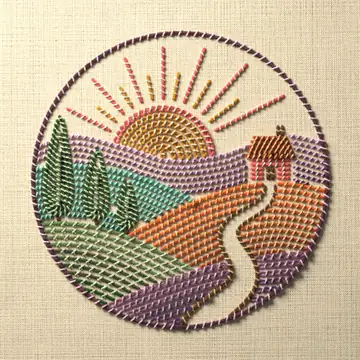
Whipped stitches practice sampler
Advanced 3–8 in hoop · 16 colors
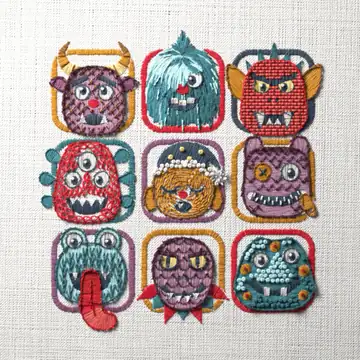
Nine monster faces sampler
Advanced 3–8 in hoop · 16 colors
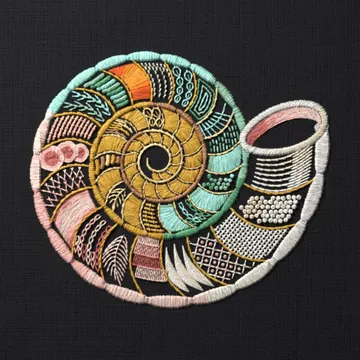
Ammonite fossil in many stitches
Advanced 3–8 in hoop · 16 colors
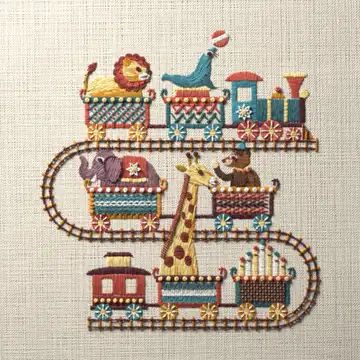
Vintage circus animal train sampler
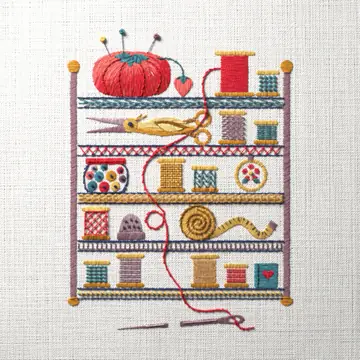
Advanced 3–8 in hoop · 15 colors
Sewing notions stitch sampler
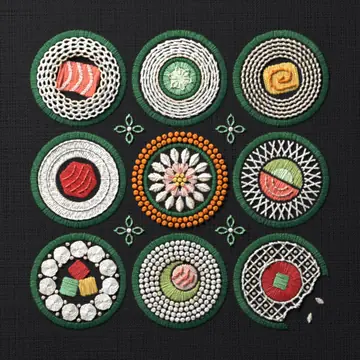
Advanced 3–8 in hoop · 12 colors
Sushi roll sampler in nine stitches
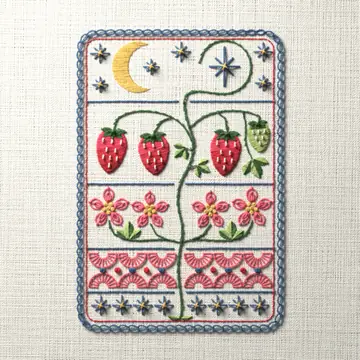
Advanced 3–8 in hoop · 9 colors
Sampler with stars and strawberries
New to hand embroidery? Starting hand embroidery, step by step